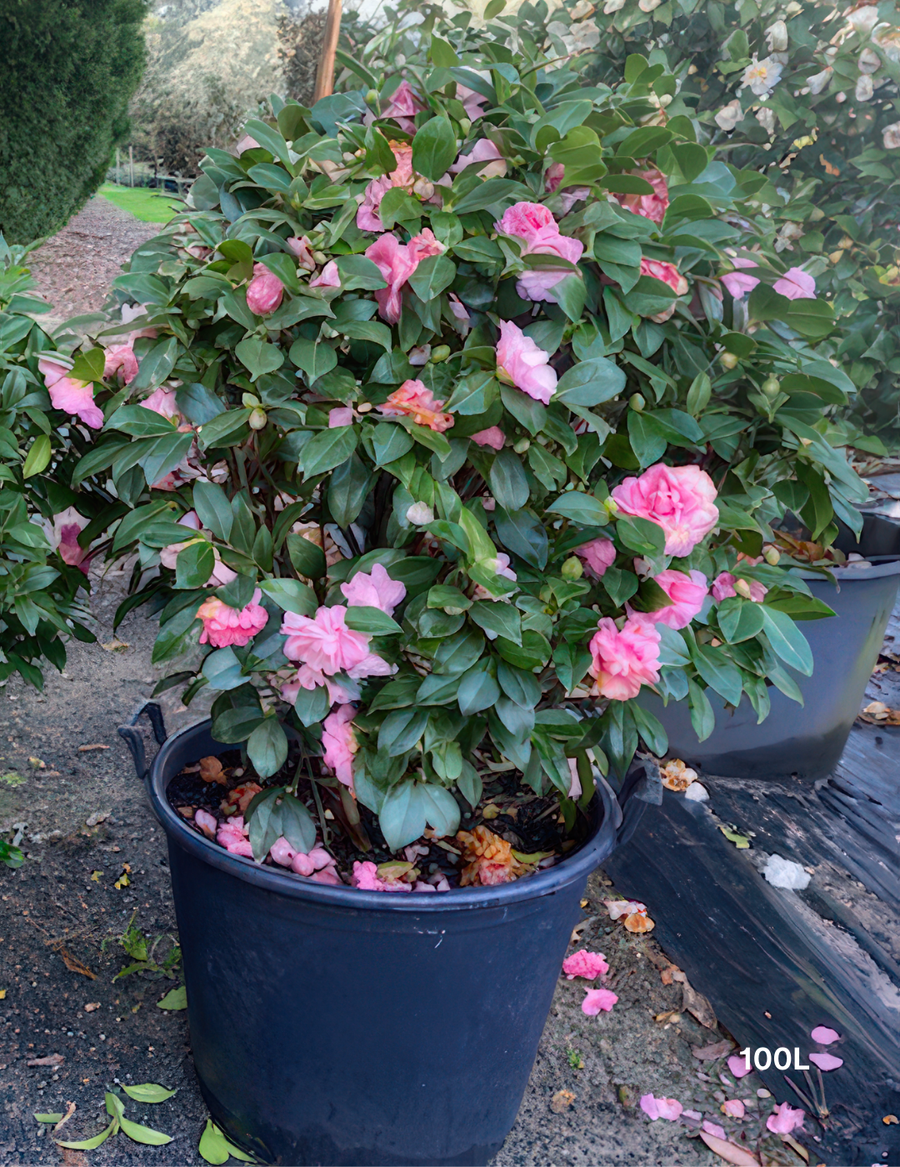
Camellia hiemalis 'Hiryu' - Sasanqua Camellia Hiryu
Camellia hiemalis 'Hiryu' - Sasanqua Camellia Hiryu
Vivid pink semi-double flowers through autumn and winter when most gardens are bare, available as a natural shrub, a pre-clipped ball or a trained standard.
Regular price
$180.00
Sale price
$180.00
Regular price
Tax included.
Shipping calculated at checkout.
Pot size
Available batches
- Current height guide
- Please enquire
- Pot size
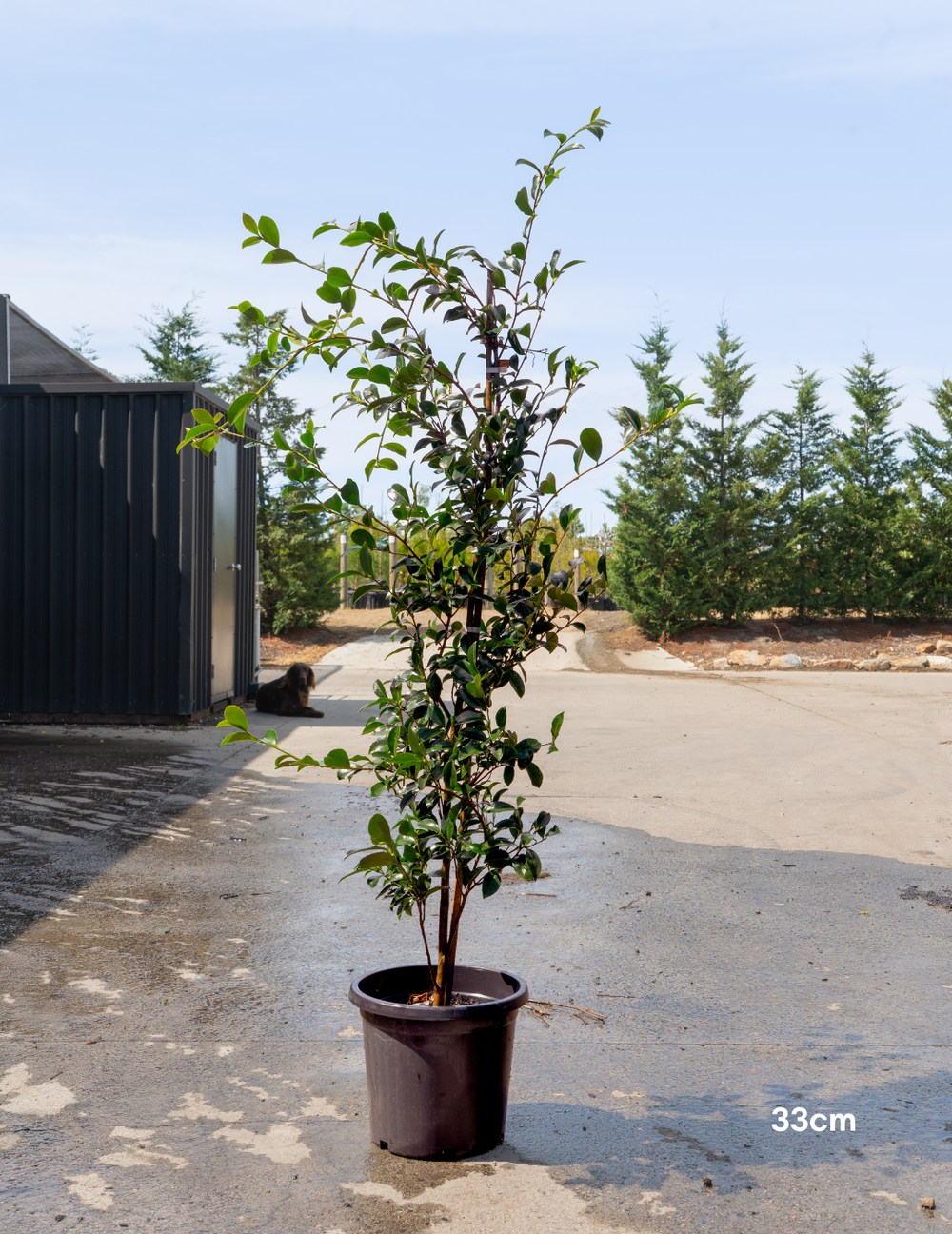
- 30cm/33cm
Approximate only. Minimum height important? Confirm with us.
Height guide & disclaimer
Height guide disclaimer: Height ranges are approximate only. As living products, plant heights naturally vary between individual plants, batches, and seasons. No guarantee is given that supplied plants will fall within the stated range. If minimum heights are required, you must confirm current batch heights with Evergreen Trees Direct prior to purchase. Variation in height is normal and is not grounds for return, refund, replacement, or compensation.
Quantity
Couldn't load pickup availability
About this tree
About this tree
- Mature height
- 2m to 3m (approx.)
- Mature width
- 1.5m to 2m
Camellia hiemalis 'Hiryu' is an evergreen shrub with a compact habit, upright at the centre and spreading at the edges, clothed in small glossy dark green leaves. Vivid pink semi-double flowers cover the plant from autumn into winter, opening in waves over a long season. In character it sits between the sasanqua and japonica camellias, closer to sasanqua.
Partial shade through to full sun suits it, in well drained slightly acidic soil improved with organic matter. Growth is about 25 to 40 centimetres a year, reaching a mature 2 to 3 metres tall and 1.5 to 2 metres wide. Light to moderate frost is tolerated once established. Drought tolerance is moderate rather than complete.
It works as a clipped hedge, a screen along a fence line, a free standing shrub or a container plant beside a door. Flowering when most gardens are quiet is what earns it a place.
Three forms on this page. All the same plant, trained differently.
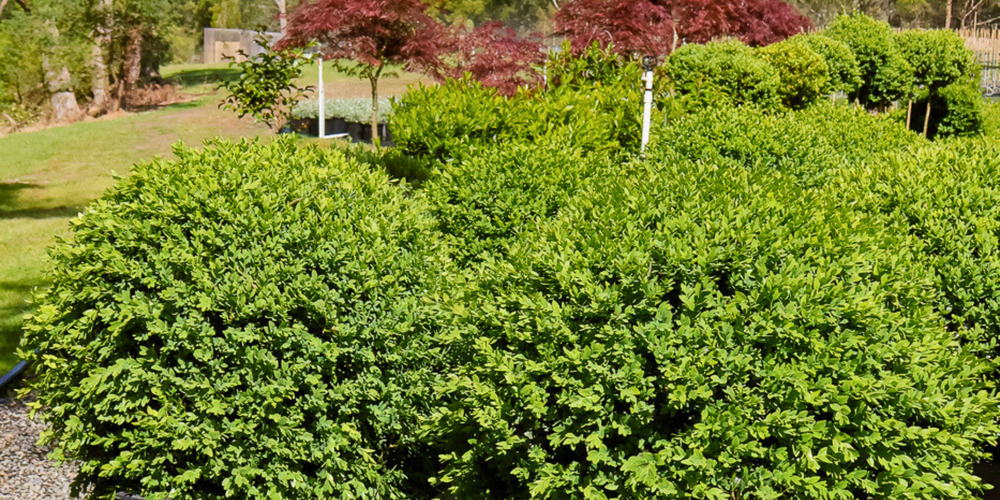
Plain sizes are the natural bushy form, supplied untrained. Plant these for hedging, screening or as a free standing shrub, and clip them to whatever shape you want.
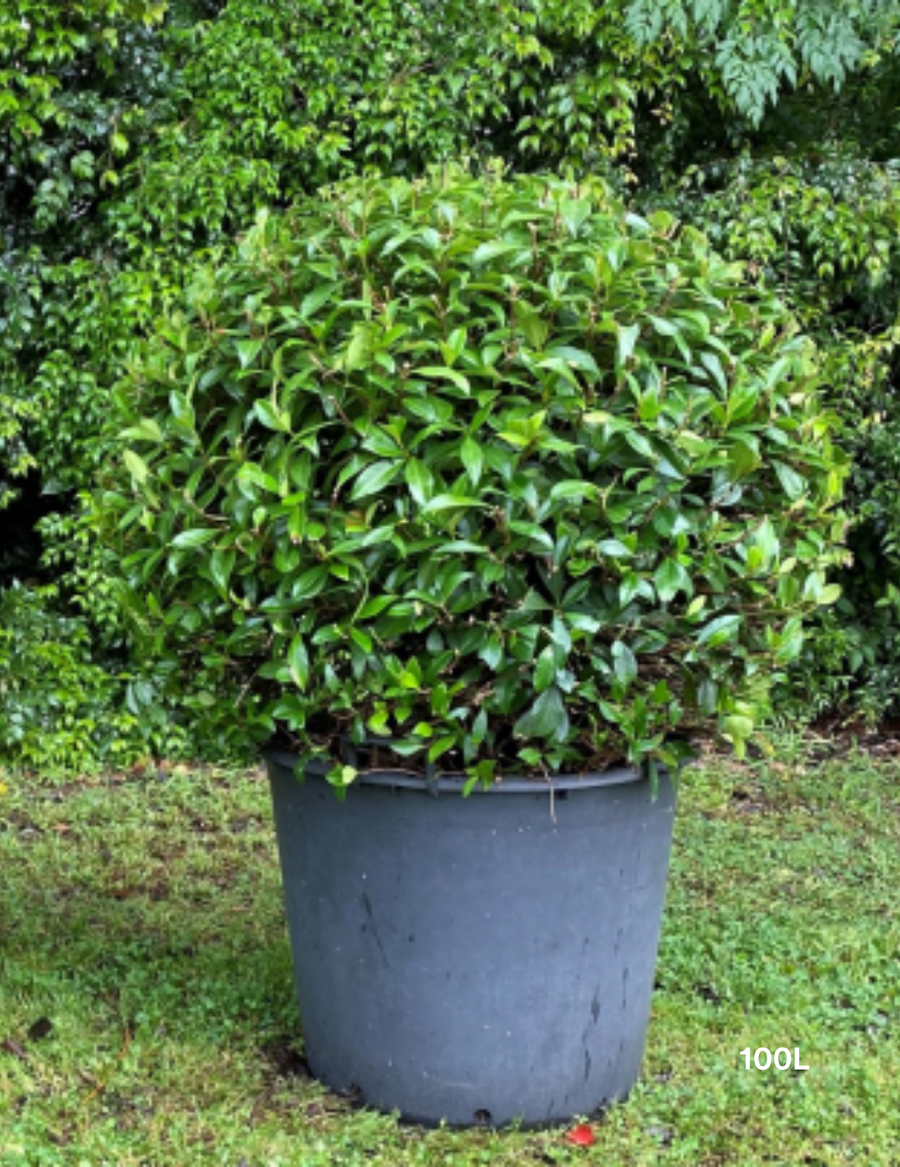
Ball Form arrives already clipped into a dense formal sphere, for instant structure at an entrance, in a pot or repeated through a bed.
Standard Form is trained onto a single clear trunk with the flowering crown carried above head height, so you can plant or walk underneath. It suits a formal avenue, a driveway or a courtyard.
Frequently Asked Questions
About Hiryu Camellia
What is Camellia hiemalis 'Hiryu'?
Camellia hiemalis 'Hiryu' is an evergreen flowering shrub, often listed as a sasanqua camellia because it shares the same garden habits. It carries bright pink semi-double flowers through autumn and winter over glossy dark foliage. Camellia hiemalis is generally treated as a group of hybrids between sasanqua and japonica, which is why both names appear in the trade.
What is the difference between the plain sizes, the Ball Form and the Standard Form?
Same plant, different training. The plain sizes are the natural bushy form, supplied untrained for hedging, screening or free standing planting. The Ball Form has been clipped at the nursery into a dense formal sphere. The Standard Form is trained onto a single clear trunk with the crown carried above head height, so you can plant or walk beneath it.
How big does Hiryu Camellia grow?
It reaches about 2 to 3 metres tall and 1.5 to 2 metres wide at maturity in a garden bed. Regular clipping holds it well below that if you want a hedge at 1.2 or 1.5 metres. In a container it stays smaller again, limited by the root volume available to it.
How fast does it grow?
Expect roughly 25 to 40 centimetres a year once established, which is a moderate rate for a flowering evergreen shrub. A hedge planted from 100 litre plants generally closes up within two to three seasons. Growth slows in the first twelve months after planting while the root system establishes, then picks up noticeably.
Is Hiryu Camellia evergreen or deciduous?
It is fully evergreen and holds its glossy dark foliage year round. Older leaves are shed gradually through the year rather than all at once, so the plant never looks bare. That reliability is why it is specified so often for screening, where a deciduous plant would leave a gap for several months each winter.
When does it flower?
Flowering starts in autumn and continues through winter, broadly March to August depending on district. Warmer coastal gardens open earlier, cooler inland ones later. Because the buds open progressively, the plant is rarely covered in flower all at once, but it stays in colour for months, which is more useful in a garden than one short flush.
How far apart should I plant it for a hedge or screen?
Space plants 1 to 1.5 metres apart for a dense informal screen, or 80 centimetres apart for a tighter formal hedge. As a free standing feature, allow 3 to 4 metres between plants so each one develops its full form. Prepare the entire planting line rather than isolated holes so growth stays even along the run.
How often do the clipped forms need trimming?
Two light clips a year holds a ball or a standard crown crisp. Trim straight after flowering, before the new growth flush, and again lightly in summer if needed. Avoid cutting hard into bare old wood, which is slow to reshoot.
How do I care for Camellia 'Hiryu'?
Keep the soil evenly moist through the first two summers with deep weekly watering, then reduce. Mulch with pine bark or leaf litter, held clear of the stem. Prune immediately after flowering, before the new growth flush, to shape and thicken the plant. Feed with a camellia or azalea fertiliser at the same time.
Mature height & width
Mature height & width
- Mature height
- 2m to 3m (approx.)
- Mature width
- 1.5m to 2m
Pot sizes & dimensions
Pot sizes & dimensions
| Pot / bag size | Width | Depth |
|---|---|---|
| 30cm Pot | 33cm | 30cm |
| 40cm/45L Pot | 44cm | 41.5cm |
| 50cm Pot / 70L Pot | 55cm | 41.8cm |
| 100L Bag | 50.6cm | 52.8cm |
| 150L Bag | 66cm | 55cm |
| 200L Bag | 71.5cm | 60.5cm |
| 300L Bag | 88cm | 63.8cm |
| 400L Bag | 99cm | 66cm |
| 500L Bag | 122cm | 66cm |
| 750L Bag | 134cm | 69cm |
| 1000L Bag | 146.3cm | 71.5cm |
| 2000L Bag | 176cm | 82.5cm |
General planting reference from our existing size guide. Actual containers can vary by supplier and batch; confirm exact dimensions if required.
Delivery & pickup
Delivery & pickup
Trade enquiries
Trade enquiries
We supply advanced trees to landscapers, developers, architects, and councils Australia-wide. Trade clients receive fast quotes, expert advice, and access to premium stock with reliable freight.
Freight estimate
Based on the items currently in your cart.
Final delivery cost is confirmed at checkout using your full address.
Not sure how many trees you need?
Plan your hedge
Enter the length of your boundary, then choose how closely you want to plant.
Enter your boundary length to see how many trees you need.
Measure only the boundary you intend to plant—exclude gates and gaps. Spacing is centre to centre. Quantities are rounded up for one row, allowing roughly half the spacing at each end. Site conditions and pruning affect the final hedge.
About Camellia hiemalis 'Hiryu'
Camellia hiemalis 'Hiryu' is an evergreen shrub with a compact habit, upright at the centre and spreading at the edges, clothed in small glossy dark green leaves. Vivid pink semi-double flowers cover the plant from autumn into winter, opening in waves over a long season. In character it sits between the sasanqua and japonica camellias, closer to sasanqua.
Partial shade through to full sun suits it, in well drained slightly acidic soil improved with organic matter. Growth is about 25 to 40 centimetres a year, reaching a mature 2 to 3 metres tall and 1.5 to 2 metres wide. Light to moderate frost is tolerated once established. Drought tolerance is moderate rather than complete.
It works as a clipped hedge, a screen along a fence line, a free standing shrub or a container plant beside a door. Flowering when most gardens are quiet is what earns it a place.
Three forms on this page. All the same plant, trained differently.
Plain sizes are the natural bushy form, supplied untrained. Plant these for hedging, screening or as a free standing shrub, and clip them to whatever shape you want.
Ball Form arrives already clipped into a dense formal sphere, for instant structure at an entrance, in a pot or repeated through a bed.
Standard Form is trained onto a single clear trunk with the flowering crown carried above head height, so you can plant or walk underneath. It suits a formal avenue, a driveway or a courtyard.
Frequently Asked Questions
About Hiryu Camellia
What is Camellia hiemalis 'Hiryu'?
Camellia hiemalis 'Hiryu' is an evergreen flowering shrub, often listed as a sasanqua camellia because it shares the same garden habits. It carries bright pink semi-double flowers through autumn and winter over glossy dark foliage. Camellia hiemalis is generally treated as a group of hybrids between sasanqua and japonica, which is why both names appear in the trade.
What is the difference between the plain sizes, the Ball Form and the Standard Form?
Same plant, different training. The plain sizes are the natural bushy form, supplied untrained for hedging, screening or free standing planting. The Ball Form has been clipped at the nursery into a dense formal sphere. The Standard Form is trained onto a single clear trunk with the crown carried above head height, so you can plant or walk beneath it.
How big does Hiryu Camellia grow?
It reaches about 2 to 3 metres tall and 1.5 to 2 metres wide at maturity in a garden bed. Regular clipping holds it well below that if you want a hedge at 1.2 or 1.5 metres. In a container it stays smaller again, limited by the root volume available to it.
How fast does it grow?
Expect roughly 25 to 40 centimetres a year once established, which is a moderate rate for a flowering evergreen shrub. A hedge planted from 100 litre plants generally closes up within two to three seasons. Growth slows in the first twelve months after planting while the root system establishes, then picks up noticeably.
Is Hiryu Camellia evergreen or deciduous?
It is fully evergreen and holds its glossy dark foliage year round. Older leaves are shed gradually through the year rather than all at once, so the plant never looks bare. That reliability is why it is specified so often for screening, where a deciduous plant would leave a gap for several months each winter.
When does it flower?
Flowering starts in autumn and continues through winter, broadly March to August depending on district. Warmer coastal gardens open earlier, cooler inland ones later. Because the buds open progressively, the plant is rarely covered in flower all at once, but it stays in colour for months, which is more useful in a garden than one short flush.
How far apart should I plant it for a hedge or screen?
Space plants 1 to 1.5 metres apart for a dense informal screen, or 80 centimetres apart for a tighter formal hedge. As a free standing feature, allow 3 to 4 metres between plants so each one develops its full form. Prepare the entire planting line rather than isolated holes so growth stays even along the run.
How often do the clipped forms need trimming?
Two light clips a year holds a ball or a standard crown crisp. Trim straight after flowering, before the new growth flush, and again lightly in summer if needed. Avoid cutting hard into bare old wood, which is slow to reshoot.
How do I care for Camellia 'Hiryu'?
Keep the soil evenly moist through the first two summers with deep weekly watering, then reduce. Mulch with pine bark or leaf litter, held clear of the stem. Prune immediately after flowering, before the new growth flush, to shape and thicken the plant. Feed with a camellia or azalea fertiliser at the same time.
- Foliage
Evergreen (foliage year round)
- Position
- Form
- Use
- Mature height
- 2m to 3m (approx.)
- Mature width
- 1.5m to 2m
Planting Information
Recommended Planting Spacing For Your Camellia hiemalis 'Hiryu' - Sasanqua Camellia Hiryu
Camellia hiemalis 'Hiryu' - Sasanqua Camellia Hiryu is expected to grow 25cm to 40cm per year (approx.).
Long Term Care For Your Camellia hiemalis 'Hiryu' - Sasanqua Camellia Hiryu
Planting Your Camellia hiemalis 'Hiryu' - Sasanqua Camellia Hiryu in Different Soil
Uses in my Garden
Uses in my Garden
Camellia hiemalis 'Hiryu' - Sasanqua Camellia Hiryu works in an:
Is Camellia hiemalis 'Hiryu' - Sasanqua Camellia Hiryu Evergreen or Deciduous?
Camellia hiemalis 'Hiryu' - Sasanqua Camellia Hiryu is an Evergreen (foliage year round) Tree
Mature Height & Width
Mature Height: 2m to 3m (approx.)
Mature Width: 1.5m to 2m
Camellia hiemalis 'Hiryu' - Sasanqua Camellia Hiryu is expected to grow 25cm to 40cm per year (approx.).
Growth Rate of Camellia hiemalis 'Hiryu' - Sasanqua Camellia Hiryu
Camellia hiemalis 'Hiryu' - Sasanqua Camellia Hiryu is expected to grow 25cm to 40cm per year (approx.).
They are considered to have a:
Frost Tolerance & Ideal Climate to plant Camellia hiemalis 'Hiryu' - Sasanqua Camellia Hiryu
Is Camellia hiemalis 'Hiryu' - Sasanqua Camellia Hiryu frost tolerant?
Camellia hiemalis 'Hiryu' - Sasanqua Camellia Hiryu is Frost Tolerant – Can handle light to moderate frost once established.
Does Camellia hiemalis 'Hiryu' - Sasanqua Camellia Hiryu Flower?
Camellia hiemalis ‘Hiryu’ produces masses of vibrant deep pink, semi-double flowers from autumn through early winter. The bright blooms stand out beautifully against the glossy dark-green foliage, creating a long-lasting and highly ornamental cool-season display.
Does Camellia hiemalis 'Hiryu' - Sasanqua Camellia Hiryu flower?
Flowering Period:
Flower Type:
Flower Colour:
Pink
Is Camellia hiemalis 'Hiryu' - Sasanqua Camellia Hiryu an Australian Native Tree?
No
Camellia hiemalis 'Hiryu' - Sasanqua Camellia Hiryu is Native to Japan, where camellias naturally grow along woodland edges and shaded forest margins.
What is the Wildlife Value of Camellia hiemalis 'Hiryu' - Sasanqua Camellia Hiryu ?
Its long flowering period supports cool-season pollinators, including native bees and hoverflies, while the dense evergreen foliage provides shelter for small birds. The layered branch structure also forms a shaded micro-habitat that enhances biodiversity in protected garden spaces.
How much Sunlight does Camellia hiemalis 'Hiryu' - Sasanqua Camellia Hiryu need?
Camellia hiemalis 'Hiryu' - Sasanqua Camellia Hiryu will thrive best in:
Preferred Soil?
Camellia hiemalis ‘Hiryu’ performs best in well-drained loam or sandy loam soils and prefers slightly acidic conditions. It may struggle in alkaline or poorly drained soils unless improved with organic matter to enhance structure and moisture regulation. Keep soil evenly moist during establishment, then transition to deep, occasional watering as it matures to support strong flowering and evergreen health.
Is Camellia hiemalis 'Hiryu' - Sasanqua Camellia Hiryu Drought Tolerant?
Is Camellia hiemalis 'Hiryu' - Sasanqua Camellia Hiryu Drought tolerant?
As a young plant it requires regular watering, but once established Camellia ‘Hiryu’ develops moderate drought tolerance. It performs best with deep, occasional watering during extended dry periods and benefits from protection from hot afternoon sun to maintain flower colour and leaf health.
Frequently Asked Questions
Frequently Asked Questions
Compare sizes side by side
Scroll to compare →30cm/33cm
Approx. 1.0m – 1.2m
40cm/45L
Enquire for current heights
50cm
Enquire for current heights
100L
Enquire for current heights
110L - Standard Form
Enquire for current heights
150L
Enquire for current heights
300L
Enquire for current heights
500L
Enquire for current heights
500L - Standard Form
Enquire for current heights
Heights are approximate and vary between individual trees.
Camellia hiemalis 'Hiryu' is loved for its Vivid pink semi-double flowers through autumn and winter when most gardens are bare, available as a natural shrub, a pre-clipped ball or a trained standard.
We take pride in supplying A+ grade advanced trees. When stock at our farm is not yet ready, we work with our trusted trade suppliers to source the best available trees for your garden.
Plant Your Camellia hiemalis 'Hiryu' - Sasanqua Camellia Hiryu With:
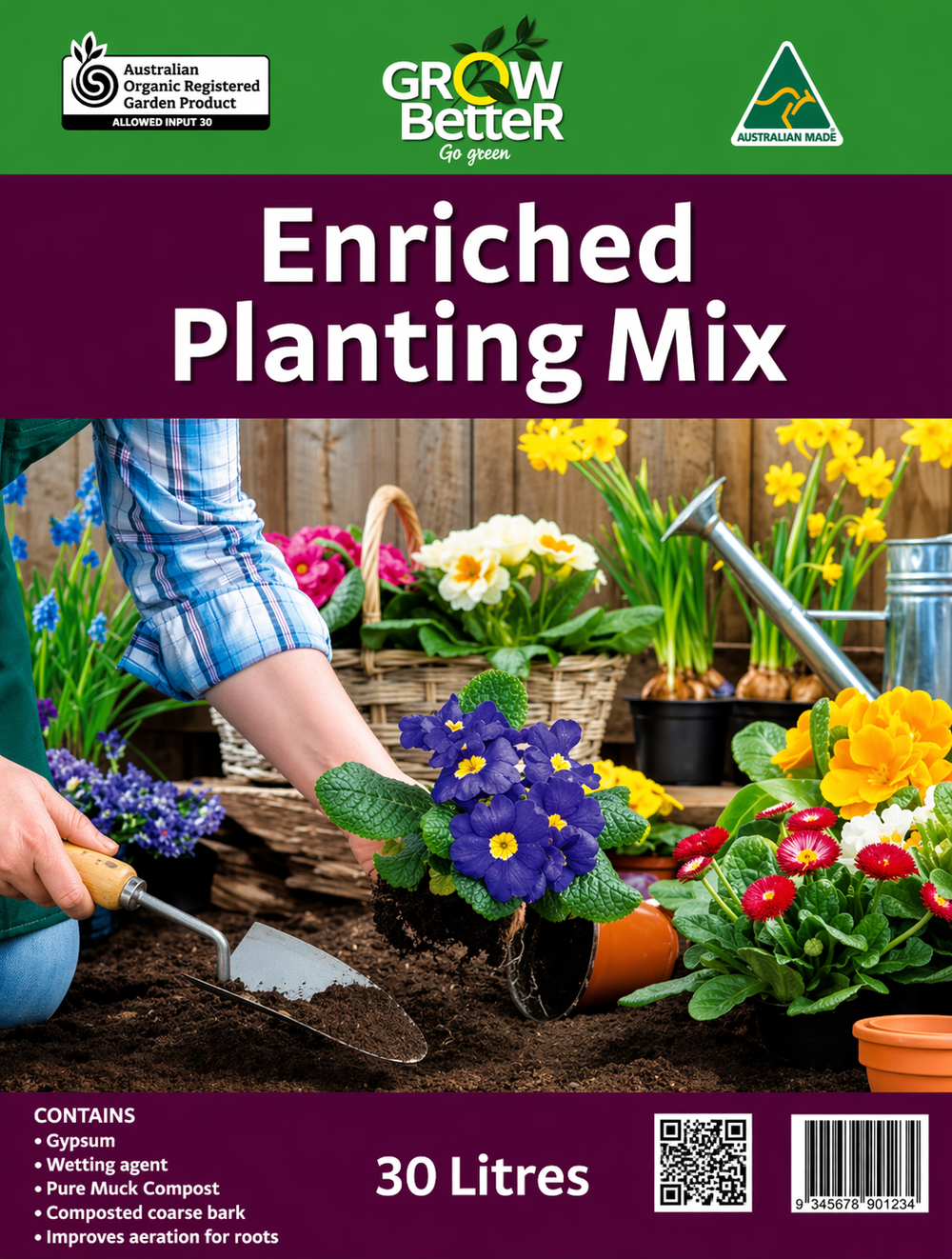
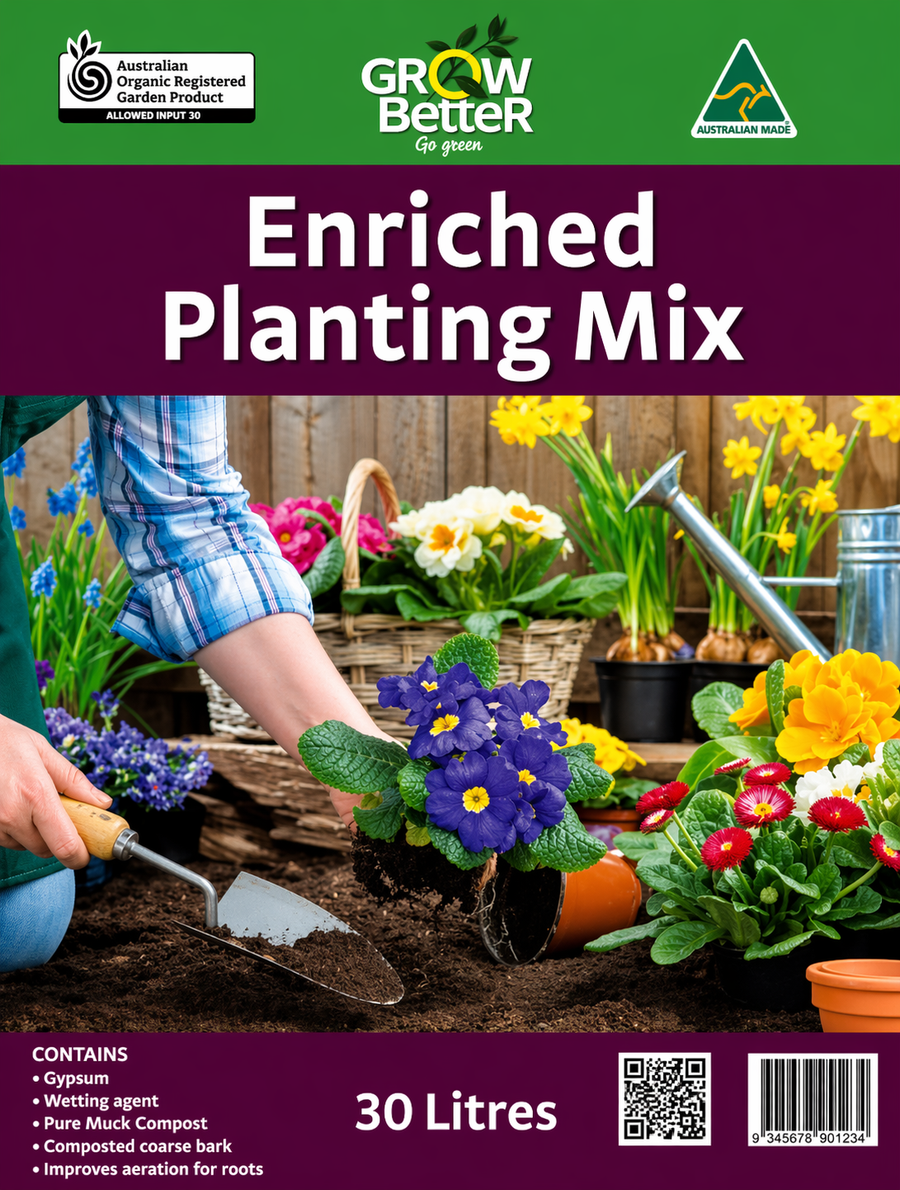
Enriched Planting Mix (AO Certified)
Enriched Planting Mix is a certified organic blend of Pure Magic Compost, composted animal manure, gypsum, composted coarse bark and a wetting agent, bagged in 30L. It is built to be dug through existing garden soil at planting time rather than used on its own, and the gypsum is what sets it apart from a plain compost.
Gypsum helps break up heavy clay so water and roots can move through it, while the compost and manure return organic matter and nutrient to tired ground. The coarse bark holds structure and keeps air around the root zone, and the wetting agent keeps moisture in the soil longer after rain or watering.
Use it when planting trees, shrubs, roses, fruit trees and exotic garden plants, particularly into clay. Dig a hole twice the width of the pot and 7 centimetres deeper, then mix roughly one third planting mix through the excavated soil. Spread 7 centimetres of that improved soil in the base before setting the plant in.
Frequently Asked Questions
About Enriched Planting Mix
What is Enriched Planting Mix made from?
It is a blend of Pure Magic Compost, composted animal manure, gypsum, composted coarse bark and a wetting agent. Each part has a job. The compost and manure supply organic matter and nutrient, the gypsum works on clay structure, the bark keeps air around the roots and the wetting agent holds moisture in the soil.
What plants is it suitable for?
It suits exotic garden plants, including roses, ornamental and deciduous trees, fruit trees, shrubs and perennials, and it earns its keep most on heavy clay sites. It is a planting mix rather than a potting mix, so its job is improving soil at planting time. Phosphorus sensitive natives are the one clear exception.
Is it safe for natives?
No, not for the phosphorus sensitive ones. The composted animal manure in this blend lifts phosphorus well above what Proteaceae such as Banksia, Grevillea, Hakea and Protea will tolerate, and the result can be leaf burn, dieback and plant death. Use the Native Potting Mix for those species, or plant them into unimproved local soil.
Is it certified organic?
Yes. It is a certified organic product with no chemical additives, which is why the manure and compost in it are fully composted rather than raw. That makes it sound around fruit trees and vegetable beds, and it means you are adding genuine organic matter to your soil rather than a synthetic conditioner.
How much do I need?
Work on roughly one third planting mix to two thirds of the soil you dug out of the hole. For a shrub out of a 200 millimetre pot that is only a few litres. An advanced tree going into a large hole will take considerably more. Judge the quantity by the volume of the hole rather than the size of the plant.
Can I use it in pots?
It is not a potting mix and should not be used on its own in a container. The blend is designed to be diluted through garden soil, and used straight in a pot it holds too much water and settles badly. For containers, reach for a premium potting mix, or the native mix if you are potting natives.
Does it need to be watered in?
Yes. Water the plant well several hours before you plant it, then water thoroughly again once the hole is backfilled and the soil firmed down. That first deep watering settles the improved soil around the root ball and drives out air pockets. Keep the water up over the first few months while the roots establish.
Enriched Planting Mix (AO Certified)
Enriched Planting Mix (AO Certified)
Enriched Planting Mix is a certified organic blend of Pure Magic Compost, composted animal manure, gypsum, composted coarse bark and a wetting agent, bagged in 30L. It is built to be dug through existing garden soil at planting time rather than used on its own, and the gypsum is what sets it apart from a plain compost.
Gypsum helps break up heavy clay so water and roots can move through it, while the compost and manure return organic matter and nutrient to tired ground. The coarse bark holds structure and keeps air around the root zone, and the wetting agent keeps moisture in the soil longer after rain or watering.
Use it when planting trees, shrubs, roses, fruit trees and exotic garden plants, particularly into clay. Dig a hole twice the width of the pot and 7 centimetres deeper, then mix roughly one third planting mix through the excavated soil. Spread 7 centimetres of that improved soil in the base before setting the plant in.
Frequently Asked Questions
About Enriched Planting Mix
What is Enriched Planting Mix made from?
It is a blend of Pure Magic Compost, composted animal manure, gypsum, composted coarse bark and a wetting agent. Each part has a job. The compost and manure supply organic matter and nutrient, the gypsum works on clay structure, the bark keeps air around the roots and the wetting agent holds moisture in the soil.
What plants is it suitable for?
It suits exotic garden plants, including roses, ornamental and deciduous trees, fruit trees, shrubs and perennials, and it earns its keep most on heavy clay sites. It is a planting mix rather than a potting mix, so its job is improving soil at planting time. Phosphorus sensitive natives are the one clear exception.
Is it safe for natives?
No, not for the phosphorus sensitive ones. The composted animal manure in this blend lifts phosphorus well above what Proteaceae such as Banksia, Grevillea, Hakea and Protea will tolerate, and the result can be leaf burn, dieback and plant death. Use the Native Potting Mix for those species, or plant them into unimproved local soil.
Is it certified organic?
Yes. It is a certified organic product with no chemical additives, which is why the manure and compost in it are fully composted rather than raw. That makes it sound around fruit trees and vegetable beds, and it means you are adding genuine organic matter to your soil rather than a synthetic conditioner.
How much do I need?
Work on roughly one third planting mix to two thirds of the soil you dug out of the hole. For a shrub out of a 200 millimetre pot that is only a few litres. An advanced tree going into a large hole will take considerably more. Judge the quantity by the volume of the hole rather than the size of the plant.
Can I use it in pots?
It is not a potting mix and should not be used on its own in a container. The blend is designed to be diluted through garden soil, and used straight in a pot it holds too much water and settles badly. For containers, reach for a premium potting mix, or the native mix if you are potting natives.
Does it need to be watered in?
Yes. Water the plant well several hours before you plant it, then water thoroughly again once the hole is backfilled and the soil firmed down. That first deep watering settles the improved soil around the root ball and drives out air pockets. Keep the water up over the first few months while the roots establish.
Enriched Planting Mix (AO Certified)
Camellia japonica – White Flowering Camellia
Camellia japonica – White Flowering Camellia
Camellia japonica in its white flowering form is an upright, broad and densely leafed evergreen shrub. Pure white blooms open against deep green glossy foliage through winter and into spring, when most gardens have little else in flower. Plain white against dark leaves is one of the more restrained combinations available in an ornamental planting.
Part shade is the position it wants, ideally morning sun with shelter from hot afternoon light, which discolours white petals. Soil should be well drained, slightly acidic and mulched. Growth is moderate, reaching a spread of 1.5 to 2.5 metres and a height of roughly 2 to 4 metres. Light to moderate frost is handled once established.
This one is used for screening a fence, filling an understorey, forming a soft informal hedge or standing as a single feature in a shaded courtyard. A pot 40 to 50 centimetres wide holds one plant near an entry. Feature plantings sit 3 to 4 metres apart so each shrub has room to develop its full form.
Frequently Asked Questions
About White Flowering Camellia
What is the White Flowering Camellia?
It is Camellia japonica, the common camellia, in a white flowered selection. The plant is an evergreen shrub with broad upright growth and thick glossy dark green leaves, carrying pure white blooms through winter and spring. It is not an Australian native, but it has been grown in Australian gardens since the nineteenth century.
How big does it grow?
It spreads to 1.5 to 2.5 metres wide and reaches roughly 2 to 4 metres in height depending on age and position. Growth is moderate rather than fast. Pruning straight after flowering keeps it to whatever dimensions the space allows, and the plant tolerates being held well under its natural size for decades.
Where does it grow best in Australia?
Cool to temperate districts suit it best, including Melbourne, Hobart, Canberra, Sydney, Adelaide, Perth and the tablelands and coastal belts nearby. It also performs in the cooler ranges of south east Queensland. Hot dry inland areas and the humid tropics are the two climates where it consistently struggles without significant intervention.
Is it evergreen or deciduous?
Fully evergreen. The dense glossy foliage stays on the plant all year, dropping old leaves gradually rather than in a seasonal flush. That makes it a dependable screening and structure plant, and it is one of the few evergreens that also carries a substantial flowering display in the middle of winter.
Can I use it as a hedge?
Yes, though it makes a soft informal hedge rather than a crisp architectural one, and its moderate growth rate means patience. Space plants around 1 to 1.5 metres apart along the line. Trim lightly after flowering each year, taking new growth only. For a formal clipped result, a small leafed sasanqua camellia is the easier choice.
Is it safe around pets and children?
Camellia japonica is listed as non toxic to dogs, cats and horses, and it is not regarded as a poisoning risk to children. There are no spines or irritant sap to worry about. As with any garden plant, discourage children and animals from chewing the foliage, but nothing about this species calls for special precautions.
How do I care for a White Flowering Camellia?
Water deeply through the first two summers and continue through autumn while flower buds are setting. Mulch over the shallow root system, kept clear of the trunk. Feed with a camellia or azalea fertiliser after flowering ends, and never lime the soil. Prune lightly in spring, thinning crowded branches rather than shearing the surface.
Camellia japonica – White Flowering Camellia
Liquid error (sections/ee-products line 16): invalid url input

Camellia japonica 'Fran Honeyer' Balls
Camellia japonica 'Fran Honeyer' Balls
Camellia japonica 'Fran Honeyer' is an evergreen shrub presented here as a clipped topiary ball. Rich pink formal double flowers open from late winter into mid spring above thick glossy dark green leaves. The sphere is built up in the nursery over several years, so the plant arrives as a finished form rather than a starting point.
It performs best in partial shade or morning sun, with protection from hot afternoon exposure. Soil should be free draining, humus rich and slightly acidic. Growth is slow to moderate, which is why the shape holds so well between trims. Light to moderate frost is tolerated once established, and cool to warm temperate districts suit it.
Balls of this kind are used in pairs at an entry, repeated along a path, set into a raised bed or placed as single accents in a lawn. A 40 to 50 centimetre wide pot carries one specimen on a courtyard or balcony. Because the form is already made, a planting reads as complete on the day it goes in.
Frequently Asked Questions
About Fran Honeyer Camellia
What is Camellia japonica 'Fran Honeyer'?
It is an evergreen camellia cultivar with deep pink formal double flowers, trained and clipped into a topiary ball. The species, Camellia japonica, is a long lived shade tolerant shrub from east Asia. In this form the plant is grown for its architecture as much as its flowers, giving a clean geometric shape that stays green all year.
How big are the topiary balls?
The clipped head sits at roughly 70 to 90 centimetres across, with overall plant height around 1 to 1.3 metres including the base. Regular trimming holds it at that size indefinitely. If left unclipped the plant would eventually revert to a natural shrub of 3 to 4 metres, so ongoing shaping is what keeps the form.
When does Fran Honeyer Camellia flower?
Flowering runs from late winter into mid spring, generally July through October in most southern Australian gardens. Warmer coastal districts start a few weeks earlier and cool highland gardens a little later. The formal double blooms are held well against the dark foliage, and flowering continues over roughly eight to ten weeks rather than in one flush.
Does it need sun or shade?
Partial shade is the preference, ideally with gentle morning sun and shelter from hot afternoon light. Camellia japonica scorches in strong exposed sun, particularly on a clipped surface where every leaf sits at the outside of the plant. A position under high tree canopy, on an eastern wall, or in a courtyard with reflected light suits it well.
Can it grow in pots?
Yes, and containers are one of its most common uses. A pot 40 to 50 centimetres wide holds a single specimen for a courtyard, entry or balcony. Use a premium potted colour or camellia mix, make sure the drainage holes stay clear, and water more often than you would in the ground, since pots dry out quickly in summer.
Is it frost tolerant?
Yes, once established it handles light to moderate frost, which covers most cool temperate parts of southern Australia. The foliage is unaffected by ordinary winter cold. A severe frost while flowers are open can mark the petals, so in frost prone gardens a position with overhead protection from a wall or canopy keeps the display looking better.
How do I care for and clip a Camellia topiary ball?
Trim lightly two or three times a year, taking only the new growth, with the main cut straight after flowering ends in spring. Keep the sphere even by working around the plant rather than finishing one side. Feed with a camellia fertiliser after that prune, mulch to hold moisture, and water deeply rather than briefly.
Camellia japonica 'Fran Honeyer' Balls

Correa 'Tucker Time Dinner Bells'
Correa 'Tucker Time Dinner Bells'
Correa 'Tucker Time Dinner Bells' is a compact Australian native shrub with a rounded bushy habit and small glossy dark green leaves. Its feature is the flowers, large pendulous tubular bells in red to orange with greenish yellow tips, hanging along the stems through the cooler months when little else is out.
It grows in full sun or part shade in free draining soil and takes light to moderate frost once established. Growth is around 20 to 40 centimetres a year, reaching roughly 1 to 1.2 metres across and a similar height. It tolerates dry spells, coastal conditions and low fertility, and wants no phosphorus rich fertiliser.
Use it in native and bird attracting gardens, as an informal low hedge, in borders, in pots, or as underplanting beneath taller natives and eucalypts. It is one of the few shrubs that puts on a real display through autumn and winter, which makes it worth having in a garden that otherwise goes quiet.
Frequently Asked Questions
About Dinner Bells Correa
What is Correa 'Tucker Time Dinner Bells'?
It is a hybrid Australian native correa bred in the Tucker Time series for large pendulous bell flowers and a neat compact habit. The flowers are red to orange with pale green tips and hang from the stems in numbers. The foliage is small, glossy and dark green, and the plant is evergreen.
How big does it grow?
It forms a rounded shrub roughly 1 to 1.2 metres wide and a similar height, growing at about 20 to 40 centimetres a year. The habit is naturally bushy so it rarely needs corrective pruning. A light trim after the main flowering flush keeps it dense and stops the base opening up over the years.
When does it flower?
The main display runs from late autumn through winter and into early spring, roughly May to September, with scattered flowers at other times. That winter timing is the point of the plant, since it fills the gap when most gardens have little colour. Flowering is heavier in an open sunny position than in shade.
Does it attract birds?
Yes. The tubular flowers are shaped for honeyeaters, and eastern spinebills, New Holland honeyeaters and wattlebirds work them steadily through winter when other nectar is scarce. Native bees visit as well. Planting a group of three or more rather than a single specimen makes the patch far more useful to birds.
Does it need sun or shade?
Both work. Full sun produces the densest growth and the heaviest flowering, while part shade suits it in hot inland gardens and still gives a good display. It is one of the more shade tolerant natives, which is why it is often used under established trees. Avoid heavy shade and wet, poorly drained ground.
How far apart should I plant it for a low hedge?
Space plants about 70 to 80 centimetres apart for a continuous low informal hedge, given the mature width of 1 to 1.2 metres. For a looser mass planting go out to 1 metre. In borders or as underplanting, single plants set 1 metre or more from their neighbours keep their rounded shape.
How do I care for Correa 'Tucker Time Dinner Bells'?
Water through the first two summers, then only during extended dry spells. Mulch with a coarse organic mulch and feed once in spring with a native fertiliser low in phosphorus. Trim lightly after the main flowering to keep the shape tight. It has no significant pest problems and dislikes waterlogged soil more than anything else.
Correa 'Tucker Time Dinner Bells'
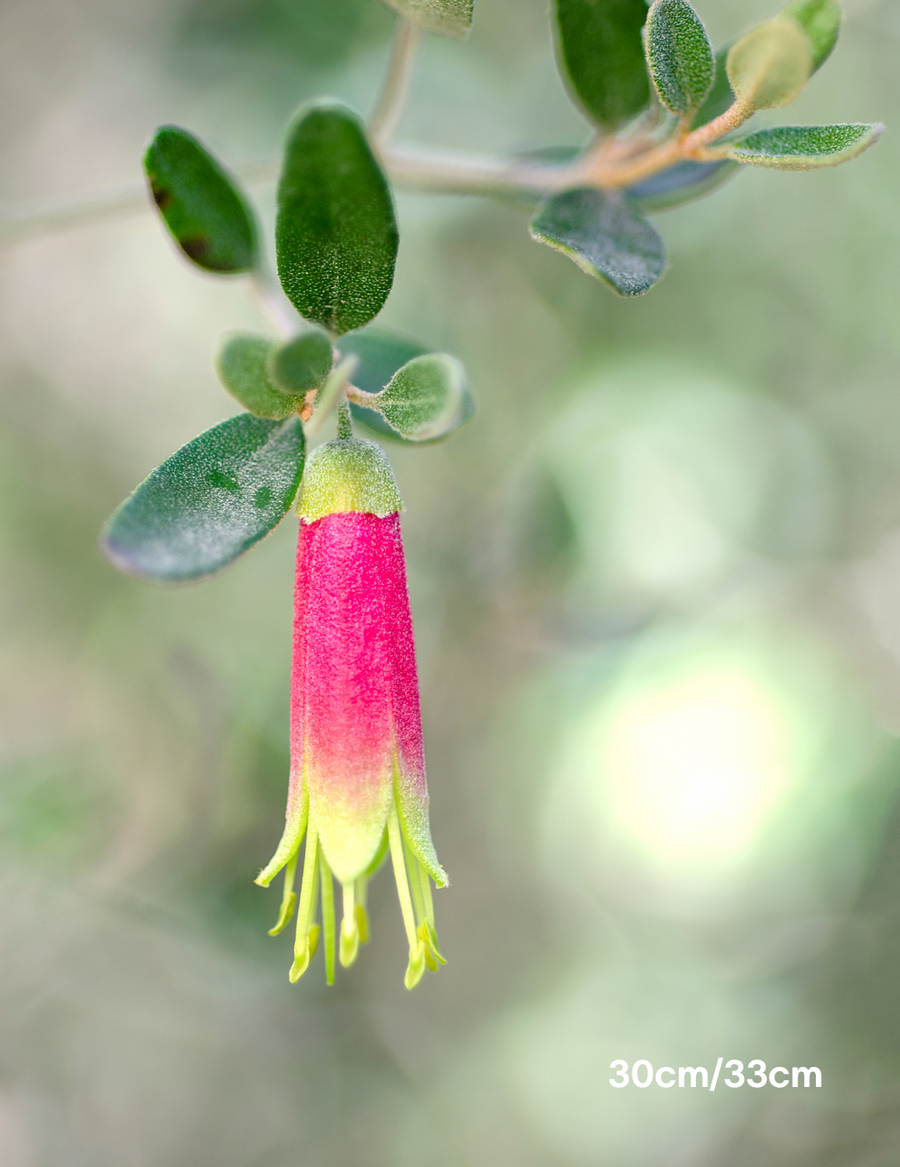
Leptospermum laevigatum - Coastal Tea Tree
Leptospermum laevigatum - Coastal Tea Tree
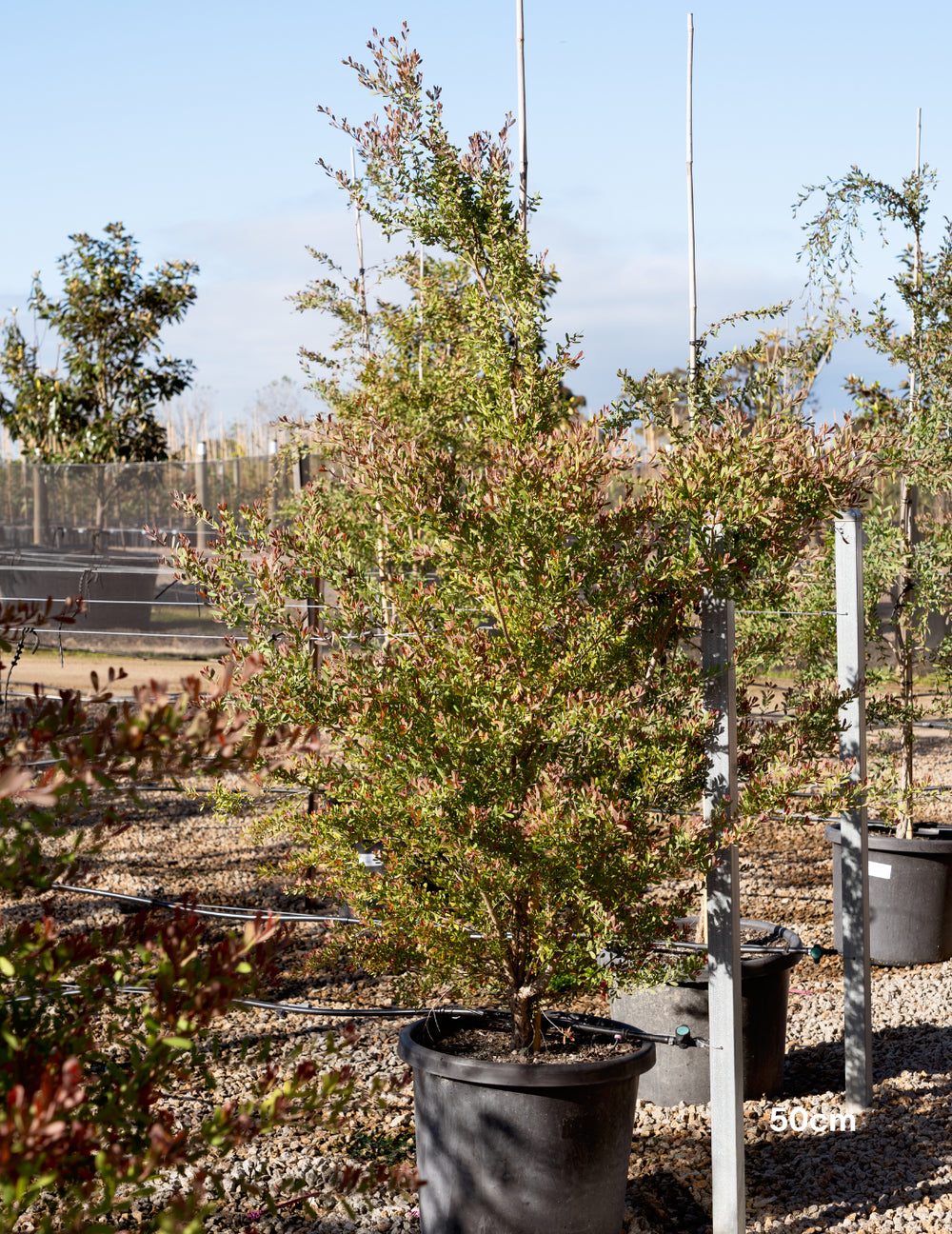
Leptospermum laevigatum is one of the toughest screening plants available for exposed coastal sites, holding dense grey-green foliage through salt spray and constant wind that would strip most other species. Masses of small white flowers cover the plant in spring.
The Coastal Tea Tree grows to 3 to 5 metres tall and 2 to 4 metres wide at 50 to 80 centimetres per year, and develops a gnarled sculptural trunk with age that becomes a feature in its own right. It can be run as a dense windbreak or thinned and lifted to show the framework as a specimen.
This is an Australian native that survives heavy and frequent frost without damage and tolerates poor sandy soils, drought and coastal exposure once established. It performs from tropical Queensland down through New South Wales, Victoria and South Australia with almost no ongoing maintenance.
Frequently Asked Questions
About Leptospermum laevigatum
How tall does Leptospermum laevigatum grow?
Leptospermum laevigatum grows to 3 to 5 metres tall and 2 to 4 metres wide, and can reach larger dimensions in sheltered inland positions where wind does not restrict it.
Is Coastal Tea Tree salt tolerant?
Yes. Leptospermum laevigatum is among the most salt-tolerant screening plants available in Australia and is a standard choice for front-line coastal planting where salt spray is constant.
How fast does Coastal Tea Tree grow?
It grows at 50 to 80 centimetres per year once established, which is fast for a plant of this hardiness. It establishes quickly in sandy free-draining soils.
Is Leptospermum laevigatum an Australian native?
Yes. It is native to coastal southern and eastern Australia and is widely used in revegetation, dune stabilisation and rural windbreak planting as well as in gardens.
When does it flower?
Masses of small white flowers cover the plant through spring. The flowers attract bees, native pollinators and small insect-feeding birds.
How far apart should I plant it for a windbreak?
Plant 1 to 1.5 metres apart for a dense informal screen or windbreak, or 3 to 4 metres apart as individual feature trees where the sculptural trunk can develop.
Is Coastal Tea Tree frost hardy?
Yes. It is frost hardy and survives heavy and frequent frost without damage, so it suits inland and tableland districts as well as its natural coastal range.
Leptospermum laevigatum - Coastal Tea Tree

Pittosporum tobira 'Miss Muffet'
Pittosporum tobira 'Miss Muffet'
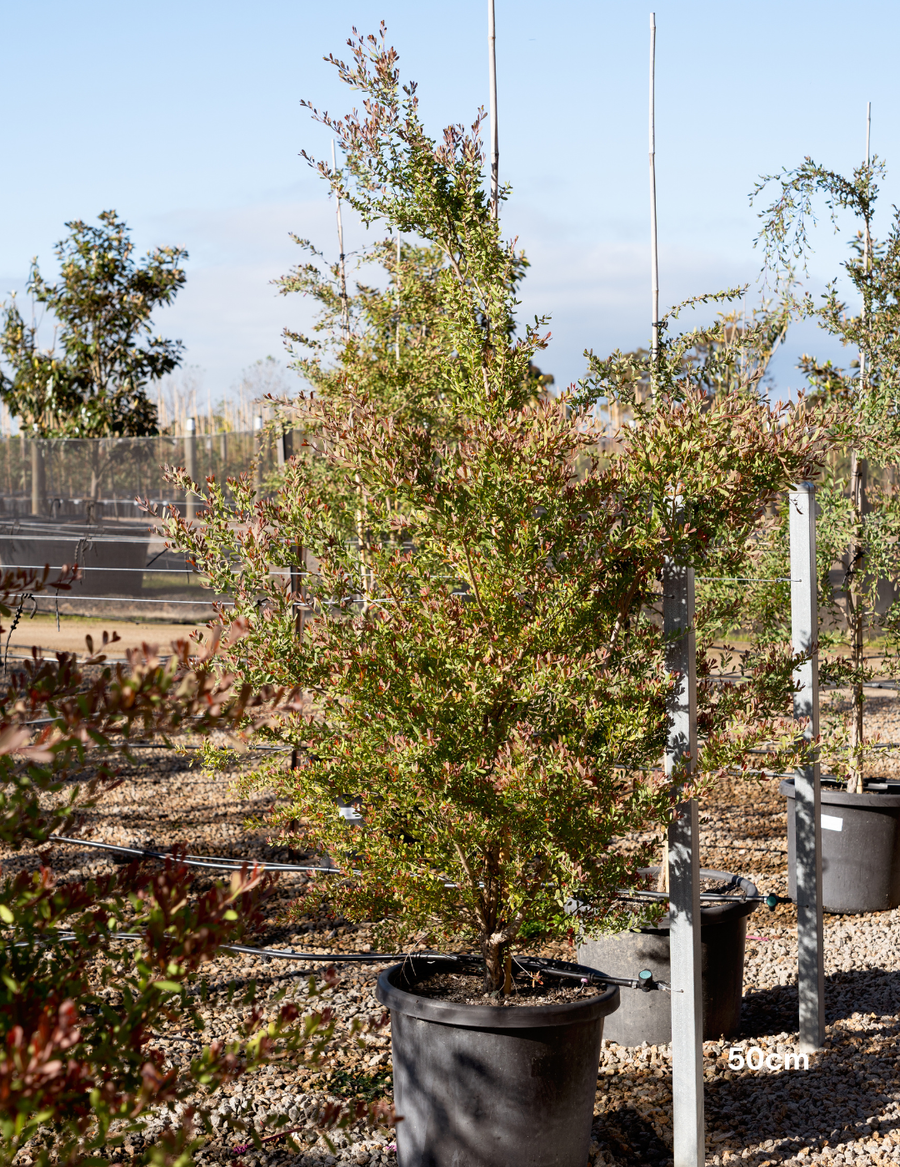
Pittosporum tobira 'Miss Muffet' forms a naturally tidy dome of glossy dark green foliage without ever needing to be clipped into shape, and carries clusters of intensely fragrant creamy-white flowers through spring. It is the low structural plant that does the work of a clipped hedge with none of the trimming.
'Miss Muffet' grows to just 0.5 to 1 metre tall and around 1.5 metres wide at 20 to 40 centimetres per year, holding density right to ground level. That compact scale suits low borders along paths and driveways, underplanting beneath feature trees, and mass planting in courtyards and civic beds.
'Miss Muffet' grows in full sun to part shade, tolerates light to moderate frost once established, and copes with coastal exposure and extended dry. It performs well in pots, and maintenance is limited to removing the occasional wayward shoot.
Frequently Asked Questions
About Pittosporum tobira 'Miss Muffet'
How big does Pittosporum 'Miss Muffet' grow?
'Miss Muffet' grows to 0.5 to 1 metre tall and around 1.5 metres wide, forming a naturally rounded dome. It is a true dwarf and will not need cutting back to stay low.
Does 'Miss Muffet' need pruning?
No. It holds a tidy rounded shape naturally. An occasional trim to remove a wayward shoot is all that is required, which is its main advantage over clipped alternatives.
When does 'Miss Muffet' flower and is it fragrant?
Clusters of creamy-white flowers appear through spring and are strongly fragrant, with a scent often compared to orange blossom.
Can 'Miss Muffet' be used as a low hedge?
Yes. Plant 0.8 to 1 metre apart for a continuous low evergreen border. Because it is naturally dense and low, it forms a hedge line without formal clipping.
Does 'Miss Muffet' grow in shade?
Yes. It performs in full sun through to part shade, which makes it useful for underplanting beneath established canopy trees where light is limited.
Is 'Miss Muffet' suitable for coastal gardens?
Yes. Pittosporum tobira tolerates salt-laden wind and sandy soils well, and 'Miss Muffet' is widely used in coastal courtyard and foreshore plantings.
Can 'Miss Muffet' be grown in pots?
Yes. Its compact rounded habit makes it an excellent pot plant for entries, balconies and courtyards. Use a free-draining mix and water regularly through summer.
Pittosporum tobira 'Miss Muffet'

Trachelospermum jasminoides Balls – Star Jasmine Balls
Trachelospermum jasminoides Balls – Star Jasmine Balls
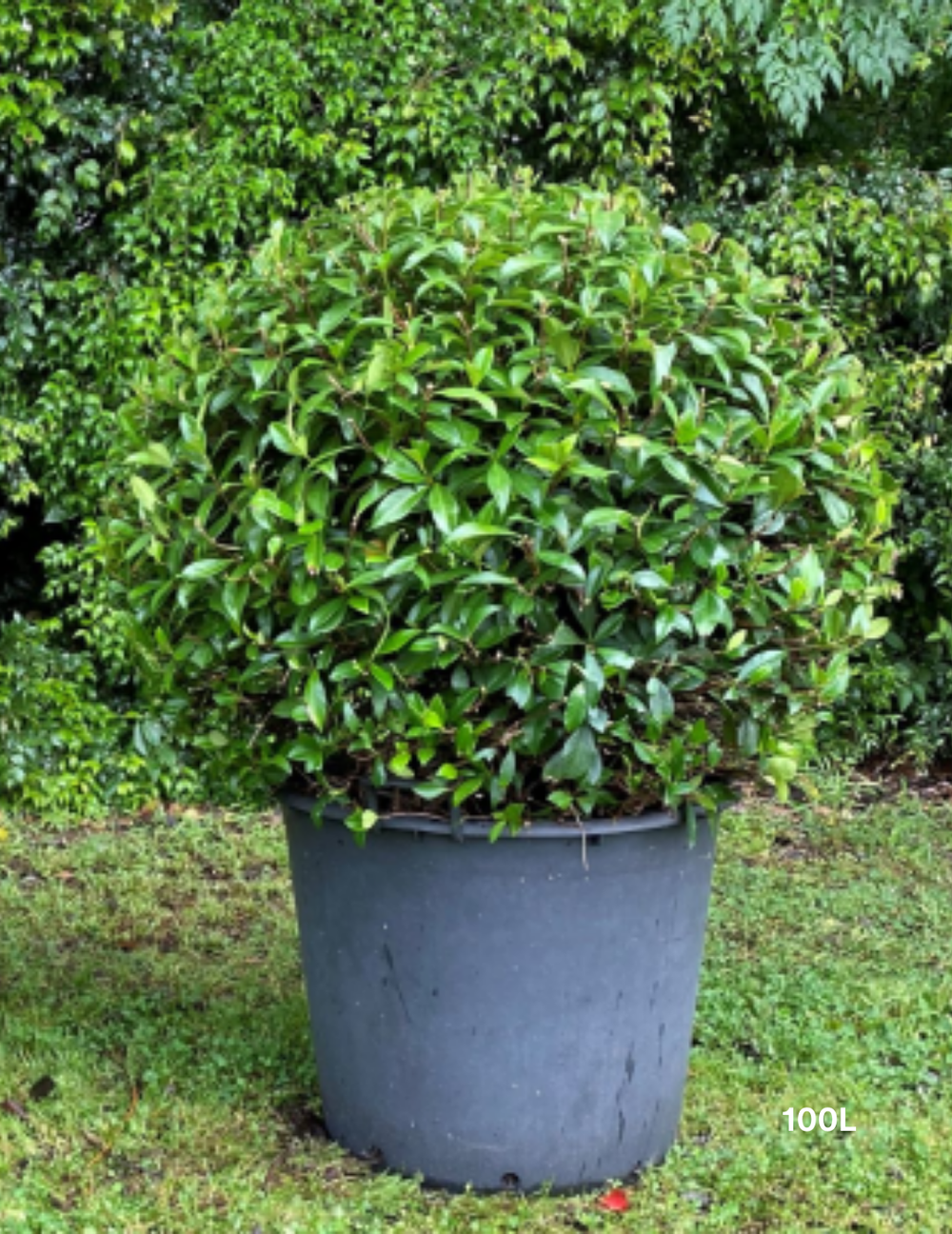
Trachelospermum jasminoides 'Balls' is Star Jasmine grown and clipped into a dense evergreen sphere. The small glossy leaves sit tight on a woody framework, holding a clean rounded outline year round. White pinwheel flowers open in spring and carry a strong sweet scent right across a courtyard.
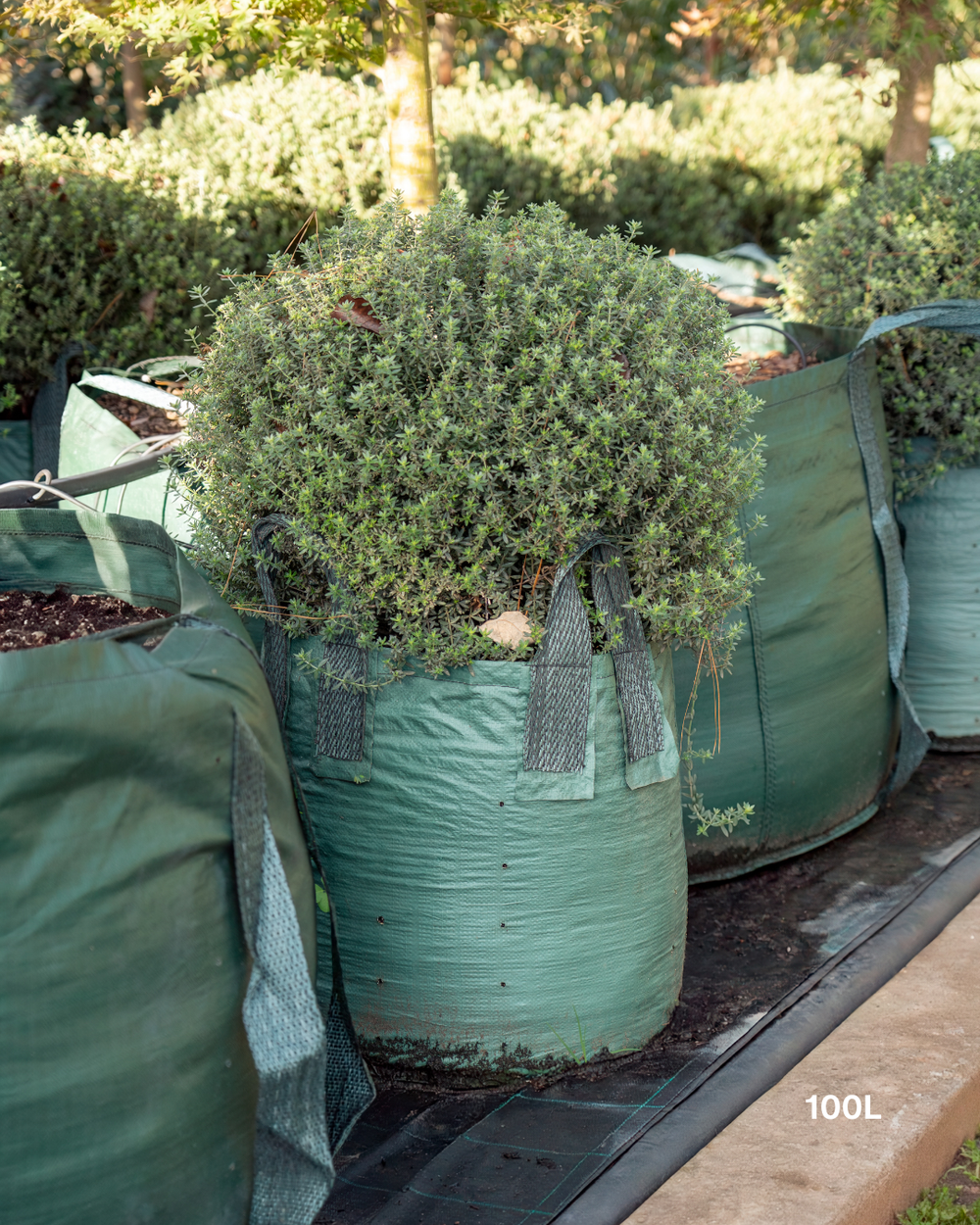
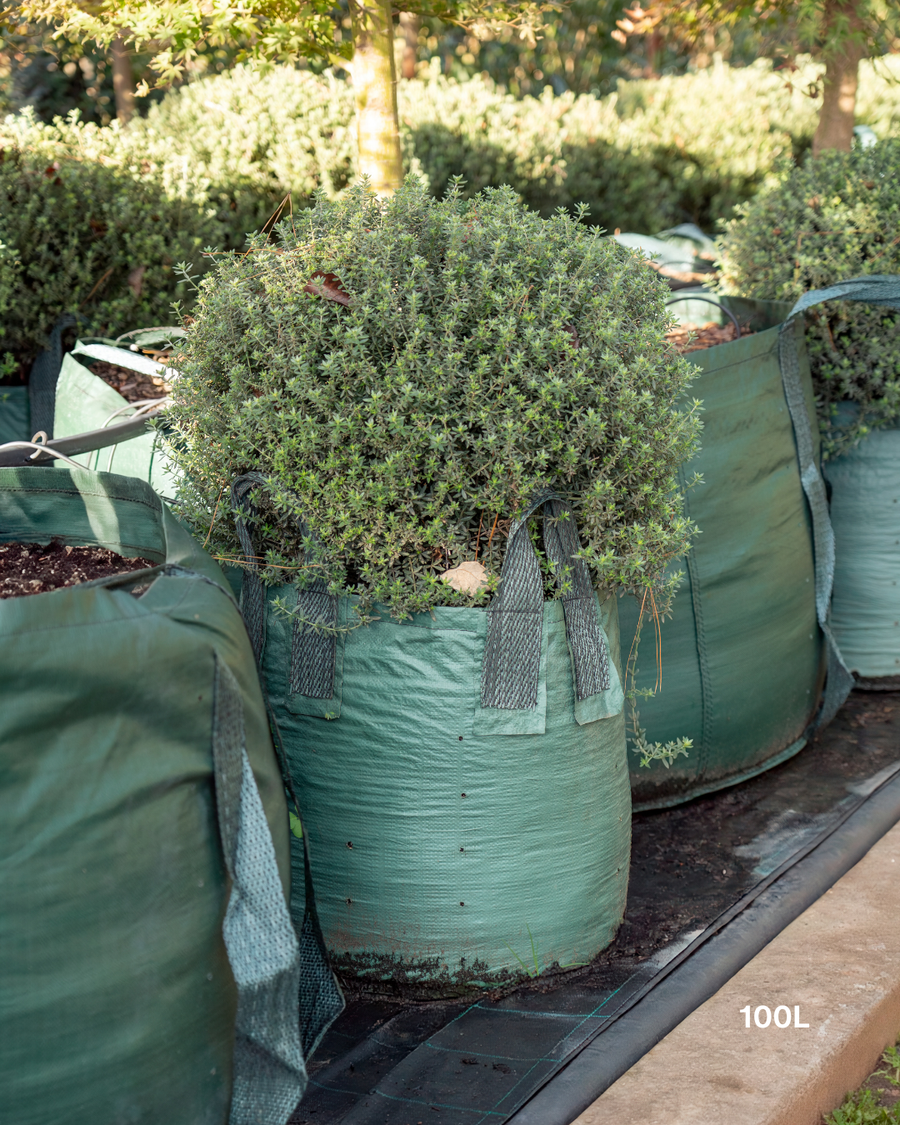
Ball specimens hold at about 1 to 1.5 metres tall and wide with light clipping. Full sun to part shade suits them, in any free draining soil. Growth is slow to moderate at 30 to 50 centimetres a year. They handle coastal exposure, light frost and dry spells once the roots are down.
Repeat them along a driveway, either side of an entry, or in pots on a terrace where a formal shape is wanted straight away. They read as structure in a planting scheme without the height of a hedge, and because the form is already trained, a new garden looks settled from the day it goes in.
Frequently Asked Questions
About Star Jasmine Balls
What are Star Jasmine Balls?
They are Trachelospermum jasminoides, the common Star Jasmine, grown and clipped into a dense evergreen sphere on a woody framework. Instead of climbing, the plant is trained into a self supporting rounded shape. The foliage is small, glossy and dark green, and the plant carries scented white flowers through spring.
How big do Star Jasmine Balls grow?
They hold at roughly 1 to 1.5 metres tall and 1 to 1.5 metres wide. Growth is slow to moderate at 30 to 50 centimetres a year, so a light clip once or twice a year keeps the ball tight at whatever size within that range suits the setting.
Do Star Jasmine Balls need sun or shade?
Full sun to part shade both work. Full sun gives the densest foliage and the heaviest flowering, while part shade produces slightly softer, more open growth and fewer flowers. Avoid deep shade, where the ball thins out and loses its outline. Morning sun with afternoon protection suits hot inland gardens.
Can Star Jasmine Balls be grown in pots?
Yes, and pots are one of the main uses. A container 50 to 60 centimetres wide with a quality free draining mix will hold a ball for years. Water more often than you would in the ground, especially in summer, and feed in spring and again in late summer. Refresh the mix every few years.
Are Star Jasmine Balls evergreen?
Yes, the foliage is held year round. The glossy dark green leaves take on a bronze tinge in cold weather and green up again in spring, but the plant never goes bare. That is what makes it useful as permanent structure in a scheme, particularly in winter once perennials have died back.
When do Star Jasmine Balls flower?
Flowering runs through spring, roughly September to November, and often carries into early summer in warmer districts. The white pinwheel flowers are small but produced in quantity, and the scent is strong on still evenings. Flowering is heaviest on plants in full sun that were not clipped hard just before bud set.
How do I prune and care for Star Jasmine Balls?
Clip lightly with hedging shears once after flowering and again in late summer if needed, taking only the new growth to keep the outline crisp. Water deeply in dry weather, mulch the base, and feed in early spring. The sap is milky and can irritate skin, so wear gloves when trimming.
Trachelospermum jasminoides Balls – Star Jasmine Balls
Westringia fruticosa – Coastal Rosemary
Westringia fruticosa – Coastal Rosemary
Westringia fruticosa, Coastal Rosemary, is an Australian native evergreen shrub from the headlands and dunes of the east coast. It builds a dense rounded bush of fine grey green leaves held in whorls, with small white to pale lilac flowers. Despite the common name it is not the culinary herb.
Mature plants sit at 1.5 to 2 metres tall and 1.5 to 2 metres wide, growing 30 to 60 centimetres a year, and they clip smaller without complaint. Full sun to part shade and sharp drainage are the requirements. Salt wind, sandy soil, drought and light to moderate frost are all handled.
It is a standard on coastal projects, road verges, council garden beds and exposed banks that need erosion cover. Plant 1 to 1.5 metres apart for an informal screen, or 80 centimetres for a clipped hedge. A single plant fills a 40 to 50 centimetre pot on a courtyard or balcony.
Frequently Asked Questions
About Coastal Rosemary
What is Coastal Rosemary?
Westringia fruticosa is an Australian native evergreen shrub from the headlands and dunes of the east coast. It forms a dense rounded bush of fine grey green leaves held in whorls, with small white to pale lilac flowers. Despite the common name it is not culinary rosemary and is not used in cooking.
How big does Coastal Rosemary grow?
Mature plants reach 1.5 to 2 metres tall and 1.5 to 2 metres wide. It clips readily to smaller dimensions and is often maintained at around a metre as a hedge or a low mound. Growth is moderate, roughly 30 to 60 centimetres a year, so it holds a trimmed shape well.
Is Coastal Rosemary suitable for coastal positions?
It is one of the best shrubs available for exposed coastal work. It grows naturally on sea cliffs and copes with salt laden wind, sand and reflected heat. It is used constantly on beachfront reserves, dune stabilisation projects and seaside gardens where little else holds a tidy shape.
When does Coastal Rosemary flower?
The main flush is spring and summer, roughly September through February, with scattered flowering at other times of the year in mild districts. The flowers are small, white to pale lilac and sit among the foliage rather than above it. Clipped hedges flower less than plants left to grow informally.
How far apart should I plant Coastal Rosemary for a hedge?
Space plants 80 centimetres apart for a tight formal hedge, or 1 to 1.5 metres apart for a dense informal screen. On banks and batters used for erosion cover, 1 metre in a staggered grid gives full ground coverage within about two growing seasons.
Can Coastal Rosemary grow in pots?
Yes. A pot 40 to 50 centimetres wide suits a single plant for a courtyard, entry or balcony. Use a free draining mix, because the roots will not tolerate sitting wet. Container plants need watering more often than those in the ground, plus a light trim to hold their shape.
How do I prune and care for Coastal Rosemary?
Trim lightly two or three times a year, taking the soft new growth and avoiding cuts into bare old wood, which reshoots poorly. Water through the first summer, then only in extended dry spells. On most soils it needs no feeding at all, and it resents heavy watering and poor drainage.
Westringia fruticosa – Coastal Rosemary

Evergreen Trees Direct Has Been Featured In:


Perfect Substitutes for Camellia hiemalis 'Hiryu' - Sasanqua Camellia Hiryu

Camellia sasanqua 'Pure Silk'
Camellia sasanqua 'Pure Silk'
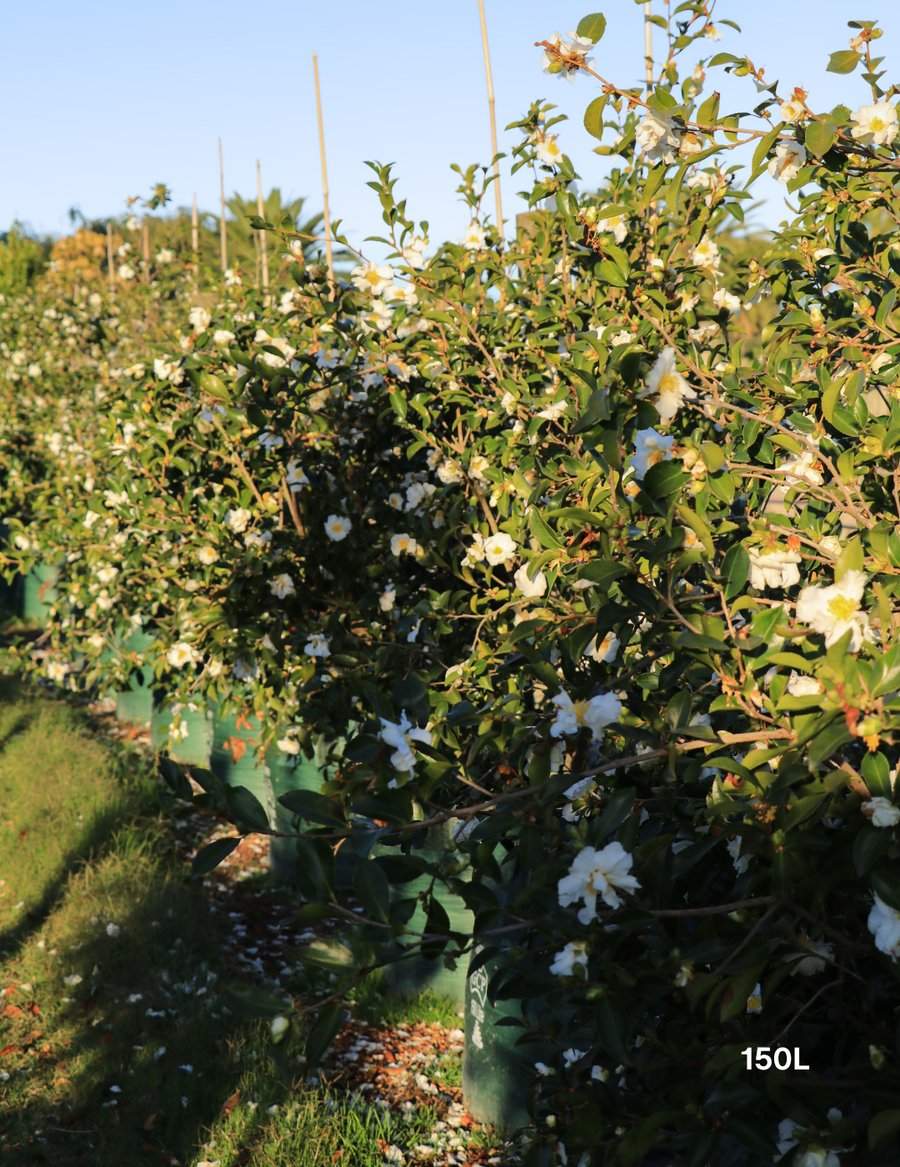
Camellia sasanqua 'Pure Silk' is an elegant evergreen shrub grown for its pure white semi-double blooms, which stand out beautifully against glossy dark green foliage. Flowering from autumn into early winter, it brings serene seasonal colour to the garden in the cooler months.
Pure Silk grows to 2-3 metres tall and 1.5-2 metres wide with an upright, slightly spreading habit. The size and dense growth make it ideal for hedging, screening, containers, and feature planting, and it can also be espaliered against walls and fences. Sasanqua camellias tolerate more sun than other camellia types.
Pure Silk thrives in part shade to full sun and prefers well-drained, moist, slightly acidic soil. It is evergreen, holding glossy foliage year-round, and is low maintenance, needing only light pruning and mulching to keep it healthy and in shape.
Frequently Asked Questions
About Camellia sasanqua 'Pure Silk'
How tall does Camellia 'Pure Silk' grow?
Camellia sasanqua 'Pure Silk' grows to 2-3 metres tall and 1.5-2 metres wide, and can be maintained smaller with pruning.
How fast does 'Pure Silk' grow?
'Pure Silk' has a moderate growth rate of 20-40cm per year once established.
When does 'Pure Silk' flower?
'Pure Silk' produces masses of soft white flowers through autumn and into winter, providing colour when little else is flowering.
Is 'Pure Silk' good for hedging?
Yes. Camellia sasanqua 'Pure Silk' makes an excellent flowering hedge or screen and responds well to pruning. It can also be espaliered against walls and fences.
Is 'Pure Silk' evergreen?
Yes. 'Pure Silk' is fully evergreen, holding glossy dark green foliage year-round.
How far apart should I plant 'Pure Silk' for a hedge?
Plant 60-80cm apart for a dense flowering hedge, or 1 metre for a more relaxed screen.
Where does 'Pure Silk' grow best in Australia?
'Pure Silk' thrives across most Australian climates in part shade to full sun, preferring well-drained, slightly acidic soil. Sasanqua camellias tolerate more sun than other camellia types.
Camellia sasanqua 'Pure Silk'
Camellia sasanqua 'Setsugekka'
Camellia sasanqua 'Setsugekka'
Camellia sasanqua 'Setsugekka' is a tall evergreen shrub with large, single to semi double white flowers, the petals slightly ruffled around a centre of golden stamens. Bloom runs from late autumn into early winter. Foliage is small, glossy and dark green, carried densely on an upright, gently spreading frame.
It takes more sun than a japonica and will hold full sun in cooler districts, though part shade suits inland heat. Soil should be well drained and slightly acidic. Growth is 40 to 60 centimetres a year, to 2 to 4 metres tall and 1.5 to 2.5 metres wide. Light frost is tolerated.
This is the standard choice for a tall evergreen screen along a boundary or between neighbouring houses, and it clips readily into a formal hedge. It also stands alone as a feature, or fills a large pot at an entry. The height and density make it useful wherever fence line privacy is the brief.
Frequently Asked Questions
About Camellia sasanqua 'Setsugekka'
What is Camellia sasanqua 'Setsugekka'?
'Setsugekka' is a tall evergreen sasanqua camellia with large single to semi double white flowers, the petals slightly ruffled around a boss of golden stamens. It flowers from late autumn into early winter. Small glossy dark leaves are held densely on an upright, gently spreading shrub used widely for screening.
How big does 'Setsugekka' grow?
It reaches 2 to 4 metres tall and 1.5 to 2.5 metres wide, at a rate of roughly 40 to 60 centimetres a year. That upper height is what makes it a genuine screening plant rather than a border shrub. Regular trimming will hold it at any height above about 1.5 metres.
How far apart should I plant it for a hedge or screen?
Space plants 1 to 1.5 metres apart for a dense informal screen, or 80 centimetres apart for a tighter formal hedge. Tighter spacing closes the gaps faster but increases competition for water and nutrients, so prepare a continuous trench rather than individual holes and keep irrigation even along the run.
When does it flower?
Flowering starts in late autumn and carries into early winter, roughly April through to June across most of southern Australia. Sasanquas flower ahead of japonicas, so this one fills the gap before the japonica season begins. Individual flowers drop cleanly from the plant rather than browning on the bush.
Does it need sun or shade?
It takes more sun than a japonica and will hold full sun in cooler and coastal districts. In hot inland gardens give it afternoon shade to protect the foliage. It also flowers acceptably in part shade, which makes it one of the more flexible screening plants for a boundary with mixed aspect.
Can it be grown in pots?
Yes. A pot 40 to 50 centimetres wide suits a single specimen for a courtyard, entry or balcony. Use a free draining camellia and azalea mix, water regularly because containers dry out fast, and feed after flowering. Expect a smaller final size in a container than the same plant would reach in open ground.
How do I prune and care for it?
Trim once flowering finishes in early winter, taking the new growth back to shape. For a formal hedge, a second light trim in late summer keeps the face tidy. Feed with a camellia fertiliser after pruning, keep mulch over the shallow roots, and water deeply through summer dry spells.
Camellia sasanqua 'Setsugekka'
Laurus nobilis 'Miles Choice' Bay Tree
Laurus nobilis 'Miles Choice' Bay Tree
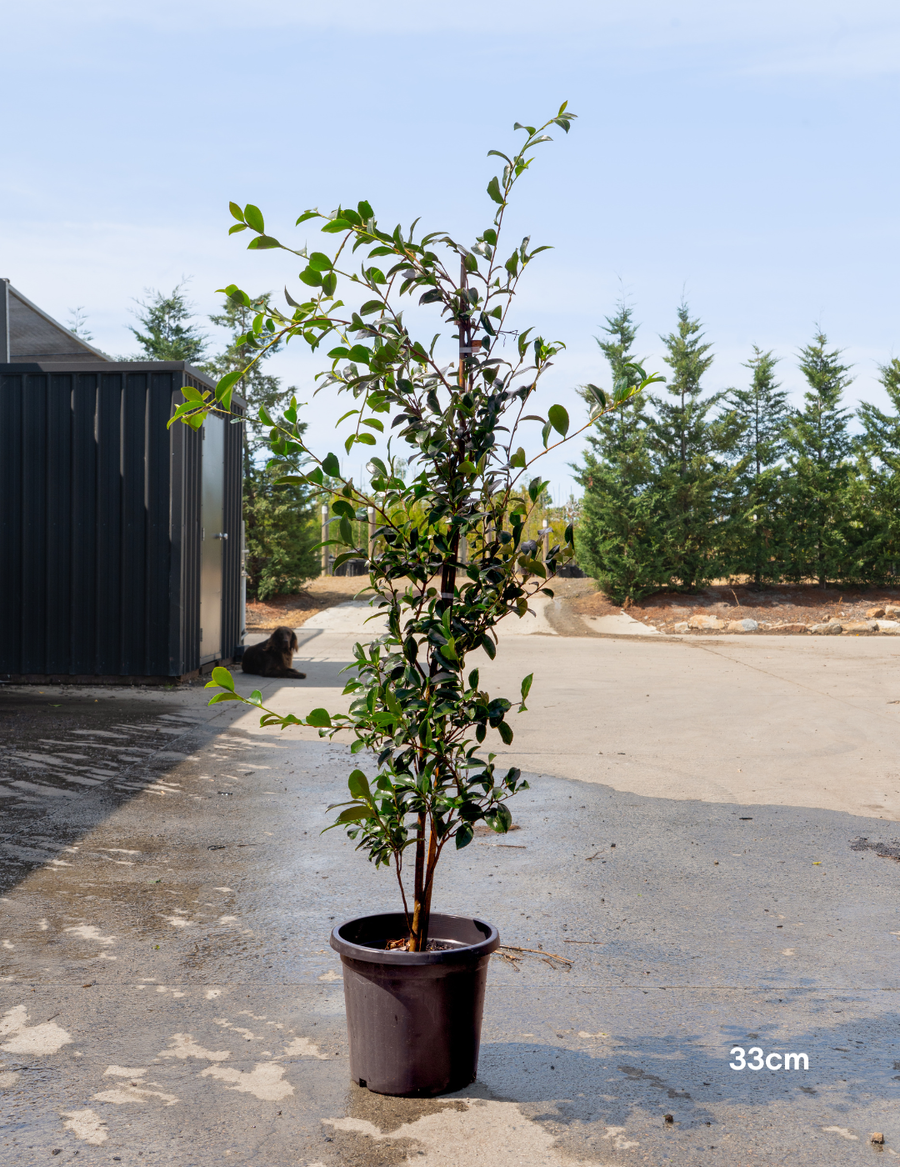
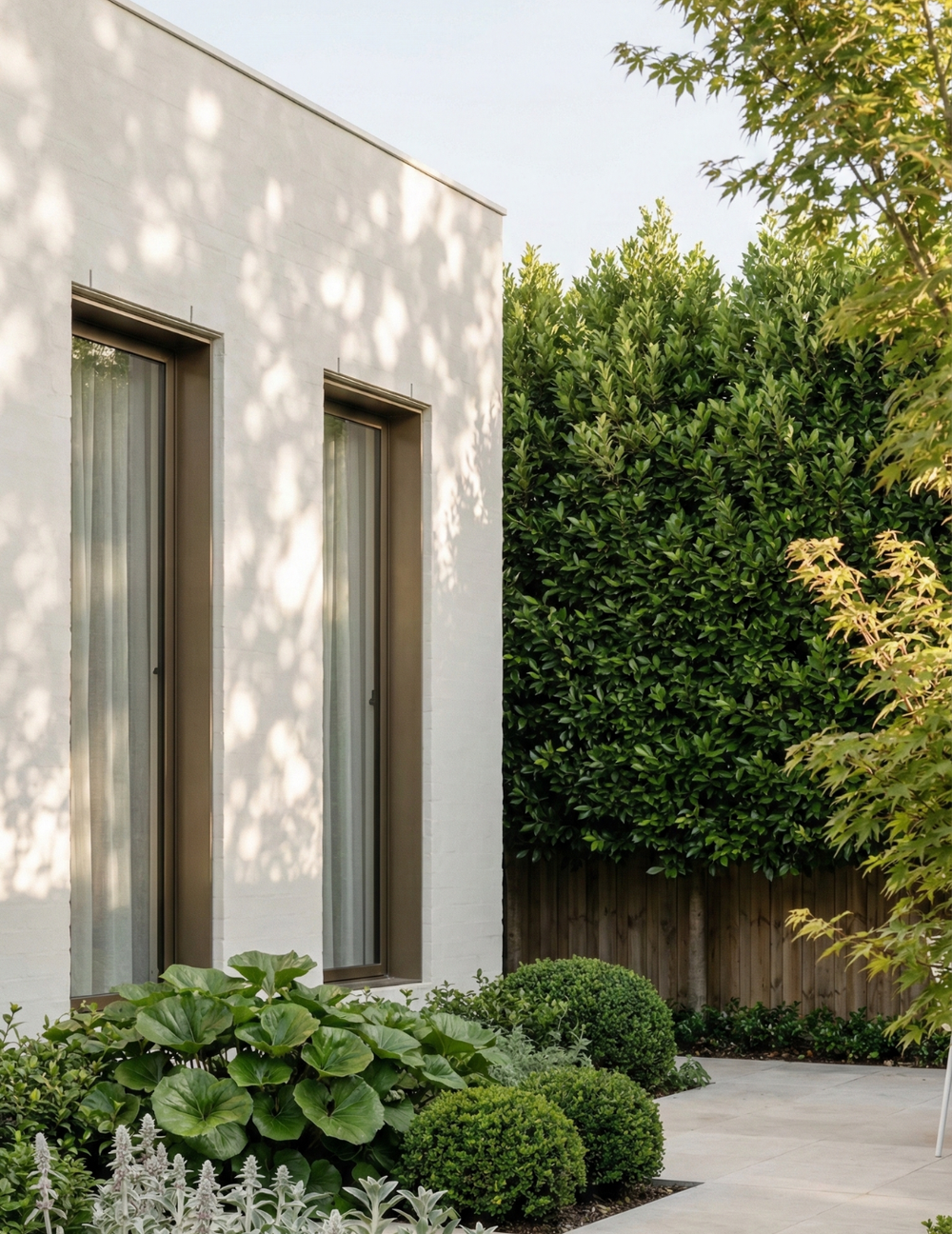
Laurus nobilis 'Miles Choice' is considered an improved form of the traditional bay tree, selected for its more compact, upright growth. This variety is known for producing denser, tidier hedging with less effort, which is why it has become one of our best-selling choices for structured residential and commercial landscapes.
Its dark green, glossy, aromatic foliage creates a strong, uniform backdrop that instantly elevates surrounding plantings and holds its shape beautifully year-round. It is ideal for clipped formal hedges, privacy screening, and pleached rows, responding exceptionally well to pruning and maintaining a clean, polished finish with regular trimming.
'Miles Choice' performs reliably in full sun to part shade and tolerates a wide range of conditions, including coastal and windy sites once established. The foliage is also edible, making it both a practical and ornamental option.
Low-maintenance, resilient, and highly refined, it is a go-to hedging tree for projects where structure, longevity, and a premium finish matter.
Frequently Asked Questions
About Laurus nobilis 'Miles Choice' Bay Tree
How tall does Miles Choice Bay Tree grow?
Miles Choice grows to 4-6 metres tall and is most commonly maintained as a 2-4 metre clipped hedge. Its compact upright form holds a tighter shape than standard Laurus nobilis.
How fast does Miles Choice grow?
Miles Choice has a moderate growth rate of 30-50cm per year once established.
Is Miles Choice the same as standard bay tree?
Miles Choice is an improved cultivar of Laurus nobilis with a tighter, more compact habit. The foliage is still fully edible and aromatic, but the plant produces denser, tidier hedges with less pruning than the standard form.
Are Miles Choice leaves edible?
Yes. Like the standard bay tree, Miles Choice leaves are fully edible and can be used in cooking. Pick fresh leaves as needed for stocks, soups, slow-cooked dishes, and marinades.
How far apart should I plant Miles Choice for a hedge?
Plant 60-80cm apart for a dense formal hedge, or 1 metre apart for a more relaxed screen.
Can Miles Choice grow in pots?
Yes. Miles Choice performs well in large pots (60L+) and is a popular choice for formal entrances, courtyards, and balcony screening.
How do I prune Miles Choice Bay Tree?
Trim two to three times through the warmer months, taking a little each time rather than one hard cut. Use sharp secateurs on individual stems so the large leaves are not sliced in half and left browning on the face of the hedge. Miles Choice reshoots readily from older wood, so an overgrown plant can be brought back into shape over a season or two.
Laurus nobilis 'Miles Choice' Bay Tree

Syzygium paniculatum 'Backyard Bliss' Lilly Pilly
Syzygium paniculatum 'Backyard Bliss' Lilly Pilly
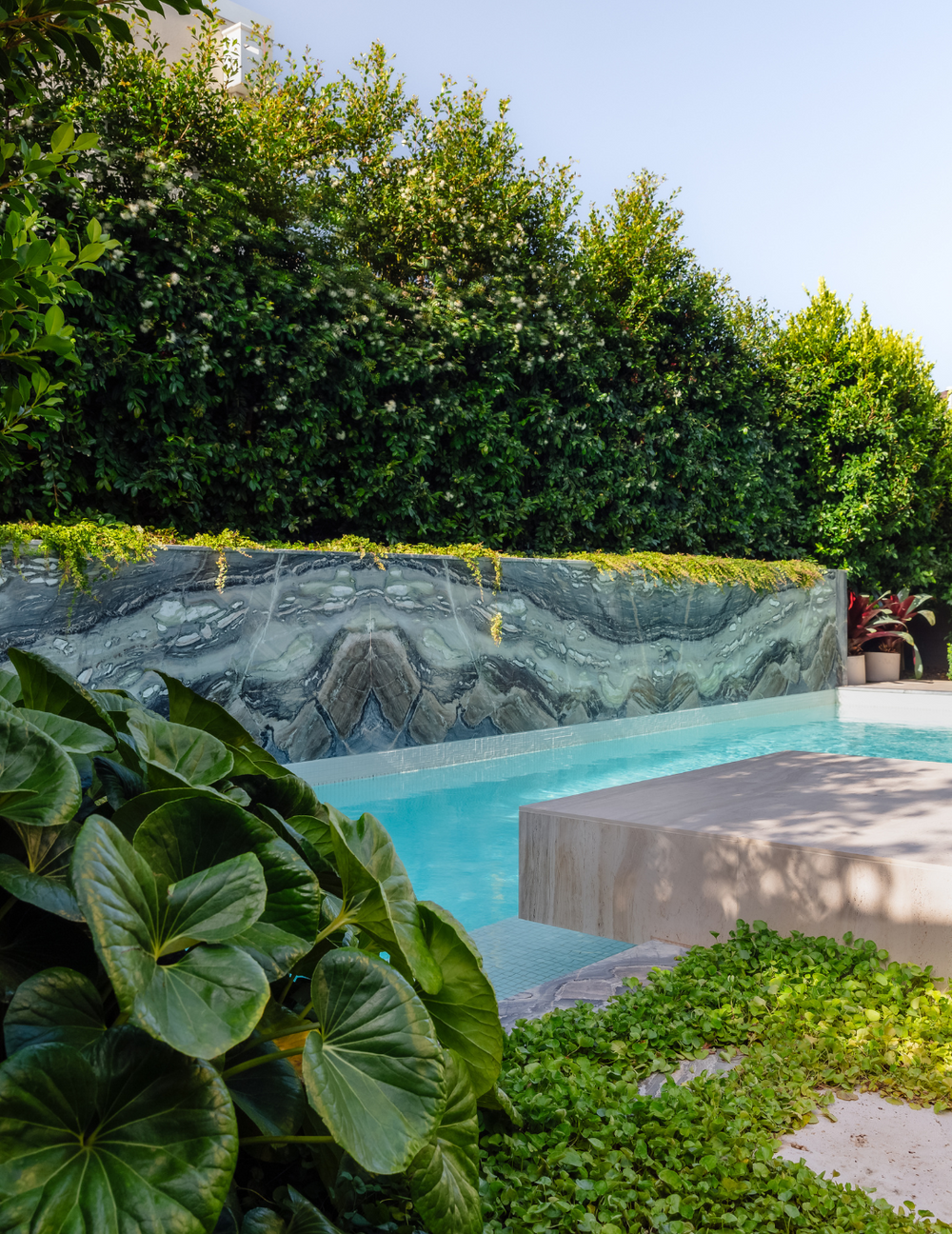
Syzygium paniculatum 'Backyard Bliss' is a fast-growing, low-maintenance Australian native ideal for creating dense, lush hedges. Its vibrant evergreen foliage is complemented by striking coppery bronze new growth, making it a gorgeous and eye-catching feature in any garden.
They look excellent when planted as privacy screens or formal hedges and work well for topiary or standalone ornamental trees. Summer brings fluffy cream-white blossoms that attract bees and native birds, boosting your garden's ecological value.
Thriving in full sun to part shade and adaptable to well-drained soils, including clay and sandy types, this resilient tree is drought and frost tolerant once established. For added landscape interest, 'Backyard Bliss' hedges can be underplanted with shade-tolerant groundcovers or small flowering plants to create layered garden designs.
Frequently Asked Questions
About Syzygium paniculatum 'Backyard Bliss' Lilly Pilly
How tall does Backyard Bliss Lilly Pilly grow?
Backyard Bliss reaches 4-5 metres tall and around 2 metres wide at maturity. With regular trimming it can be maintained at any height between 1.5 and 4 metres, making it one of the most versatile lilly pilly varieties for Australian hedges.
How fast does Backyard Bliss grow?
Backyard Bliss is a fast-growing cultivar, adding roughly 1 metre of growth per year once established in good conditions. Expect a usable privacy hedge within 18-24 months from 45L pot size.
How far apart should I plant Backyard Bliss for a hedge?
Plant 60-80cm apart for a dense, fast-establishing formal hedge. For a looser informal screen, 1 metre spacing also works well.
Is Backyard Bliss psyllid resistant?
Yes. Backyard Bliss is one of the most psyllid-resistant lilly pilly varieties available, which is the main reason it outperforms older Syzygium cultivars across Australian gardens.
Can Backyard Bliss grow in pots?
Yes. Backyard Bliss performs well in large pots (minimum 50L) and is widely used as a balcony screen or potted formal hedge with regular watering and feeding.
Will Backyard Bliss attract birds and pollinators?
Yes. The summer cream-white flowers attract native birds, bees, and pollinators, and the dense evergreen canopy provides shelter and nesting habitat.
How do I prune Backyard Bliss?
Trim two to three times through the warmer months to keep a formal hedge dense and even, starting while the plants are young so the base fills out properly. Light, regular clipping gives a better result than one hard cut. Backyard Bliss shoots readily from older wood, so it recovers well if you need to bring a hedge back down in height.
Syzygium paniculatum 'Backyard Bliss' Lilly Pilly
Follow Us On Instagram
@evergreentreesdirect ↗
Tips & Tricks
Best Trees for Creating a Privacy Screen: 10 Picks Across Fast Formal, Native and Narrow Column Options
Read the story
How to Incorporate Trees into Your Modern Landscape Design
Read the story
The Importance of Root Health: How to Choose Quality Trees
Read the story