Buxus sempervirens (Hedging Form) – English Box
Buxus sempervirens (Hedging Form) – English Box
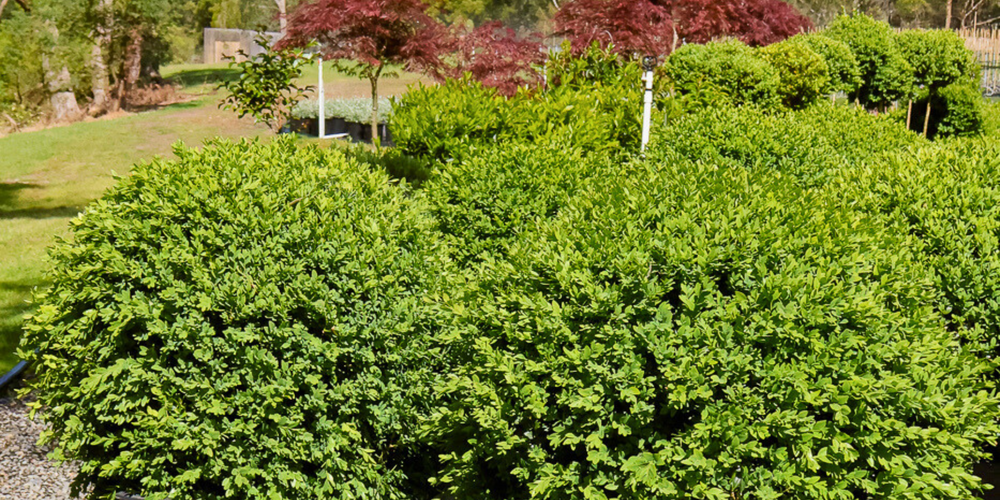
Most loved for its dense evergreen foliage and exceptional response to clipping, allowing precise, formal hedge shapes year-round.
Regular price
$55.00
Sale price
$55.00
Regular price
Tax included.
Shipping calculated at checkout.
01 Choose your pot size
02 Your selection
- Current height guide
- Please enquire
- Pot size
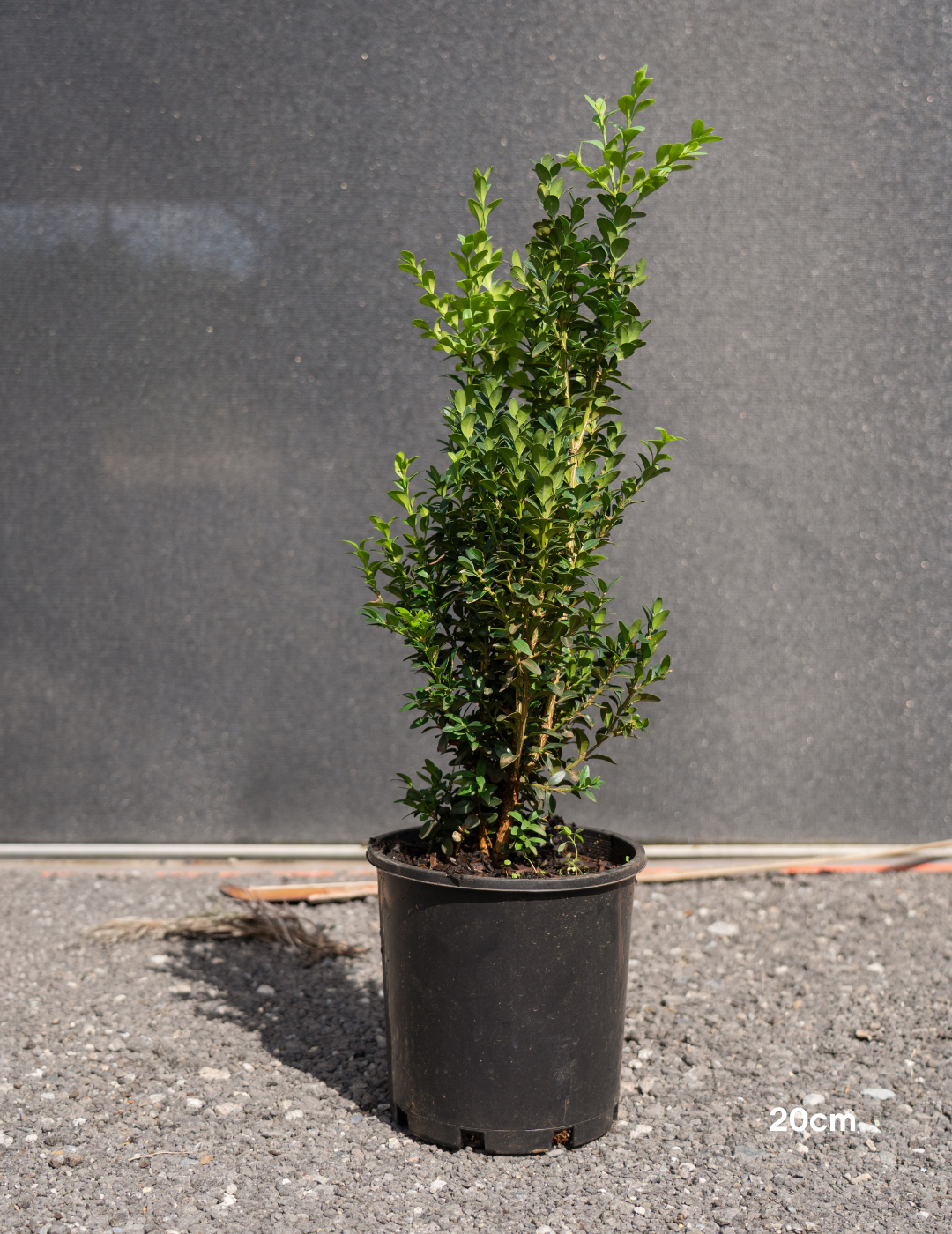
- 20cm
Approximate only. Minimum height important? Confirm with us.
Height guide disclaimer: Height ranges are approximate only. As living products, plant heights naturally vary between individual plants, batches, and seasons. No guarantee is given that supplied plants will fall within the stated range. If minimum heights are required, you mustconfirm current batch heights with Evergreen Trees Direct prior to purchase. Variation in height is normal and is not grounds for return, refund, replacement, or compensation.
03 How many trees?
Couldn't load pickup availability
About this tree
About this tree
Buxus sempervirens, English Box, is the classic hedging box, a dense evergreen shrub with small glossy leaves set on short internodes. Hedging form stock is grown from material selected for tight branching, so plants knit into a solid face and take a clean line under shears. Pale yellow spring flowers are small and lightly scented.
Full sun through to part shade suits it, in a well drained soil kept evenly moist while the roots establish. Cool temperate and temperate districts are its strength, and mature plants shrug off repeated winter frost. Growth of 15 to 30 centimetres a year is steady rather than quick, which keeps a hedge line honest.
It is the standard choice for low borders, parterres, knot gardens and the clipped edges that hold a formal garden together. Councils and heritage properties specify it for the same reason home gardeners do. It stays where it is put and reads the same in July as it does in January.
Frequently Asked Questions
About English Box
What is English Box?
Buxus sempervirens is a slow growing evergreen shrub with small, glossy, dark green leaves, grown for centuries as a clipped hedge. The hedging form is selected for tight branching and short internodes, so plants knit together into a solid face and take a sharp edge under shears. It is not related to native Australian box species.
How big does English Box grow?
As a hedge it is normally held between 30 centimetres and 1 metre, which is where the plant looks its best. Taller hedges to about 1.5 metres are achievable with patience. Left entirely unclipped the species will slowly reach 3 to 5 metres tall and 2 to 3 metres wide over several decades.
How far apart should I plant English Box for a hedge?
For a low border hedge from 20 or 30 centimetre stock, plant 25 to 30 centimetres apart, which is three to four plants per metre. For a taller hedge from 50 centimetre stock, 35 to 40 centimetres apart is enough. Closer spacing closes the line sooner but does not change the finished result.
What is the difference between English Box and Japanese Box?
English Box has finer, darker foliage and a slower, tighter habit, which suits low formal hedges and parterres. Japanese Box is a little coarser and faster, holds its colour better in heat and humidity, and is the safer choice in warmer or more humid districts. In cool temperate gardens English Box remains the traditional pick.
Is English Box frost tolerant?
Yes, and comfortably so. It is one of the more cold hardy hedging plants available, and established hedges take repeated winter frost without damage, including in Canberra, Ballarat, Orange and across Tasmania. A late frost can bronze new spring growth, but the plant grows straight through it. Water well before winter in the first year.
Does English Box grow in shade?
It grows in full sun through to part shade. Part shade keeps the leaf a deeper green in hot districts, while full sun gives the densest growth in cool ones. Heavy shade produces thin, open growth that never closes properly into a hedge, so aim for at least three or four hours of direct light.
How do I care for and prune an English Box hedge?
Trim twice a year, in late spring and again in late summer, always cutting the sides slightly wider at the base so light reaches the lower foliage. Feed in early spring, mulch, and water deeply in dry spells rather than lightly and often. Renovation cuts back into old wood are tolerated but are best staged over two seasons.
Delivery & pickup
Delivery & pickup
Shipping is calculated at checkout based on the pallet space your order occupies in the truck and your delivery location.
There is no charge to calculate your freight.
Planting, roots & care
Planting, roots & care
Trade enquiries
Trade enquiries
We supply advanced trees to landscapers, developers, architects, and councils Australia-wide. Trade clients receive fast quotes, expert advice, and access to premium stock with reliable freight.
About Buxus sempervirens
Buxus sempervirens, English Box, is the classic hedging box, a dense evergreen shrub with small glossy leaves set on short internodes. Hedging form stock is grown from material selected for tight branching, so plants knit into a solid face and take a clean line under shears. Pale yellow spring flowers are small and lightly scented.
Full sun through to part shade suits it, in a well drained soil kept evenly moist while the roots establish. Cool temperate and temperate districts are its strength, and mature plants shrug off repeated winter frost. Growth of 15 to 30 centimetres a year is steady rather than quick, which keeps a hedge line honest.
It is the standard choice for low borders, parterres, knot gardens and the clipped edges that hold a formal garden together. Councils and heritage properties specify it for the same reason home gardeners do. It stays where it is put and reads the same in July as it does in January.
Frequently Asked Questions
About English Box
What is English Box?
Buxus sempervirens is a slow growing evergreen shrub with small, glossy, dark green leaves, grown for centuries as a clipped hedge. The hedging form is selected for tight branching and short internodes, so plants knit together into a solid face and take a sharp edge under shears. It is not related to native Australian box species.
How big does English Box grow?
As a hedge it is normally held between 30 centimetres and 1 metre, which is where the plant looks its best. Taller hedges to about 1.5 metres are achievable with patience. Left entirely unclipped the species will slowly reach 3 to 5 metres tall and 2 to 3 metres wide over several decades.
How far apart should I plant English Box for a hedge?
For a low border hedge from 20 or 30 centimetre stock, plant 25 to 30 centimetres apart, which is three to four plants per metre. For a taller hedge from 50 centimetre stock, 35 to 40 centimetres apart is enough. Closer spacing closes the line sooner but does not change the finished result.
What is the difference between English Box and Japanese Box?
English Box has finer, darker foliage and a slower, tighter habit, which suits low formal hedges and parterres. Japanese Box is a little coarser and faster, holds its colour better in heat and humidity, and is the safer choice in warmer or more humid districts. In cool temperate gardens English Box remains the traditional pick.
Is English Box frost tolerant?
Yes, and comfortably so. It is one of the more cold hardy hedging plants available, and established hedges take repeated winter frost without damage, including in Canberra, Ballarat, Orange and across Tasmania. A late frost can bronze new spring growth, but the plant grows straight through it. Water well before winter in the first year.
Does English Box grow in shade?
It grows in full sun through to part shade. Part shade keeps the leaf a deeper green in hot districts, while full sun gives the densest growth in cool ones. Heavy shade produces thin, open growth that never closes properly into a hedge, so aim for at least three or four hours of direct light.
How do I care for and prune an English Box hedge?
Trim twice a year, in late spring and again in late summer, always cutting the sides slightly wider at the base so light reaches the lower foliage. Feed in early spring, mulch, and water deeply in dry spells rather than lightly and often. Renovation cuts back into old wood are tolerated but are best staged over two seasons.
- Foliage
Evergreen (foliage year round)
- Position
- Form
- Use
Planting Information
Recommended Planting Spacing For Your Buxus sempervirens (Hedging Form) – English Box
Buxus sempervirens (Hedging Form) – English Box is expected to grow 15cm to 30cm per year (slow to moderate).
Long Term Care For Your Buxus sempervirens (Hedging Form) – English Box
Planting Your Buxus sempervirens (Hedging Form) – English Box in Different Soil
Uses in my Garden
Uses in my Garden
Buxus sempervirens (Hedging Form) – English Box works in an:
Is Buxus sempervirens (Hedging Form) – English Box Evergreen or Deciduous?
Buxus sempervirens (Hedging Form) – English Box is an Evergreen (foliage year round) Tree
Mature Height & Width
Mature Height: 1m to 3m (unclipped)
Mature Width: 1m to 2m
Buxus sempervirens (Hedging Form) – English Box is expected to grow 15cm to 30cm per year (slow to moderate).
Growth Rate of Buxus sempervirens (Hedging Form) – English Box
Buxus sempervirens (Hedging Form) – English Box is expected to grow 15cm to 30cm per year (slow to moderate).
They are considered to have a:
Frost Tolerance & Ideal Climate to plant Buxus sempervirens (Hedging Form) – English Box
Is Buxus sempervirens (Hedging Form) – English Box frost tolerant?
Buxus sempervirens (Hedging Form) – English Box is Frost Tolerant – Can handle light to moderate frost once established.
Does Buxus sempervirens (Hedging Form) – English Box Flower?
Buxus sempervirens produces small, pale yellow flowers in spring. These blooms are inconspicuous and lightly fragrant, with the plant valued primarily for its dense foliage, neat form and suitability for clipped hedging rather than its flowering display.
Does Buxus sempervirens (Hedging Form) – English Box flower?
Flowering Period:
Flower Type:
Flower Colour:
Yellow
Is Buxus sempervirens (Hedging Form) – English Box an Australian Native Tree?
No
Buxus sempervirens (Hedging Form) – English Box is Native to Southern and Western Europe, where Buxus sempervirens grows naturally in woodland margins and limestone soils.
What is the Wildlife Value of Buxus sempervirens (Hedging Form) – English Box ?
Its dense, evergreen structure provides excellent shelter and nesting habitat for small birds and beneficial insects. While not grown for nectar-rich flowers, the compact foliage contributes to garden biodiversity by offering year-round protection and habitat within formal landscapes.
How much Sunlight does Buxus sempervirens (Hedging Form) – English Box need?
Buxus sempervirens (Hedging Form) – English Box will thrive best in:
Preferred Soil?
Buxus sempervirens performs best in well-drained loam soils with a neutral to slightly alkaline pH. It will tolerate heavier soils if drainage is improved with organic matter. Avoid persistently wet or compacted ground, as excess moisture can stress the roots and reduce vigour. Keep soil evenly moist during establishment, then gradually reduce watering as the hedge matures.
Is Buxus sempervirens (Hedging Form) – English Box Drought Tolerant?
Is Buxus sempervirens (Hedging Form) – English Box Drought tolerant?
As a young plant it benefits from regular watering to establish evenly, particularly during warmer weather. Once established, English Box shows moderate drought tolerance and performs reliably through dry periods when planted in well-drained soil, with occasional supplementary watering supporting best growth and foliage colour.
Frequently Asked Questions
Frequently Asked Questions
Compare sizes
20cm
Approx. 0.5m – 0.6m
30cm
Approx. 0.5m – 0.6m
50cm
Approx. 1.2m – 1.5m
Photographs are not to scale. Heights are approximate and vary between individual trees.
Buxus sempervirens is loved for its dense evergreen foliage and exceptional response to clipping, allowing precise, formal hedge shapes year-round.
We take pride in supplying A+ grade advanced trees. When stock at our farm is not yet ready, we work with our trusted trade suppliers to source the best available trees for your garden.
Plant Your Buxus sempervirens (Hedging Form) – English Box With:
Enriched Planting Mix (AO Certified)
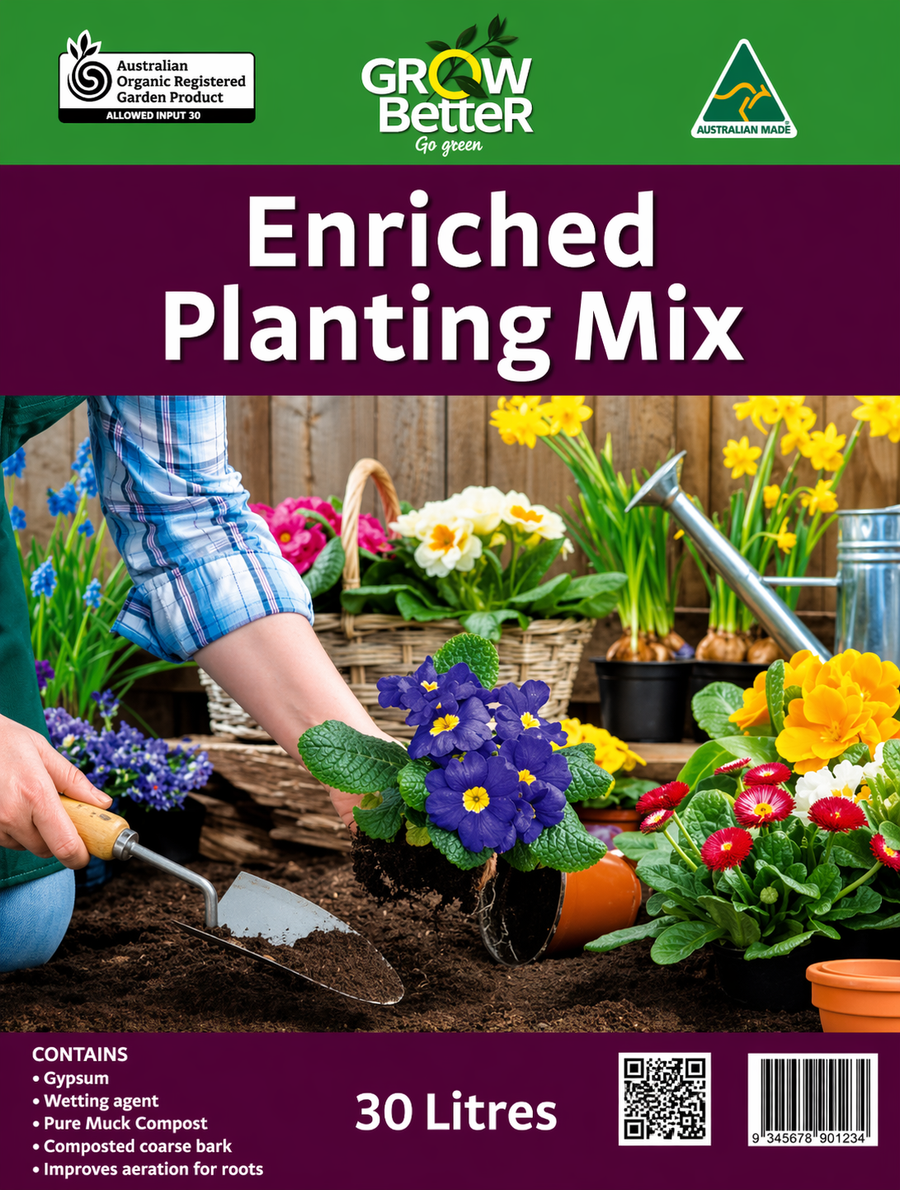
Enriched Planting Mix is a certified organic blend of Pure Magic Compost, composted animal manure, gypsum, composted coarse bark and a wetting agent, bagged in 30L. It is built to be dug through existing garden soil at planting time rather than used on its own, and the gypsum is what sets it apart from a plain compost.
Gypsum helps break up heavy clay so water and roots can move through it, while the compost and manure return organic matter and nutrient to tired ground. The coarse bark holds structure and keeps air around the root zone, and the wetting agent keeps moisture in the soil longer after rain or watering.
Use it when planting trees, shrubs, roses, fruit trees and exotic garden plants, particularly into clay. Dig a hole twice the width of the pot and 7 centimetres deeper, then mix roughly one third planting mix through the excavated soil. Spread 7 centimetres of that improved soil in the base before setting the plant in.
Frequently Asked Questions
About Enriched Planting Mix
What is Enriched Planting Mix made from?
It is a blend of Pure Magic Compost, composted animal manure, gypsum, composted coarse bark and a wetting agent. Each part has a job. The compost and manure supply organic matter and nutrient, the gypsum works on clay structure, the bark keeps air around the roots and the wetting agent holds moisture in the soil.
What plants is it suitable for?
It suits exotic garden plants, including roses, ornamental and deciduous trees, fruit trees, shrubs and perennials, and it earns its keep most on heavy clay sites. It is a planting mix rather than a potting mix, so its job is improving soil at planting time. Phosphorus sensitive natives are the one clear exception.
Is it safe for natives?
No, not for the phosphorus sensitive ones. The composted animal manure in this blend lifts phosphorus well above what Proteaceae such as Banksia, Grevillea, Hakea and Protea will tolerate, and the result can be leaf burn, dieback and plant death. Use the Native Potting Mix for those species, or plant them into unimproved local soil.
Is it certified organic?
Yes. It is a certified organic product with no chemical additives, which is why the manure and compost in it are fully composted rather than raw. That makes it sound around fruit trees and vegetable beds, and it means you are adding genuine organic matter to your soil rather than a synthetic conditioner.
How much do I need?
Work on roughly one third planting mix to two thirds of the soil you dug out of the hole. For a shrub out of a 200 millimetre pot that is only a few litres. An advanced tree going into a large hole will take considerably more. Judge the quantity by the volume of the hole rather than the size of the plant.
Can I use it in pots?
It is not a potting mix and should not be used on its own in a container. The blend is designed to be diluted through garden soil, and used straight in a pot it holds too much water and settles badly. For containers, reach for a premium potting mix, or the native mix if you are potting natives.
Does it need to be watered in?
Yes. Water the plant well several hours before you plant it, then water thoroughly again once the hole is backfilled and the soil firmed down. That first deep watering settles the improved soil around the root ball and drives out air pockets. Keep the water up over the first few months while the roots establish.

Enriched Planting Mix (AO Certified)
Enriched Planting Mix (AO Certified)
Enriched Planting Mix is a certified organic blend of Pure Magic Compost, composted animal manure, gypsum, composted coarse bark and a wetting agent, bagged in 30L. It is built to be dug through existing garden soil at planting time rather than used on its own, and the gypsum is what sets it apart from a plain compost.
Gypsum helps break up heavy clay so water and roots can move through it, while the compost and manure return organic matter and nutrient to tired ground. The coarse bark holds structure and keeps air around the root zone, and the wetting agent keeps moisture in the soil longer after rain or watering.
Use it when planting trees, shrubs, roses, fruit trees and exotic garden plants, particularly into clay. Dig a hole twice the width of the pot and 7 centimetres deeper, then mix roughly one third planting mix through the excavated soil. Spread 7 centimetres of that improved soil in the base before setting the plant in.
Frequently Asked Questions
About Enriched Planting Mix
What is Enriched Planting Mix made from?
It is a blend of Pure Magic Compost, composted animal manure, gypsum, composted coarse bark and a wetting agent. Each part has a job. The compost and manure supply organic matter and nutrient, the gypsum works on clay structure, the bark keeps air around the roots and the wetting agent holds moisture in the soil.
What plants is it suitable for?
It suits exotic garden plants, including roses, ornamental and deciduous trees, fruit trees, shrubs and perennials, and it earns its keep most on heavy clay sites. It is a planting mix rather than a potting mix, so its job is improving soil at planting time. Phosphorus sensitive natives are the one clear exception.
Is it safe for natives?
No, not for the phosphorus sensitive ones. The composted animal manure in this blend lifts phosphorus well above what Proteaceae such as Banksia, Grevillea, Hakea and Protea will tolerate, and the result can be leaf burn, dieback and plant death. Use the Native Potting Mix for those species, or plant them into unimproved local soil.
Is it certified organic?
Yes. It is a certified organic product with no chemical additives, which is why the manure and compost in it are fully composted rather than raw. That makes it sound around fruit trees and vegetable beds, and it means you are adding genuine organic matter to your soil rather than a synthetic conditioner.
How much do I need?
Work on roughly one third planting mix to two thirds of the soil you dug out of the hole. For a shrub out of a 200 millimetre pot that is only a few litres. An advanced tree going into a large hole will take considerably more. Judge the quantity by the volume of the hole rather than the size of the plant.
Can I use it in pots?
It is not a potting mix and should not be used on its own in a container. The blend is designed to be diluted through garden soil, and used straight in a pot it holds too much water and settles badly. For containers, reach for a premium potting mix, or the native mix if you are potting natives.
Does it need to be watered in?
Yes. Water the plant well several hours before you plant it, then water thoroughly again once the hole is backfilled and the soil firmed down. That first deep watering settles the improved soil around the root ball and drives out air pockets. Keep the water up over the first few months while the roots establish.
Enriched Planting Mix (AO Certified)
Acer palmatum dissectum ‘Green’ – Green Japanese Maple
Acer palmatum dissectum ‘Green’ – Green Japanese Maple
Acer palmatum dissectum 'Green' is a graceful low-growing Japanese maple admired for its finely cut lacy green foliage and elegant cascading form. The deeply dissected leaves create a soft feathery texture, glowing bright green in spring and summer before turning vivid gold, orange, and red in autumn.
This weeping maple grows to 1.5-2 metres tall and 2-3 metres wide, forming a naturally domed cascading shape that provides year-round structure and seasonal colour. The slow growth and refined appearance make it ideal for courtyards, Japanese-inspired gardens, raised beds, and large containers.
Acer dissectum 'Green' performs best in part shade, with protection from harsh afternoon sun and drying wind, and prefers moist, well-drained, slightly acidic soil. It is frost hardy once established and suits cool to warm temperate climates. Mulching keeps the roots cool and moist.
Frequently Asked Questions
About Acer palmatum dissectum 'Green'
How tall does Acer dissectum 'Green' grow?
Acer palmatum dissectum 'Green' grows to 1.5-2 metres tall and 2-3 metres wide, forming a naturally domed weeping shape.
How fast does it grow?
Acer dissectum 'Green' is slow-growing, adding 15-25cm per year, with cascading branches that build a layered form over time.
What colour is the foliage?
The finely dissected foliage is bright green through spring and summer, then turns vivid gold, orange and red in autumn before dropping.
Can Acer dissectum 'Green' grow in pots?
Yes. The compact cascading form makes it well suited to large decorative containers, courtyards, and raised beds.
Is it deciduous?
Yes. Acer dissectum 'Green' is fully deciduous, dropping its autumn foliage in winter and producing fresh green laceleaf growth in spring.
Is it frost tolerant?
Yes. Acer dissectum 'Green' is frost hardy once established. Shelter it from harsh afternoon sun and drying wind.
Where in Australia does it grow best?
Acer dissectum 'Green' performs best in cool to warm temperate climates including VIC, NSW, ACT, Tasmania, and elevated parts of SA and WA.
Acer palmatum dissectum ‘Green’ – Green Japanese Maple
Liquid error (sections/ee-products line 16): invalid url input

Betula pendula 'Fastigiata' Upright Silver Birch
Betula pendula 'Fastigiata' Upright Silver Birch
Betula pendula 'Fastigiata', the Upright Silver Birch, combines the white papery bark of the classic Silver Birch with a refined narrow columnar habit, making it ideal for smaller gardens and formal avenues where space is limited.
Upright Silver Birch grows to 8-12 metres tall and just 3-4 metres wide. The fine serrated green leaves create a light airy canopy that turns golden-yellow in autumn before falling to reveal the elegant white trunk. The narrow vertical form makes a striking accent in the landscape.
Upright Silver Birch is hardy and adaptable, thriving in full sun and moist, well-drained soil. It is frost tolerant and drought hardy once established, performing best in cool to temperate regions including VIC, Tasmania, the ACT, the NSW Southern Highlands, and elevated parts of SA and WA.
Frequently Asked Questions
About Betula pendula 'Fastigiata' Upright Silver Birch
How tall does Upright Silver Birch grow?
Betula pendula 'Fastigiata' grows to 8-12 metres tall and just 3-4 metres wide, with a narrow upright columnar habit.
How fast does it grow?
Upright Silver Birch has a moderate growth rate of 50-80cm per year in cool to temperate climates.
What makes 'Fastigiata' different from standard Silver Birch?
'Fastigiata' is a narrow columnar cultivar of Betula pendula. It shares the white bark and golden autumn colour of standard Silver Birch but in a far more upright, space-saving form.
Is Upright Silver Birch suitable for small gardens?
Yes. At just 3-4 metres wide, the narrow columnar habit makes it ideal for smaller gardens, narrow planting strips, and formal avenues.
Is Upright Silver Birch deciduous?
Yes. It is fully deciduous. Foliage turns golden-yellow in autumn before dropping in winter, revealing the striking white bark.
Where in Australia does it grow best?
Upright Silver Birch performs best in cool to temperate regions including VIC, Tasmania, the ACT, the NSW Southern Highlands, and elevated parts of SA and WA.
How far apart should I plant it for an avenue?
Plant 2-3 metres apart for a narrow columnar avenue, or 1.5 metres for a dense screening row.
Betula pendula 'Fastigiata' Upright Silver Birch


Gardenia augusta ‘Magnifica’ – Magnifica Gardenia
Gardenia augusta ‘Magnifica’ – Magnifica Gardenia
Gardenia augusta 'Magnifica' is a compact evergreen flowering shrub valued for its large highly fragrant double white flowers and lush glossy dark green foliage. From late spring through summer it produces creamy-white blooms up to 10 cm across that perfume the surrounding garden, set against broad leathery leaves that hold their colour year-round.
It performs reliably in full sun to part shade with humus-rich, slightly acidic and free-draining soil. Mature plants reach 1.5 to 2 metres tall and 1 to 1.5 metres wide, forming a dense rounded habit that responds well to light pruning after flowering. Gardenia 'Magnifica' is frost tolerant once established and benefits from regular feeding and watering through the warmer months to support strong flowering.
As a fragrant evergreen flowering shrub for cottage, formal, Japanese-inspired and low-maintenance gardens, in courtyards, entrance plantings, informal hedges and decorative pots near pathways, Gardenia augusta 'Magnifica' brings outstanding perfume, glossy foliage and reliable summer flowering to gardens where its scent can be appreciated up close.
Frequently Asked Questions
About Gardenia augusta 'Magnifica' Magnifica Gardenia
When does Gardenia 'Magnifica' flower?
Gardenia 'Magnifica' flowers from late spring through summer, producing large creamy-white double blooms up to 10 cm across. The flowers are intensely fragrant and the display lasts for several months, with light repeat flowering possible into autumn in warm conditions.
How big does Gardenia 'Magnifica' grow?
Mature plants reach approximately 1.5 to 2 metres tall and 1 to 1.5 metres wide, forming a dense rounded habit. Growth is moderate at 20 to 40 cm per year, and the plant can be lightly pruned to maintain a more compact size or shaped into a formal flowering hedge.
Where does Gardenia 'Magnifica' grow best?
Gardenia 'Magnifica' performs best in warm temperate to subtropical climates with full sun to part shade. It thrives across coastal NSW, Queensland, frost-free parts of Victoria and South Australia, and warm coastal areas. It prefers humus-rich slightly acidic soil and protection from harsh afternoon sun in hot inland areas.
Is Gardenia 'Magnifica' frost tolerant?
Gardenia 'Magnifica' is frost tolerant once established and handles light to moderate frost without damage. Young plants benefit from protection in their first winter through frost-prone areas, and severe inland frost should be avoided. Mature plants in established positions hold their foliage and form through cooler months.
Can Gardenia 'Magnifica' be grown in pots?
Yes. Gardenia 'Magnifica' is excellent in large decorative pots near entrances and courtyards where its perfume can be appreciated up close. Use a quality potting mix designed for acid-loving plants, water regularly through the warmer months, and feed with an acid-loving plant food in spring and summer.
How do I care for Gardenia 'Magnifica'?
Water regularly during the growing season to keep the soil evenly moist but never waterlogged. Feed with an acid-loving plant food in spring and again in mid-summer to support strong flowering. Prune lightly after flowering to maintain shape and encourage dense bushy growth, and mulch annually with an acidic mulch like pine bark.
Why are the leaves turning yellow?
Yellowing leaves on Gardenia 'Magnifica' usually indicate either iron deficiency in alkaline soil, overwatering, or seasonal cool weather. The most common cause is alkaline soil pH. Apply an iron chelate or soil acidifier, ensure drainage is excellent, and mulch with pine bark to maintain the acidic conditions Gardenias need to thrive.
Gardenia augusta ‘Magnifica’ – Magnifica Gardenia

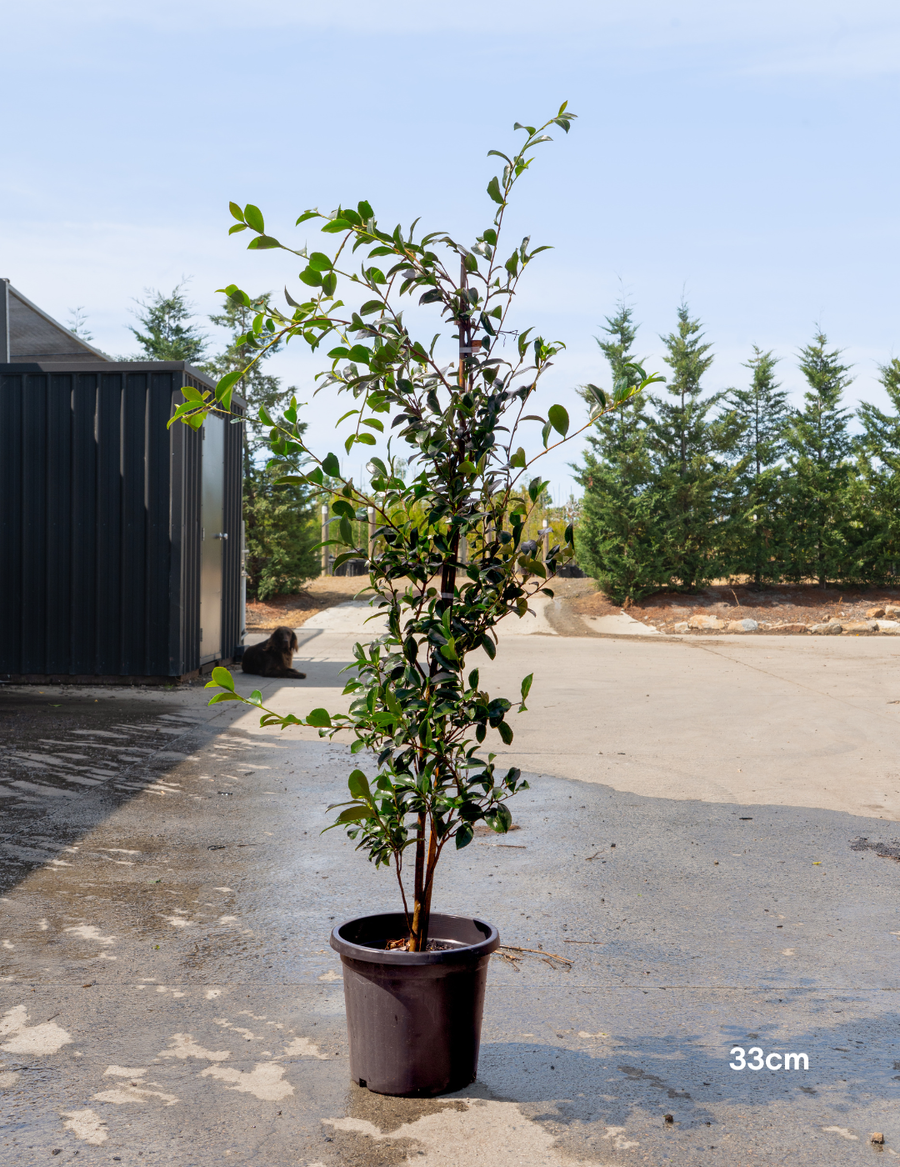
Camellia sasanqua 'Setsugekka'
Camellia sasanqua 'Setsugekka'
Camellia sasanqua 'Setsugekka' is a tall evergreen shrub with large, single to semi double white flowers, the petals slightly ruffled around a centre of golden stamens. Bloom runs from late autumn into early winter. Foliage is small, glossy and dark green, carried densely on an upright, gently spreading frame.
It takes more sun than a japonica and will hold full sun in cooler districts, though part shade suits inland heat. Soil should be well drained and slightly acidic. Growth is 40 to 60 centimetres a year, to 2 to 4 metres tall and 1.5 to 2.5 metres wide. Light frost is tolerated.
This is the standard choice for a tall evergreen screen along a boundary or between neighbouring houses, and it clips readily into a formal hedge. It also stands alone as a feature, or fills a large pot at an entry. The height and density make it useful wherever fence line privacy is the brief.
Frequently Asked Questions
About Camellia sasanqua 'Setsugekka'
What is Camellia sasanqua 'Setsugekka'?
'Setsugekka' is a tall evergreen sasanqua camellia with large single to semi double white flowers, the petals slightly ruffled around a boss of golden stamens. It flowers from late autumn into early winter. Small glossy dark leaves are held densely on an upright, gently spreading shrub used widely for screening.
How big does 'Setsugekka' grow?
It reaches 2 to 4 metres tall and 1.5 to 2.5 metres wide, at a rate of roughly 40 to 60 centimetres a year. That upper height is what makes it a genuine screening plant rather than a border shrub. Regular trimming will hold it at any height above about 1.5 metres.
How far apart should I plant it for a hedge or screen?
Space plants 1 to 1.5 metres apart for a dense informal screen, or 80 centimetres apart for a tighter formal hedge. Tighter spacing closes the gaps faster but increases competition for water and nutrients, so prepare a continuous trench rather than individual holes and keep irrigation even along the run.
When does it flower?
Flowering starts in late autumn and carries into early winter, roughly April through to June across most of southern Australia. Sasanquas flower ahead of japonicas, so this one fills the gap before the japonica season begins. Individual flowers drop cleanly from the plant rather than browning on the bush.
Does it need sun or shade?
It takes more sun than a japonica and will hold full sun in cooler and coastal districts. In hot inland gardens give it afternoon shade to protect the foliage. It also flowers acceptably in part shade, which makes it one of the more flexible screening plants for a boundary with mixed aspect.
Can it be grown in pots?
Yes. A pot 40 to 50 centimetres wide suits a single specimen for a courtyard, entry or balcony. Use a free draining camellia and azalea mix, water regularly because containers dry out fast, and feed after flowering. Expect a smaller final size in a container than the same plant would reach in open ground.
How do I prune and care for it?
Trim once flowering finishes in early winter, taking the new growth back to shape. For a formal hedge, a second light trim in late summer keeps the face tidy. Feed with a camellia fertiliser after pruning, keep mulch over the shallow roots, and water deeply through summer dry spells.
Camellia sasanqua 'Setsugekka'

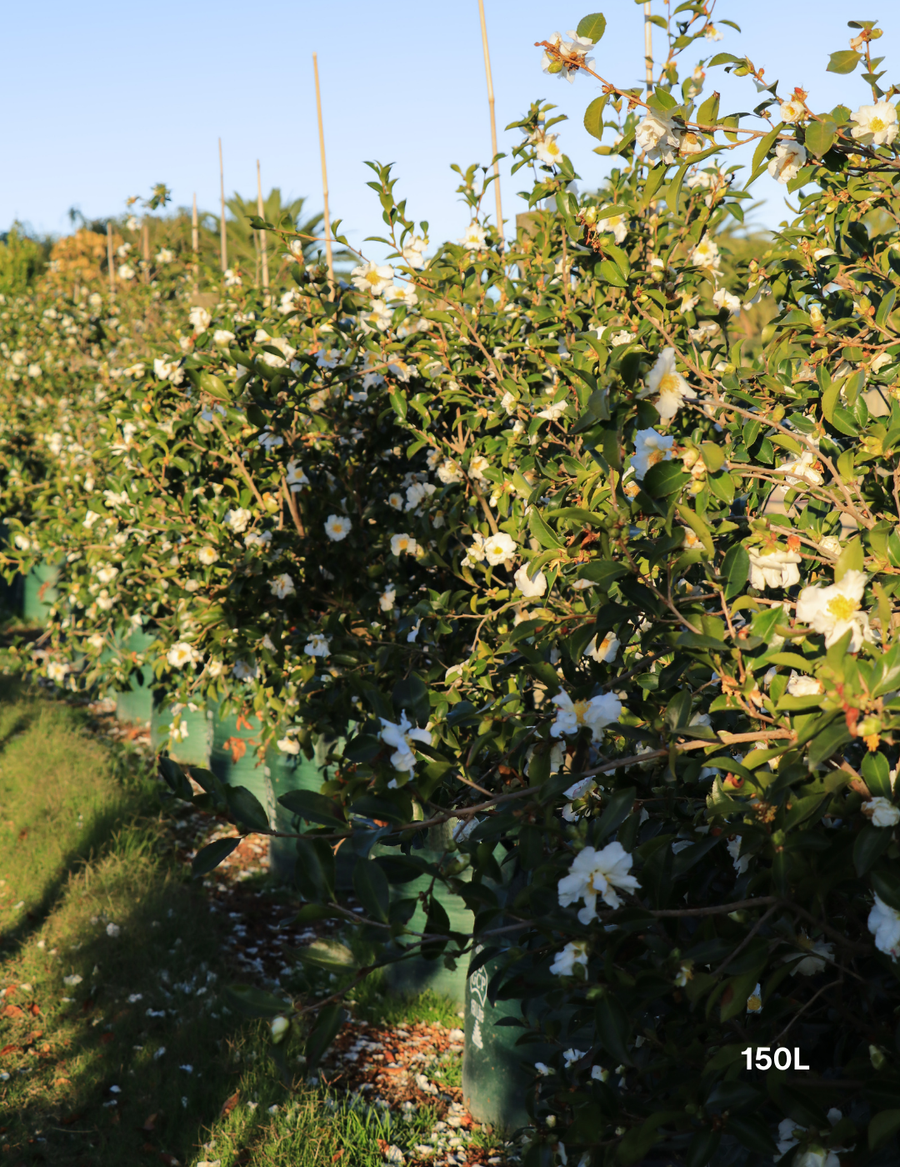
Camellia sasanqua 'Pure Silk'
Camellia sasanqua 'Pure Silk'
Camellia sasanqua 'Pure Silk' is an elegant evergreen shrub grown for its pure white semi-double blooms, which stand out beautifully against glossy dark green foliage. Flowering from autumn into early winter, it brings serene seasonal colour to the garden in the cooler months.
Pure Silk grows to 2-3 metres tall and 1.5-2 metres wide with an upright, slightly spreading habit. The size and dense growth make it ideal for hedging, screening, containers, and feature planting, and it can also be espaliered against walls and fences. Sasanqua camellias tolerate more sun than other camellia types.
Pure Silk thrives in part shade to full sun and prefers well-drained, moist, slightly acidic soil. It is evergreen, holding glossy foliage year-round, and is low maintenance, needing only light pruning and mulching to keep it healthy and in shape.
Frequently Asked Questions
About Camellia sasanqua 'Pure Silk'
How tall does Camellia 'Pure Silk' grow?
Camellia sasanqua 'Pure Silk' grows to 2-3 metres tall and 1.5-2 metres wide, and can be maintained smaller with pruning.
How fast does 'Pure Silk' grow?
'Pure Silk' has a moderate growth rate of 20-40cm per year once established.
When does 'Pure Silk' flower?
'Pure Silk' produces masses of soft white flowers through autumn and into winter, providing colour when little else is flowering.
Is 'Pure Silk' good for hedging?
Yes. Camellia sasanqua 'Pure Silk' makes an excellent flowering hedge or screen and responds well to pruning. It can also be espaliered against walls and fences.
Is 'Pure Silk' evergreen?
Yes. 'Pure Silk' is fully evergreen, holding glossy dark green foliage year-round.
How far apart should I plant 'Pure Silk' for a hedge?
Plant 60-80cm apart for a dense flowering hedge, or 1 metre for a more relaxed screen.
Where does 'Pure Silk' grow best in Australia?
'Pure Silk' thrives across most Australian climates in part shade to full sun, preferring well-drained, slightly acidic soil. Sasanqua camellias tolerate more sun than other camellia types.
Camellia sasanqua 'Pure Silk'

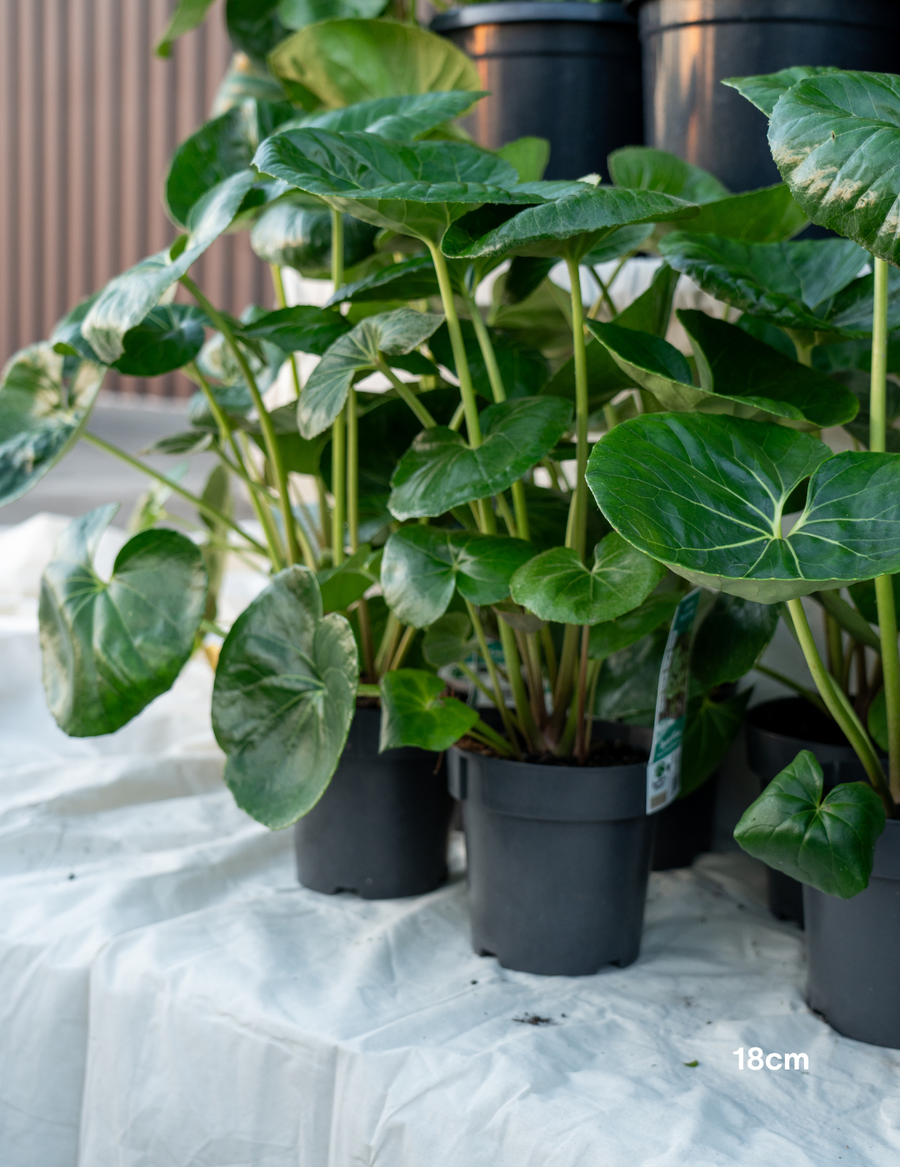
Ligularia reniformis
Ligularia reniformis
Ligularia reniformis carries enormous glossy kidney-shaped leaves that give a shaded garden the bold tropical texture usually only available in full sun. The Tractor Seat Plant is grown for foliage first, with tall stems of bright yellow daisy flowers through summer as a bonus.
Ligularia reniformis forms a clump 0.6 to 1 metre tall and 1 to 1.5 metres wide, spreading slowly at 10 to 20 centimetres per year. That steady habit makes it reliable as a mass underplanting beneath established trees, an edging along a shaded path, or a single specimen in a large pot.
This is a full shade plant. It wants consistent moisture and protection from hot afternoon sun, which scorches the leaves, and it is frost sensitive, so in cold districts it needs a protected position. Given shade and water it is close to maintenance free.
Frequently Asked Questions
About Ligularia reniformis
How big does Ligularia reniformis grow?
It forms a clump 0.6 to 1 metre tall and 1 to 1.5 metres wide. The individual leaves can reach 40 centimetres across, which is where the bold texture comes from.
Why is it called the Tractor Seat Plant?
The common name comes from the large round kidney-shaped leaves, which resemble the seat of an old tractor. The botanical name reniformis means kidney-shaped.
Does Ligularia reniformis need shade?
Yes. It performs best in full shade and will scorch in hot afternoon sun. It is one of the most useful foliage plants available for genuinely dark positions.
When does it flower?
Tall stems of bright yellow daisy-like flowers rise well above the foliage through summer. The foliage remains the main feature for the rest of the year.
Is Ligularia reniformis frost tolerant?
No. It is frost sensitive and may be damaged by frost. In cold districts plant it in a protected position, or grow it in a pot that can be moved under cover.
How much water does it need?
It wants consistently moist soil and does not tolerate drying out. Mulch well and water regularly through summer, particularly in pots and under established trees where roots compete.
How far apart should I plant it for a mass planting?
Plant 0.8 to 1 metre apart for a continuous shaded groundcover mass. Closer spacing fills in faster but the clumps will crowd within a few seasons.
Ligularia reniformis
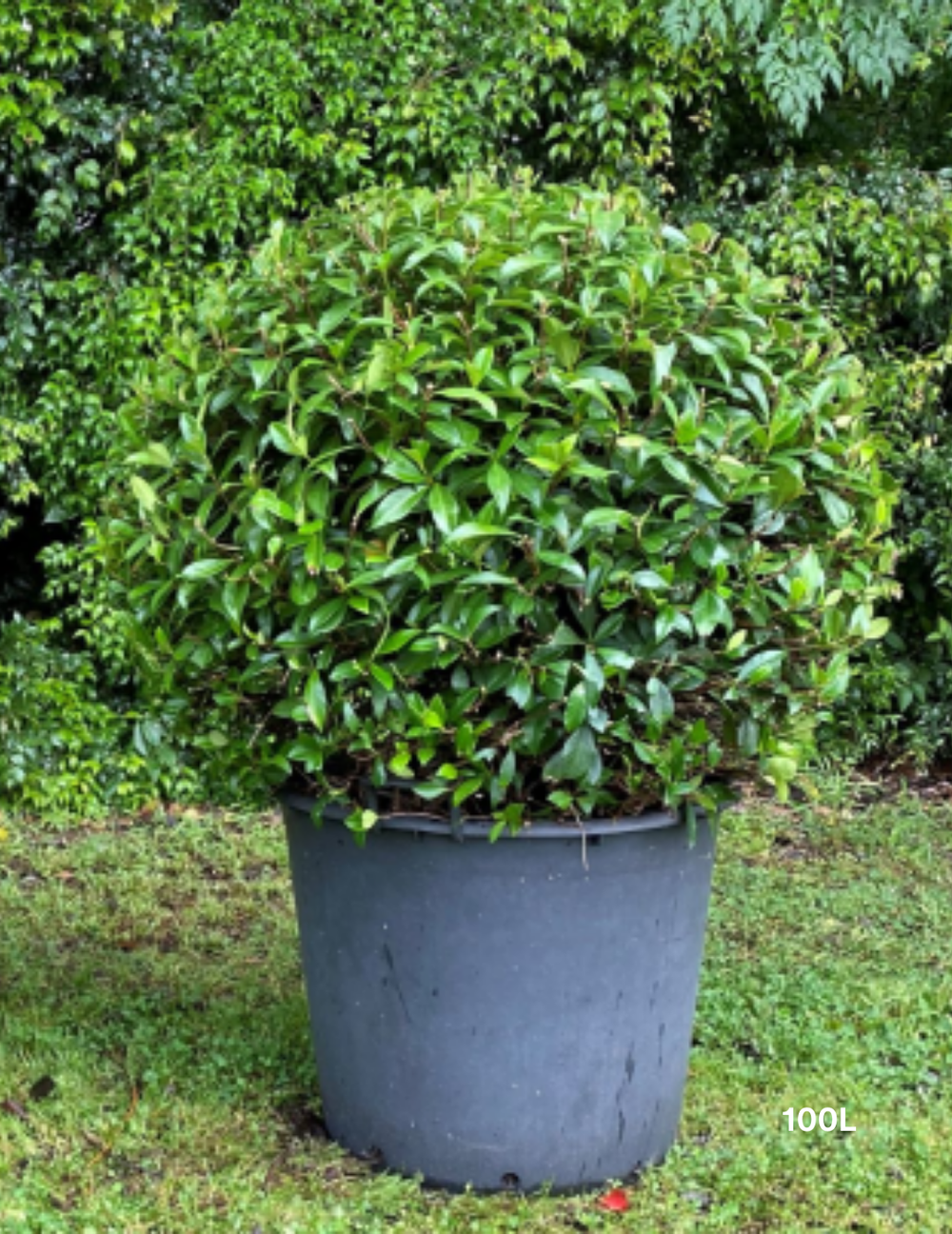
Trachelospermum jasminoides Balls – Star Jasmine Balls
Trachelospermum jasminoides Balls – Star Jasmine Balls
Trachelospermum jasminoides 'Balls' is Star Jasmine grown and clipped into a dense evergreen sphere. The small glossy leaves sit tight on a woody framework, holding a clean rounded outline year round. White pinwheel flowers open in spring and carry a strong sweet scent right across a courtyard.
Ball specimens hold at about 1 to 1.5 metres tall and wide with light clipping. Full sun to part shade suits them, in any free draining soil. Growth is slow to moderate at 30 to 50 centimetres a year. They handle coastal exposure, light frost and dry spells once the roots are down.
Repeat them along a driveway, either side of an entry, or in pots on a terrace where a formal shape is wanted straight away. They read as structure in a planting scheme without the height of a hedge, and because the form is already trained, a new garden looks settled from the day it goes in.
Frequently Asked Questions
About Star Jasmine Balls
What are Star Jasmine Balls?
They are Trachelospermum jasminoides, the common Star Jasmine, grown and clipped into a dense evergreen sphere on a woody framework. Instead of climbing, the plant is trained into a self supporting rounded shape. The foliage is small, glossy and dark green, and the plant carries scented white flowers through spring.
How big do Star Jasmine Balls grow?
They hold at roughly 1 to 1.5 metres tall and 1 to 1.5 metres wide. Growth is slow to moderate at 30 to 50 centimetres a year, so a light clip once or twice a year keeps the ball tight at whatever size within that range suits the setting.
Do Star Jasmine Balls need sun or shade?
Full sun to part shade both work. Full sun gives the densest foliage and the heaviest flowering, while part shade produces slightly softer, more open growth and fewer flowers. Avoid deep shade, where the ball thins out and loses its outline. Morning sun with afternoon protection suits hot inland gardens.
Can Star Jasmine Balls be grown in pots?
Yes, and pots are one of the main uses. A container 50 to 60 centimetres wide with a quality free draining mix will hold a ball for years. Water more often than you would in the ground, especially in summer, and feed in spring and again in late summer. Refresh the mix every few years.
Are Star Jasmine Balls evergreen?
Yes, the foliage is held year round. The glossy dark green leaves take on a bronze tinge in cold weather and green up again in spring, but the plant never goes bare. That is what makes it useful as permanent structure in a scheme, particularly in winter once perennials have died back.
When do Star Jasmine Balls flower?
Flowering runs through spring, roughly September to November, and often carries into early summer in warmer districts. The white pinwheel flowers are small but produced in quantity, and the scent is strong on still evenings. Flowering is heaviest on plants in full sun that were not clipped hard just before bud set.
How do I prune and care for Star Jasmine Balls?
Clip lightly with hedging shears once after flowering and again in late summer if needed, taking only the new growth to keep the outline crisp. Water deeply in dry weather, mulch the base, and feed in early spring. The sap is milky and can irritate skin, so wear gloves when trimming.
Trachelospermum jasminoides Balls – Star Jasmine Balls

Evergreen Trees Direct Has Been Featured In:


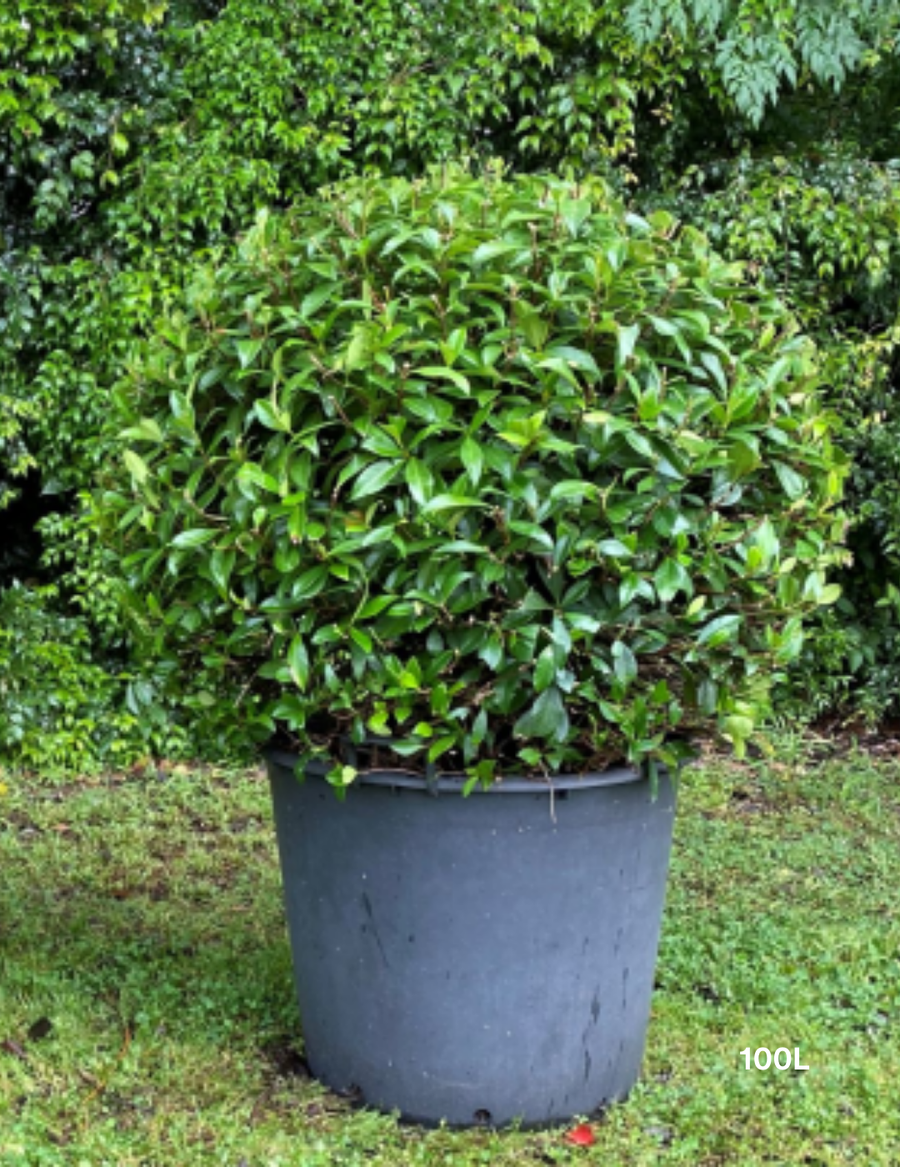
Perfect Substitutes for Buxus sempervirens (Hedging Form) – English Box
Follow Us On Instagram
@evergreentreesdirect ↗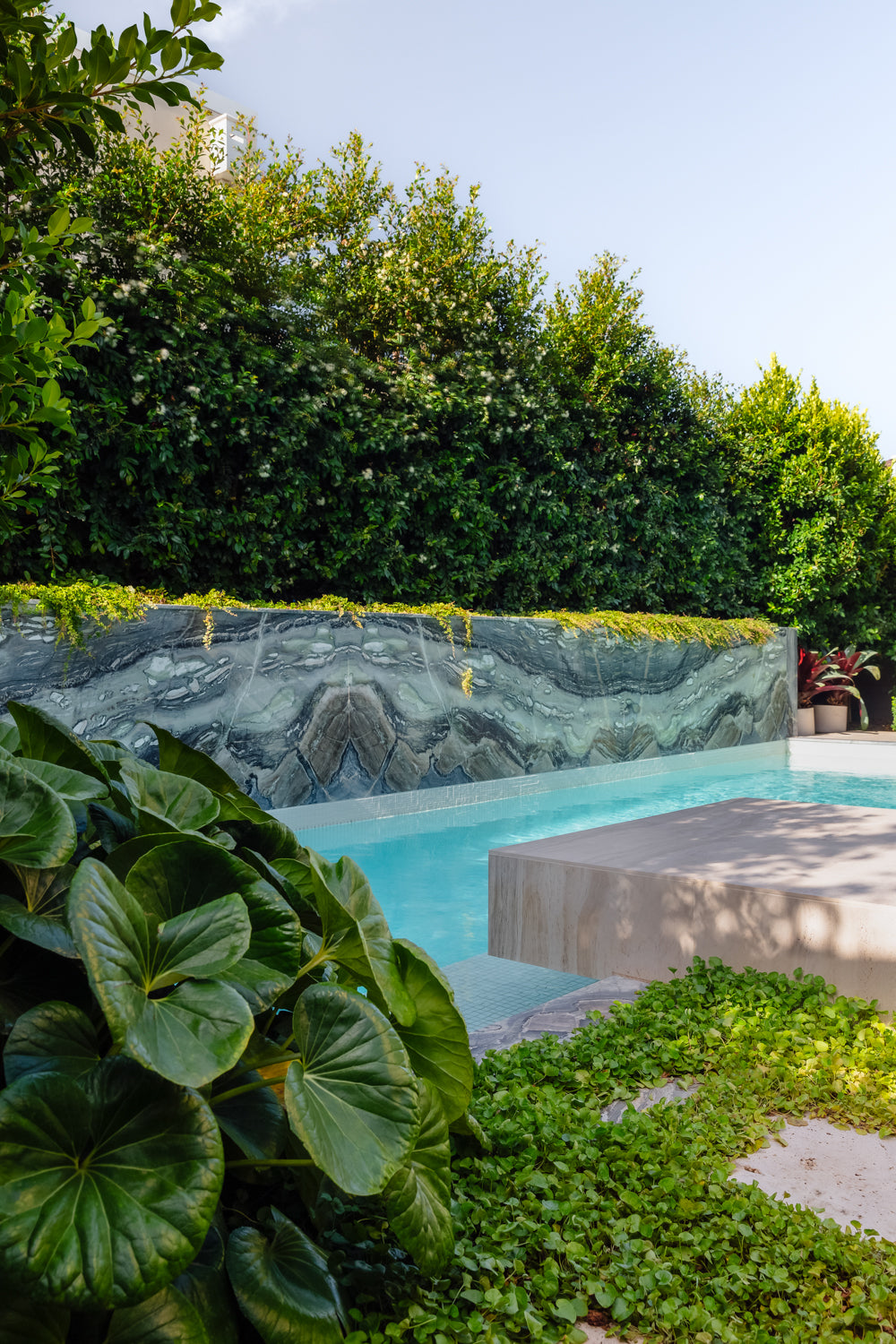
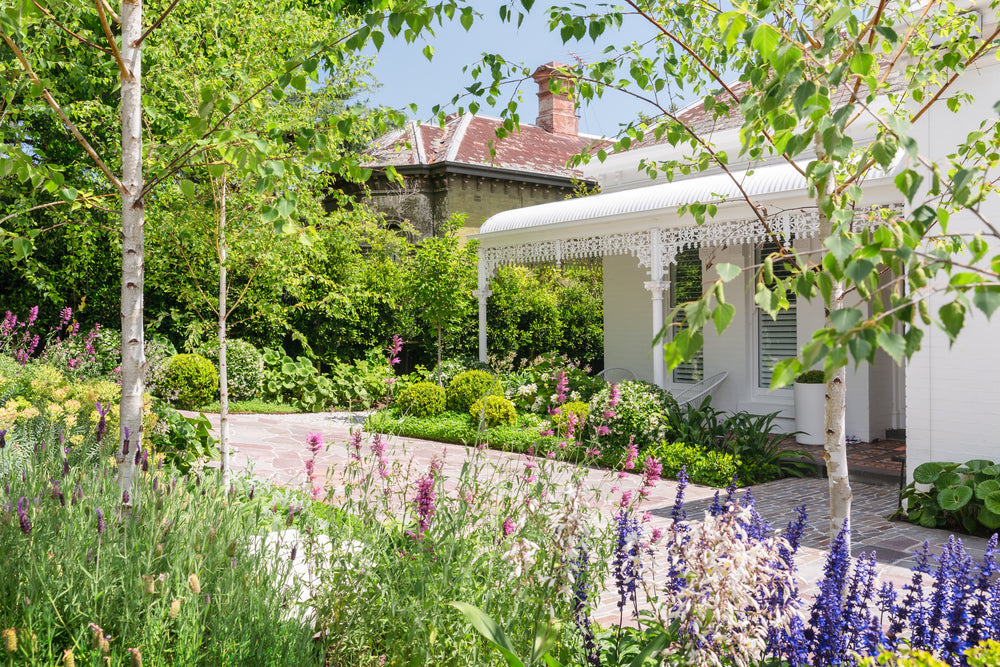
Tips & Tricks
Best Trees for Creating a Privacy Screen: 10 Picks Across Fast Formal, Native and Narrow Column Options
Read the story
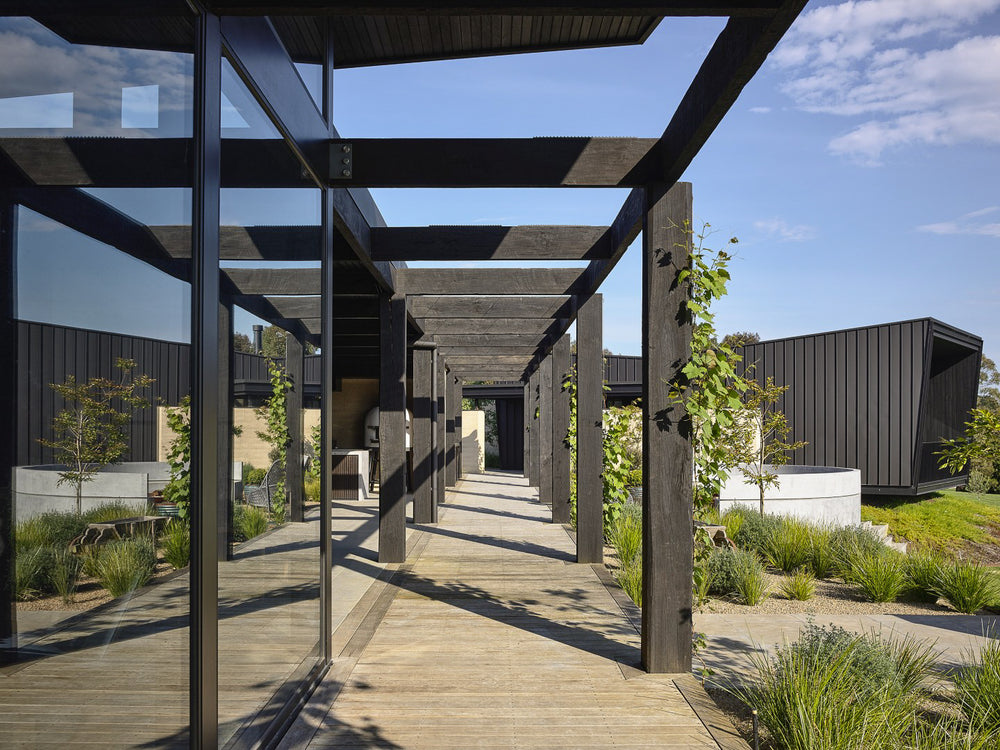
How to Incorporate Trees into Your Modern Landscape Design
Read the story
The Importance of Root Health: How to Choose Quality Trees
Read the story