



Skip to content

Volume Discounts Apply At Checkout

Top Trees for Creating Tropical Vibes: 16 Picks to Turn Your Garden Into a Holiday

Top Trees for Creating Tropical Vibes: 16 Picks to Turn Your Garden Into a Holiday

A practical guide to designing a tropical garden in Australian climates. Vertical palms, bold-leaf statements, fragrance layers and sculptural counterpoint. Sixteen picks from cool-climate hardy to frost-free tropical.


Architectural PlantsMagnoliaMicheliaPalmsPhoenix canariensisStrelitziaTropical Gardens

A tropical garden turns the backyard into a holiday. Architectural foliage, bold leaf shapes, statement palms, fragrant flowers and sculptural succulents combine into the resort atmosphere most Australian gardens never reach. The work is in the layering: vertical structure, leaf scale, fragrance, and sculptural counterpoint, each holding its own part of the planting.

This guide is for anyone wanting to design a tropical garden in an Australian climate, from frost-free coastal up to cool-climate inland pockets. The sixteen picks below cover every layer of a tropical planting and every climate zone where tropical character can be achieved.

Build the vertical structure first

The vertical elements set the tone of a tropical garden. Tall palms and architectural evergreens carry the eye upward and create the canopy that everything underneath relates to. Without them, even an excellent ground-level planting reads as a flat shrubbery rather than a tropical garden.

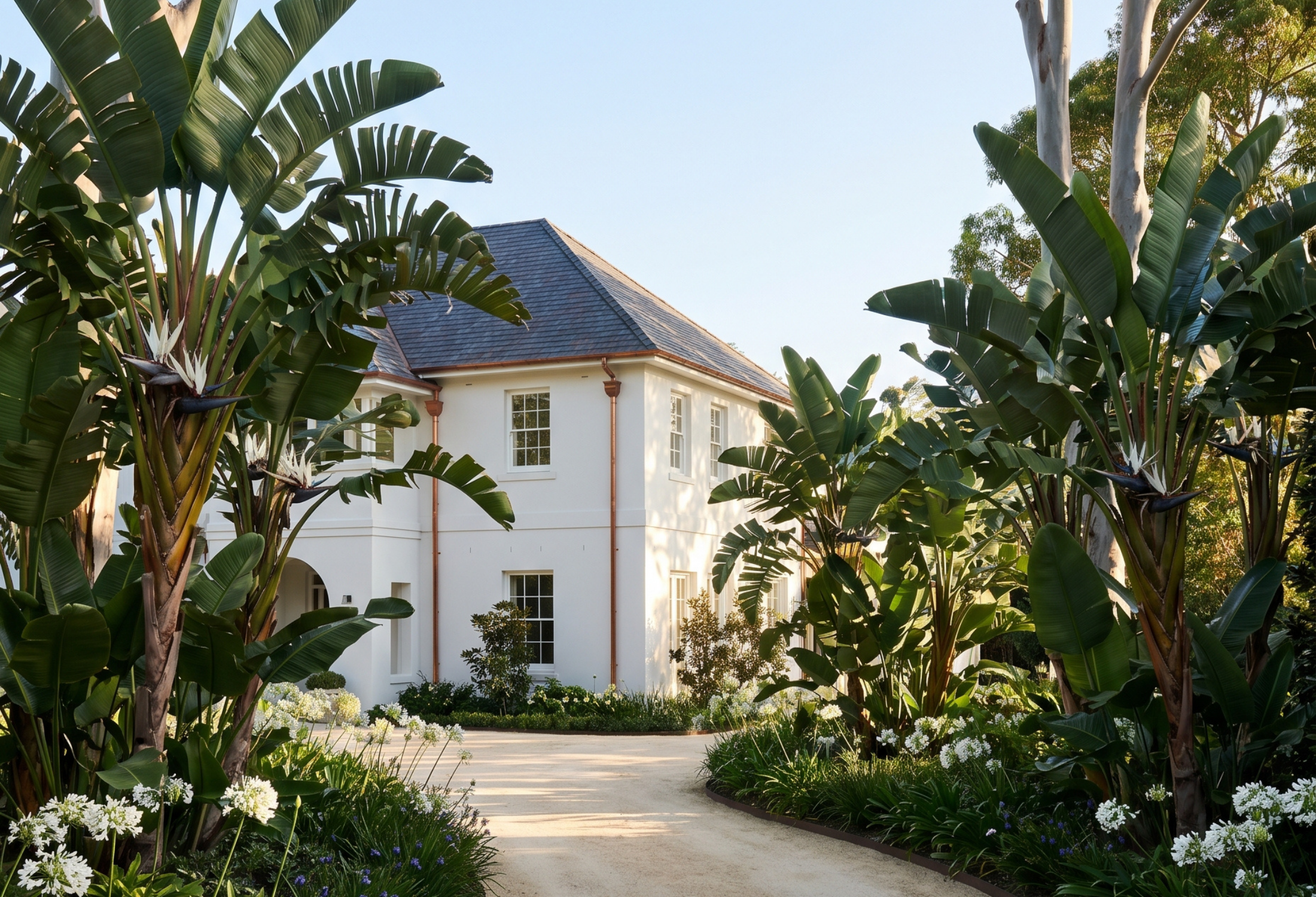
Strelitzia nicolai (Giant White Bird of Paradise) is the standout architectural statement, with massive paddle leaves carried on tall pseudo-stems. Howea forsteriana (Kentia Palm) provides refined arching fronds at canopy height. Phoenix roebelenii (Pygmy Date Palm) suits courtyards where space is limited. Magnolia 'Exmouth' offers a frost-hardy alternative with massive glossy leaves. Plant the verticals first, decide their positions, then layer everything else underneath.

Layer bold leaves at mid level

The defining characteristic of a tropical garden is leaf scale. Bold oversized leaves break the fine-foliage rhythm of most Australian native plantings and signal tropical instantly. One or two bold-leaf species per garden zone is enough to carry the look.

Alocasia macrorrhizos (Giant Elephant Ear) carries the largest leaf in cultivation, suiting sheltered tropical pockets. Cyathea cooperi (Australian Tree Fern) brings the native rainforest scale and is hardier than its tropical cousins. Cycas revoluta delivers the prehistoric symmetrical rosette. Layer these mid-height species under the palms, ideally with three together for a designed clump rather than spaced singles that read as sparse.

Plant fragrance where you sit

Fragrance is what turns a tropical garden from a look to an experience. Plant the fragrant species directly beside or adjacent to outdoor living areas, paths to the front door, and any windows that open onto the garden. A tropical garden you can see but not smell is half the experience missing.

Michelia alba delivers the most intensely fragrant tropical evergreen, with creamy white flowers carrying the deep frangipani-like scent. Plumeria rubra 'Tricolour' is the iconic resort Frangipani, deciduous but unmatched in flower fragrance. Gardenia 'Magnifica' brings the compact rich-foliage option with classic Gardenia perfume. Trachelospermum jasminoides (Star Jasmine) climbs walls and fences to deliver fragrance at face level. Plant each near where people sit and the garden completes itself.

Sculptural counterpoint and Mediterranean column

An all-green tropical garden risks reading as a single tone. Two species break the rule in useful ways: a bold architectural succulent for grey-blue contrast at ground level, and a Mediterranean column for vertical silver-grey punctuation. Both are climate-flexible and bring restraint to an otherwise lush palette.

Agave americana (Century Plant) delivers the massive blue-grey rosette that anchors any tropical planting. Olea 'Tolley's Upright' brings the silver Mediterranean column that breaks the green palette and adds vertical tension. For native tropical authenticity, Banksia 'Sentinel' provides a narrow native column with golden autumn-winter cones, while a single Banksia integrifolia delivers the iconic Australian native canopy. Mix these counterpoint species through the planting and the garden becomes both tropical and clearly designed.

Before you start: what you'll need

Climate zone and shelter assessment
Tropical species span a huge climate range. Match the species to the site.

Before choosing tropical plants, work out which climate zone you're in. Coastal Sydney, Brisbane, the Gold Coast and Perth all support frost-free tropical species (Strelitzia, Plumeria, Howea, Bougainvillea) outdoors year-round. Melbourne, Canberra and inland zones need cool-climate hardy alternatives (Magnolia 'Exmouth', Cycas revoluta, Agave, Olive).

Within your climate, identify the most sheltered position in the garden. The frost-tender species go there. The hardier species fill the rest. Get this matching right and the whole planting thrives.
Improved planting holes for tropical species
Tropical species need richer soil than most other planting categories.

Improve each planting hole with aged compost (one part to three parts existing soil), aged manure for slow-release nitrogen, and a moisture-retaining additive (coco coir or vermiculite) for sandy soils. Add slow-release fertiliser at the rate recommended for the species.

Most tropical species are heavy feeders by Australian native standards. The richer the planting hole, the faster they establish into the tropical look.
A quality stake for tall narrow features
Strelitzia, young Phoenix and tall Frangipani all need staking through establishment.

Use a single hardwood stake driven outside the rootball, with a soft figure-eight tie. The stake stays in place for one to two seasons, then comes out. The tall narrow form of these species is vulnerable to wind damage in the first growing seasons before the root system has anchored.

For multi-stemmed clumps (Strelitzia nicolai matures into a multi-trunk clump), stake the dominant stem.
Mulch and feed for tropical growth
Tropical species reward generous feeding and consistent mulching.

Apply 75 to 100 mm of chunky bark or sugar-cane mulch around all tropical plantings. Refresh annually before summer. The mulch conserves moisture (critical for Strelitzia, Alocasia, Plumeria), insulates roots, and breaks down to feed the soil.

Apply a slow-release general fertiliser in early spring at the recommended rate, then top up with liquid seaweed every six weeks through the warm growing months. Tropical species respond visibly to consistent feeding and growth accelerates dramatically when nutrition is correct.
Fragrance positioning plan
Plan where the fragrant species go before you start planting.

Mark on a site plan where outdoor furniture sits, where the path from the front door runs, where windows that open onto the garden are positioned, and where outdoor cooking and dining happens. The fragrant species (Michelia alba, Plumeria, Gardenia, Star Jasmine) go in those positions. Everything else fills the rest of the garden.

A tropical garden you can see but not smell delivers half the experience. Planning the fragrance positioning is the single highest-return planning move in a tropical garden design.

How to keep your tree happy

Watering through establishment and the warm months
Tropical species establish faster with consistent moisture.

Deep weekly soak through the first two summers, more often in extreme heat. Use a slow soak rather than a sprinkler so water penetrates the root zone properly. Tropical species can handle considerable moisture once their roots are established, but they hate being waterlogged in winter.

From year three onward, water deeply in the warm growing months (October through March). Reduce sharply in winter for deciduous species (Plumeria) and frost-tender evergreens that enter natural slowdown.
Feeding for tropical growth
The tropical look depends on rapid warm-season growth.

Apply slow-release general fertiliser in early spring at the recommended rate as growth restarts. For heavy feeders (Strelitzia, Alocasia, Plumeria), top up with a half-rate application in midsummer. Apply liquid seaweed every six weeks through October to March.

For natives in the mix (Banksia, Cyathea cooperi), use low-phosphorus native plant feed only. A general fertiliser on a Banksia will damage or kill it. Two bags of fertiliser, applied to the right plants at the right times, transforms the planting.
Mulch the root zone, refresh annually
Mulch is the easiest tropical garden upgrade.

Apply 75 to 100 mm of chunky bark or sugar-cane mulch over all tropical plantings. Refresh annually before summer. The mulch retains moisture (critical for Alocasia, Plumeria), insulates roots from temperature swings, suppresses weeds, and breaks down to feed the soil.

Use pine bark for heavier tropical plantings, sugar-cane mulch for lighter soils, and pebble mulch for Mediterranean accent positions (around Olive, Agave). Refresh after any major storm that blows mulch away.
Frost protection for tender species
The non-negotiable winter task in cool-climate tropical gardens.

Frost-tender species (Strelitzia, Howea, Phoenix roebelenii, Plumeria, Bougainvillea, Gardenia) all need frost protection in cool-climate gardens. The simplest protection is a horticultural frost cloth thrown over the canopy on forecast frost nights.

For container species in cool climates, move pots to the most sheltered position available (under eaves, against a north-facing wall) for the cold months. Cycas, Magnolia 'Exmouth', Agave americana and Olive are the hardiest picks and tolerate frost without protection.
Reading tropical species leaves
Tropical foliage tells you what is going wrong before the plant declines.

Yellowing whole leaves on Strelitzia or Alocasia usually mean the plant is hungry. Apply slow-release fertiliser and the colour returns within weeks. Yellowing with green veins on a Banksia or Cyathea is a wrong-feed symptom. Switch to low-phosphorus native plant food immediately.

Crispy brown leaf edges mean watering inconsistency or wind damage; mulch more and consider shelter. Sudden wilting in wet soil is root rot from poor drainage. Check and improve.

Perfect pairs for the front garden

Strelitzia nicolai + Agave americana
The tropical-meets-Mediterranean statement.

A tall Strelitzia nicolai as the central paddle-leaf feature with massive Agave americana planted at its base. The Agave's blue-grey rosette breaks the green canopy and adds a sculptural ground anchor.

Why it works: maximum leaf scale at canopy height paired with maximum leaf scale at ground level. The Agave delivers Mediterranean tone against the all-tropical Strelitzia, preventing the planting from reading as too-much-of-one-thing.
Plumeria + Gardenia underneath
The fragrant tropical pair.

A Plumeria rubra 'Tricolour' as the deciduous fragrant feature, with Gardenia 'Magnifica' planted in a band underneath. Both flower through the warm months, layering two distinct tropical fragrances at canopy and at face level.

Why it works: the Plumeria delivers the iconic resort silhouette and signature fragrance. The Gardenia adds the rich glossy understory with a different fragrance profile. Together they create the deeply fragrant outdoor zone every tropical garden aspires to.
Howea forsteriana + Cycas revoluta
The refined courtyard palm pair.

A Kentia Palm (Howea forsteriana) as the upright pinnate-leaved canopy, with a Sago Palm (Cycas revoluta) at its base as the symmetrical ground rosette.

Why it works: two completely different palm forms (arching pinnate fronds against stiff symmetrical rosette) sharing the same green tones. The pair anchors a courtyard with refined tropical elegance and works in cool climates where the Howea sits indoors as a houseplant and the Cycas remains outside.
Michelia alba + Star Jasmine
The fragrant climbing pair for an outdoor living zone.

A Michelia alba tree as the intensely fragrant tropical evergreen feature, with Trachelospermum jasminoides (Star Jasmine) trained on a wall or trellis behind. Both flower through summer and the combined fragrance defines the outdoor zone.

Why it works: the Michelia delivers the deep tropical perfume from the canopy. The Star Jasmine layers a different fragrance at face level. Sitting under the Michelia with the Star Jasmine on the wall behind delivers a tropical sensory experience few gardens achieve.
Phoenix roebelenii + Bougainvillea cascading
The resort entry pair.

A Phoenix roebelenii (Pygmy Date Palm) flanking a path or driveway, with Bougainvillea 'White Cascade' trained on the wall behind. The palm carries the height and Mediterranean-tropical refinement; the Bougainvillea adds the dramatic colour cascade.

Why it works: this is the pairing that reads as a Bali resort entry. The Phoenix delivers the tropical palm silhouette without overwhelming a courtyard scale. The Bougainvillea adds spectacular flower colour through the warm months.
Cyathea cooperi + Banksia integrifolia
The Australian native tropical pair.

An Australian Tree Fern (Cyathea cooperi) as the rainforest understory feature with a mature Coast Banksia (Banksia integrifolia) behind as the canopy native. Together they create native tropical authenticity without leaving the country for inspiration.

Why it works: both species are Australian natives, both deliver tropical character, and both handle Australian climates without protection. The Cyathea brings the rainforest scale; the Banksia brings the open canopy with golden autumn-winter cones. The pair tells an Australian native story while still reading as tropical garden.
Magnolia 'Exmouth' + Cycas revoluta
The cool-climate tropical solution.

A Magnolia grandiflora 'Exmouth' as the cool-climate hardy big-leaf feature, with Cycas revoluta at its base as the symmetrical sculptural rosette. Both species handle frost and deliver tropical character in climates where Strelitzia would struggle.

Why it works: the Magnolia carries massive glossy leaves at canopy height, delivering the tropical scale every cool-climate gardener wants. The Cycas adds the prehistoric sculptural rosette that no other plant matches. Together they bring tropical character to Melbourne, Canberra and inland zones.
Olea 'Tolley's Upright' + Banksia 'Sentinel'
The narrow vertical pair.

A narrow Mediterranean column (Olea 'Tolley's Upright') and a narrow Australian native column (Banksia 'Sentinel') planted as paired verticals through the tropical planting. Both stay tight at 1.5 to 2 m wide and bring vertical tension without taking up canopy space.

Why it works: two distinctly different cultural backgrounds (Mediterranean silver-grey, Australian native silver-back leaf with gold cones) sharing the same narrow vertical form. The pair breaks the tropical horizontal rhythm with deliberate vertical punctuation.

Caring for your tree through the seasons

Spring: feed for warm-season growth
The main growth season for tropical plants is starting and the planting needs feeding.

Apply slow-release general fertiliser in early spring at the recommended rate. Use a half-rate first feed for newly planted trees and full rate for established ones. For natives in the mix, use low-phosphorus native plant food only.

Refresh chunky mulch back to 75 to 100 mm. Plant any new tropical trees once frost risk has passed in your zone. Watch for early pest activity, particularly scale on Magnolia and Plumeria. Start the regular liquid seaweed schedule for the warm months.
Summer: water deeply and watch for storm damage
The growth season at full speed and the season with the highest watering demand.

Deep weekly soak for young plantings, deep fortnightly soak for established trees in dry weather. Tropical species respond visibly to consistent moisture through summer.

Apply liquid seaweed every six weeks. Watch for tropical storms and stake any leaning trees back to vertical within a day. Net Plumeria against fruit fly if growing for fruit. Bougainvillea peaks in flowering during summer; allow the spectacle to develop without pruning.
Autumn: harvest fragrance and prep for winter
The reward season as flowering peaks and the slow-down begins.

Plumeria continues flowering through autumn before dropping leaves. Star Jasmine flowering tapers off. Apply a final light feed in early autumn. Top-dress mulch before winter rain.

For frost-tender species, plan winter protection now. Identify where the frost cloth will go on the forecast cold nights. Reduce watering for deciduous species (Plumeria) and Mediterranean species (Olive). Begin to dial back the irrigation schedule.
Winter: protect tender species and rest the rest
The most vulnerable season for tropical species in cool climates.

Move frost-tender container species (Strelitzia in pots, Phoenix roebelenii, Plumeria, Howea forsteriana) to the most sheltered position available. Frost-cloth in-ground tender species on cold nights.

Reduce watering sharply for all species. Avoid all fertilising until early spring. Plumeria is dormant and looks bare; leave it alone. Plan any new plantings and order for early-spring delivery. Cool-climate hardy picks (Magnolia 'Exmouth', Cycas, Agave, Olive) carry the look through winter when softer species are dormant or protected.

Pruning: when, how, and why it matters

Strelitzia: remove old leaves only
Strelitzia nicolai does not need traditional pruning.

Remove old browned-off leaves at the base of the pseudo-stem with a sharp pruning saw. The remaining leaves carry the form. As individual stems age and decline, cut them out at ground level to make space for new stems coming through.

Strelitzia matures into a multi-trunk clump over time. The mature clump form is the design, not a problem to be pruned out. Resist the urge to thin.
Palms: minimal intervention
Howea forsteriana and Phoenix roebelenii both need very little active pruning.

Remove only completely browned-off fronds at the base of the leaf where it meets the trunk. Use a sharp pruning saw, never tear fronds off. Live green fronds should never be removed; they feed the palm.

For Phoenix roebelenii, occasionally remove tan-coloured spent flower spikes once they have finished. The trunks of both species are the form; do not attempt to shape them.
Frangipani: late winter dormant prune only
Plumeria sets next year's flowers on the previous year's branch tips.

Any pruning sacrifices flowering. Limit pruning to dead or damaged wood, and do it in late winter while the tree is dormant and bare. For overgrown specimens, you can take harder cuts in late winter without killing the tree, but expect the next flowering season to be reduced.

The species responds well to cuttings; cut branches root readily in spring. This is the simplest way to make more Plumeria from one mature tree.
Magnolia and Michelia: light shape after flowering
Both species respond well to light annual pruning to maintain form.

Light shape after the main flowering flush for Magnolia 'Exmouth' (late spring) and Michelia alba (autumn). Use sharp bypass secateurs and remove only crossing, damaged or inward-growing branches. Avoid heavy reductions.

The natural form of both species is the design. Maintenance pruning supports the form rather than imposing a new one.
Bougainvillea: hard prune in late winter
The exception to the tropical pruning rules.

Bougainvillea 'White Cascade' benefits from a hard pruning in late winter while dormant. Cut back the previous year's flowering wood by half to two-thirds. New growth from the cuts produces the year's flower display.

Untouched Bougainvillea becomes a tangled woody mess with sparse flowering. Hard-pruned Bougainvillea delivers the spectacular cascading display the species is grown for. Wear thick gloves and long sleeves: the species has serious thorns.
Olive and Banksia columns: maintain the narrow form
The two narrow column species need different pruning approaches.

Olea 'Tolley's Upright' takes a light shape twice a year (after spring flush and again in early autumn) to maintain the narrow column. Trim back any wayward shoots that break the vertical line. Remove suckers from the base.

Banksia 'Sentinel' takes tip pruning only, after autumn flowering. Never cut into old wood. The narrow form is genetic, not pruning-dependent, so light maintenance is all that's needed.

Our favourite picks

1. Strelitzia nicolai (Giant White Bird of Paradise)

Iconic tropical statement. Paddle-shaped leaves up to 2m wide create instant resort atmosphere. White-and-blue bird-form flowers held high. Clumping evergreen suits frost-free positions and is the single highest-impact tropical plant on this list.

Type
Architectural clumping tropical evergreen
Height
6 to 8m
Width
3 to 4m
Growth rate
Moderate
Foliage
Massive paddle-shaped grey-green
Flowers
Striking white-and-blue bird-form flowers
Form
Upright clumping
Conditions
Full sun to part shade, frost-free, well-drained
Maintenance
Low. Remove spent leaves at base.
Best for
the single highest-impact tropical statement plant, or a resort-scale paddle-leaf feature in a frost-free corner.

Why we love it

Strelitzia nicolai is the fastest way to make any garden read tropical. The leaf scale alone is the design feature. Paddle-shaped leaves up to 2m wide create resort atmosphere in a single plant. No other species on this list delivers that instant tropical statement.\n\nWhere Phoenix and Howea read refined palm, Strelitzia reads bold architectural. The paddle leaves are the visual cue every visitor associates with tropical holiday.

Perfect pair

Plant in front of Howea forsteriana for layered tropical canopy, or pair with a clump of Cycas revoluta for prehistoric architectural contrast.

Tips for planting

Frost-free position essential. Allow 3 to 4m clear space for mature spread. Single specimen is more dramatic than a row.

Resort-scale paddle leaves and bird-form flowers in one plant.

Shop Strelitzia nicolai

2. Alocasia macrorrhizos (Giant Elephant Ear)

Massive heart-shaped paddle leaves up to 1m long. The largest leaf scale of any plant in cultivation — the absolute maximum tropical statement. Reads as architectural sculpture and pure tropical holiday at once. Frost-free warm-climate species.

Type
Massive paddle-leaf tropical feature
Height
2 to 3m
Width
1.5 to 2m
Growth rate
Moderate
Foliage
Massive heart-shaped glossy bright green
Flowers
Insignificant spathe
Form
Upright clumping with arching leaf stems
Conditions
Part shade to full sun warm humid, rich moist, frost-free
Maintenance
Remove spent leaves at base.
Best for
the largest leaf scale on the list, or the absolute maximum tropical statement in a warm-climate garden.

Why we love it

Alocasia macrorrhizos delivers the absolute maximum tropical leaf scale on this list. A single mature leaf is up to 1m long — the kind of tropical statement that anchors an entire planting from one plant.\n\nFor pure tropical holiday atmosphere, no other plant on this list delivers the same visual weight. Pair with Strelitzia paddle leaves and Magnolia 'Exmouth' glossy crown for layered tropical leaf scale.

Perfect pair

Pair with Strelitzia nicolai for layered paddle-leaf tropical, or with Agave americana for massive-leaf tropical and architectural succulent contrast.

Tips for planting

Frost-free positions only. Rich moist soil. Part shade in hottest climates. Mass plant for greatest impact.

The largest tropical leaf in cultivation. Maximum tropical impact.

Shop Alocasia macrorrhizos

3. Cyathea cooperi (Australian Tree Fern)

Iconic Australian native tree fern with massive arching fronds and a dramatic dark scaly trunk. Reads as primeval tropical forest in a single plant. The rainforest tropical statement that anchors any shaded tropical planting.

Type
Native tropical tree fern
Height
4 to 8m
Width
3 to 4m
Growth rate
Moderate
Foliage
Massive arching bipinnate fronds
Flowers
None (spore-bearing)
Form
Single dark scaly trunk topped with arching crown of fronds
Conditions
Part shade, moist humid, sheltered from harsh wind
Maintenance
Mist trunk in dry weather. Remove spent fronds.
Best for
primeval rainforest tropical atmosphere, or a native tree fern statement in a sheltered shaded courtyard.

Why we love it

Cyathea cooperi is the only true tree fern on this list. Where palms and Strelitzia deliver tropical from frond and paddle leaf, the tree fern delivers primeval rainforest — the deep ancient quality of Australian wet forest condensed into one plant.\n\nDramatic dark scaly trunk and massive arching fronds combine for tropical scale that no other native delivers.

Perfect pair

Plant beside Alocasia macrorrhizos for layered rainforest tropical, or with Howea forsteriana for refined frond layering.

Tips for planting

Part shade essential. Mist trunk in dry weather. Sheltered from wind. Frost-free preferred.

Primeval rainforest in a single plant. The Australian tropical statement.

Shop Cyathea cooperi

4. Howea forsteriana (Kentia Palm)

The most refined tropical palm in cultivation. Slender arching pinnate fronds and elegant proportions made this the palm of choice in Edwardian conservatories for centuries. Slow growing, shade tolerant, frost tender. Perfect for sheltered tropical pockets and indoor-to-outdoor transitions.

Type
Slow-growing refined tropical palm
Height
6 to 10m
Width
3 to 4m
Growth rate
Slow
Foliage
Elegant arching pinnate fronds
Flowers
Insignificant
Form
Upright slender trunk topped with crown of arching fronds
Conditions
Part shade to full sun, frost-free, sheltered, well-drained
Maintenance
Low. Remove spent fronds.
Best for
the most refined tropical palm in cultivation, or a sheltered courtyard palm that bridges indoor and outdoor.

Why we love it

Where Phoenix and Strelitzia read bold, Howea reads refined. The slender arching pinnate fronds give the same tropical structure but with softer texture and slower growth that suits more refined design.\n\nKentia Palm is the palm of choice for hotel lobbies and Edwardian conservatories worldwide. The shade tolerance and indoor-outdoor versatility are the design features.

Perfect pair

Plant beside Phoenix roebelenii for layered tropical palm canopy, or under-plant with Trachelospermum jasminoides for fragrant ground cover.

Tips for planting

Slow growing. Buy as large a specimen as budget allows. Frost-free position essential. Best in dappled shade in hottest climates.

Refined arching fronds and slow growth. The elegant tropical palm.

Shop Howea forsteriana

5. Phoenix roebelenii (Pygmy Date Palm)

Compact tropical palm with fine arching fronds and a slender single trunk. Ideal for courtyards, pool surrounds and pots where space rules out larger palms. Frost tender but cold tolerant for a tropical palm.

Type
Compact tropical feature palm
Height
2 to 3m
Width
1.5 to 2m
Growth rate
Slow to moderate
Foliage
Fine arching pinnate fronds
Flowers
Insignificant cream
Form
Slender single trunk with arching crown
Conditions
Full sun to part shade, well-drained, frost protection in cool climates
Maintenance
Low. Remove spent fronds.
Best for
a compact tropical palm for a courtyard or pool surround, or matched triplets in a tight resort corner.

Why we love it

Phoenix roebelenii delivers the tropical palm look at compact scale. Where Howea and Strelitzia need 6m+ vertical, Phoenix roebelenii fits 2 to 3m gardens and still reads unambiguously tropical.\n\nMulti-trunk specimens are particularly dramatic. The fine fronds catch light beautifully and the slender trunks suit pots and pool surrounds where bigger palms overwhelm.

Perfect pair

Pair triplets in pool corner for resort effect, or pair with Cycas revoluta for tropical-prehistoric layered architecture.

Tips for planting

Tight gardens. Plant 1.5m from edges. Multi-trunk specimens are more dramatic than single. Tropical climates grow faster than cool climates.

The compact tropical palm. Resort look at courtyard scale.

Shop Phoenix roebelenii

6. Cycas revoluta (Sago Palm)

Prehistoric sculptural form. Symmetrical rosette of stiff dark green pinnate fronds gives the most architectural tropical statement of any plant on this list. Cycads have survived 200+ million years in cultivation. Old-growth specimens read like living garden sculpture.

Type
Sculptural prehistoric cycad
Height
2 to 3m
Width
1.5 to 2m
Growth rate
Very slow
Foliage
Stiff dark green pinnate fronds in symmetrical rosette
Flowers
Cone (not true flower)
Form
Single trunk with symmetrical rosette crown
Conditions
Full sun to part shade, well-drained
Maintenance
Very low. Remove spent fronds. Minimal water once established.
Best for
an architectural prehistoric sculpture in plant form, or a low-water tropical-look feature with almost no maintenance.

Why we love it

Cycas revoluta is the only plant on this list that reads as living garden sculpture. The symmetrical rosette form, prehistoric structural quality and very slow growth mean the specimen you buy is essentially the specimen you will have in ten years. Perfect for design where architectural precision matters.\n\nUnlike most tropical species, Cycas tolerates a wide climate range including light frost. The drought tolerance once established makes it the easiest tropical-look plant to grow successfully.

Perfect pair

Pair with Strelitzia nicolai for paddle-leaf vs symmetrical rosette contrast, or specimen in a black ceramic pot with Trachelospermum jasminoides as ground cover.

Tips for planting

Very slow growing. Buy mature size. Tolerates a wide climate range. Avoid waterlogged positions.

Prehistoric symmetrical rosette. The tropical garden's living sculpture.

Shop Cycas revoluta

7. Magnolia grandiflora 'Exmouth' (Exmouth Magnolia)

The classic large evergreen Magnolia. Massive glossy dark green leaves with copper-felted undersides, huge fragrant cream-white flowers up to 30cm across in summer. Reads tropical at scale where other temperate evergreens read formal. Tall growing, frost hardy.

Type
Large evergreen feature Magnolia
Height
10 to 15m
Width
5 to 7m
Growth rate
Moderate
Foliage
Massive glossy dark green leathery, copper-felted undersides
Flowers
Huge fragrant cream-white cup-shaped in summer
Form
Upright pyramidal
Conditions
Full sun to part shade, well-drained, frost hardy
Maintenance
Low. Light pruning for shape.
Best for
a tropical look in a cool-climate garden, or a large fragrant feature with massive glossy evergreen leaves.

Why we love it

Magnolia 'Exmouth' is the only plant on this list that delivers a true tropical look in cool-climate gardens. Where Strelitzia, Plumeria and Bougainvillea need frost-free positions, Exmouth tolerates frost and still reads tropical at any scale.\n\nThe massive glossy leaves with copper-felted undersides and huge fragrant flowers are the two design features. Hardier than every other plant on this list.

Perfect pair

Pair with Michelia alba for layered tropical fragrance, or under-plant with Gardenia 'Magnifica' for layered white-flower tropical layer.

Tips for planting

Big tree. Allow 7m clear at maturity. Hardier than most tropical-look species, suits cool-climate gardens needing tropical structure.

Massive glossy leaves and huge fragrant flowers. The cool-climate tropical statement.

Shop Magnolia grandiflora 'Exmouth'

8. Michelia alba (White Champaca)

Intensely fragrant tropical evergreen with slender pointed glossy leaves and creamy-white star-shaped flowers. Fragrance perfumes the entire courtyard. Iconic temple tree across South-East Asia for the perfume profile alone.

Type
Tropical fragrant flowering evergreen
Height
8 to 12m
Width
4 to 6m
Growth rate
Moderate
Foliage
Slender pointed glossy mid-green
Flowers
Creamy-white star-shaped, intensely fragrant, repeat flushes
Form
Upright open
Conditions
Full sun to part shade, frost-free, rich moist well-drained
Maintenance
Low. Light pruning for shape.
Best for
the most intense floral fragrance in cultivation, or a tropical perfume tree near outdoor dining or paths.

Why we love it

Michelia alba delivers the most intense floral fragrance of any plant on this list. Where Gardenia and Plumeria are pleasantly fragrant, Michelia alba perfumes the entire courtyard from a single specimen. The signature fragrance of resort and temple gardens across South-East Asia.\n\nThe creamy white flowers appear in repeat flushes through the warm months. Pointed glossy leaves carry the tropical texture year-round.

Perfect pair

Pair with Plumeria rubra for layered tropical fragrance, or plant beside outdoor dining for evening perfume.

Tips for planting

Frost-free position essential. Best planted near where people sit or walk so the fragrance is enjoyed. Rich moist soil with good drainage.

The most fragrant tropical evergreen. Perfume on a single plant.

Shop Michelia alba

9. Plumeria rubra 'Tricolour' (Tricolour Frangipani)

The quintessential tropical fragrance. Tricolour pink/cream/yellow Frangipani flowers in summer-autumn, sweet evening perfume, dramatic sculptural deciduous form even in winter. Iconic resort tree.

Type
Deciduous tropical fragrant feature tree
Height
4 to 6m
Width
3 to 4m
Growth rate
Slow to moderate
Foliage
Large soft mid-green, deciduous
Flowers
Tricolour pink/cream/yellow, fragrant, summer to autumn
Form
Open sculptural multi-trunk
Conditions
Full sun, frost-free, well-drained
Maintenance
Very low.
Best for
the most iconic resort fragrance and sculptural form, or a Frangipani feature at the pool corner or entry.

Why we love it

No other plant on this list says tropical holiday the way Plumeria does. The flower form, fragrance, and sculptural deciduous structure all read as iconic resort imagery. Perfect for entry corners or pool surrounds where one tree carries the whole tropical theme.\n\nThe Tricolour cultivar adds layered colour to the classic Frangipani fragrance. Even in deciduous winter the sculptural bare branches are part of the design.

Perfect pair

Pair with Bougainvillea 'White Cascade' for layered tropical colour, or plant beside Howea forsteriana for canopy-feature tropical layer.

Tips for planting

Strict frost-free position. Drought-tolerant once established. Deciduous in winter. The sculptural bare branches are part of the appeal.

The most iconic tropical fragrance and form. Pure holiday.

Shop Plumeria rubra 'Tricolour'

10. Gardenia augusta 'Magnifica' (Magnifica Gardenia)

Glossy dark green tropical-look leaves and large fragrant pure white double flowers. Reliable in warm-temperate gardens, blooms repeatedly through summer-autumn. Bold compact plant for tropical layering.

Type
Compact tropical-look fragrant evergreen
Height
1.5 to 2m
Width
1.5 to 2m
Growth rate
Slow to moderate
Foliage
Glossy dark green
Flowers
Large pure white double, intensely fragrant, summer-autumn repeat
Form
Rounded dense bushy
Conditions
Part shade to full sun, rich moist well-drained, acidic
Maintenance
Light pruning after flowering.
Best for
a fragrant glossy compact layer under bigger tropical statement plants, or a pool-surround perfume shrub.

Why we love it

Gardenia 'Magnifica' provides the layered fragrance and glossy tropical foliage that make the bigger statement plants on this list read complete. Where Strelitzia and Phoenix deliver vertical scale, Gardenia delivers the ground-level fragrance plus glossy mass that resort planting always layers underneath.\n\nLarge double white flowers and intense fragrance through the whole warm season.

Perfect pair

Plant under Magnolia 'Exmouth' for layered glossy evergreen tropical, or pair with Trachelospermum jasminoides for white double fragrance layer.

Tips for planting

Acidic soil. Add compost and peat. Yellow leaves indicate alkaline soil or iron deficiency. Best in dappled shade in hottest climates.

Large fragrant white blooms and glossy tropical leaves at courtyard scale.

Shop Gardenia augusta 'Magnifica'

11. Bougainvillea 'White Cascade' (White Cascade Bougainvillea)

Cascading clouds of pure white papery bracts from spring through autumn. Iconic Mediterranean-tropical climber, drought tolerant once established, dramatic on walls or pergolas. White Cascade is the most refined cultivar. Clean white reads tropical without the colour overload of pink and magenta variants.

Type
Cascading tropical climber/shrub
Height
4 to 6m climbing
Width
3 to 4m
Growth rate
Fast
Foliage
Small mid-green
Flowers
Cascading clouds of pure white papery bracts, spring through autumn
Form
Cascading climber or large mounding shrub
Conditions
Full sun, well-drained, drought tolerant once established
Maintenance
Prune after main flush. Tip-prune to control size.
Best for
cascading clouds of pure white over a wall or pergola, or the iconic resort wall climber that nothing else replicates.

Why we love it

Bougainvillea 'White Cascade' is the highest visual-impact tropical climber on this list. Where Strelitzia and Plumeria are point statements, Bougainvillea covers entire walls in cascading white. The resort-pool-wall plant that nothing else replicates.\n\nDrought tolerant once established, perfect for the hot dry positions where bold tropical greens struggle.

Perfect pair

Plant against rendered white wall for full tropical Mediterranean effect, or pair with Plumeria rubra for layered tropical colour and fragrance.

Tips for planting

Drought tolerant once established. Train against a wall or pergola. Tip-prune for compact form. Best flowering in full sun.

Cascading clouds of white. The iconic tropical wall.

Shop Bougainvillea 'White Cascade'

12. Trachelospermum jasminoides (Star Jasmine)

Glossy dark green evergreen climber with masses of intensely fragrant pure white star flowers in spring-summer. Versatile across climber, ground cover or hedge layer. Tropical fragrance and glossy foliage at any scale.

Type
Evergreen fragrant tropical climber
Height
3 to 5m climbing
Width
1 to 2m
Growth rate
Moderate
Foliage
Glossy dark green
Flowers
Pure white star-shaped, intensely fragrant, spring-summer
Form
Twining climber or trailing ground cover
Conditions
Full sun to part shade, well-drained, drought tolerant once established
Maintenance
Light pruning after flowering. Train on supports.
Best for
a versatile fragrance climber that works almost anywhere, or a glossy evergreen ground cover with intense scent.

Why we love it

Trachelospermum jasminoides is the most versatile tropical fragrance plant in cultivation. It works as climber, ground cover, hedge or feature wall. Where Gardenia and Plumeria need conditions, Star Jasmine grows almost anywhere and still delivers the fragrance plus glossy tropical foliage.\n\nHardier than every other fragrance plant on this list. Suits cool-climate gardens that need tropical fragrance and glossy structure.

Perfect pair

Train up a black steel screen beside outdoor dining for evening fragrance, or pair as ground cover under Magnolia 'Exmouth' for layered fragrance.

Tips for planting

Train on a frame for climbing form, or plant in mass for ground cover. Hardier than most fragrant climbers. Light pruning after main flush.

Glossy evergreen leaves and intense fragrance. The versatile tropical climber.

Shop Trachelospermum jasminoides

13. Agave americana (Century Plant)

Bold architectural rosette of massive blue-grey succulent leaves. Sculptural statement plant. Single specimens form 2m wide rosettes that read as living sculpture. Drought tolerant, iconic Mediterranean-tropical succulent.

Type
Architectural succulent
Height
1.5 to 2m
Width
2 to 3m
Growth rate
Slow
Foliage
Massive blue-grey succulent rosette
Flowers
Spectacular 6m flower spike once per lifetime
Form
Symmetrical rosette
Conditions
Full sun, well-drained
Maintenance
Very low. Minimal water once established.
Best for
a massive blue-grey architectural succulent, or a sculptural feature contrasting bold tropical green.

Why we love it

Agave americana is the most architectural tropical succulent in cultivation. The massive symmetrical blue-grey rosette reads as living sculpture and contrasts beautifully against the fine palms and bold-leaved tropicals on this list.\n\nWhere everything else on this list is green, Agave brings silver-blue colour and rigid geometric form.

Perfect pair

Pair with Cycas revoluta for prehistoric-succulent architectural contrast, or plant in matched pair flanking entry steps.

Tips for planting

Very drought tolerant once established. Spines on leaf tips. Plant away from paths. Single specimens are more dramatic than groups.

Massive blue-grey rosette. Living sculpture for the tropical garden.

Shop Agave americana

14. Olea europaea 'Tolley's Upright' (Tolley's Upright Olive)

Compact narrow upright Olive with silver-grey foliage. Mediterranean refinement that complements tropical layering. Silver-grey foliage breaks the all-green tropical palette and pulls the Mediterranean-tropical resort look together. Low-fruiting variety.

Type
Compact narrow Mediterranean evergreen
Height
3 to 5m
Width
1 to 1.5m
Growth rate
Moderate
Foliage
Silver-grey narrow evergreen
Flowers
Insignificant cream
Form
Narrow upright column
Conditions
Full sun, well-drained
Maintenance
Light pruning to shape.
Best for
Mediterranean refinement in a tropical palette, or a silver-grey column that breaks the all-green planting.

Why we love it

Olea 'Tolley's Upright' brings the Mediterranean-tropical fusion that high-end resort design depends on. Silver-grey foliage breaks the all-green tropical palette and provides the column form that vertical structure needs against the bold leaves of Strelitzia and Plumeria.\n\nLow-fruiting variety keeps the planting clean against pool and entry zones.

Perfect pair

Plant in matched pair flanking entry against tropical layered planting, or alternate with Cycas revoluta for layered silver-architectural contrast.

Tips for planting

Tight narrow form. Plant 1m from walls. Drought tolerant once established. Low-fruiting variety keeps the planting clean.

Silver-grey column. The Mediterranean refinement in tropical design.

Shop Olea europaea 'Tolley's Upright'

15. Banksia integrifolia 'Sentinel' (Sentinel Banksia)

Narrow upright cultivar of the Coast Banksia. Compact 4 to 6m mature with a tight columnar form, glossy dark green leaves, and golden cylindrical flower cones autumn through winter. Native architectural statement at vertical scale.

Type
Narrow native flowering feature
Height
4 to 6m
Width
1.5 to 2m
Growth rate
Moderate
Foliage
Glossy dark green leathery
Flowers
Golden cylindrical cones, autumn-winter
Form
Narrow upright columnar
Conditions
Full sun, well-drained, drought and coastal tolerant
Maintenance
Very low.
Best for
a narrow native vertical statement, or a compact alternative to standard Coast Banksia where space is tight.

Why we love it

'Sentinel' is the narrow cultivar that brings native architectural form to tropical-leaning plantings. The tight columnar habit suits tight positions and matched-pair plantings, the golden autumn-winter cones add seasonal interest, and the native origin keeps maintenance low.\n\nBrings Australian native character into the tropical palette without competing with palms or Strelitzia for paddle-leaf scale.

Perfect pair

Plant in matched pair flanking a path or entry, or pair with Banksia integrifolia for layered native column-and-spreading habit.

Tips for planting

Full sun. Drought and coastal tolerant. Plant in matched pair for strongest formal-native impact.

Narrow native column with golden autumn-winter cones.

Shop Banksia integrifolia 'Sentinel'

16. Banksia integrifolia (Coast Banksia)

Iconic Australian native with leathery dark green leaves with silver undersides and large golden cylindrical flower cones through autumn and winter. Brings authentic Australian native character to the tropical palette. Coastal and drought tolerant.

Type
Native flowering feature tree
Height
6 to 10m
Width
3 to 5m
Growth rate
Moderate
Foliage
Leathery dark green with silver undersides
Flowers
Large golden cylindrical cones, autumn-winter
Form
Upright spreading
Conditions
Full sun, well-drained, drought and coastal tolerant
Maintenance
Very low.
Best for
authentic Australian native character in tropical planting, or autumn-winter golden cones attracting honeyeaters.

Why we love it

Banksia integrifolia brings native Australian authenticity to the tropical palette. Where Strelitzia and Plumeria deliver imported tropical, Banksia anchors the planting in Australian native bushland character — a powerful design move for owners who want tropical-meets-Australian-native fusion.\n\nGolden cone flowering in autumn-winter also extends the seasonal interest of the tropical palette into the cooler months.

Perfect pair

Plant beside Cyathea cooperi for layered native tropical, or with Banksia 'Sentinel' for layered Banksia structure.

Tips for planting

Full sun. Drought and coastal tolerant. Avoid phosphorus fertiliser — use native plant feed only.

Iconic Australian native with autumn-winter golden cones.

Shop Banksia integrifolia

Frequently asked questions

Can I create a tropical garden in cool climate Australian zones?
Yes, by choosing cool-climate hardy tropical species. Magnolia grandiflora 'Exmouth' delivers massive glossy leaves and tolerates frost. Cycas revoluta provides the symmetrical rosette without frost protection. Agave americana brings the bold sculptural succulent form. Olea 'Tolley's Upright' adds the silver-grey vertical column. Banksia 'Sentinel' and Banksia integrifolia deliver native tropical character. Combined, these picks create a tropical look in Melbourne, Canberra and inland zones where Strelitzia and Plumeria would struggle.
What's the most fragrant tropical plant?
Michelia alba (White Champaca) is the most intensely fragrant tropical evergreen for Australian gardens, with a deep tropical perfume from creamy white flowers through summer. Plumeria rubra (Frangipani) is the iconic resort fragrance, deciduous but unmatched in flower scent. Gardenia 'Magnifica' brings the classic rich Gardenia perfume in a compact glossy shrub. Star Jasmine (Trachelospermum jasminoides) climbs walls and fences to deliver fragrance at face level. Plant all four where people sit and the tropical garden experience is complete.
How do I get a tropical look without leaving Australia?
Combine native species (Banksia integrifolia, Banksia 'Sentinel', Cyathea cooperi Australian Tree Fern) with sculptural picks (Cycas revoluta, Agave americana, Olive column) for an Australian tropical garden that reads as designed and locally appropriate. Layer in fragrant evergreens where possible (Michelia alba for warm climates) and add bold leaf scale through Strelitzia or Magnolia 'Exmouth' depending on climate. The native picks anchor the planting and reduce maintenance demands.
What's the best tropical palm for Australian gardens?
For frost-free coastal zones, Howea forsteriana (Kentia Palm) and Phoenix roebelenii (Pygmy Date Palm) are the standout choices. Both deliver refined arching pinnate fronds and tolerate Australian conditions without fuss. Howea reaches 6 to 10 m in time and suits larger gardens; Phoenix roebelenii stays compact at 2 to 3 m and suits courtyards. In cooler climates, both species perform as container plants brought into protected positions through winter.
Are Cycas and Cyathea the same thing?
No. Cycas revoluta is a Sago Palm, a cycad from Japan that grows as a single trunk crown of stiff symmetrical fronds. Cyathea cooperi is an Australian Tree Fern, a true fern with a tall fibrous trunk and arching frond canopy. Both deliver tropical character but suit different positions: Cycas tolerates full sun and is highly drought-tolerant, Cyathea prefers part shade and consistent moisture. Both are excellent picks but for different garden zones.
Will tropical plants survive frost?
Some yes, some no. The hardiest picks (Magnolia 'Exmouth', Cycas revoluta, Agave americana, Olive, Banksia integrifolia, Banksia 'Sentinel') tolerate frost without protection. Cyathea cooperi tolerates light frost. Strelitzia, Howea, Phoenix roebelenii, Plumeria, Bougainvillea, Gardenia and Michelia alba all need frost-free positions or active winter protection. Match the species selection to your climate honestly and the planting succeeds.