



Skip to content

OUR END OF FINANCIAL YEAR SALE IS LIVE!

20% OFF ORDERS OVER $1,500 - DISCOUNT APPLIES AUTOMATICALLY AT CHECKOUT

Top 5 Trees for Foliage and Shade: Leaf-led Picks That Cool the Garden in Style

Top 5 Trees for Foliage and Shade: Leaf-led Picks That Cool the Garden in Style

Five trees that deliver dense foliage and reliable shade in larger gardens.

FoliageLarge TreeShade Tree

The best shade trees do two jobs at once: they throw cooling canopy across the garden and they put on a foliage show worth looking at. The five picks here are chosen for leaf interest first and shade delivery second. Star-shaped, fan-shaped, deeply lobed, small-glossy, palmate: five different leaf signatures, five different autumn finales, all delivering serious summer shade.

Ulmus parvifolia (Chinese Elm) brings small glossy leaves on a fast wide vase canopy: the cleanest, fastest path to a usable shaded space. Liquidambar styraciflua brings the iconic star-shaped leaf that turns scarlet, orange and burgundy on the same tree. Ginkgo biloba brings the unmistakable fan-shape and the cleanest brilliant gold autumn. Pin Oak (Quercus palustris) brings deeply lobed leaves with crimson autumn and grand heritage scale. Acer rubrum 'October Glory' brings the palmate Canadian Maple form on a tighter suburban-scale upright canopy.

Each pick below is rated on canopy density, summer leaf colour, autumn show, mature size and best position in the garden, so you can match the right foliage signature to the right space.

How to choose a foliage and shade tree

Leaf shape and signature
Foliage character comes down to leaf shape. Liquidambar has star-shaped leaves no other tree matches. Ginkgo has fan-shaped leaves with parallel veining. Pin Oak has deeply lobed dramatic leaves. Acer rubrum has the classic palmate maple form. Chinese Elm has small glossy oval leaves that read more textural than sculptural. Choose leaf signature based on the look you want from across the lawn.
Canopy density: dense shade or filtered light
Densest shade comes from Liquidambar and Pin Oak. Medium density from October Glory. More filtered light from Chinese Elm and Ginkgo. For an outdoor dining or pool surround, choose dense. For lawn underneath, choose filtered.
Autumn finale
Liquidambar gives multi-colour scarlet, orange, burgundy over six weeks. Pin Oak gives the steadiest scarlet to bronze. October Glory gives the most consistent brilliant red of the maples. Ginkgo gives the cleanest gold. Chinese Elm drops a softer yellow then re-leafs almost immediately.
Scale matched to garden
Grand-scale (15 to 25 metres): Liquidambar, Pin Oak. Suburban-scale (10 to 15 metres): Chinese Elm, October Glory, Ginkgo. Plant according to the room available so the tree never outgrows the space.
Position in the garden
Set the foliage tree where the eye lands from inside the house and where it shades the most-used outdoor zone. A single mature specimen is more memorable than three of the same tree dotted around. Lawn at the base reads best.
Companion planting under the canopy
For dense canopies (Pin Oak, Liquidambar) plant shade-tolerant evergreens like Buxus japonica or hellebores. For filtered canopies (Chinese Elm, Ginkgo) lawn underplants comfortably.

1. Cupaniopsis anacardioides (Tuckeroo)

Slow-growing Australian native evergreen with dense glossy compound foliage and tidy rounded crown. The compact native shade tree — stays at sensible suburban scale for decades while providing year-round shade and structure.

Type
Compact native evergreen shade tree
Height
6 to 8m
Width
4 to 5m
Growth rate
Slow
Foliage
Glossy compound mid-green evergreen
Flowers
Insignificant cream
Form
Dense rounded crown
Conditions
Full sun to part shade, well-drained, coastal and drought tolerant
Maintenance
Very low.
Best for
compact native evergreen shade at suburban scale, or a slow-growing tree that stays small for decades.

Why choose it

Tuckeroo is the compact native evergreen shade tree. Slow growth keeps it at suburban-garden scale for decades, the dense glossy foliage provides reliable year-round shade, and native origin keeps maintenance minimal.

Perfect pair

Pair with Tristaniopsis 'Luscious' for layered native evergreen shade.

Tips for planting

Very slow growing — buy as large a specimen as budget allows. Coastal and drought tolerant once established.

The compact native evergreen. Suburban-scale year-round shade.

Shop Cupaniopsis anacardioides

2. Quercus palustris (Pin Oak)

Grand symmetrical Oak with classic pyramidal form, deeply-lobed glossy leaves and brilliant red-bronze autumn colour. The benchmark large-scale deciduous shade tree — mature specimens deliver centuries-long heritage presence.

Type
Grand-scale deciduous shade tree
Height
15 to 20m
Width
8 to 12m
Growth rate
Moderate to fast
Foliage
Deeply-lobed glossy mid-green, brilliant red-bronze autumn
Flowers
Insignificant catkins
Form
Symmetrical pyramidal with horizontal branching
Conditions
Full sun, well-drained, frost hardy
Maintenance
Very low.
Best for
the benchmark grand-scale deciduous shade tree, or a centuries-long heritage specimen for large properties.

Why choose it

Pin Oak is the gold-standard deciduous shade tree. The naturally symmetrical form holds shape without intervention, dense foliage provides reliable summer canopy, and brilliant red-bronze autumn lasts six weeks. Centuries-long lifespan adds heritage weight.

Perfect pair

Plant as single specimen on large lawn, or pair with Quercus robur for layered Oak grove.

Tips for planting

Large mature size — allow 10m+ clear space. Full sun. Centuries-long lifespan.

Grand symmetrical Oak. The benchmark deciduous shade tree.

Shop Quercus palustris

3. Acer rubrum 'October Glory' (October Glory Maple)

Brilliant red autumn Maple with strong pyramidal form and reliable colour intensity. Six to eight weeks of vivid red autumn display — the most dramatic autumn-colour shade tree in cultivation.

Type
Deciduous autumn-colour shade tree
Height
10 to 15m
Width
6 to 8m
Growth rate
Moderate to fast
Foliage
Glossy mid-green summer, brilliant red autumn
Flowers
Small red in spring
Form
Strong pyramidal
Conditions
Full sun, moist well-drained, frost hardy
Maintenance
Very low.
Best for
the most dramatic autumn-colour shade tree, or six weeks of brilliant red display each autumn.

Why choose it

October Glory delivers reliable vivid red autumn across the whole canopy for six to eight weeks. Strong pyramidal form holds without staking, dense summer foliage provides reliable shade canopy.

Perfect pair

Plant as matched-pair flanks at the entry, or pair with Lagerstroemia 'Natchez' for layered autumn-colour shade.

Tips for planting

Full sun for best colour. Moist well-drained soil. Best in cool-temperate climates.

Six weeks of brilliant red autumn. The autumn shade benchmark.

Shop Acer rubrum 'October Glory'

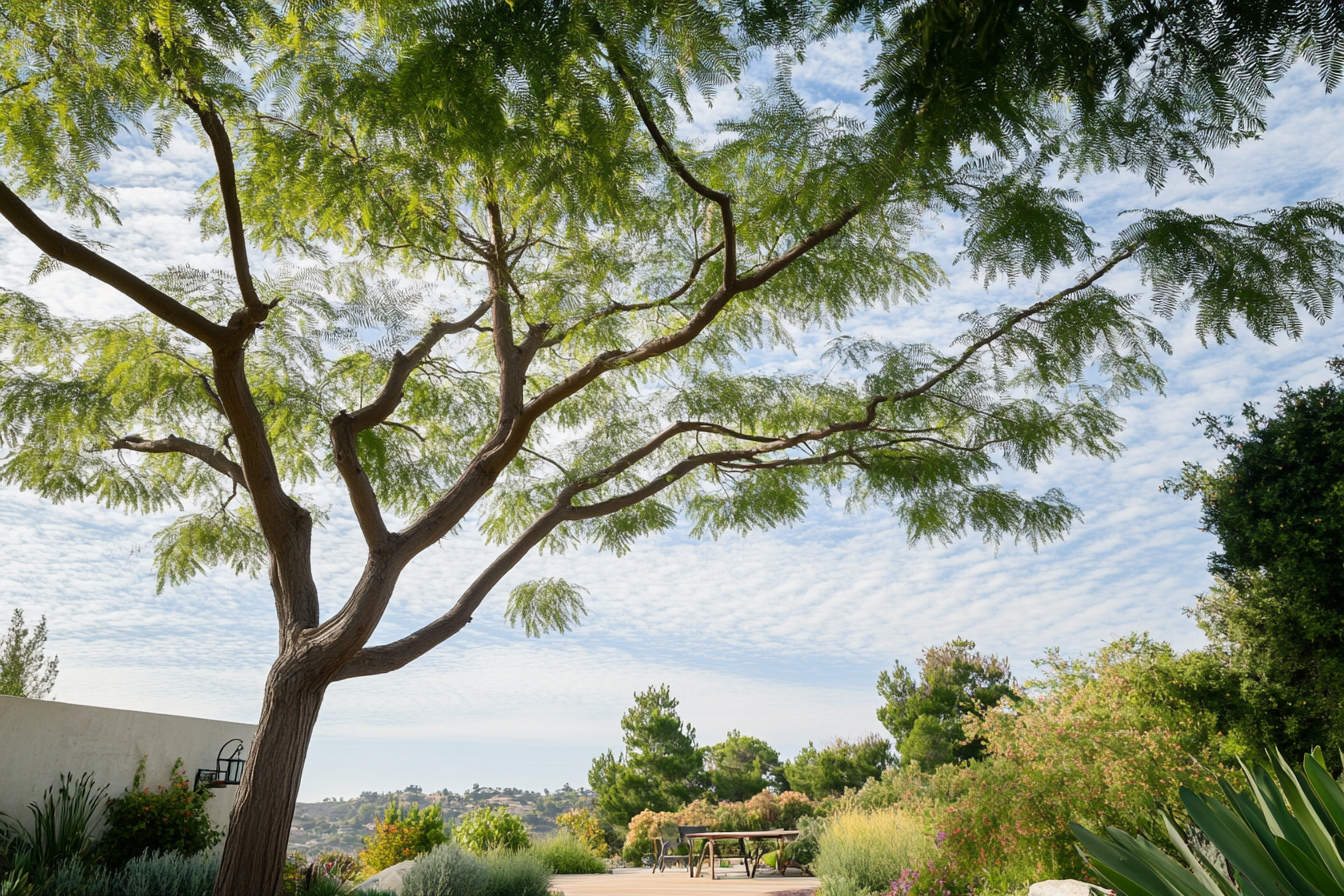
4. Jacaranda mimosifolia (Jacaranda)

Iconic spring-flowering shade tree with cascading clouds of purple-blue trumpet flowers and fine fern-like foliage. The most spectacular flowering shade tree in cultivation — four to six weeks of unmatched purple-blue display each spring.

Type
Iconic deciduous flowering shade tree
Height
10 to 15m
Width
8 to 12m
Growth rate
Moderate
Foliage
Fine fern-like fresh green
Flowers
Spectacular cascading purple-blue trumpets in spring
Form
Spreading umbrella canopy
Conditions
Full sun, well-drained, warm-temperate to subtropical
Maintenance
Very low.
Best for
the most spectacular spring-flowering shade tree, or an iconic Australian summer-shade tree with unmatched flowering display.

Why choose it

Jacaranda is the most spectacular flowering shade tree in cultivation. The spring purple-blue cascade is unmatched by any other species — four to six weeks of full canopy display followed by dense fern-like foliage and summer shade. Iconic Australian feature tree.

Perfect pair

Plant as single specimen on large lawn, or pair with Quercus palustris for layered spring-flowering and autumn-colour shade.

Tips for planting

Warm-temperate to subtropical. Full sun. Large mature size — allow 10m+ clear space.

Purple-blue spring cascade. The iconic flowering shade tree.

Shop Jacaranda mimosifolia

5. Pyrus calleryana 'Capital' (Capital Ornamental Pear)

Tight narrow columnar Ornamental Pear with white spring blossom, glossy summer foliage and brilliant red-purple autumn colour. The narrowest deciduous shade tree in cultivation — perfect for tight side strips and narrow runs that still need shade.

Type
Narrow columnar deciduous shade tree
Height
8 to 10m
Width
2 to 2.5m
Growth rate
Moderate
Foliage
Glossy dark green summer, brilliant red-purple autumn
Flowers
Clouds of pure white blossom in spring
Form
Tight narrow upright column
Conditions
Full sun, well-drained, frost hardy
Maintenance
Very low.
Best for
the narrowest deciduous shade tree, or a tall narrow column with spring blossom and brilliant autumn colour.

Why choose it

Capital is the narrowest deciduous shade tree in cultivation. At 2 to 2.5m wide it fits side strips where other shade trees can't go, and the four-season interest (spring blossom, summer foliage, autumn colour, winter silhouette) means the tree is always doing visual work.

Perfect pair

Plant in matched row along narrow side strip, or pair with Ulmus parvifolia for layered narrow-and-vase shade.

Tips for planting

Narrow column — allow 2m clear width. Full sun. Frost hardy.

The narrowest deciduous shade. Tight column with four-season interest.

Shop Pyrus calleryana 'Capital'

Compare at a glance

CultivarHeightWidthFormFoliageBest if you…
Cupaniopsis anacardioides
Tuckeroo
6 to 8m4 to 5mDense rounded crownGlossy compound mid-green evergreencompact native evergreen shade at suburban scale, or a slow-growing tree that stays small for decades.
Quercus palustris
Pin Oak
15 to 20m8 to 12mSymmetrical pyramidal with horizontal branchingDeeply-lobed glossy mid-green, brilliant red-bronze autumnthe benchmark grand-scale deciduous shade tree, or a centuries-long heritage specimen for large properties.
Acer rubrum 'October Glory'
October Glory Maple
10 to 15m6 to 8mStrong pyramidalGlossy mid-green summer, brilliant red autumnthe most dramatic autumn-colour shade tree, or six weeks of brilliant red display each autumn.
Jacaranda mimosifolia
Jacaranda
10 to 15m8 to 12mSpreading umbrella canopyFine fern-like fresh greenthe most spectacular spring-flowering shade tree, or an iconic Australian summer-shade tree with unmatched flowering display.
Pyrus calleryana 'Capital'
Capital Ornamental Pear
8 to 10m2 to 2.5mTight narrow upright columnGlossy dark green summer, brilliant red-purple autumnthe narrowest deciduous shade tree, or a tall narrow column with spring blossom and brilliant autumn colour.

How to plant and care for them

Choose the planting spot
Stand on the lawn where you want shade at 2pm in summer. The trunk goes between you and the western or northern sun, set back to a distance equal to half the tree's mature spread.
Prepare a wide hole
Twice as wide as the root ball, same depth. Loosen sides. Mix gypsum into clay. Water in deeply at planting and again three days later.
Stake low and remove early
A single low stake set 30cm from the trunk, tied loosely. Remove at 12 to 18 months so the trunk thickens to support the canopy.
Establishment watering
Deep weekly water through the first two summers. Slow soaker for 30 minutes per tree. Mulch 75mm coarse bark to a 1.5 metre radius. Never let the root zone bake dry in years one and two.
Formative pruning
Each winter, prune to a clear central leader, remove crossing branches and double leaders. Aim for the architectural shape the species was bred for: pyramidal (Pin Oak, Liquidambar), vase (Chinese Elm), upright oval (October Glory, Ginkgo).
Progressive crown lift
Once the trunk thickens (year three onwards), remove the lowest one or two branches each winter until the canopy lifts above head height. The garden under the tree opens up; the foliage canopy stays the show.

The wrap up

Five foliage-led shade trees, each with a different leaf signature and autumn show: star-shaped Liquidambar, fan-shaped Ginkgo, lobed Pin Oak, palmate Acer 'October Glory', and small-glossy Chinese Elm. The guide explains how to match leaf, density, scale and position to your garden.