



Skip to content

OUR END OF FINANCIAL YEAR SALE IS LIVE!

20% OFF ORDERS OVER $1,500 - DISCOUNT APPLIES AUTOMATICALLY AT CHECKOUT

Growing Trees in Containers: A Complete Guide to Pot Size, Mix, Watering and the Right Varieties

Growing Trees in Containers: A Complete Guide to Pot Size, Mix, Watering and the Right Varieties

A practical guide to growing trees in pots that thrive for decades. Pot size, mix, drainage, watering, feeding, repotting, and the varieties that perform best in Australian conditions.


balconybay treecontainer treescourtyardjapanese maplemagnoliamurrayaolive

A tree in a pot changes a space the way furniture never can. A small balcony reads as a garden. A bare entry reads as considered. A paved courtyard, suddenly, has a focal point. The right tree in the right pot will sit there for fifteen, twenty, sometimes thirty years, growing slowly into the shape you trained it.

Container trees aren't a compromise for people without a garden. Some of the most photographed gardens in the world are built almost entirely in pots. The principles are the same as planting in the ground: full sun where the species asks for it, the right mix, honest drainage, steady watering. Get those right and a pot becomes a place a tree wants to live.

Pot size is the decision that matters most

A tree in a too-small pot becomes root-bound within a season. The soil dries out faster than you can water it, the roots circle and choke themselves, and the tree declines from chronic stress no amount of feed can rescue. A tree in a generously sized pot grows slowly, holds moisture between drinks, and lives for decades.

When in doubt, go a size larger than feels necessary. The pot is the foundation of everything that follows.

Drainage and the right mix

Every container tree dies from one of two things: drought or drowning. Drainage is what separates them. The pot needs multiple drainage holes (not just the one), it needs to sit on feet or risers so water flows away freely, and saucers need to be emptied rather than left full.

The mix matters as much as the pot. Garden soil isn't pot mix and shouldn't go anywhere near a container. Use a premium red-ticked Australian Standards potting mix, add ten to twenty percent perlite or coarse propagating sand for extra drainage, and mix through a little aged compost for slow-release feeding.

Watering is rhythm, not a routine

Overwatering kills more pot trees than drought ever does. The trick is to water deeply and less often, rather than little and frequent.

In summer, check daily by pushing a finger 5 cm into the mix. If the top 5 cm is dry, water until it runs from the drainage holes. If it's still damp, leave it. In winter, reduce watering sharply, particularly for Mediterranean species like olive and rosemary that resent wet feet in cold weather. A self-watering pot can be the easiest answer for citrus, buxus and bay.

Repot every two to four years

Container trees become root-bound over time, and even perfect watering and feeding won't fix it. Once water drains straight through in seconds, or you can see roots circling at the base or pushing through the drainage holes, or growth has clearly slowed compared to the season before, it's time to repot.

Do it in late winter or early spring while the tree is dormant. Slide the rootball out, trim 3 to 5 cm off the outer roots and the bottom with a sharp pruning saw, and repot into fresh premium mix. The same pot is fine if the tree has reached its target size, or upsize if you want it to keep growing. Water deeply and keep the tree sheltered for a few weeks while roots regenerate.

Before you start: what you'll need

A pot bigger than you think you need
Pot size is the foundation of everything.

• Compact features (buxus balls, Miss Muffet): 25 to 50 L
• Medium evergreens (bay standards, Phoenix roebelenii, calamondin): 50 to 80 L
• Tall features (Magnolia 'Teddy Bear', Acer palmatum, ex-ground olive): 80 L or larger
• Pencil pine and tall columns: 80 to 120 L

When in doubt, go a size larger. Multiple drainage holes are non-negotiable. Drill more if needed.
Premium potting mix
Red-ticked Australian Standards mix only.

• Premium grade as the base (cheap mix breaks down in months)
• Add 10 to 20 percent perlite or coarse propagating sand for drainage
• Mix in 10 to 15 percent aged compost for slow-release feeding

Never use garden soil in pots. It compacts, drains poorly, and often carries pests.
Drainage essentials
Drainage is the difference between drowning and thriving.

• Pot feet or risers to elevate the pot off the ground
• A saucer if needed, emptied regularly and never left standing
• A drill and masonry bit for adding holes to ceramic or concrete pots
Mulch and feed
Buy these once, use them for a season.

• 30 to 50 mm of decorative mulch (pebble, scoria or fine bark)
• Premium slow-release fertiliser for trees and shrubs
• Liquid feed for 6-weekly top-ups
• Citrus food (three times a year) if you're growing citrus
• Native plant feed (no phosphorus) if you're growing natives

How to keep your tree happy

Watering rhythm
Deep and infrequent beats little and often.

In summer, check daily by pushing a finger 5 cm into the mix. If the top 5 cm is dry, water until it runs from the drainage holes.

In winter, reduce watering sharply. Mediterranean species like olive, rosemary and bay resent wet feet in cold weather.

Self-watering pots are excellent for thirstier species like citrus, buxus and bay.
Feeding by species
Pot culture is fertile or starved. Choose fertile.

• Apply slow-release tree and shrub fertiliser in early spring as growth restarts
• Top up with liquid feed every 6 weeks through the growing season
• Citrus needs dedicated citrus food three times a year
• Native species use native plant feed only (no phosphorus, which damages most natives)

Stop all feeding in late autumn so the tree can harden off for winter.
Mulch the surface
A mulched pot is a healthier pot.

30 to 50 mm of decorative mulch over the surface:

• Slows evaporation in summer
• Insulates roots from temperature swings
• Suppresses weeds
• Reads better visually than bare mix

Refresh annually. Keep mulch a finger's width clear of the trunk.
Reading the leaves
Your tree tells you what it needs.

Yellowing all over: usually hungry. Feed.
Yellowing with green veins: trace-element deficiency, especially on citrus. Use the right feed.
Crispy brown edges: dry, or wind-burned. Mulch and shelter.
Pale leaves and weak growth: root-bound. Time to repot.
Sudden wilting in damp mix: roots rotting. Check drainage.
When to lift and repot
Root-bound trees stop growing, even with perfect care.

Signs you need to repot:

• Water drains straight through in seconds rather than soaking in
• Roots visible circling at the base or through drainage holes
• Growth obviously slower than previous seasons

Every 2 to 4 years is the rhythm. Late winter or early spring is the season.

Caring for your tree through the seasons

Spring (plant, feed and repot)
The best season for any container tree work.

• Apply slow-release fertiliser in early spring as growth restarts
• Repot or root-prune any trees showing signs of being root-bound
• Refresh the top 25 mm of mulch around each pot
• Increase watering as temperatures rise
• Plant any new container trees once frost has passed
Summer (water and watch the heat)
Pots dry out and overheat fast. Stay ahead of it.

• Check water daily by feel (finger test 5 cm into the mix)
• Water deeply when you do water, not little and often
• Move sensitive species into morning sun only if afternoon temperatures exceed 35°C
• Dark pots can bake roots above 50°C. Use lighter-coloured pots or shade the pot itself.
• Apply liquid feed every 6 weeks
Autumn (prepare for winter)
Wind down the growing season.

• Reduce watering as growth slows
• Final liquid feed in early autumn
• Top-dress with fresh mulch before winter rain
• Stop fertilising by late autumn so the tree hardens off
Winter (protect tender species)
The most vulnerable season for pots.

• Frost-tender species (citrus, Plumeria, Phoenix palms): move to a sheltered spot under eaves or against a north-facing wall
• Pots dry out and freeze faster than ground. Wrap pots in hessian or bubble wrap in extreme frost.
• Reduce watering significantly for Mediterranean species (olive, rosemary, bay)
• Avoid feeding until early spring

Pruning: when, how, and why it matters

Why pruning matters more in pots
A pot tree's shape is the design. Keep it.

Pruning isn't optional for container trees. The shape you bought is the shape that fits the space. Without regular passes, the tree outgrows its proportions, becomes top-heavy, and shades itself.

Container trees benefit from many light passes a year, not one heavy prune.
When to prune evergreens
Most evergreens can be lightly shaped year-round.

• Buxus, bay, magnolia, olive: trim lightly after the spring flush, again in early autumn
• Pencil pine and conifers: light shape in spring only. Avoid cutting into old wood that won't reshoot.
• Citrus: tidy after each harvest, remove water-shoots on sight
When to prune deciduous
Late winter, while dormant.

Acer palmatum and other deciduous trees should be pruned in late winter when the structure is visible and the tree won't bleed sap.

For acers, work to enhance the natural layered shape. Remove crossing branches, dead twigs, and anything growing toward the centre.
How to cut
Sharp, clean, considered.

• Wipe blades with metho between trees
• Cut just above an outward-facing bud
• Angle the cut at about 45° away from the bud
• Step back often. Prune less than you think.
Why pruning keeps a pot tree happy
Pruning balances the tree to the pot.

The roots in a pot are limited. The canopy needs to match. Keeping the canopy in scale prevents the tree from over-reaching, drying out, and declining. A well-pruned tree in a pot can live for decades.

Common mistakes to avoid

Pot too small
The #1 cause of container tree decline. A tree in a too-small pot becomes root-bound within a season, dries out faster than you can water it, and never reaches its potential.
No drainage or sitting in saucer
Drowns roots within weeks. Every pot needs multiple drainage holes and must be raised so water flows freely. Saucers must be emptied.
Garden soil in pots
Compacts, drains poorly, often contaminated. Always use premium potting mix. Never substitute garden soil even temporarily.
Inconsistent watering
Bone-dry then drowning cycles stress trees more than steady underwatering. Establish a consistent watering schedule — same time of day, same depth, same frequency.
Never repotting
Root-bound trees decline even with perfect watering. Every 2 to 4 years, slide the rootball out and trim the outer roots. Repot into fresh mix in the same pot, or upsize.
Wrong species
Some trees just don't suit pot culture. Stick with proven container performers — Acer palmatum, Olive, Magnolia 'Teddy Bear', Pencil Pine, Buxus topiary, Citrus, Bay Standards.

Our favourite picks

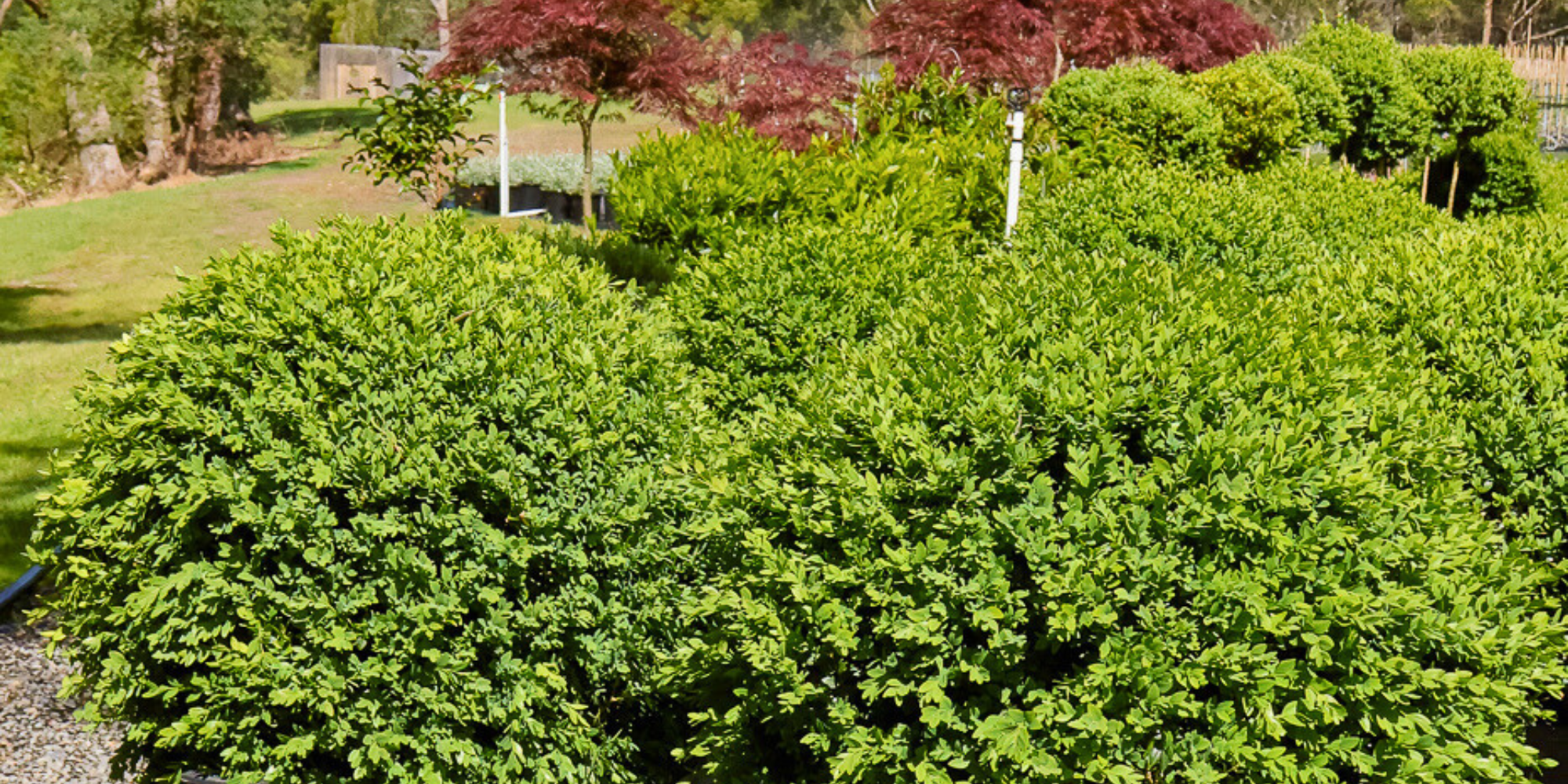
1. Buxus japonica (Japanese Box Topiary Ball)

Compact, formal evergreen sphere that holds its shape with minimal pruning. The container plant that turns a balcony or entry into a designed space overnight.

Type
Evergreen shrub
Height
30 to 60 cm in pots
Width
30 to 60 cm
Growth rate
Slow
Foliage
Small glossy green oval leaves
Form
Pre-shaped formal sphere
Conditions
Full sun to part shade, well-drained premium mix
Maintenance
Light trim once a year to maintain shape
Best for
Symmetrical entry pairs, formal terraces, courtyard pots

Why we love it

Already trained into a perfect ball, so a beginner instantly gets a designer look. Lives for decades in a pot.

Perfect pair

Pair Buxus topiary with Pittosporum Miss Muffet for a calm shrub mix at low level.

Tips for planting

30 to 50 L pot is plenty. Trim with sharp shears once a year after the spring flush.

Instant formality in a single pot.

Shop Buxus japonica

2. Laurus nobilis (Bay Leaf Standard)

Lollipop-shaped standard with a clean clear stem and a tidy green head. The classical entry pot.

Type
Evergreen tree
Height
1.5 to 2 m on standard form
Width
60 to 80 cm head
Growth rate
Slow
Foliage
Glossy dark green aromatic culinary leaves
Flowers
Small yellow in spring
Form
Standard lollipop
Conditions
Full sun, well-drained mix
Maintenance
Trim head twice a year to maintain the ball shape
Best for
Entry doorways, balconies, formal symmetrical planting

Why we love it

Edible culinary leaves and an instantly classical container shape. Pairs read as commissioned design.

Perfect pair

Pair Bay standards with Buxus topiary at the base of the pot for tiered formality.

Tips for planting

50 L pot or larger. Stake the trunk for the first season.

Mediterranean structure, useful in the kitchen.

Shop Laurus nobilis

3. Podocarpus falcatus (Podocarpus Clouds)

Cloud-pruned Podocarpus with soft layered tiers, like a living bonsai at full size. A focal-point pot tree that reads as commissioned design.

Type
Evergreen tree
Height
1.5 to 2.5 m on cloud form
Width
1 to 1.5 m
Growth rate
Slow
Foliage
Fine soft dark green needles
Form
Cloud-pruned tiered canopy
Conditions
Full sun to part shade, well-drained mix
Maintenance
Light trim once or twice a year to keep the cloud shape
Best for
Japanese-influenced courtyards, modern entries, sculptural pot features

Why we love it

Pre-trained sculptural form. Holds its shape for decades with minimal pruning.

Perfect pair

Pair Podocarpus Clouds with Buxus japonica at ground level for layered Japanese restraint.

Tips for planting

80 L pot or larger. Sheltered from hot afternoon wind.

Living sculpture, instantly.

Shop Podocarpus falcatus

4. Ficus microcarpa hillii (Ficus Hillii Standard)

Sculptural standard with a dense rounded head, ideal for paired entries and modern courtyards.

Type
Evergreen tree
Height
1.8 to 2.5 m on standard form
Width
80 cm to 1.2 m head
Growth rate
Moderate
Foliage
Small glossy dark green
Form
Standard with rounded ball head
Conditions
Full sun to part shade, well-drained mix
Maintenance
Clip twice a year to keep the ball tight
Best for
Modern entries, courtyard pairs, formal driveways

Why we love it

Holds a perfectly round head with minimal effort. Looks expensive in a pot.

Perfect pair

Pair Ficus standards with low Buxus japonica at ground level for a layered entry.

Tips for planting

80 L pot or larger. Water deeply weekly through summer.

Architectural impact, low fuss.

Shop Ficus microcarpa hillii

5. Pittosporum tobira 'Miss Muffet' (Miss Muffet)

Compact rounded evergreen that holds a tight natural dome shape without clipping. The lazy gardener's dream pot plant.

Type
Evergreen shrub
Height
60 to 80 cm
Width
60 to 80 cm
Growth rate
Slow to moderate
Foliage
Glossy dark green with lime new growth
Flowers
Small fragrant white in spring
Form
Natural rounded dome
Conditions
Full sun to part shade, well-drained mix
Maintenance
Almost none. Light tip prune if desired.
Best for
Modern courtyards, low pot pairs, balconies

Why we love it

Looks tailored without any clipping. A genuine low-fuss shrub for pots.

Perfect pair

Pair Miss Muffet with Acer palmatum for low and tall contrast.

Tips for planting

30 to 50 L pot. Free-draining mix is essential.

Tidy by design.

Shop Pittosporum tobira 'Miss Muffet'

6. Dracaena marginata (Madagascar Dragon Tree)

Sculptural multi-stemmed indoor or sheltered courtyard plant with arching strappy leaves and red edges.

Type
Evergreen tree
Height
1 to 2.5 m
Width
60 cm to 1 m
Growth rate
Slow
Foliage
Narrow strappy green with red edges
Form
Multi-stemmed sculptural
Conditions
Bright filtered light to partial sun, well-drained mix
Maintenance
Wipe leaves occasionally. Water modestly.
Best for
Indoor pots, sheltered courtyards, modern interiors

Why we love it

Long-lived architectural pot plant that tolerates lower light and infrequent watering.

Perfect pair

Pair Dracaena with Agave attenuata in a sunny courtyard for sculptural contrast.

Tips for planting

30 to 50 L pot. Let the top inch dry between waterings.

A statement piece, indoors or in shelter.

Shop Dracaena marginata

7. Acer palmatum (Japanese Maple)

Deciduous sculptural tree with delicate layered branching and brilliant autumn colour. The defining pot tree of the world.

Type
Deciduous tree
Height
1.5 to 2.5 m in pots
Width
1 to 1.5 m
Growth rate
Slow
Foliage
Soft palmate green turning red orange in autumn
Form
Layered open canopy
Conditions
Morning sun, afternoon shade. Sheltered from hot wind.
Maintenance
Late winter shape only. Refresh mulch annually.
Best for
Courtyard focal points, shaded patios, autumn colour

Why we love it

Looks better every year. A pot tree that grows into a sculpture.

Perfect pair

Pair Acer palmatum with Pittosporum Miss Muffet at the base for low and high layers.

Tips for planting

80 L pot or larger. Premium mix with extra perlite for drainage.

A pot tree that grows into a sculpture.

Shop Acer palmatum

8. Magnolia grandiflora 'Teddy Bear' (Teddy Bear Magnolia)

Compact evergreen magnolia with broad dark glossy leaves and large white fragrant summer flowers. Tropical scale, manageable size.

Type
Evergreen tree
Height
2 to 3 m in pots
Width
1 to 1.5 m
Growth rate
Moderate
Foliage
Large glossy dark green with rust-coloured backs
Flowers
Large fragrant white in summer
Form
Compact upright pyramid
Conditions
Full sun to part shade, deep well-drained mix
Maintenance
Light shape after flowering only
Best for
Bold feature pots, modern entries, courtyard centrepieces

Why we love it

Tropical scale without becoming a giant. Reliable summer flowers in a pot.

Perfect pair

Pair Teddy Bear with Buxus japonica at the base for layered formality.

Tips for planting

80 L pot or larger. Mulch heavily.

Big-leaf drama in a manageable form.

Shop Magnolia grandiflora 'Teddy Bear'

9. Calamondin (Calamondin Cumquat)

Compact productive citrus with year-round white blossom and bright orange fruit. The perfect beginner fruit tree — forgiving, prolific, suits both pots and ground, fruit ripens across all seasons.

Type
Beginner-friendly compact citrus
Height
2 to 3m
Width
1.5 to 2m
Growth rate
Slow to moderate
Foliage
Glossy mid-green evergreen
Flowers
Fragrant white year-round, followed by orange fruit
Form
Compact rounded
Conditions
Full sun, well-drained, frost protection in cool climates
Maintenance
Citrus feed three times a year.
Best for
the most forgiving beginner citrus, or year-round fruit and fragrant blossom in pots or ground.

Why we love it

Calamondin is the most beginner-friendly citrus in cultivation. Year-round white blossom and bright orange fruit, compact size, drought tolerant once established, and almost no pest issues. First harvest within 12 to 18 months of planting. Cooks beautifully into marmalades, drinks and Asian dishes.

Perfect pair

Plant beside Finger Lime for layered citrus harvest, or in matched pots at the entry.

Tips for planting

Citrus feed three times a year. Frost protect cool climates. First fruit 12-18 months.

The forgiving year-round beginner citrus.

Shop Calamondin

10. Citrus australasica 'Australian Blood Red Centre' (Finger Lime)

Australian native citrus producing distinctive finger-shaped fruit filled with caviar-like pearls. Chef-prized. Compact thorny form suits pots and tight spaces. The most-talked-about fruit on any dinner-party plate.

Type
Native gourmet citrus
Height
2 to 3m
Width
1 to 1.5m
Growth rate
Slow to moderate
Foliage
Small bright green
Flowers
Small white in spring
Form
Compact thorny upright
Conditions
Full sun to part shade, well-drained, frost protection
Maintenance
Citrus feed three times a year.
Best for
the chef's prized native caviar lime, or compact productive Australian native citrus.

Why we love it

Finger Lime is the Australian native citrus chefs around the world pay premium for. Distinctive finger-shaped fruit filled with bright pearls of citrus flesh — looks like caviar, bursts on the tongue. Compact thorny growth suits pots and narrow spaces. First harvest 2-3 years.

Perfect pair

Plant in pots near outdoor dining where the harvest happens, with Calamondin for layered native-Mediterranean citrus.

Tips for planting

Thorny — not for high-traffic positions. Citrus feed. Frost protect cool climates.

The chef's prized native citrus caviar.

Shop Citrus australasica 'Australian Blood Red Centre'

11. Citrus limon 'Lisbon' (Lisbon Lemon)

Australia's most reliable productive lemon. Larger and tougher than Meyer, with classic tart lemon flavour. The everyday backyard lemon — hardy, prolific, dependable.

Type
Reliable everyday backyard lemon
Height
3 to 5m
Width
2 to 3m
Growth rate
Moderate
Foliage
Glossy dark green evergreen
Flowers
Fragrant white main flush spring + sporadic year-round
Form
Upright rounded
Conditions
Full sun, well-drained, frost protection in cool climates
Maintenance
Citrus feed three times a year.
Best for
the hardy everyday productive backyard lemon, or reliable cooking lemon supply for the kitchen.

Why we love it

Lisbon is the lemon Australians actually cook with. Tougher than Meyer, larger fruit, tarter classic lemon flavour, reliable across all climate zones. Mature trees produce 50-100+ lemons per season. Heavy spring blossom perfumes the entire surrounding area.

Perfect pair

Plant beside Blood Orange and Mandarin for full citrus grove.

Tips for planting

Citrus feed three times a year. Hardy across most climates. First harvest 18-24 months.

The everyday reliable backyard lemon.

Shop Citrus limon 'Lisbon'

12. Cycas revoluta (Sago Palm)

Architectural fern-like evergreen with a thick trunk and a crown of stiff dark fronds. Prehistoric design in a pot.

Type
Cycad
Height
1 to 1.5 m in pots
Width
1 to 1.5 m
Growth rate
Very slow
Foliage
Stiff glossy dark green fronds
Form
Single trunk crown of fronds
Conditions
Full sun to part shade, sharply draining mix
Maintenance
Almost none. Remove old fronds at the base.
Best for
Modern entries, courtyard features, tropical pot planting

Why we love it

A living sculpture. Tolerates drought and looks the same year-round.

Perfect pair

Pair Cycas revoluta with Agave attenuata for sculptural contrast in dry pots.

Tips for planting

50 to 80 L pot. Sharp drainage is non-negotiable.

Prehistoric architecture in a pot.

Shop Cycas revoluta

13. Agave attenuata (Foxtail Agave)

Soft-edged architectural succulent with a rosette of pale green fleshy leaves. Looks intentional in any pot.

Type
Succulent
Height
60 cm to 1 m
Width
1 to 1.5 m
Growth rate
Slow
Foliage
Pale green fleshy rosette
Flowers
Tall arching pale yellow flower spike (rare)
Form
Open rosette
Conditions
Full sun, free-draining mix
Maintenance
Almost none. Tolerates neglect.
Best for
Sunny modern courtyards, coastal pots, drought-tolerant displays

Why we love it

Survives weeks without water. Looks more designed every year.

Perfect pair

Pair Agave attenuata with Cycas revoluta for layered sculptural pots.

Tips for planting

30 to 50 L pot. Reduce watering sharply in winter.

A coastal sculpture in a pot.

14. Camellia sasanqua 'Early Pearly' (Early Pearly Camellia)

Compact sasanqua Camellia with crisp white double flowers in autumn and winter, ideal as a flowering pot feature.

Type
Evergreen shrub
Height
1.5 to 2.5 m in pots
Width
1 to 1.5 m
Growth rate
Slow to moderate
Foliage
Glossy dark green
Flowers
Crisp white double flowers in autumn and winter
Form
Upright rounded
Conditions
Morning sun, afternoon shade. Acid-leaning premium mix.
Maintenance
Light shape after flowering. Feed with azalea and camellia food.
Best for
Courtyard pots, shaded entries, cool-season flowering

Why we love it

Flowers when the rest of the garden is asleep. A pot full of clean white blooms in winter.

Perfect pair

Pair Early Pearly with Buxus japonica for a year-round green base.

Tips for planting

50 to 80 L pot. Use a camellia and azalea mix, or premium mix with iron supplement.

White flowers when you need them most.

Shop Camellia sasanqua 'Early Pearly'

15. Juniperus virginiana 'Spartan' (Spartan Juniper Triple Balls)

Three pre-trained dense green spheres stacked on a single trunk. Pure topiary impact in a single pot.

Type
Evergreen conifer
Height
1.8 to 2.5 m on triple ball form
Width
60 to 80 cm at widest ball
Growth rate
Slow
Foliage
Dense fine dark green scale-like leaves
Form
Pre-trained triple ball topiary
Conditions
Full sun, well-drained mix
Maintenance
Trim each ball once a year in late spring or early autumn
Best for
Statement entries, modern formal pots, symmetrical driveway pairs

Why we love it

Three trained shapes for the price of one tree. Reads as commissioned topiary art.

Perfect pair

Pair Spartan Triple Balls with Buxus japonica at the base for layered evergreen formality.

Tips for planting

80 L pot or larger. Stake until established. Trim with hand shears, not hedge shears.

Three balls, one pot, total topiary.

Shop Juniperus virginiana 'Spartan'

Frequently asked questions

What size pot do I need for a tree?
Minimum 25 L for compact features like buxus balls, 50 L for medium evergreens like bay standards and calamondin, 80 L or larger for tall features like Magnolia 'Teddy Bear' or ex-ground olive, and 80 to 120 L for pencil pine and tall narrow columns. When in doubt, go a size larger than feels necessary.
Can I use garden soil in pots?
No. Garden soil is not pot mix. It compacts, drains poorly, may contain pests or diseases, and drowns roots in winter while starving them in summer. Always use premium red-ticked Australian Standards potting mix with 10 to 20 percent added perlite or coarse propagating sand for extra drainage.
How often do I water trees in containers?
Check daily in summer by pushing a finger 5 cm into the mix. Water deeply only if the top 5 cm is dry. Water until it runs from the drainage holes. Reduce watering significantly in winter, particularly for Mediterranean species like olive and rosemary.
How often should I repot my container tree?
Every 2 to 4 years. Signs you need to repot: water drains straight through in seconds, roots visible circling at the base or through drainage holes, growth significantly slower than previous seasons. Best done in late winter or early spring while dormant. Trim 3 to 5 cm off the outer roots and bottom of the rootball before repotting.
Which trees are best for containers?
Reliable container performers include Acer palmatum, ex-ground olive, Magnolia 'Teddy Bear', Cupressus 'Glauca' (Italian Pencil Pine), buxus topiary balls, Calamondin Cumquat, bay standards, Phoenix roebelenii Pygmy Date Palm, Pittosporum 'Miss Muffet', Dracaena marginata, and Agave attenuata.
How do I protect container trees in winter?
Move frost-tender species (citrus, Plumeria, Phoenix palms) to a sheltered position under eaves or against a north-facing wall. Wrap pots in hessian or bubble wrap in extreme frost to insulate the roots, which freeze and dry out faster in pots than in the ground.