Skip to content

Volume Discounts Apply At Checkout

Rosmarinus officinalis 'Prostratus' – Prostrate Rosemary

Rosmarinus officinalis 'Prostratus' – Prostrate Rosemary

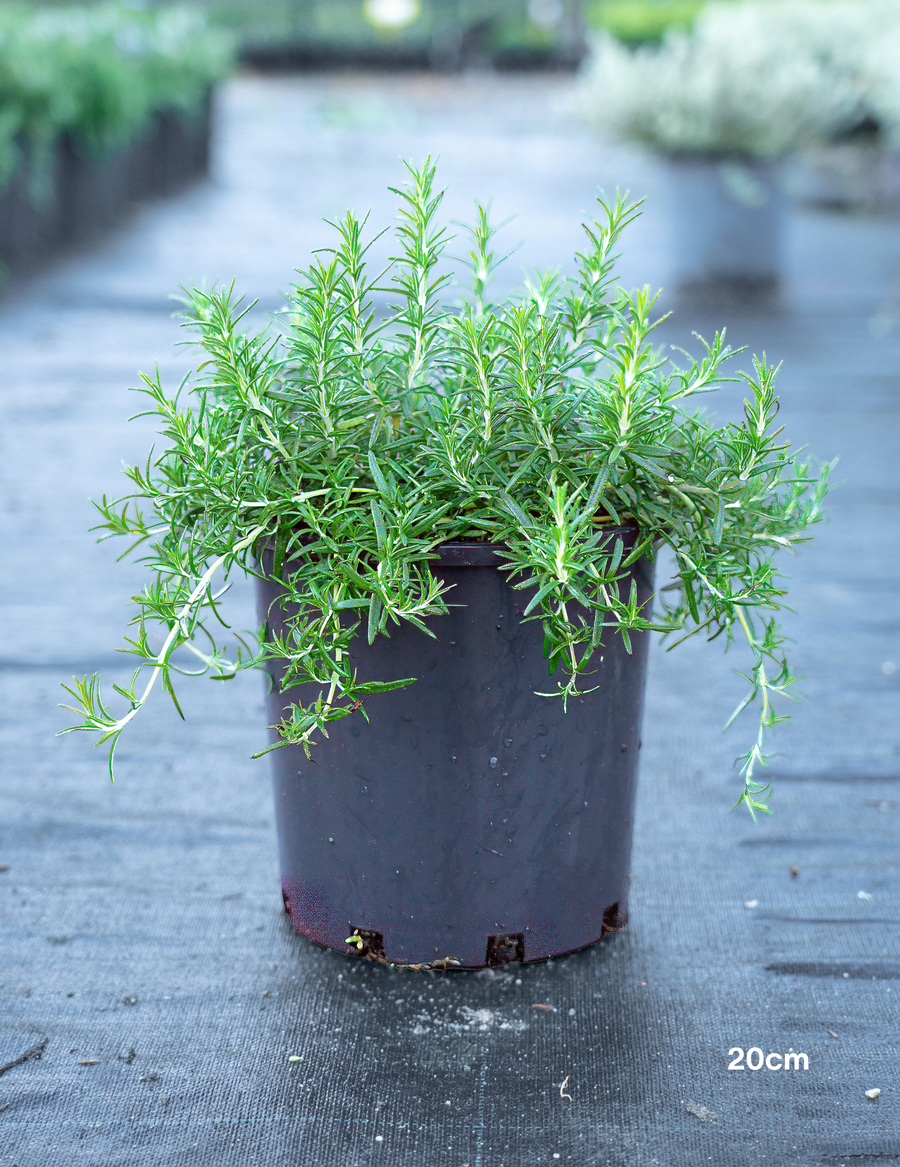
Low trailing form of culinary rosemary that cascades over walls and embankments. Fully edible, exceptionally drought and salt tolerant, and flowers pale blue through winter when little else is out.

Regular price $45.00
Sale price $45.00 Regular price
Tax included. Shipping calculated at checkout.
Pot size
Available batches
Size: 18cm
Current height guide
Please enquire
Pot size
18cm

Approximate only. Minimum height important? Confirm with us.

Height guide & disclaimer

Height guide disclaimer: Height ranges are approximate only. As living products, plant heights naturally vary between individual plants, batches, and seasons. No guarantee is given that supplied plants will fall within the stated range. If minimum heights are required, you must confirm current batch heights with Evergreen Trees Direct prior to purchase. Variation in height is normal and is not grounds for return, refund, replacement, or compensation.

Quantity

Order multiple sizes

Mix pot sizes and batches in one order.

Size / batchEachQuantity
18cmApprox. height: Enquire for current heights$45.00

Height guide & disclaimer

Height guide disclaimer: Height ranges are approximate only. As living products, plant heights naturally vary between individual plants, batches, and seasons. No guarantee is given that supplied plants will fall within the stated range. If minimum heights are required, you must confirm current batch heights with Evergreen Trees Direct prior to purchase. Variation in height is normal and is not grounds for return, refund, replacement, or compensation.

Subtotal before discounts & delivery$0.00

Delivery is calculated at checkout.

Ask a question

The fields marked * are required.

Not sure how many trees you need?

Plan your hedge

Enter the length of your boundary, then choose how closely you want to plant.

Choose your planting spacing

Enter your boundary length to see how many trees you need.

Measure only the boundary you intend to plant—exclude gates and gaps. Spacing is centre to centre. Quantities are rounded up for one row, allowing roughly half the spacing at each end. Site conditions and pruning affect the final hedge.

Compare trees

Choose two trees and compare the same pot size.

    About Rosmarinus officinalis 'Prostratus'

    Rosmarinus officinalis 'Prostratus', the Prostrate or Trailing Rosemary, is a low spreading evergreen that trails rather than stands up. Where common rosemary grows into an upright bush, this one hugs the ground and cascades, which makes it a groundcover and a wall-spiller rather than a hedge plant.

    It reaches around 20 to 40 centimetres high and spreads 1 to 1.5 metres wide. The needle-like aromatic foliage is the same as culinary rosemary, and it is fully edible, so it earns its place in a kitchen garden as well as an ornamental one. Small pale blue flowers appear through winter and spring and are heavily worked by bees.

    Its real strength is toughness in hard positions. Once established it handles drought, heat, salt wind, poor rocky soil and reflected heat from paving. It is the plant for the top of a retaining wall, a dry embankment, the edge of a raised bed or a hot coastal verge, where it will spill over and soften the edge while suppressing weeds underneath.

    Full sun and free-draining soil are the two things it insists on. It will not tolerate wet feet or heavy shade.

    Frequently Asked Questions

    About Prostrate Rosemary

    How is Prostrate Rosemary different from normal rosemary?

    Habit, not flavour. Common rosemary grows upright into a bush of 1 to 1.5 metres. Prostrate Rosemary stays low at 20 to 40 centimetres and spreads or trails 1 to 1.5 metres wide. The foliage, aroma and culinary use are the same. Choose prostrate for groundcover, wall edges and embankments, and upright for hedging or a standing shrub.

    Can you eat Prostrate Rosemary?

    Yes. It is the same species as culinary rosemary and is fully edible, with the same aroma and flavour. Pick sprigs as needed, which also helps keep the plant compact.

    How far does it spread?

    Around 1 to 1.5 metres wide, at a height of 20 to 40 centimetres. Plant 80 centimetres to 1 metre apart for a continuous groundcover, or space wider where you want individual plants to read separately.

    Is it good for retaining walls and embankments?

    It is one of the best plants for the job. Planted along the top of a wall it cascades over the face and softens the edge, and on a dry embankment the spreading habit stabilises loose soil and suppresses weeds. Both positions suit it because drainage is excellent.

    When does it flower?

    Small pale blue flowers appear through winter and into spring, with scattered flowering at other times in mild climates. The flowers are a valuable nectar source for bees during the cooler months when little else is out.

    Is it drought tolerant?

    Very. Once established it survives on rainfall alone across most of Australia and copes with heat, reflected warmth from paving and poor rocky ground. Water through the first summer to establish, then only in extended dry spells. Overwatering is a greater risk than underwatering.

    Will it grow in shade?

    No. It needs full sun. In shade the growth becomes sparse and leggy, flowering drops away and the plant is far more prone to fungal problems. Give it the sunniest, best-drained position you have.

    How do I care for it?

    Very little. Water through the first summer, then only in extended dry periods. Trim lightly after flowering to keep it dense, and harvest sprigs regularly for the same effect. Avoid cutting back into bare old wood, which is slow to reshoot. It rarely needs feeding and prefers lean soil over rich.


    Foliage

    Evergreen (foliage year round)

    Position
    • Full Sun
    Form
    • Spreading
    • Ground-Cover
    Use
    • Groundcovers
    • Plant in Pots (or) Suitable for Pots
    • Council or Civic Landscapes
    Mature height
    0.2m to 0.4m
    Mature width
    1m to 1.5m

    Planting Information

    How To Plant Your Rosmarinus officinalis 'Prostratus' – Prostrate Rosemary

    Site: Full sun with sharp drainage. Tops of retaining walls, raised beds, embankments and hot verges all suit it well.

    Hole: Dig twice the width of the root ball and the same depth. Do not plant deep.

    Planting: Set the crown level with or slightly above the surrounding soil, backfill and water in. On heavier ground, plant on a raised mound to keep the crown dry.

    Mulch: A gravel or coarse mineral mulch suits it better than heavy organic mulch, which holds moisture against the stems.

    Recommended Planting Spacing For Your Rosmarinus officinalis 'Prostratus' – Prostrate Rosemary

    Groundcover: 80 cm to 1 metre apart for continuous coverage.

    Retaining wall tops and raised beds: 80 cm apart so the plants meet and cascade evenly over the edge.

    Embankments: 1 metre apart for soil stabilisation and weed suppression.

    Pots: Single plants in a 30 cm or larger pot, ideal spilling over the rim.

    Rosmarinus officinalis 'Prostratus' – Prostrate Rosemary is expected to grow 30cm to 50cm spread per year.

    • Medium Growth Rate

    Long Term Care For Your Rosmarinus officinalis 'Prostratus' – Prostrate Rosemary

    Watering: Water through the first summer to establish, then only in extended dry periods. Overwatering is the most common cause of failure.

    Pruning: Trim lightly after flowering to keep growth dense. Harvesting sprigs achieves the same thing. Avoid cutting back into bare old wood, which reshoots slowly.

    Fertilising: Rarely needed. It prefers lean soil, and heavy feeding produces soft growth at the expense of aroma and hardiness.

    Pest and disease: Very hardy. Root rot from poor drainage is the main risk, not pests.

    Planting Your Rosmarinus officinalis 'Prostratus' – Prostrate Rosemary in Different Soil

    Sandy and gravelly soils: Ideal. Mirrors the dry Mediterranean hillsides it comes from.

    Loam soils: Good, provided drainage is excellent. Avoid enriching heavily, as it prefers lean ground.

    Clay soils: Avoid unless heavily improved with coarse sand and grit, or plant on a raised mound or in a pot. Wet feet will kill it.

    pH preference: Neutral to alkaline. One of the better choices for limestone and alkaline coastal soils.

    Uses in my Garden

    Uses in my Garden

    • Groundcovers
    • Plant in Pots (or) Suitable for Pots
    • Council or Civic Landscapes

    Rosmarinus officinalis 'Prostratus' – Prostrate Rosemary works in an:

    • Mediterranean Style Garden – timeless courtyard look with stone, pots, and bold greenery.
    • Coastal Garden – relaxed, seaside feel with hardy, textural plants.
    • Low-maintenance Garden – resilient choices for easy care and year-round appeal.
    • Edible Garden – integrates fruit, herbs, and productive plants.
    • Cottage Garden – romantic mix of flowers, colour, and texture.
    • Succulent / Dry Garden – sculptural planting with cacti, agaves, and drought-style textures.

    Is Rosmarinus officinalis 'Prostratus' – Prostrate Rosemary Evergreen or Deciduous?

    Rosmarinus officinalis 'Prostratus' – Prostrate Rosemary is an Evergreen (foliage year round) Tree

    Mature Height & Width

    Mature Height: 0.2m to 0.4m

    Mature Width: 1m to 1.5m

    Rosmarinus officinalis 'Prostratus' – Prostrate Rosemary is expected to grow 30cm to 50cm spread per year.

    Growth Rate of Rosmarinus officinalis 'Prostratus' – Prostrate Rosemary

    Rosmarinus officinalis 'Prostratus' – Prostrate Rosemary is expected to grow 30cm to 50cm spread per year.

    They are considered to have a:

    • Medium Growth Rate

    Frost Tolerance & Ideal Climate to plant Rosmarinus officinalis 'Prostratus' – Prostrate Rosemary

    Is Rosmarinus officinalis 'Prostratus' – Prostrate Rosemary frost tolerant?

    Rosmarinus officinalis 'Prostratus' – Prostrate Rosemary is Frost Tolerant – Can handle light to moderate frost once established.

    Does Rosmarinus officinalis 'Prostratus' – Prostrate Rosemary Flower?

    Prostrate Rosemary produces small pale blue flowers along its trailing stems through winter and into spring, with scattered flowering at other times in mild climates. The flowers are modest individually but carried in quantity across the plant, and are heavily worked by bees.

    Does Rosmarinus officinalis 'Prostratus' – Prostrate Rosemary flower?

    • Yes - Flowers

    Flowering Period:

    • Winter
    • Spring

    Flower Type:

    • Clustered
    • Pollinator-attracting

    Flower Colour:

    Purple

    Is Rosmarinus officinalis 'Prostratus' – Prostrate Rosemary an Australian Native Tree?

    No

    Rosmarinus officinalis 'Prostratus' – Prostrate Rosemary is Native to Mediterranean basin. Rosmarinus officinalis grows naturally on dry rocky coastal hillsides across southern Europe and North Africa, which is the source of its drought, heat and salt tolerance. 'Prostratus' is a low spreading form of the same species.

    What is the Wildlife Value of Rosmarinus officinalis 'Prostratus' – Prostrate Rosemary ?

    Prostrate Rosemary flowers through winter and spring, providing an important nectar source for bees at a time when very few other plants are in bloom. The dense spreading habit also offers ground-level shelter for beneficial insects, making it a useful addition to edible and pollinator gardens.

    How much Sunlight does Rosmarinus officinalis 'Prostratus' – Prostrate Rosemary need?

    Rosmarinus officinalis 'Prostratus' – Prostrate Rosemary will thrive best in:

    • Full Sun

    Preferred Soil?

    Prostrate Rosemary needs free-draining soil above all else. It performs best in sandy or gravelly ground with a neutral to alkaline pH and actually prefers lean soil over rich. Avoid heavy clay and any position that stays wet, as root rot is the main cause of failure. On heavier soils plant on a raised mound or in a pot.

    Is Rosmarinus officinalis 'Prostratus' – Prostrate Rosemary Drought Tolerant?

    Is Rosmarinus officinalis 'Prostratus' – Prostrate Rosemary Drought tolerant?

    Exceptional. Through establishment Prostrate Rosemary benefits from regular watering, but once established it survives on rainfall alone across most of Australia and copes with heat, reflected warmth from paving and poor rocky ground. Overwatering is a far greater risk than underwatering, and wet feet will kill it.

    Frequently Asked Questions

    How is Prostrate Rosemary different from normal rosemary?

    Habit, not flavour. Common rosemary grows upright into a bush of 1 to 1.5 metres. Prostrate Rosemary stays low at 20 to 40 centimetres and spreads or trails 1 to 1.5 metres wide. The foliage, aroma and culinary use are the same. Choose prostrate for groundcover, wall edges and embankments, and upright for hedging or a standing shrub.

    Can you eat Prostrate Rosemary?

    Yes. It is the same species as culinary rosemary and is fully edible, with the same aroma and flavour. Pick sprigs as needed, which also helps keep the plant compact.

    How far does it spread?

    Around 1 to 1.5 metres wide, at a height of 20 to 40 centimetres. Plant 80 centimetres to 1 metre apart for a continuous groundcover, or space wider where you want individual plants to read separately.

    Is it good for retaining walls and embankments?

    It is one of the best plants for the job. Planted along the top of a wall it cascades over the face and softens the edge, and on a dry embankment the spreading habit stabilises loose soil and suppresses weeds. Both positions suit it because drainage is excellent.

    When does it flower?

    Small pale blue flowers appear through winter and into spring, with scattered flowering at other times in mild climates. The flowers are a valuable nectar source for bees during the cooler months when little else is out.

    Is it drought tolerant?

    Very. Once established it survives on rainfall alone across most of Australia and copes with heat, reflected warmth from paving and poor rocky ground. Water through the first summer to establish, then only in extended dry spells. Overwatering is a greater risk than underwatering.

    Will it grow in shade?

    No. It needs full sun. In shade the growth becomes sparse and leggy, flowering drops away and the plant is far more prone to fungal problems. Give it the sunniest, best-drained position you have.

    How do I care for it?

    Very little. Water through the first summer, then only in extended dry periods. Trim lightly after flowering to keep it dense, and harvest sprigs regularly for the same effect. Avoid cutting back into bare old wood, which is slow to reshoot. It rarely needs feeding and prefers lean soil over rich.

    Compare sizes side by side

    18cm

    Enquire for current heights

    Heights are approximate and vary between individual trees.

    Rosmarinus officinalis 'Prostratus' is loved for its Low trailing form of culinary rosemary that cascades over walls and embankments. Fully edible, exceptionally drought and salt tolerant, and flowers pale blue through winter when little else is out.

    We take pride in supplying A+ grade advanced trees. When stock at our farm is not yet ready, we work with our trusted trade suppliers to source the best available trees for your garden.

    Plant Your Rosmarinus officinalis 'Prostratus' – Prostrate Rosemary With:

    Lavandula angustifolia English Lavender

    Lavandula angustifolia, commonly known as English Lavender or True Lavender, is the classic culinary and aromatic lavender, valued for its slim silver-grey foliage and slender unbranched flower spikes that produce the strongest, sweetest fragrance of any lavender species. The dried flowers and essential oil from this species are the foundation of lavender's culinary, medicinal and perfumery use worldwide.

    It performs best in full sun with free-draining soil and prefers cool to warm temperate climates. Lavandula angustifolia is highly drought tolerant and frost hardy once established, suited to cottage gardens, herb gardens, low formal borders and pots. It is less tolerant of high humidity than other lavender species, performing best through inland and Mediterranean climates rather than humid subtropical coastal conditions.

    As a feature in cottage, herb, kitchen and Mediterranean-style gardens, in low formal borders, pots and mass plantings, Lavandula angustifolia brings refined fragrance, reliable summer flowering and the culinary value that makes it the most useful lavender for cut flowers, drying, oil production and cooking.

    Frequently Asked Questions

    About Lavandula angustifolia English Lavender

    How tall does Lavandula angustifolia grow?

    Lavandula angustifolia generally reaches around 40 to 80 centimetres tall and 50 to 80 centimetres wide at maturity. It is the most compact of the common lavender species, suiting low borders, herb gardens and pots.

    When does Lavandula angustifolia flower?

    Lavandula angustifolia flowers from late spring through summer, producing slender unbracted purple spikes on long stems above silver-grey foliage. The flowers are the most fragrant of any lavender species and are the source of culinary lavender and lavender essential oil.

    Can I cook with Lavandula angustifolia?

    Yes. Lavandula angustifolia is the true culinary lavender, used in baking, herbal teas, syrups, infusions and as part of the classic Herbes de Provence blend. Other lavender species such as stoechas and dentata are higher in camphor and not recommended for culinary use.

    Is Lavandula angustifolia frost tolerant?

    Yes. Lavandula angustifolia is the most frost-hardy of the commonly grown lavenders, handling moderate to heavy frost once established. It is well suited to inland, tableland and cool temperate gardens where other lavender species can struggle.

    Can Lavandula angustifolia be grown in a pot?

    Yes. Lavandula angustifolia performs excellently in pots and raised planters thanks to its compact size. Use a quality free-draining mix, water moderately through warm weather and ensure drainage holes stay clear, since wet roots are the main cause of lavender decline in containers.

    How is Lavandula angustifolia different from Italian Lavender?

    Lavandula angustifolia (English Lavender) has slender unbracted flower spikes, flowers later in the season, prefers cooler climates and produces the sweet fragrance associated with culinary and oil use. Lavandula stoechas (Italian Lavender) carries distinctive winged bracts on top of each spike, flowers earlier, suits warm temperate and coastal climates and is grown primarily for ornamental display.

    How should Lavandula angustifolia be pruned?

    Lavandula angustifolia responds well to a hard prune straight after flowering, cutting back by roughly a third into green foliage. Avoid cutting into old woody stems, since lavender does not reliably reshoot from bare wood. Regular pruning keeps the plant compact and productive for many years.

    youtube Load video:

    Evergreen Trees Direct Has Been Featured In:

    Perfect Substitutes for Rosmarinus officinalis 'Prostratus' – Prostrate Rosemary

    Follow Us On Instagram

    @evergreentreesdirect ↗
    Evergreen Trees DirectEvergreen Trees DirectEvergreen Trees DirectEvergreen Trees DirectEvergreen Trees Direct
    youtube Load video: