Skip to content

Volume Discounts Apply At Checkout

Kalanchoe beharensis – Felt Bush

Kalanchoe beharensis – Felt Bush

Most loved for its large velvety silver-grey foliage that creates dramatic texture and architectural structure in dry gardens.

Regular price $160.00
Sale price $160.00 Regular price
Tax included. Shipping calculated at checkout.
Pot size
Available batches
Size: 30cm
Current height guide
Please enquire
Pot size
30cm

Approximate only. Minimum height important? Confirm with us.

Height guide & disclaimer

Height guide disclaimer: Height ranges are approximate only. As living products, plant heights naturally vary between individual plants, batches, and seasons. No guarantee is given that supplied plants will fall within the stated range. If minimum heights are required, you must confirm current batch heights with Evergreen Trees Direct prior to purchase. Variation in height is normal and is not grounds for return, refund, replacement, or compensation.

Quantity

Order multiple sizes

Mix pot sizes and batches in one order.

Size / batchEachQuantity
30cmApprox. height: Enquire for current heights$160.00

Height guide & disclaimer

Height guide disclaimer: Height ranges are approximate only. As living products, plant heights naturally vary between individual plants, batches, and seasons. No guarantee is given that supplied plants will fall within the stated range. If minimum heights are required, you must confirm current batch heights with Evergreen Trees Direct prior to purchase. Variation in height is normal and is not grounds for return, refund, replacement, or compensation.

Subtotal before discounts & delivery$0.00

Delivery is calculated at checkout.

Ask a question

The fields marked * are required.

Compare trees

Choose two trees and compare the same pot size.

    About Kalanchoe beharensis

    Kalanchoe beharensis, commonly known as Felt Bush or Velvet Leaf Kalanchoe, is a striking evergreen succulent shrub valued for its large velvety silver-grey foliage and bold sculptural form. The triangular leaves are covered in a soft felt-like texture that catches the light, creating dramatic visual contrast in dry, contemporary and Mediterranean-style gardens.

    Native to the dry rocky slopes of Madagascar, Kalanchoe beharensis performs reliably in full sun through to part shade with free-draining soil. Once established it is exceptionally drought tolerant, handles heat with ease, and develops a sculptural branching form with age that softens with each season. It is sensitive to frost and to wet feet, so it does best in warm protected positions or as a striking feature in generous containers.

    As an architectural evergreen succulent for contemporary, Mediterranean, succulent and dry gardens, in courtyards, large pots and high-impact feature positions, Kalanchoe beharensis brings velvety silver foliage, sculptural form, year-round texture and exceptional drought tolerance to warm Australian climates.

    Frequently Asked Questions

    About Kalanchoe beharensis Felt Bush

    How big does Felt Bush grow?

    Kalanchoe beharensis grows to a mature size of approximately 2 to 4 metres tall and 1.5 to 3 metres wide, forming an upright sculptural branching shrub over time. Growth is moderate at 20 to 50 cm per year in suitable conditions, and the plant develops increasing character and gnarled branching with age.

    Where does Kalanchoe beharensis grow best?

    Kalanchoe beharensis performs best in warm climates with full sun to part shade, free-draining soil and protection from frost. It thrives in tropical and subtropical Queensland, coastal NSW, warm parts of Sydney and Adelaide, and is best grown in pots in cooler climates so it can be moved under cover through winter.

    Is Felt Bush drought tolerant?

    Yes. Kalanchoe beharensis is exceptionally drought tolerant once established, reflecting its origins on the dry rocky slopes of Madagascar. Through establishment it needs only light watering, and once established it thrives on natural rainfall and minimal supplementary watering. Overwatering is a much greater risk than underwatering.

    Is Kalanchoe beharensis frost tolerant?

    No. Kalanchoe beharensis is frost sensitive and can suffer damage in frost-prone conditions. It performs best in frost-free or protected positions. In cooler climates it is best grown in a moveable pot that can be brought under cover through winter, or planted in a heavily protected microclimate.

    Can Felt Bush grow in pots?

    Yes. Kalanchoe beharensis is excellent in large pots, where it makes a dramatic architectural feature. Use a free-draining succulent or cactus mix, choose a generous pot of at least 40 cm diameter to support the sculptural form, and water sparingly. Potted plants can be moved under cover in cooler months in frost-prone areas.

    Does Felt Bush flower?

    Yes. Mature Kalanchoe beharensis produces clusters of small yellow to greenish flowers on tall stems through the warmer months. The flowers are relatively subtle and the plant is valued primarily for its large felted silver foliage and sculptural form rather than its flowering display.

    How do I care for Kalanchoe beharensis?

    Kalanchoe beharensis is very low maintenance once established. Water sparingly, especially through cooler months when overwatering risks root rot. Remove older yellowing leaves as required to keep the form clean. Apply a light succulent fertiliser in early spring if growth is slow. Protect from frost in marginal climates.


    Foliage

    Evergreen (foliage year round)

    Position
    • Full Sun
    • Part Shade
    Form
    • Upright
    Use
    • Plant in Pots (or) Suitable for Pots
    Mature height
    2m to 4m
    Mature width
    1.5m to 3m

    Planting Information

    How To Plant Your Kalanchoe beharensis – Felt Bush

    Site: Choose a well-drained position in full sun to part shade with room for the canopy to develop.

    Soil preparation: Enrich the planting area with quality compost and aged manure for a strong establishment phase.

    Hole: Dig twice as wide as the root ball and the same depth.

    Planting: Position level with the surrounding soil, backfill gently, firm in, then water deeply to settle the roots.

    Recommended Planting Spacing For Your Kalanchoe beharensis – Felt Bush

    Feature tree: 3 to 4 metres apart to allow the full canopy and form to develop.

    Avenue planting: 3 metres apart for a uniform soft-textured avenue.

    Kalanchoe beharensis – Felt Bush is expected to grow 20cm to 50cm per year (moderate).

    • Medium Growth Rate

    Long Term Care For Your Kalanchoe beharensis – Felt Bush

    Watering: Water deeply twice weekly through the first 12 months. Once established, this is drought tolerant and only needs a deep soak during extended dry periods.

    Mulching: Apply a 5 to 7 centimetre layer of organic mulch over the root zone, keeping it 5 centimetres clear of the trunk.

    Pruning: Minimal pruning required. Light tip prune in late winter to maintain shape, and remove lower branches as the tree grows to develop a clean feature trunk.

    Fertilising: Apply a slow-release general-purpose fertiliser in early spring and again in autumn for steady growth and consistent foliage colour.

    Pest and disease: Hardy against most pests and diseases. Occasional inspection in warm humid conditions is all that's needed.

    Planting Your Kalanchoe beharensis – Felt Bush in Different Soil

    Kalanchoe beharensis performs best in free-draining loam or sandy loam with a neutral to slightly alkaline pH. Adaptable to a wide range of soils when drainage is sharp.

    Sandy soil: Free-draining and ideal. Mulch lightly to moderate surface temperature.

    Clay soil: Improve drainage with gypsum and coarse organic compost before planting.

    Loam: The preferred soil for steady root development and consistent growth.

    pH: Neutral to slightly alkaline preferred. Avoid waterlogging at all times.

    Uses in my Garden

    Uses in my Garden

    • Plant in Pots (or) Suitable for Pots

    Kalanchoe beharensis – Felt Bush works in an:

    • Contemporary / Architectural Garden – striking forms for bold design statements.
    • Mediterranean Style Garden – timeless courtyard look with stone, pots, and bold greenery.
    • Succulent / Dry Garden – sculptural planting with cacti, agaves, and drought-style textures.

    Is Kalanchoe beharensis – Felt Bush Evergreen or Deciduous?

    Kalanchoe beharensis – Felt Bush is an Evergreen (foliage year round) Tree

    Mature Height & Width

    Mature Height: 2m to 4m

    Mature Width: 1.5m to 3m

    Kalanchoe beharensis – Felt Bush is expected to grow 20cm to 50cm per year (moderate).

    Growth Rate of Kalanchoe beharensis – Felt Bush

    Kalanchoe beharensis – Felt Bush is expected to grow 20cm to 50cm per year (moderate).

    They are considered to have a:

    • Medium Growth Rate

    Frost Tolerance & Ideal Climate to plant Kalanchoe beharensis – Felt Bush

    Is Kalanchoe beharensis – Felt Bush frost tolerant?

    Kalanchoe beharensis – Felt Bush is Frost Sensitive – May suffer damage from frost, best in frost-free or protected spots.

    Does Kalanchoe beharensis – Felt Bush Flower?

    Kalanchoe beharensis produces clusters of small yellow-green flowers on tall stems from mature plants during the warmer months. While relatively subtle, the blooms add light seasonal interest, with the plant primarily valued for its large felted foliage and sculptural form.

    Does Kalanchoe beharensis – Felt Bush flower?

    • Yes - Flowers

    Flowering Period:

    • Spring
    • Summer

    Flower Type:

    • Clustered

    Flower Colour:

    Yellow

    Is Kalanchoe beharensis – Felt Bush an Australian Native Tree?

    No

    Kalanchoe beharensis – Felt Bush is Native to Madagascar, where Kalanchoe beharensis grows naturally in dry rocky environments and arid tropical regions.

    What is the Wildlife Value of Kalanchoe beharensis – Felt Bush ?

    Its seasonal flowers provide nectar for bees and other beneficial pollinators when in bloom. The dense velvety foliage also creates sheltered microhabitats for small insects within dry garden and container settings.

    How much Sunlight does Kalanchoe beharensis – Felt Bush need?

    Kalanchoe beharensis – Felt Bush will thrive best in:

    • Full Sun
    • Part Shade

    Preferred Soil?

    Kalanchoe beharensis performs best in free-draining sandy or gritty soils with a neutral to slightly alkaline pH, reflecting the dry rocky habitats of its native Madagascar. It will tolerate poorer soils provided drainage remains excellent, and is sensitive to heavy clay or persistently wet conditions which can quickly lead to root rot. Improve drainage in heavier soils with coarse sand and grit, or grow in elevated raised beds or generous free-draining pots.

    Is Kalanchoe beharensis – Felt Bush Drought Tolerant?

    Is Kalanchoe beharensis – Felt Bush Drought tolerant?

    Through establishment Kalanchoe beharensis benefits from light watering to build a strong root system without saturating the soil. Once established it shows exceptional drought tolerance reflecting its origins on the dry rocky slopes of Madagascar, performing reliably on minimal supplementary watering, and overwatering poses a far greater risk than underwatering at all stages.

    Frequently Asked Questions

    What is Kalanchoe beharensis?

    Kalanchoe beharensis, commonly known as Felt Bush or Velvet Leaf Kalanchoe, is a striking evergreen succulent shrub from Madagascar valued for its large velvety silver-grey triangular leaves and sculptural architectural form. It is one of the most distinctive succulents available for warm Australian gardens.

    How big does Felt Bush grow?

    Kalanchoe beharensis grows to a mature size of approximately 2 to 4 metres tall and 1.5 to 3 metres wide, forming an upright sculptural branching shrub over time. Growth is moderate at 20 to 50 cm per year in suitable conditions, and the plant develops increasing character and gnarled branching with age.

    Where does Kalanchoe beharensis grow best?

    Kalanchoe beharensis performs best in warm climates with full sun to part shade, free-draining soil and protection from frost. It thrives in tropical and subtropical Queensland, coastal NSW, warm parts of Sydney and Adelaide, and is best grown in pots in cooler climates so it can be moved under cover through winter.

    Is Felt Bush drought tolerant?

    Yes. Kalanchoe beharensis is exceptionally drought tolerant once established, reflecting its origins on the dry rocky slopes of Madagascar. Through establishment it needs only light watering, and once established it thrives on natural rainfall and minimal supplementary watering. Overwatering is a much greater risk than underwatering.

    Is Kalanchoe beharensis frost tolerant?

    No. Kalanchoe beharensis is frost sensitive and can suffer damage in frost-prone conditions. It performs best in frost-free or protected positions. In cooler climates it is best grown in a moveable pot that can be brought under cover through winter, or planted in a heavily protected microclimate.

    Can Felt Bush grow in pots?

    Yes. Kalanchoe beharensis is excellent in large pots, where it makes a dramatic architectural feature. Use a free-draining succulent or cactus mix, choose a generous pot of at least 40 cm diameter to support the sculptural form, and water sparingly. Potted plants can be moved under cover in cooler months in frost-prone areas.

    Does Felt Bush flower?

    Yes. Mature Kalanchoe beharensis produces clusters of small yellow to greenish flowers on tall stems through the warmer months. The flowers are relatively subtle and the plant is valued primarily for its large felted silver foliage and sculptural form rather than its flowering display.

    How do I care for Kalanchoe beharensis?

    Kalanchoe beharensis is very low maintenance once established. Water sparingly, especially through cooler months when overwatering risks root rot. Remove older yellowing leaves as required to keep the form clean. Apply a light succulent fertiliser in early spring if growth is slow. Protect from frost in marginal climates.

    Compare sizes side by side

    30cm

    Enquire for current heights

    Heights are approximate and vary between individual trees.

    Kalanchoe beharensis is loved for its large velvety silver-grey foliage that creates dramatic texture and architectural structure in dry gardens.

    We take pride in supplying A+ grade advanced trees. When stock at our farm is not yet ready, we work with our trusted trade suppliers to source the best available trees for your garden.

    Plant Your Kalanchoe beharensis – Felt Bush With:

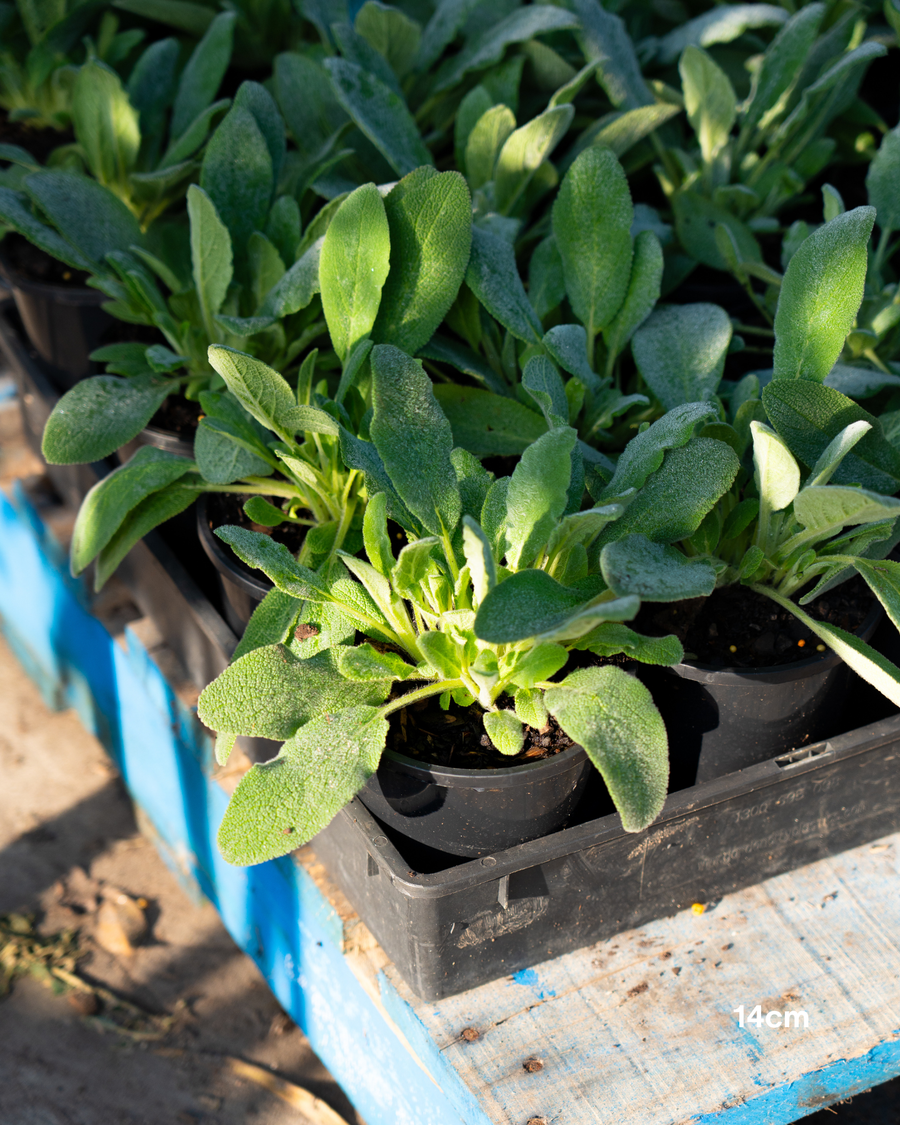
    Stachys byzantina Lamb's Ears

    Stachys byzantina, commonly known as Lamb's Ears, is a low-growing spreading perennial valued for its remarkably soft, silvery-white woolly foliage that has the texture of lamb's ears. The thick, fuzzy oval leaves form low dense mats of silver, creating one of the most distinctive textural foliage effects in the garden.

    It performs best in full sun to part shade with free-draining soil and is highly drought tolerant once established. Stachys byzantina spreads gently to form silver mats, suiting cottage gardens, sensory gardens, Mediterranean borders and as silver foliage contrast in mixed plantings. Tall pink-purple flower spikes appear through late spring and summer, though many gardeners remove them to keep the focus on the unique foliage.

    As a foliage groundcover in cottage, Mediterranean, sensory and contemporary gardens, in low borders, mass plantings and along pathways where the soft texture invites touch, Stachys byzantina brings silvery contrast, drought tolerance and a tactile quality children and visitors gravitate toward.

    Frequently Asked Questions

    About Stachys byzantina Lamb's Ears

    How tall does Stachys byzantina grow?

    Stachys byzantina foliage forms low mats around 20 to 30 centimetres tall and 45 to 60 centimetres wide, spreading gently to form dense silver groundcover. Flower spikes can reach 50 to 75 centimetres when in bloom.

    When does Stachys byzantina flower?

    Stachys byzantina produces tall pink-purple flower spikes through late spring and summer, rising well above the silver foliage. Some gardeners remove the flower spikes as they emerge to maintain a tidy carpet of foliage and concentrate the plant's energy into leaf growth.

    Where should I plant Stachys byzantina?

    Stachys byzantina grows best in full sun to part shade with free-draining soil. It suits cottage borders, Mediterranean gardens, sensory plantings, pathway edges and silver foliage features. Avoid humid, poorly drained or deeply shaded positions where the woolly leaves can rot.

    Is Stachys byzantina drought tolerant?

    Yes. Once established, Stachys byzantina is highly drought tolerant thanks to its silvery hairs that reflect heat and reduce water loss. Through establishment it benefits from light, regular watering, then transitions to occasional watering through dry periods.

    Is Stachys byzantina frost tolerant?

    Yes. Stachys byzantina is highly frost hardy, handling moderate to heavy frost once established. The silver foliage often takes on a slightly bronzed tinge in colder periods and recovers fully through spring.

    Can Stachys byzantina be grown in a pot?

    Yes. Stachys byzantina performs well in pots, raised planters and trough plantings, particularly where the silver foliage can spill over edges. Use a free-draining mix, water moderately and ensure the woolly leaves do not sit on wet soil.

    How do I maintain Stachys byzantina?

    Maintain Stachys byzantina by removing flower spikes as they fade, clipping back any rotted or damaged foliage in autumn, and lifting and dividing clumps every two to three years to refresh the planting. Avoid overhead watering, which can mat down the soft foliage.

    youtube Load video:

    Evergreen Trees Direct Has Been Featured In:

    Perfect Substitutes for Kalanchoe beharensis – Felt Bush

    Follow Us On Instagram

    @evergreentreesdirect ↗
    Evergreen Trees DirectEvergreen Trees DirectEvergreen Trees DirectEvergreen Trees DirectEvergreen Trees Direct
    youtube Load video: