





Cotyledon orbiculata var. oblonga ‘Macrantha’ – Pig’s Ear Succulent
Cotyledon orbiculata var. oblonga ‘Macrantha’ – Pig’s Ear Succulent
Most loved for its thick, moisture-storing foliage and sculptural form, providing strong structure in low-water and dry garden landscapes.
Regular price
$45.00
Sale price
$45.00
Regular price
Tax included.
Shipping calculated at checkout.
Pot size
Available batches
- Current height guide
- Please enquire
- Pot size
- 20cm
Approximate only. Minimum height important? Confirm with us.
Height guide & disclaimer
Height guide disclaimer: Height ranges are approximate only. As living products, plant heights naturally vary between individual plants, batches, and seasons. No guarantee is given that supplied plants will fall within the stated range. If minimum heights are required, you must confirm current batch heights with Evergreen Trees Direct prior to purchase. Variation in height is normal and is not grounds for return, refund, replacement, or compensation.
Quantity
Couldn't load pickup availability
About this tree
About this tree
- Mature height
- 0.4m to 0.6m (to 1m in flower)
- Mature width
- 0.6m to 1m
Cotyledon orbiculata var. oblonga 'Macrantha' is the Pig's Ear Succulent, an evergreen clumping plant with thick, paddle shaped grey-green leaves finely edged in red. The foliage is waxy and holds its colour all year on sturdy upright stems. Tall stems carry drooping orange-red bell flowers well above the leaves over summer.
It wants full sun to light shade and sharp drainage. Sandy or gravelly soil suits it; heavy wet clay does not. Growth is slow to moderate at 10 to 20 centimetres a year. Heat, wind and long dry periods are no trouble, but frost marks the leaves, so keep it to frost free spots.
Rockeries, raised beds, dry garden borders and containers are its usual homes. Landscapers use it in waterwise commercial plantings and coastal verges where irrigation is limited. Mass planted it forms a low grey band that reads well against dark mulch or rendered walls, and it asks for almost no upkeep.
Frequently Asked Questions
About Cotyledon orbiculata 'Macrantha'
What is Cotyledon orbiculata 'Macrantha'?
It is the Pig's Ear Succulent, an evergreen clumping plant from southern Africa with thick, paddle shaped leaves in grey-green, finely edged in red. The leaves are waxy and store water, giving the plant a solid, sculptural look. Tall stems carry hanging orange-red bell flowers through summer.
How big does it grow?
The foliage clump sits around 40 to 60 centimetres tall and spreads to roughly a metre over time as new rosettes form. Flower stems lift well above that, taking the plant close to a metre in summer. It spreads slowly, so it stays where you put it in a garden bed.
When does it flower?
Summer, from about December through February, on stems held clear of the foliage. The flowers are tubular orange to coral bells that hang downwards and are visited by honeyeaters. Cut the spent stems off at the base once the display finishes to keep the clump looking tidy.
Can it grow in pots?
Yes, and it is one of the better succulents for containers. Use a free draining cactus and succulent mix in a pot with drainage holes, and avoid a saucer that holds water underneath. Terracotta suits it because the mix dries faster. Water only when the mix has dried right through.
Is it frost tolerant?
No. Frost marks and rots the fleshy leaves, so grow it in frost free or sheltered positions. It is at home in warm temperate, subtropical and arid climates, and handles heat, wind and long dry periods without complaint. In cold districts keep it in a pot under an eave through winter.
Is it safe around pets and children?
No. Cotyledon orbiculata contains cardiac glycosides and all parts are toxic if eaten, to people, pets and livestock. It is a well documented poisoning risk for grazing stock. Plant it away from areas where small children or animals browse, and wash your hands after cutting stems or handling the sap.
How do I care for Cotyledon orbiculata 'Macrantha'?
Give it sun, sharp drainage and very little else. Water occasionally through summer and hold off through winter. Plants in the ground need no fertiliser, though potted specimens take a light succulent feed in spring. Remove spent flower stems and damaged leaves, and watch for mealybug in the leaf joints.
Mature height & width
Mature height & width
- Mature height
- 0.4m to 0.6m (to 1m in flower)
- Mature width
- 0.6m to 1m
Pot sizes & dimensions
Pot sizes & dimensions
| Pot / bag size | Width | Depth |
|---|---|---|
| 30cm Pot | 33cm | 30cm |
| 40cm/45L Pot | 44cm | 41.5cm |
| 50cm Pot / 70L Pot | 55cm | 41.8cm |
| 100L Bag | 50.6cm | 52.8cm |
| 150L Bag | 66cm | 55cm |
| 200L Bag | 71.5cm | 60.5cm |
| 300L Bag | 88cm | 63.8cm |
| 400L Bag | 99cm | 66cm |
| 500L Bag | 122cm | 66cm |
| 750L Bag | 134cm | 69cm |
| 1000L Bag | 146.3cm | 71.5cm |
| 2000L Bag | 176cm | 82.5cm |
General planting reference from our existing size guide. Actual containers can vary by supplier and batch; confirm exact dimensions if required.
Delivery & pickup
Delivery & pickup
Trade enquiries
Trade enquiries
We supply advanced trees to landscapers, developers, architects, and councils Australia-wide. Trade clients receive fast quotes, expert advice, and access to premium stock with reliable freight.
Freight estimate
Based on the items currently in your cart.
Final delivery cost is confirmed at checkout using your full address.
About Cotyledon orbiculata var. oblonga ‘Macrantha’
Cotyledon orbiculata var. oblonga 'Macrantha' is the Pig's Ear Succulent, an evergreen clumping plant with thick, paddle shaped grey-green leaves finely edged in red. The foliage is waxy and holds its colour all year on sturdy upright stems. Tall stems carry drooping orange-red bell flowers well above the leaves over summer.
It wants full sun to light shade and sharp drainage. Sandy or gravelly soil suits it; heavy wet clay does not. Growth is slow to moderate at 10 to 20 centimetres a year. Heat, wind and long dry periods are no trouble, but frost marks the leaves, so keep it to frost free spots.
Rockeries, raised beds, dry garden borders and containers are its usual homes. Landscapers use it in waterwise commercial plantings and coastal verges where irrigation is limited. Mass planted it forms a low grey band that reads well against dark mulch or rendered walls, and it asks for almost no upkeep.
Frequently Asked Questions
About Cotyledon orbiculata 'Macrantha'
What is Cotyledon orbiculata 'Macrantha'?
It is the Pig's Ear Succulent, an evergreen clumping plant from southern Africa with thick, paddle shaped leaves in grey-green, finely edged in red. The leaves are waxy and store water, giving the plant a solid, sculptural look. Tall stems carry hanging orange-red bell flowers through summer.
How big does it grow?
The foliage clump sits around 40 to 60 centimetres tall and spreads to roughly a metre over time as new rosettes form. Flower stems lift well above that, taking the plant close to a metre in summer. It spreads slowly, so it stays where you put it in a garden bed.
When does it flower?
Summer, from about December through February, on stems held clear of the foliage. The flowers are tubular orange to coral bells that hang downwards and are visited by honeyeaters. Cut the spent stems off at the base once the display finishes to keep the clump looking tidy.
Can it grow in pots?
Yes, and it is one of the better succulents for containers. Use a free draining cactus and succulent mix in a pot with drainage holes, and avoid a saucer that holds water underneath. Terracotta suits it because the mix dries faster. Water only when the mix has dried right through.
Is it frost tolerant?
No. Frost marks and rots the fleshy leaves, so grow it in frost free or sheltered positions. It is at home in warm temperate, subtropical and arid climates, and handles heat, wind and long dry periods without complaint. In cold districts keep it in a pot under an eave through winter.
Is it safe around pets and children?
No. Cotyledon orbiculata contains cardiac glycosides and all parts are toxic if eaten, to people, pets and livestock. It is a well documented poisoning risk for grazing stock. Plant it away from areas where small children or animals browse, and wash your hands after cutting stems or handling the sap.
How do I care for Cotyledon orbiculata 'Macrantha'?
Give it sun, sharp drainage and very little else. Water occasionally through summer and hold off through winter. Plants in the ground need no fertiliser, though potted specimens take a light succulent feed in spring. Remove spent flower stems and damaged leaves, and watch for mealybug in the leaf joints.
- Foliage
Evergreen (foliage year round)
- Position
- Form
- Use
- Mature height
- 0.4m to 0.6m (to 1m in flower)
- Mature width
- 0.6m to 1m
Planting Information
Recommended Planting Spacing For Your Cotyledon orbiculata var. oblonga ‘Macrantha’ – Pig’s Ear Succulent
Cotyledon orbiculata var. oblonga ‘Macrantha’ – Pig’s Ear Succulent is expected to grow 10cm to 20cm per year (slow to moderate).
Long Term Care For Your Cotyledon orbiculata var. oblonga ‘Macrantha’ – Pig’s Ear Succulent
Planting Your Cotyledon orbiculata var. oblonga ‘Macrantha’ – Pig’s Ear Succulent in Different Soil
Uses in my Garden
Uses in my Garden
Cotyledon orbiculata var. oblonga ‘Macrantha’ – Pig’s Ear Succulent works in an:
Is Cotyledon orbiculata var. oblonga ‘Macrantha’ – Pig’s Ear Succulent Evergreen or Deciduous?
Cotyledon orbiculata var. oblonga ‘Macrantha’ – Pig’s Ear Succulent is an Evergreen (foliage year round) Tree
Mature Height & Width
Mature Height: 0.4m to 0.6m (to 1m in flower)
Mature Width: 0.6m to 1m
Cotyledon orbiculata var. oblonga ‘Macrantha’ – Pig’s Ear Succulent is expected to grow 10cm to 20cm per year (slow to moderate).
Growth Rate of Cotyledon orbiculata var. oblonga ‘Macrantha’ – Pig’s Ear Succulent
Cotyledon orbiculata var. oblonga ‘Macrantha’ – Pig’s Ear Succulent is expected to grow 10cm to 20cm per year (slow to moderate).
They are considered to have a:
Frost Tolerance & Ideal Climate to plant Cotyledon orbiculata var. oblonga ‘Macrantha’ – Pig’s Ear Succulent
Is Cotyledon orbiculata var. oblonga ‘Macrantha’ – Pig’s Ear Succulent frost tolerant?
Cotyledon orbiculata var. oblonga ‘Macrantha’ – Pig’s Ear Succulent is Frost Sensitive – May suffer damage from frost, best in frost-free or protected spots.
Does Cotyledon orbiculata var. oblonga ‘Macrantha’ – Pig’s Ear Succulent Flower?
Cotyledon orbiculata var. oblonga ‘Macrantha’ produces clusters of bell-shaped flowers in shades of orange to red, typically in late winter to spring. The blooms rise above the fleshy grey-green foliage, offering a bold seasonal contrast and adding ornamental interest to succulent gardens.
Does Cotyledon orbiculata var. oblonga ‘Macrantha’ – Pig’s Ear Succulent flower?
Flowering Period:
Flower Type:
Flower Colour:
Not Applicable
Is Cotyledon orbiculata var. oblonga ‘Macrantha’ – Pig’s Ear Succulent an Australian Native Tree?
No
Cotyledon orbiculata var. oblonga ‘Macrantha’ – Pig’s Ear Succulent is Native to South Africa, where Cotyledon orbiculata grows naturally on rocky slopes and in dry, well-drained habitats.
What is the Wildlife Value of Cotyledon orbiculata var. oblonga ‘Macrantha’ – Pig’s Ear Succulent ?
Its tubular flowers provide a nectar source for bees and other pollinating insects when in bloom. While primarily valued as an ornamental succulent, it contributes to local biodiversity by supporting pollinators during its flowering period.
How much Sunlight does Cotyledon orbiculata var. oblonga ‘Macrantha’ – Pig’s Ear Succulent need?
Cotyledon orbiculata var. oblonga ‘Macrantha’ – Pig’s Ear Succulent will thrive best in:
Preferred Soil?
Cotyledon orbiculata var. oblonga ‘Macrantha’ performs best in free-draining sandy or gritty soils with a neutral pH. It will tolerate poor soils provided drainage remains excellent. Avoid heavy clay or waterlogged conditions, as excess moisture can quickly lead to root rot. Keep soil lightly moist during establishment, then allow it to dry between watering as the plant matures.
Is Cotyledon orbiculata var. oblonga ‘Macrantha’ – Pig’s Ear Succulent Drought Tolerant?
Is Cotyledon orbiculata var. oblonga ‘Macrantha’ – Pig’s Ear Succulent Drought tolerant?
As a young plant it benefits from light, regular watering to establish, particularly during warmer months. Once established, this variety shows excellent drought tolerance and thrives with minimal watering, making it well suited to low-water and arid-style plantings.
Frequently Asked Questions
Frequently Asked Questions
Compare sizes side by side
20cm
Enquire for current heights
Heights are approximate and vary between individual trees.
Cotyledon orbiculata var. oblonga ‘Macrantha’ is loved for its thick, moisture-storing foliage and sculptural form, providing strong structure in low-water and dry garden landscapes.
We take pride in supplying A+ grade advanced trees. When stock at our farm is not yet ready, we work with our trusted trade suppliers to source the best available trees for your garden.
Plant Your Cotyledon orbiculata var. oblonga ‘Macrantha’ – Pig’s Ear Succulent With:
Enriched Planting Mix (AO Certified)
Enriched Planting Mix is a certified organic blend of Pure Magic Compost, composted animal manure, gypsum, composted coarse bark and a wetting agent, bagged in 30L. It is built to be dug through existing garden soil at planting time rather than used on its own, and the gypsum is what sets it apart from a plain compost.
Gypsum helps break up heavy clay so water and roots can move through it, while the compost and manure return organic matter and nutrient to tired ground. The coarse bark holds structure and keeps air around the root zone, and the wetting agent keeps moisture in the soil longer after rain or watering.
Use it when planting trees, shrubs, roses, fruit trees and exotic garden plants, particularly into clay. Dig a hole twice the width of the pot and 7 centimetres deeper, then mix roughly one third planting mix through the excavated soil. Spread 7 centimetres of that improved soil in the base before setting the plant in.
Frequently Asked Questions
About Enriched Planting Mix
What is Enriched Planting Mix made from?
It is a blend of Pure Magic Compost, composted animal manure, gypsum, composted coarse bark and a wetting agent. Each part has a job. The compost and manure supply organic matter and nutrient, the gypsum works on clay structure, the bark keeps air around the roots and the wetting agent holds moisture in the soil.
What plants is it suitable for?
It suits exotic garden plants, including roses, ornamental and deciduous trees, fruit trees, shrubs and perennials, and it earns its keep most on heavy clay sites. It is a planting mix rather than a potting mix, so its job is improving soil at planting time. Phosphorus sensitive natives are the one clear exception.
Is it safe for natives?
No, not for the phosphorus sensitive ones. The composted animal manure in this blend lifts phosphorus well above what Proteaceae such as Banksia, Grevillea, Hakea and Protea will tolerate, and the result can be leaf burn, dieback and plant death. Use the Native Potting Mix for those species, or plant them into unimproved local soil.
Is it certified organic?
Yes. It is a certified organic product with no chemical additives, which is why the manure and compost in it are fully composted rather than raw. That makes it sound around fruit trees and vegetable beds, and it means you are adding genuine organic matter to your soil rather than a synthetic conditioner.
How much do I need?
Work on roughly one third planting mix to two thirds of the soil you dug out of the hole. For a shrub out of a 200 millimetre pot that is only a few litres. An advanced tree going into a large hole will take considerably more. Judge the quantity by the volume of the hole rather than the size of the plant.
Can I use it in pots?
It is not a potting mix and should not be used on its own in a container. The blend is designed to be diluted through garden soil, and used straight in a pot it holds too much water and settles badly. For containers, reach for a premium potting mix, or the native mix if you are potting natives.
Does it need to be watered in?
Yes. Water the plant well several hours before you plant it, then water thoroughly again once the hole is backfilled and the soil firmed down. That first deep watering settles the improved soil around the root ball and drives out air pockets. Keep the water up over the first few months while the roots establish.

Enriched Planting Mix (AO Certified)
Enriched Planting Mix (AO Certified)
Enriched Planting Mix is a certified organic blend of Pure Magic Compost, composted animal manure, gypsum, composted coarse bark and a wetting agent, bagged in 30L. It is built to be dug through existing garden soil at planting time rather than used on its own, and the gypsum is what sets it apart from a plain compost.
Gypsum helps break up heavy clay so water and roots can move through it, while the compost and manure return organic matter and nutrient to tired ground. The coarse bark holds structure and keeps air around the root zone, and the wetting agent keeps moisture in the soil longer after rain or watering.
Use it when planting trees, shrubs, roses, fruit trees and exotic garden plants, particularly into clay. Dig a hole twice the width of the pot and 7 centimetres deeper, then mix roughly one third planting mix through the excavated soil. Spread 7 centimetres of that improved soil in the base before setting the plant in.
Frequently Asked Questions
About Enriched Planting Mix
What is Enriched Planting Mix made from?
It is a blend of Pure Magic Compost, composted animal manure, gypsum, composted coarse bark and a wetting agent. Each part has a job. The compost and manure supply organic matter and nutrient, the gypsum works on clay structure, the bark keeps air around the roots and the wetting agent holds moisture in the soil.
What plants is it suitable for?
It suits exotic garden plants, including roses, ornamental and deciduous trees, fruit trees, shrubs and perennials, and it earns its keep most on heavy clay sites. It is a planting mix rather than a potting mix, so its job is improving soil at planting time. Phosphorus sensitive natives are the one clear exception.
Is it safe for natives?
No, not for the phosphorus sensitive ones. The composted animal manure in this blend lifts phosphorus well above what Proteaceae such as Banksia, Grevillea, Hakea and Protea will tolerate, and the result can be leaf burn, dieback and plant death. Use the Native Potting Mix for those species, or plant them into unimproved local soil.
Is it certified organic?
Yes. It is a certified organic product with no chemical additives, which is why the manure and compost in it are fully composted rather than raw. That makes it sound around fruit trees and vegetable beds, and it means you are adding genuine organic matter to your soil rather than a synthetic conditioner.
How much do I need?
Work on roughly one third planting mix to two thirds of the soil you dug out of the hole. For a shrub out of a 200 millimetre pot that is only a few litres. An advanced tree going into a large hole will take considerably more. Judge the quantity by the volume of the hole rather than the size of the plant.
Can I use it in pots?
It is not a potting mix and should not be used on its own in a container. The blend is designed to be diluted through garden soil, and used straight in a pot it holds too much water and settles badly. For containers, reach for a premium potting mix, or the native mix if you are potting natives.
Does it need to be watered in?
Yes. Water the plant well several hours before you plant it, then water thoroughly again once the hole is backfilled and the soil firmed down. That first deep watering settles the improved soil around the root ball and drives out air pockets. Keep the water up over the first few months while the roots establish.
Enriched Planting Mix (AO Certified)


Olea europaea 'Tolley's Upright' Low Fruiting Olive
Olea europaea 'Tolley's Upright' Low Fruiting Olive
Olea europaea 'Tolley's Upright', also known as the Tolley's Upright Olive, is an elegant evergreen olive cultivar known for its narrow, columnar form and silvery-green foliage. Growing up to 7 metres tall and 4 metres wide, it offers a striking vertical presence without the mess of fruit, making it ideal for low-maintenance landscapes.
Its moderate growth and excellent drought tolerance suit hedging, screening, street planting, and architectural garden designs. Thriving in full sun and well-drained soils, this olive tree withstands wind, coastal exposure, and poor soils. It responds well to pruning and shaping, perfect for formal hedges, topiary, pleaching, or as a sculptural focal point.
Tolley's Upright Olive is a resilient, versatile choice for modern and sustainable gardens requiring year-round structure and minimal upkeep.
Frequently Asked Questions
About Olea europaea 'Tolley's Upright' Low Fruiting Olive
How tall does Tolley's Upright Olive grow?
Tolley's Upright grows to around 7 metres tall and 4 metres wide with a striking narrow columnar form.
Does Tolley's Upright fruit?
Tolley's Upright is a low-fruiting cultivar producing only minimal fruit. This makes it ideal for landscaping and avoids the staining and mess of standard olive trees.
How fast does Tolley's Upright grow?
Moderate growth rate of 30-50cm per year, faster in well-drained warm conditions with full sun.
Is Tolley's Upright drought tolerant?
Yes. Tolley's Upright is highly drought tolerant once established and thrives in dry, exposed sites including coastal positions.
How far apart should I plant Tolley's Upright for a hedge or row?
Plant 1-1.5 metres apart for a tight formal hedge or columnar row. For individual feature spacing, plant 2-3 metres apart.
Can Tolley's Upright Olive grow in pots?
Yes. Tolley's Upright is excellent in large pots (minimum 60-80L) and is a popular choice for formal entrance planting and Mediterranean-style courtyards.
Is Tolley's Upright Olive frost tolerant?
Yes. Once established, Tolley's Upright handles frost well and copes with the cold winters of inland and elevated parts of southern Australia. Young trees are more vulnerable in their first winter, so mulch the root zone and avoid frost hollows where cold air settles. Drainage matters as much as temperature here, because cold wet soil does more damage than frost itself.
Olea europaea 'Tolley's Upright' Low Fruiting Olive

Westringia fruticosa – Coastal Rosemary
Westringia fruticosa – Coastal Rosemary
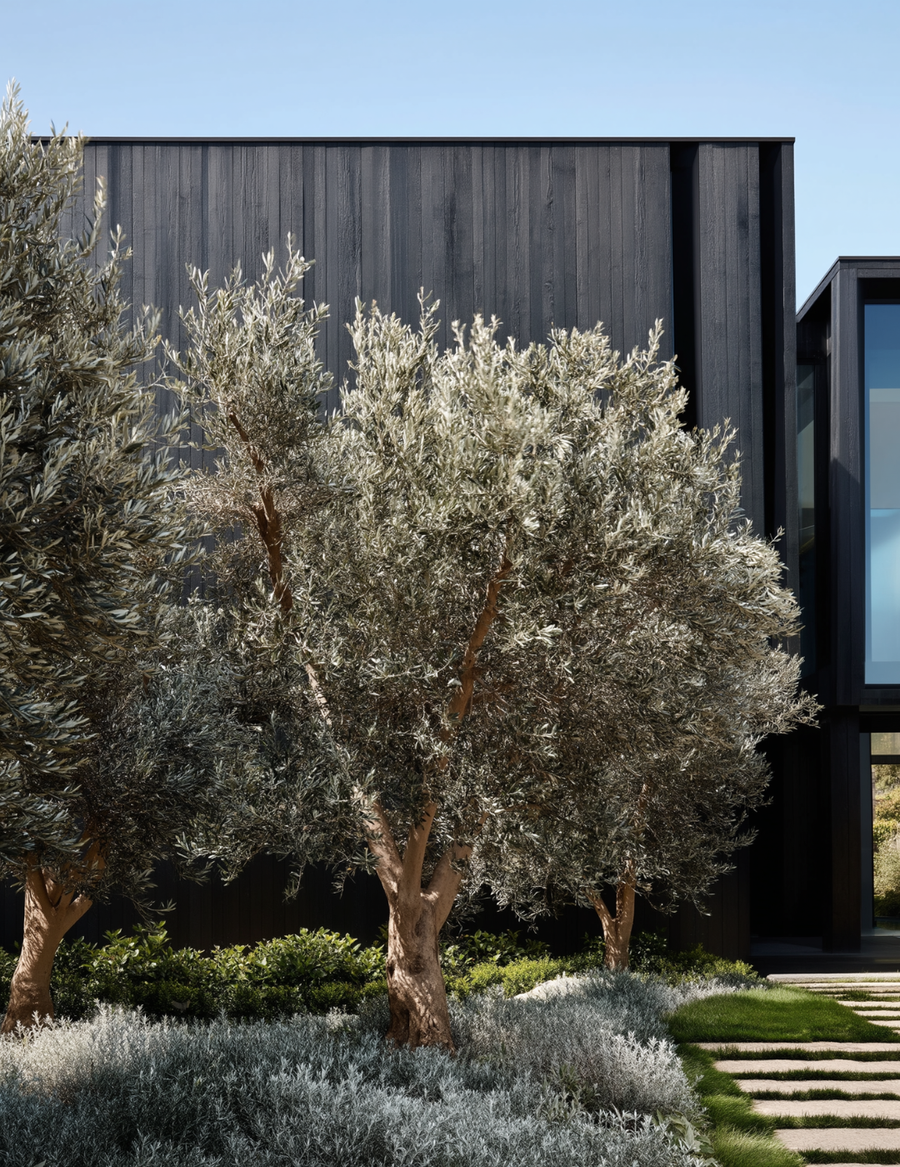
Westringia fruticosa, Coastal Rosemary, is an Australian native evergreen shrub from the headlands and dunes of the east coast. It builds a dense rounded bush of fine grey green leaves held in whorls, with small white to pale lilac flowers. Despite the common name it is not the culinary herb.
Mature plants sit at 1.5 to 2 metres tall and 1.5 to 2 metres wide, growing 30 to 60 centimetres a year, and they clip smaller without complaint. Full sun to part shade and sharp drainage are the requirements. Salt wind, sandy soil, drought and light to moderate frost are all handled.
It is a standard on coastal projects, road verges, council garden beds and exposed banks that need erosion cover. Plant 1 to 1.5 metres apart for an informal screen, or 80 centimetres for a clipped hedge. A single plant fills a 40 to 50 centimetre pot on a courtyard or balcony.
Frequently Asked Questions
About Coastal Rosemary
What is Coastal Rosemary?
Westringia fruticosa is an Australian native evergreen shrub from the headlands and dunes of the east coast. It forms a dense rounded bush of fine grey green leaves held in whorls, with small white to pale lilac flowers. Despite the common name it is not culinary rosemary and is not used in cooking.
How big does Coastal Rosemary grow?
Mature plants reach 1.5 to 2 metres tall and 1.5 to 2 metres wide. It clips readily to smaller dimensions and is often maintained at around a metre as a hedge or a low mound. Growth is moderate, roughly 30 to 60 centimetres a year, so it holds a trimmed shape well.
Is Coastal Rosemary suitable for coastal positions?
It is one of the best shrubs available for exposed coastal work. It grows naturally on sea cliffs and copes with salt laden wind, sand and reflected heat. It is used constantly on beachfront reserves, dune stabilisation projects and seaside gardens where little else holds a tidy shape.
When does Coastal Rosemary flower?
The main flush is spring and summer, roughly September through February, with scattered flowering at other times of the year in mild districts. The flowers are small, white to pale lilac and sit among the foliage rather than above it. Clipped hedges flower less than plants left to grow informally.
How far apart should I plant Coastal Rosemary for a hedge?
Space plants 80 centimetres apart for a tight formal hedge, or 1 to 1.5 metres apart for a dense informal screen. On banks and batters used for erosion cover, 1 metre in a staggered grid gives full ground coverage within about two growing seasons.
Can Coastal Rosemary grow in pots?
Yes. A pot 40 to 50 centimetres wide suits a single plant for a courtyard, entry or balcony. Use a free draining mix, because the roots will not tolerate sitting wet. Container plants need watering more often than those in the ground, plus a light trim to hold their shape.
How do I prune and care for Coastal Rosemary?
Trim lightly two or three times a year, taking the soft new growth and avoiding cuts into bare old wood, which reshoots poorly. Water through the first summer, then only in extended dry spells. On most soils it needs no feeding at all, and it resents heavy watering and poor drainage.
Westringia fruticosa – Coastal Rosemary


Leptospermum brachyandrum 'Jack Frost'
Leptospermum brachyandrum 'Jack Frost'
Leptospermum brachyandrum 'Jack Frost' is a compact form of the weeping tea tree, an Australian native evergreen with fine silver grey foliage on softly arching branches and smooth bark that peels away to cream and orange beneath. Small white flowers cover the branches through spring and into early summer.
It grows 30 to 50 centimetres a year to 2 to 3 metres tall and 1 to 2 metres wide. Full sun to part shade suits it, in soil that drains freely. Frost, coastal salt and dry periods are handled once established, and it performs from cool temperate through to subtropical districts.
The weeping habit and pale foliage make a good contrast against dark green natives, timber screens or rendered walls. Use it as a small feature tree, as an informal screen at 1 to 1.5 metres apart, or through a native or coastal garden. It suits nature strips and courtyards with limited root room.
Frequently Asked Questions
About 'Jack Frost' Tea Tree
What is Leptospermum brachyandrum 'Jack Frost'?
'Jack Frost' is a compact selection of the weeping tea tree, an Australian native in the family Myrtaceae. Its appeal is the fine silver grey foliage on weeping branches and the smooth bark that peels to show cream and orange tones underneath. White tea tree flowers appear in spring and early summer.
How big does 'Jack Frost' grow?
It reaches 2 to 3 metres tall and 1 to 2 metres wide, noticeably smaller than the species, which can make a tree of 6 metres or more. Growth of 30 to 50 centimetres a year gets it to useful size within a few seasons. The narrow width suits confined beds and side gardens.
Is the foliage variegated?
No. The silvery appearance comes from a fine covering on narrow, needle like leaves rather than any cream or white leaf margin. The colour is uniform across the plant and reads as pale silver grey from a distance. New growth carries the strongest silver tone, which softens slightly as the foliage matures.
When does it flower?
White tea tree flowers appear through spring and into early summer, roughly September to December, and are carried thickly along the arching branches. The display is short but heavy, and it draws native bees and other beneficial insects. Outside flowering, the silver foliage and peeling bark carry the plant year round.
Is it suitable for coastal gardens?
Yes. Leptospermum species are among the most reliable coastal plants in Australia, and 'Jack Frost' tolerates salt laden wind and sandy soil well once established. Give it free draining ground, avoid positions where water sits after rain, and keep water up for the first summer while roots take hold.
Does it have invasive roots?
No. The root system is fibrous and non aggressive, with no history of lifting paving or invading pipes, which makes it a sensible choice for nature strips, courtyards and beds near paths or pools. As with any tree, allow a reasonable soil volume and keep the plant clear of shallow services.
How do I care for 'Jack Frost' Tea Tree?
Water through the first summer, then only in extended dry spells. Prune lightly straight after flowering, tipping the growth to keep the plant dense, and avoid cutting back into bare old wood as tea trees reshoot poorly from it. Use a low phosphorus native fertiliser in spring and mulch the root zone.
Leptospermum brachyandrum 'Jack Frost'


Agonis flexuosa 'Burgundy' Willow Myrtle
Agonis flexuosa 'Burgundy' Willow Myrtle
Agonis flexuosa 'Burgundy' is a medium-sized evergreen Australian native grown for its rich burgundy-purple foliage and graceful weeping form. The deep leaf colour creates bold contrast against green plantings, while the lance-shaped leaves release a subtle aroma when crushed.
Burgundy Willow Myrtle grows to 5-7 metres tall and 3-4 metres wide with a soft weeping habit. The graceful form and manageable size suit informal screens, feature planting, avenue lines, residential gardens, and streetscapes. Small white flowers appear through spring and summer, adding a light seasonal display.
Burgundy Willow Myrtle is highly drought tolerant once established and also handles coastal exposure including salt spray and wind. It performs best in full sun to part shade across WA, SA, VIC, NSW and southern QLD, tolerating light frost once established.
Frequently Asked Questions
About Agonis flexuosa 'Burgundy' Willow Myrtle
How tall does Burgundy Willow Myrtle grow?
Burgundy Willow Myrtle grows to 5-7 metres tall and 3-4 metres wide with a graceful weeping form.
How fast does Agonis Burgundy grow?
Agonis Burgundy is moderately fast-growing, adding 40-60cm per year once established.
When does Agonis Burgundy flower?
Agonis flexuosa 'Burgundy' produces small clustered white flowers through spring and summer. While subtle, the blooms add a delicate contrast to its deep burgundy foliage, offering a light seasonal display.
Is Agonis Burgundy an Australian native?
Yes. Agonis flexuosa is native to south-western Western Australia. 'Burgundy' is a selected cultivar of the species with rich burgundy-purple foliage in place of the species' green leaves.
Is Agonis Burgundy drought tolerant?
Yes. Burgundy Willow Myrtle is highly drought tolerant once established and also handles coastal exposure including salt spray and sandy soils.
Where does Agonis Burgundy grow best in Australia?
Agonis Burgundy thrives across most of Australia, particularly in WA, SA, VIC, NSW, and southern QLD. It tolerates light frost once established and prefers full sun.
How far apart should I plant Agonis Burgundy?
Plant 3-4 metres apart for a feature row or informal screen, or 5 metres for individual canopy spread.
Agonis flexuosa 'Burgundy' Willow Myrtle


Syzygium australe 'Straight & Narrow' Lilly Pilly
Syzygium australe 'Straight & Narrow' Lilly Pilly
Syzygium australe 'Straight and Narrow' (PBR SAN01) is a tightly columnar evergreen Lilly Pilly, designed for high-density hedging and narrow planting spaces. Its slim form, reaching 5-8m tall but only 1-1.5m wide, is perfect for modern gardens where space is limited but vertical structure is desired.
They look excellent when used as a striking vertical screen or boundary hedge, providing year-round greenery with rich mid to dark green foliage and attractive reddish-bronze new growth. Summer fluffy white flowers and bird-attracting edible berries add seasonal interest.
For a polished effect, plant in rows spaced 80cm to 1.2m apart and maintain with annual or biannual pruning to keep the clean, architectural shape. 'Straight and Narrow' thrives in full sun to part shade and adapts well to well-drained soils. Its psyllid resistance and tolerance to urban conditions make it a reliable, low-maintenance choice for compact and contemporary landscapes.
Frequently Asked Questions
About Syzygium australe 'Straight & Narrow' Lilly Pilly
How tall does Straight & Narrow grow?
Straight & Narrow grows to 5-8 metres tall but only 1-1.5 metres wide, making it one of the narrowest lilly pilly cultivars available.
How wide does Straight & Narrow get?
It stays just 1-1.5 metres wide at maturity, making it ideal for narrow garden beds, tight boundaries, and small spaces where wider lilly pillies would be too bulky.
Is Straight & Narrow psyllid resistant?
Yes. Straight & Narrow shows good psyllid resistance, making it more reliable than older Syzygium cultivars across Australian gardens.
How fast does Straight & Narrow grow?
Straight & Narrow is fast-growing, adding 50-80cm per year once established in good conditions.
How far apart should I plant Straight & Narrow for a hedge?
Plant 80cm-1.2 metres apart for a continuous columnar screen.
Can Straight & Narrow grow in pots?
Yes. Its slim profile makes it an excellent pot plant for balconies, courtyards, and tight outdoor spaces. Use a minimum 50L pot with regular watering.
Does Straight & Narrow tolerate frost?
Straight & Narrow has moderate frost tolerance and copes with light or occasional frosts once established. Young plants are the most vulnerable, so in colder inland districts give them a sheltered position and protect them through their first couple of winters. Where frosts are heavy or prolonged, a hardier evergreen screen is the safer choice.
Syzygium australe 'Straight & Narrow' Lilly Pilly

Olea europaea 'Manzanillo' - Olive
Olea europaea 'Manzanillo' - Olive
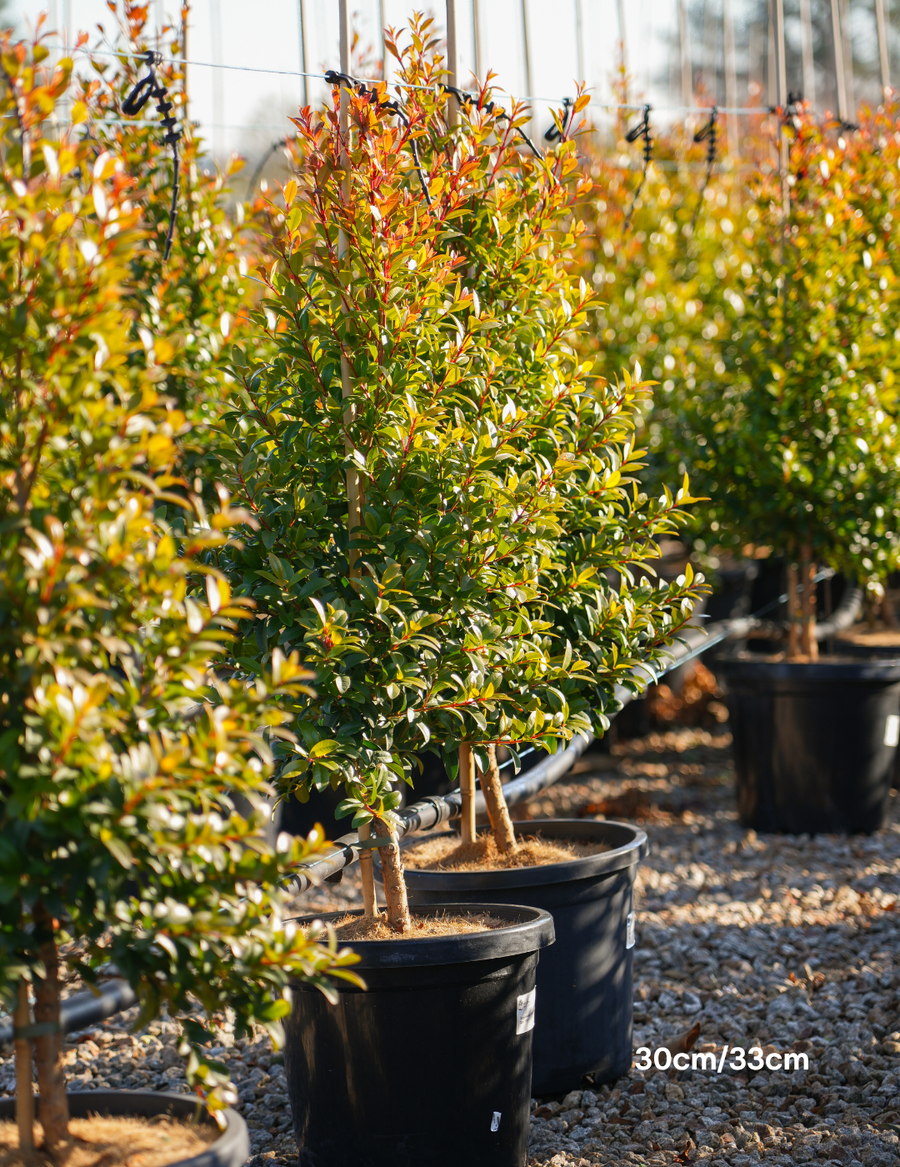
Olea europaea 'Manzanillo' is the classic Spanish table olive, a medium evergreen tree with a dense rounded canopy of silver-green foliage and a spreading branch habit. Fragrant creamy white flowers open in spring, followed by plump fruit suited to both curing and pressing. The open centre form is part of its appeal.
It wants full sun and drainage, and takes coastal exposure, urban conditions and poorer soils in its stride. Growth runs 30 to 60 centimetres a year to 4 to 6 metres tall and 3 to 4 metres wide. Highly drought tolerant once established, it needs an annual prune and little else.
Manzanillo works in productive gardens and small groves, as a clipped hedge at 80 centimetres to 1.5 metre spacing, in containers, or as a single feature. Its open crown lets light and air through the canopy, which supports fruit set. For anyone wanting fruit as well as form, it is where most Australian growers start.
Frequently Asked Questions
About Manzanillo Olive
What is a Manzanillo olive?
'Manzanillo' is a Spanish cultivar of Olea europaea and the best known table olive in the world. The fruit is round, meaty and easy to cure, and it also presses into good oil, so it is genuinely dual purpose. The tree is medium sized with a dense, spreading, silver-green canopy.
How big does the Manzanillo olive grow?
Expect 4 to 6 metres tall and 3 to 4 metres wide at maturity, with a spreading rounded shape. Most growers hold it near 3 metres with annual pruning so the fruit can be picked without a ladder. Allow the full width if you want the tree to develop its natural spreading form.
How far apart should I plant it for a hedge?
For a dense informal screen, plant 1 to 1.5 metres apart. For a tighter formal hedge, bring the spacing in to 80 centimetres. Measure centre to centre and keep the line straight, since olives clipped as a hedge show every gap. Hedged olives crop lightly, so set spacing by whether you want screening or fruit.
Does it need a pollinator?
'Manzanillo' is partly self-fertile, so a single tree will set some fruit. Yields improve substantially with a second variety flowering at the same time nearby, since pollen moves on the wind. One tree gives a modest home crop; in a grove, plant a pollinator such as 'Correggiola' through the rows.
When are the olives ready to pick?
Green table olives are picked in autumn, around March and April, before the skin colours. Black olives are left on the tree until late autumn or early winter, roughly May and June. Fruit for oil is picked when about half the crop has turned. All olives need curing in brine or salt before eating.
Where does it grow best in Australia?
It grows across most of southern Australia, doing best in Mediterranean and warm temperate climates with dry summers, including South Australia, Victoria, inland New South Wales and the south west of Western Australia. It also performs in coastal and urban gardens. Humid subtropical areas are harder, since wet summers encourage fungal problems.
How do I care for a Manzanillo olive tree?
Prune annually in late winter, thinning the centre so light reaches the inner wood, and keeping the height where you can reach it. Feed in early spring, water through flowering and fruit fill, then ease off. Remove suckers from the base. Watch for olive lace bug and scale, and treat early if either appears.
Olea europaea 'Manzanillo' - Olive

Lagerstroemia indica 'Natchez' White Crepe Myrtle
Lagerstroemia indica 'Natchez' White Crepe Myrtle
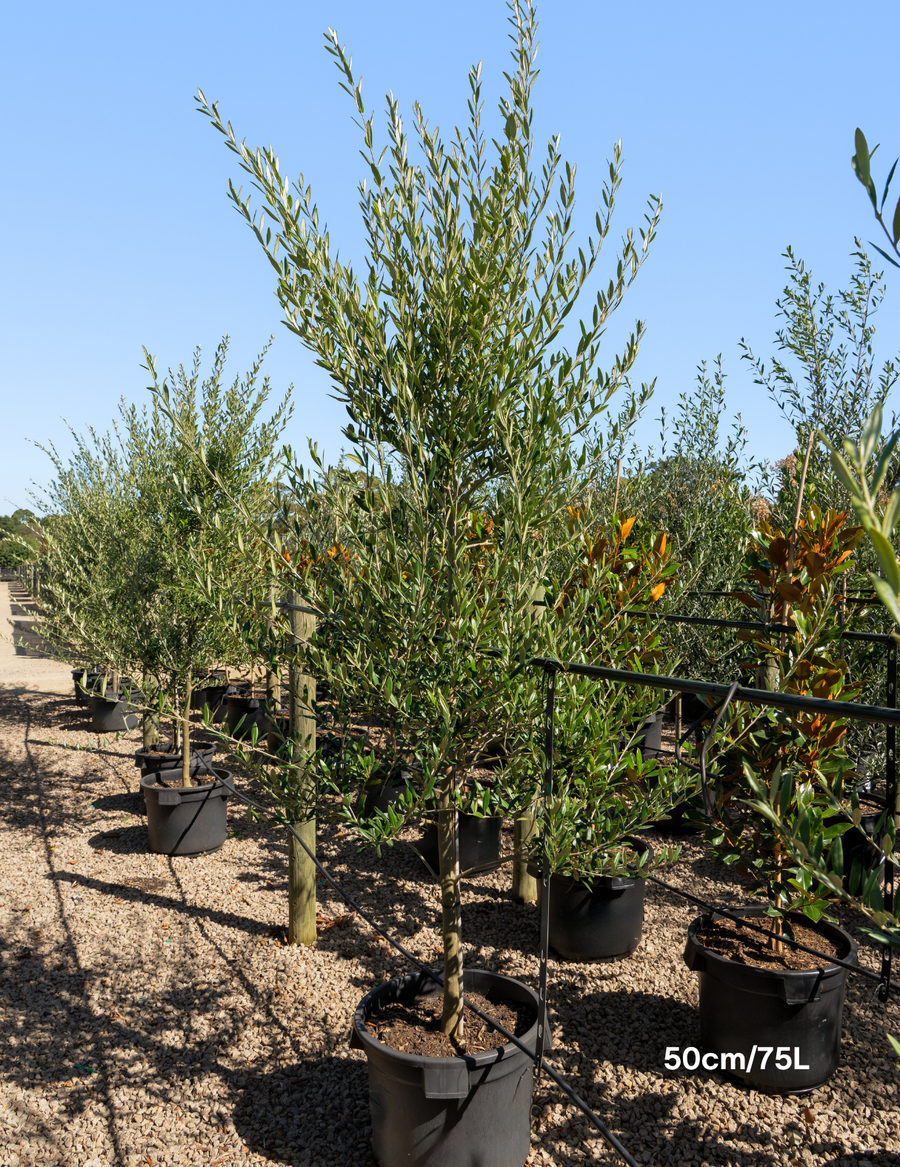
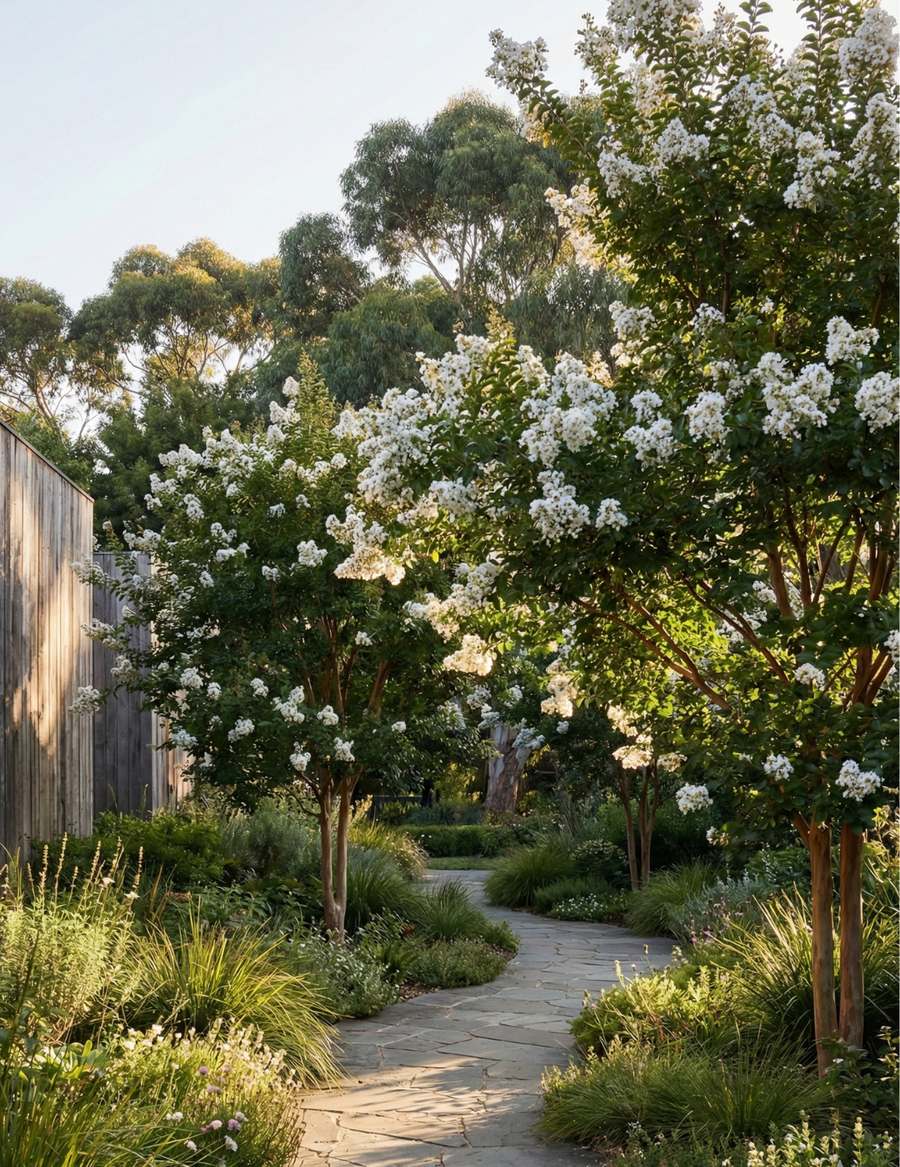
Lagerstroemia indica 'Natchez', known as White Crepe Myrtle, is a fast-growing, drought-tolerant flowering tree admired for its profuse white blooms, lush dark green foliage, and striking exfoliating bark. Growing 6-8 metres tall and 3-4 metres wide, it makes a bold statement in avenue plantings, residential gardens, and public landscapes.
Blooming from early summer through autumn, Natchez Crepe Myrtle offers months of beautiful floral display while its glossy leaves turn vibrant red-orange in autumn, adding seasonal contrast. The cinnamon-brown peeling bark reveals smooth cream and tan patches, providing visual interest year-round.
Thriving in full sun, this resilient tree tolerates heat, urban pollution, and poor soils. Its low-maintenance nature makes it perfect for busy homeowners, landscapers, and councils seeking reliable, long-lasting beauty. It looks excellent in sunny spaces, resonating with those who want a stunning, easy-care tree that brightens any landscape.
Frequently Asked Questions
About Lagerstroemia indica 'Natchez' White Crepe Myrtle
How tall does Natchez Crepe Myrtle grow?
Natchez grows to 6-8 metres tall and 3-4 metres wide, making it one of the larger crepe myrtle cultivars.
How fast does Natchez grow?
Natchez is moderately fast-growing, adding 50-80cm per year in warm conditions with adequate water.
When does Natchez flower?
Natchez produces masses of pure white blooms from early summer through to autumn, typically December to April across most Australian climates.
Is Natchez drought tolerant?
Yes. Natchez is highly drought and heat tolerant once established, and thrives in full sun positions across most Australian climates.
How far apart should I plant Natchez for an avenue?
Plant 4-5 metres apart for a full canopy avenue, or 2-3 metres for a denser flowering screen.
Is Natchez deciduous?
Yes. Natchez is deciduous. Leaves turn vibrant red-orange in autumn and drop in winter, revealing its striking cinnamon-brown exfoliating bark.
How do I prune Natchez Crepe Myrtle?
Prune in late winter while the tree is bare, taking out crossing branches, thin twiggy growth and any suckers from the base. Avoid the hard topping often inflicted on crepe myrtles, which spoils the natural vase shape and hides the exfoliating bark. Light structural pruning is enough. Flowers form on new wood, so a tidy up before spring costs you nothing in summer.
Lagerstroemia indica 'Natchez' White Crepe Myrtle

Evergreen Trees Direct Has Been Featured In:


Perfect Substitutes for Cotyledon orbiculata var. oblonga ‘Macrantha’ – Pig’s Ear Succulent
Follow Us On Instagram
@evergreentreesdirect ↗





Tips & Tricks

Best Trees for Creating a Privacy Screen: 10 Picks Across Fast Formal, Native and Narrow Column Options
Read the story
How to Incorporate Trees into Your Modern Landscape Design
Read the story
The Importance of Root Health: How to Choose Quality Trees
Read the story


