



Skip to content

VOLUME DISCOUNTS APPLY AUTOMATICALLY AT CHECKOUT.

All stock is grown, maintained and graded in strict accordance with AS 4373-2007, Australian Standard for Nursery Stock.

Best Evergreen Trees: Our 6 Reliable Picks

Best Evergreen Trees: Our 6 Reliable Picks

Evergreen trees keep gardens looking dressed all year. From fast hedges to feature trees, here are six evergreens that work hard in Australian conditions, and how to choose between them.

Australian GardensEvergreen TreesFeature TreesHedgingTree Selection

Evergreen trees do the unglamorous work of holding the garden together. They give you structure when the deciduous trees are bare, privacy when you need it, and a backdrop that makes the seasonal plants look better. The right evergreen choice depends on the role it has to play.

The six evergreens below cover the full range we sell as advanced specimens — fast tall screens, soft natives, polished features, fragrant compacts and Mediterranean classics. Each one is reliable across most of the country once established, and each one earns its place in the garden for a specific reason.

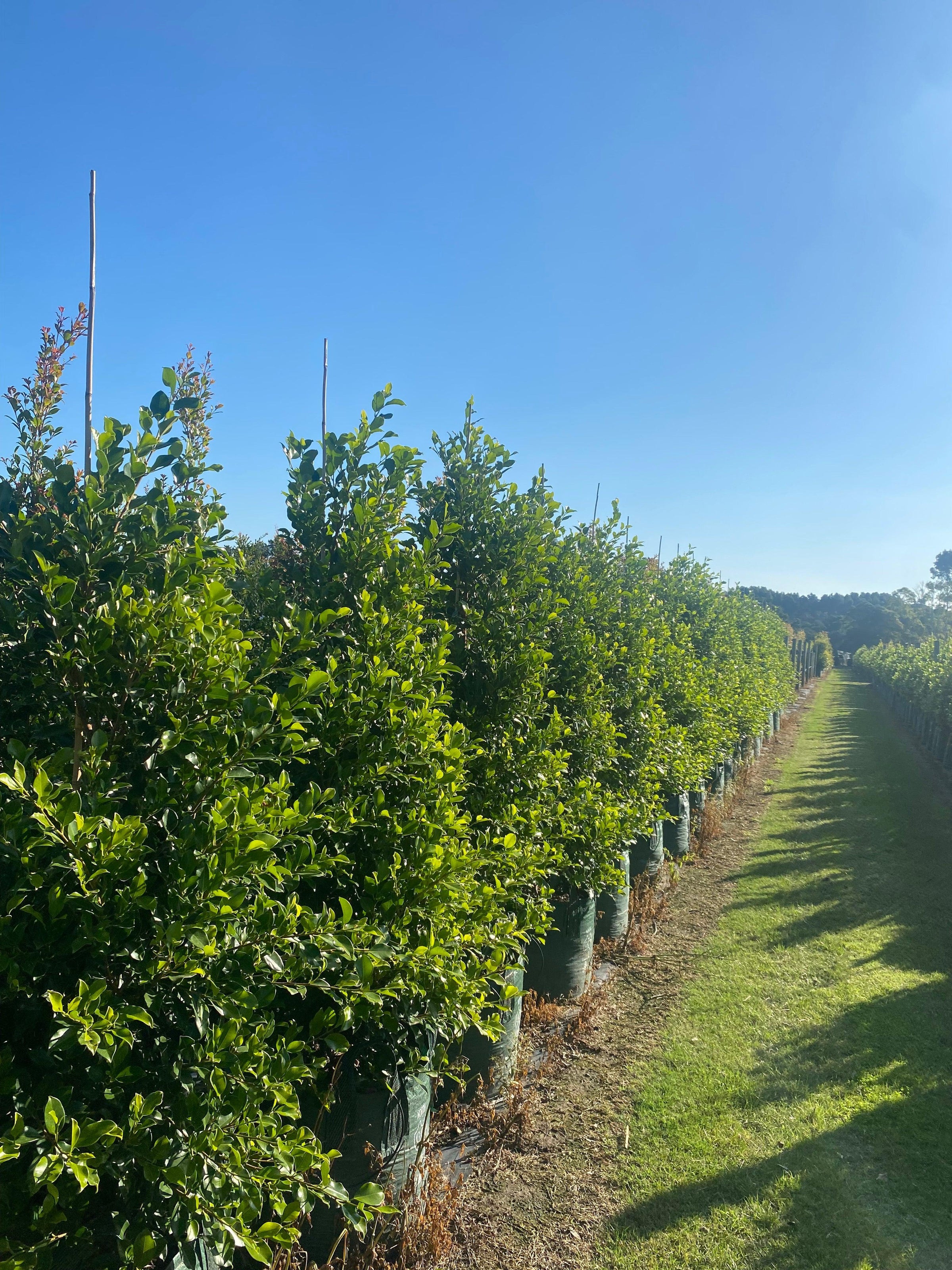
  • Ficus hillii — the fast evergreen workhorse. Dense glossy foliage, fast establishment, and takes shaping into a clean knife-edge screen. The pick when you want a tall hedge inside two seasons.
  • Waterhousea floribunda — soft Australian native screen with pendulous foliage that moves in the breeze. A relaxed weeping habit and pink-bronze new growth, ideal for informal native privacy.
  • Magnolia 'Coolwyn Gloss' — the polished evergreen feature Magnolia. Exceptionally glossy foliage, large fragrant white summer flowers, and a tidy upright frame. The natural anchor for a designed garden.
  • Murraya paniculata — the most fragrant compact hedge you can plant. Glossy dark foliage and bursts of intensely scented white flowers through warm months. Made for entries and courtyards.
  • Olea 'Manzanillo' — the productive Mediterranean olive. Silver-green foliage, sculptural trunk, and abundant olives in autumn. Drought tolerant and very low maintenance.
  • Laurus nobilis 'Miles Choice' — the improved Bay with denser habit and consistent dark green aromatic foliage. The Mediterranean formal hedge with culinary value built in.

Compare at a glance

CultivarHeightWidthFormFoliageBest if you…
Ficus microcarpa var. hillii
Ficus Hillii
8 to 30m, can be pruned to desired heightPruned to fitDense columnar when clippedLarge glossy dark greenBoundary privacy, tall hedges, fast screens.
Waterhousea floribunda
Weeping Lilly Pilly
6 to 10m, can be pruned to desired height3 to 5mSoft weeping crownGlossy green pendulous, evergreenNative hedges, softer screens, large garden feature trees.
Magnolia grandiflora 'Coolwyn Gloss'
Coolwyn Gloss Magnolia
5 to 7m, can be pruned to desired height2.5 to 3.5mUpright, dense, neatExceptionally glossy dark greenFeature trees, polished entries, formal driveways.
Murraya paniculata
Orange Jasmine
2 to 4m, can be pruned to desired height1.5 to 2.5mDense, rounded, takes a clipped wall wellGlossy dark green, evergreenLow to medium hedges, courtyard walls, fragrant entries.
Olea europaea 'Manzanillo'
Manzanillo Olive
5 to 8m, can be pruned to desired height4 to 6mOpen, sculptural, with character trunkSilver-green, evergreenMediterranean gardens, feature trees, courtyards, edible production.
Laurus nobilis 'Miles Choice'
Miles Choice Bay Tree
3 to 6m, can be pruned to desired height1.5 to 2.5mUpright, dense, takes formal shapes wellAromatic dark green, evergreenFormal hedges, clipped topiary, kitchen gardens, courtyards.
Decide the role first
Evergreens fill four roles: tall fast privacy (Ficus hillii, Waterhousea), polished feature (Coolwyn Gloss), compact fragrant front (Murraya), and Mediterranean character (Manzanillo, Bay 'Miles Choice'). Pick the role, the species follows.
Match to the climate
Waterhousea loves humid coastal and warm-temperate gardens. Ficus hillii rewards full sun in frost-free positions. Murraya is happiest in warm climates. Manzanillo and Bay 'Miles Choice' are made for dry Mediterranean conditions. Coolwyn Gloss handles a wide range.
Formal or soft
Ficus hillii, Bay 'Miles Choice' and Murraya take a tight clipped face cleanly. Waterhousea reads as soft weeping. Manzanillo carries a sculptural open habit. Coolwyn Gloss sits in the middle — upright and tidy without going strictly formal.
Native or introduced
Waterhousea is the only Australian native on this list. The other five are introduced species long established in Australian gardens, each chosen for a specific look the natives don't quite cover.
Speed of establishment
Ficus hillii and Waterhousea establish fastest — a full screen inside two seasons in good soil with consistent water. Coolwyn Gloss and Murraya are moderate. Manzanillo and Bay 'Miles Choice' are slower and steadier.
Maintenance you actually want to do
Most of these evergreens take two or three light prunes a year. Manzanillo and Coolwyn Gloss are the lowest maintenance once established — a single shaping cut keeps them tidy. Pick the maintenance level you'll actually keep up with.

1. Ficus microcarpa var. hillii (Ficus Hillii)

Ficus hillii is the fast evergreen workhorse. The choice when you want a tall, dense, glossy boundary screen quickly. Dense small glossy dark green foliage and bronze new growth on a clean upright form.

Type
Fast-growing evergreen hedge
Height
8 to 30m, can be pruned to desired height
Width
Pruned to fit
Growth rate
Very fast
Foliage
Large glossy dark green
Form
Dense columnar when clipped
Conditions
Full sun to part shade, drought tolerant once established
Maintenance
Two to three light clips a year.
Best for
Boundary privacy, tall hedges, fast screens.

Why choose it

When speed and density matter most, Ficus hillii is the answer. The fastest tall evergreen privacy screen in cultivation and the cleanest formal face once it's clipped in.

Perfect pair

Layers beautifully with Star Jasmine as a fragrant groundcover, Japanese Box Topiary Balls as sculptural punctuation, Lagerstroemia 'Natchez' as a deciduous flowering feature in front of the green wall, Ligularia reniformis for big-leafed groundcover contrast, and Betula 'Moss White' as a multi-stem feature behind the hedge line.

Tips for planting

Plant at 1m spacing for a dense clipped hedge. Tip prune early to build a dense base. Two to three light prunes a year keeps the formal face clean.

The fastest evergreen privacy hedge in Australia.

Shop Ficus microcarpa var. hillii

2. Waterhousea floribunda (Weeping Lilly Pilly)

Waterhousea floribunda is the soft Australian native hedger. Pendulous foliage that ripples in the breeze, a relaxed weeping habit, and pink-bronze new growth that gives the screen a constant warm flush. A reliable performer in suburban gardens wanting native screening without going formal.

Type
Evergreen native hedge
Height
6 to 10m, can be pruned to desired height
Width
3 to 5m
Growth rate
Moderate to fast
Foliage
Glossy green pendulous, evergreen
Flowers
Small white in summer, attractive to native pollinators
Form
Soft weeping crown
Conditions
Full sun to part shade, most soils, moisture loving
Maintenance
Light clipping for hedges, two to three times a year.
Best for
Native hedges, softer screens, large garden feature trees.

Why choose it

When you want a native hedge that moves with the breeze instead of holding stiff, Waterhousea is the pick.

Perfect pair

Layers beautifully with Japanese Box Topiary Balls as sculptural punctuation, Acer palmatum as a sheltered courtyard feature, and Gardenia 'Magnifica' as a fragrant evergreen midstorey.

Tips for planting

Plant at 1m spacing for a dense screen. Mulch heavily — this one likes a bit more soil moisture. Two light prunes a year keeps the weeping habit tidy.

The soft native screen with movement.

Shop Waterhousea floribunda

3. Magnolia grandiflora 'Coolwyn Gloss' (Coolwyn Gloss Magnolia)

Coolwyn Gloss is the polished evergreen feature Magnolia. Exceptionally glossy foliage on a tidy upright frame, large fragrant white flowers, and serious presence as a single feature or as a refined hedge.

Type
Evergreen feature or hedge
Height
5 to 7m, can be pruned to desired height
Width
2.5 to 3.5m
Growth rate
Moderate
Foliage
Exceptionally glossy dark green
Flowers
Large fragrant creamy white
Form
Upright, dense, neat
Conditions
Full sun to part shade, free-draining soil
Maintenance
Low. Light prune after flowering.
Best for
Feature trees, polished entries, formal driveways.

Why choose it

When the rest of the garden is calm and you want one evergreen tree to anchor it, Coolwyn Gloss is the answer.

Perfect pair

Pair with Crepe Myrtle 'Tuscarora' for a deep pink summer counterpoint.

Tips for planting

Excellent in coastal-influenced gardens. Mulch annually.

The polished evergreen feature Magnolia.

Shop Magnolia grandiflora 'Coolwyn Gloss'

4. Murraya paniculata (Orange Jasmine)

Murraya paniculata is the fragrant evergreen hedger. Glossy dark foliage and bursts of intensely scented white flowers through warm months. The hedge that smells as good as it looks.

Type
Evergreen flowering hedge
Height
2 to 4m, can be pruned to desired height
Width
1.5 to 2.5m
Growth rate
Moderate to fast
Foliage
Glossy dark green, evergreen
Flowers
Highly fragrant white clusters, spring through autumn
Form
Dense, rounded, takes a clipped wall well
Conditions
Full sun to part shade, free-draining soil, prefers frost-free positions when young
Maintenance
Clip after flowering flushes.
Best for
Low to medium hedges, courtyard walls, fragrant entries.

Why choose it

Murraya brings genuine fragrance, the kind that stops you when you walk past.

Perfect pair

Pair with a Bradford Pear (Pyrus calleryana 'Bradford') as a deciduous shade feature above.

Tips for planting

Plant at 1m spacing for a dense hedge. Prefers warm climates and well-drained soil. Clip lightly after each flowering flush.

The hedge that smells as good as it looks.

Shop Murraya paniculata

5. Olea europaea 'Manzanillo' (Manzanillo Olive)

Olea 'Manzanillo' is the productive Mediterranean olive. Silver-green foliage, gnarled architectural form, and abundant olives in autumn. Drought tolerant, heat tolerant, and very low maintenance.

Type
Evergreen feature or fruit tree
Height
5 to 8m, can be pruned to desired height
Width
4 to 6m
Growth rate
Moderate
Foliage
Silver-green, evergreen
Flowers
Small creamy spring, followed by olives in autumn
Form
Open, sculptural, with character trunk
Conditions
Full sun, free-draining soil, drought tolerant, handles 30°C and above happily
Maintenance
Light winter prune for shape only.
Best for
Mediterranean gardens, feature trees, courtyards, edible production.

Why choose it

When the garden needs structure, character, and very little water, Manzanillo earns its place.

Perfect pair

Pair with Murraya paniculata as a fragrant evergreen low hedge underneath.

Tips for planting

Prefers well-drained soil. Mulch with gravel or coarse pebble for the full Mediterranean look. Light winter shaping cut is enough.

The sculptural, productive Mediterranean evergreen.

Shop Olea europaea 'Manzanillo'

6. Laurus nobilis 'Miles Choice' (Miles Choice Bay Tree)

Laurus nobilis 'Miles Choice' is the improved compact form of the traditional Bay Tree. Aromatic culinary foliage, tidy upright habit, and an excellent clipped hedger for Mediterranean-leaning gardens.

Type
Evergreen hedge or feature
Height
3 to 6m, can be pruned to desired height
Width
1.5 to 2.5m
Growth rate
Slow to moderate
Foliage
Aromatic dark green, evergreen
Flowers
Small creamy spring
Form
Upright, dense, takes formal shapes well
Conditions
Full sun to part shade, free-draining soil, coastal tolerant
Maintenance
Light clipping for shape.
Best for
Formal hedges, clipped topiary, kitchen gardens, courtyards.

Why choose it

Miles Choice is the Bay to plant when you want a clipped formal evergreen with culinary value.

Perfect pair

Pair with a Manchurian Pear (Pyrus ussuriensis) for a deciduous canopy of spring flowers and autumn colour.

Tips for planting

Slow but reliable. Plant in groups of three for a Mediterranean feel.

The classic clipped culinary evergreen.

Shop Laurus nobilis 'Miles Choice'

How to plant and care for them

Pick the position
Match sun exposure to the species. Most want full sun. Waterhousea tolerates part shade. Hedging species want the position where the home most needs the screen.
Prepare the planting hole
Dig the hole twice the width of the rootball and the same depth. Mix the original soil with aged compost rather than replacing it. For hedges, trench the full row rather than digging individual holes.
Plant level
Set the rootball so the top sits level with surrounding soil, never deeper. Backfill with the soil and compost mix, firm gently and leave a watering well at the surface.
Plant hedges at 1m spacing
Use 1m spacing for any hedge in this list. Closer spacing crowds the root zone; wider spacing leaves gaps. Feature trees go in single positions with the mature width clear of buildings and other trees.
Water in deeply
Soak the rootball thoroughly at planting so the new soil settles around the roots. Any season works with the right watering rhythm — morning and evening for the first two weeks in summer, daily for the first week in cooler months.
Mulch annually
Lay 50 to 75mm of organic mulch each spring, kept 50mm clear of the trunk. Mulch keeps roots cool, holds moisture and feeds the soil as it breaks down.
Prune to the role
Hedges take two to three light prunes a year. Feature trees ask for very little — a single shaping cut after flowering keeps Coolwyn Gloss and Manzanillo tidy. Resist the urge to hard prune.
Feed in early spring
A balanced slow-release fertiliser in early spring is enough for any tree on this list. Established Manzanillo and Bay 'Miles Choice' often need no supplementary feed at all.

The wrap up

The six reliable evergreens split cleanly by role. Ficus hillii and Waterhousea carry tall fast privacy. Coolwyn Gloss anchors the designed garden as a feature. Murraya holds the fragrant compact front. Manzanillo and Bay 'Miles Choice' bring Mediterranean character.

Pick the species for the role. Plant level, water deeply through the first two summers, prune lightly to shape rather than hard back. Evergreens are the bones of the garden — these six are the ones we'd plant ourselves.