

Viburnum plicatum – Japanese Snowball
Viburnum plicatum – Japanese Snowball
Couldn't load pickup availability
Current Stock Height Guides
Current Stock Height Guides
Height guide disclaimer: Height ranges are approximate only. As living products, plant heights naturally vary between individual plants, batches, and seasons. No guarantee is given that supplied plants will fall within the stated range. If minimum heights are required, you mustconfirm current batch heights with Evergreen Trees Direct prior to purchase. Variation in height is normal and is not grounds for return, refund, replacement, or compensation.
Mature Height & Width
Mature Height & Width
Mature Height: 2m to 3m
Mature Width: 2m to 3m
Viburnum plicatum – Japanese Snowball is expected to grow 20cm to 40cm per year under suitable conditions.
Root Ball Dimensions
Root Ball Dimensions
Use this as a reference when digging your planting hole. We recommend digging at least 10% wider than the dimensions below to encourage strong root development.
- 30cm Pot: 33cm (W) × 30cm (D)
- 40cm/45L Pot: 44cm (W) × 41.5cm (D)
- 50cm Pot / 70L Pot: 55cm (W) × 41.8cm (D)
- 100L Bag: 50.6cm (W) × 52.8cm (D)
- 150L Bag: 66cm (W) × 55cm (D)
- 200L Bag: 71.5cm (W) × 60.5cm (D)
- 300L Bag: 88cm (W) × 63.8cm (D)
- 400L Bag: 99cm (W) × 66cm (D)
- 500L Bag: 122cm (W) × 66cm (D)
- 750L Bag: 134cm (W) × 69cm (D)
- 1000L Bag: 146.3cm (W) × 71.5cm (D)
- 2000L Bag: 176cm (W) × 82.5cm (D)
Trade
Trade
We supply advanced trees to landscapers, developers, architects, and councils Australia-wide. Trade clients receive fast quotes, expert advice, and access to premium stock with reliable freight.
Shipping
Shipping
Shipping is calculated at checkout based on the pallet space your order occupies in the truck and your delivery location.
There is no charge to calculate your freight.
Contact
Contact
Have a question or a list to send through to us?
Email: sales@evergreentrees.com.au
Phone: (03) 7042 3318
Share this product
About Your New Viburnum plicatum – Japanese Snowball
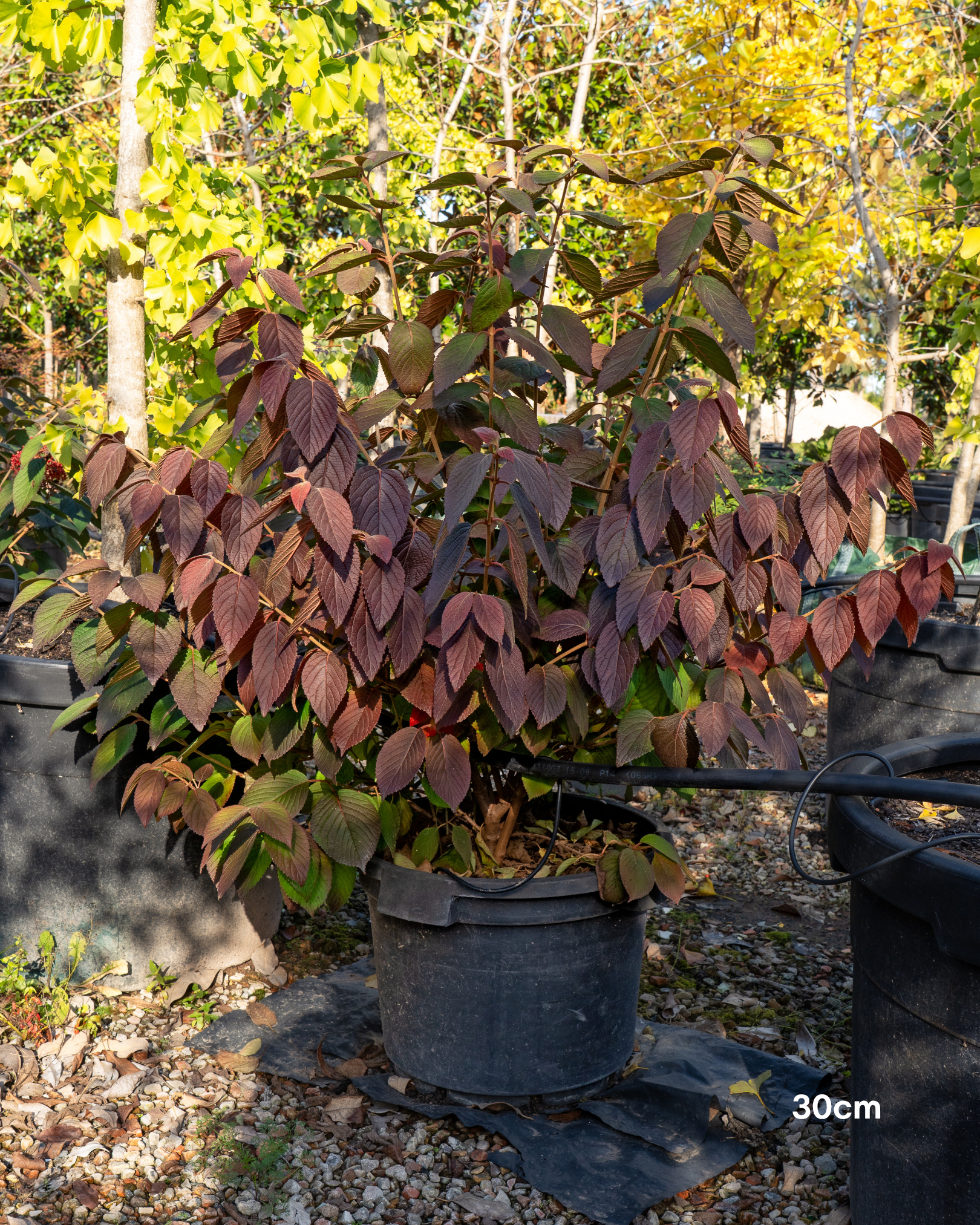
Viburnum plicatum, sold as Japanese Snowball, is a deciduous shrub built around tiered horizontal branching and pleated, deeply veined leaves. White flowers sit along the upper face of each layer in spring, so the plant reads as a series of flowering shelves rather than a single mounded shape.
It is frost hardy and grows in full sun through to part shade, with light afternoon shade helping the foliage in hot inland districts. Moist, free-draining soil enriched with organic matter suits it best. Growth is moderate, and mature plants settle at 2 to 3 metres tall and 2 to 3 metres wide in cool temperate and temperate climates.
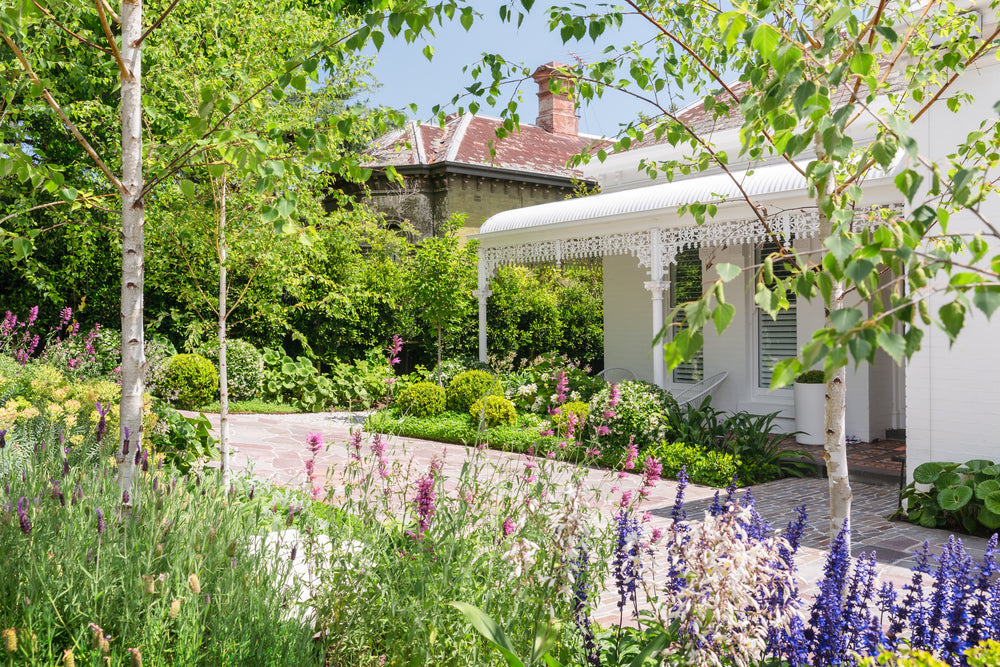
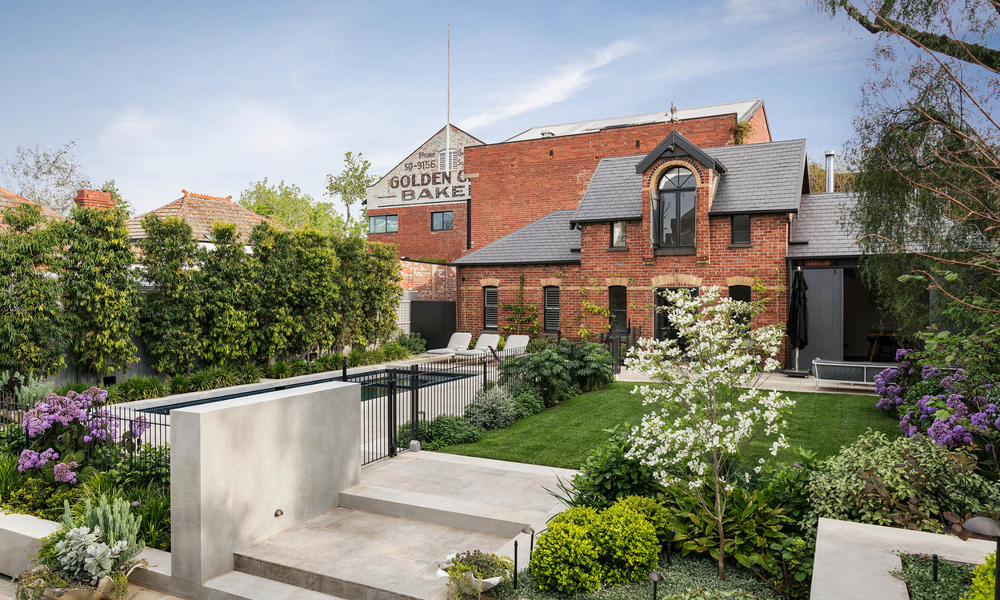
The horizontal habit reads well against paving, rendered walls and open lawn, which makes it a feature shrub for courtyards and cottage gardens or an informal screen through a mixed border. Flowering runs from September to November, and the foliage colours before leaf drop. Where a project wants seasonal structure rather than year-round bulk, this is a sound choice.
Frequently Asked Questions
About Viburnum plicatum
What is Viburnum plicatum?
Viburnum plicatum is a deciduous shrub from Japan, China and Taiwan, grown for its strongly tiered horizontal branching and white spring flowers. Two forms are commonly sold. Viburnum plicatum f. tomentosum carries flat lacecap heads with a ring of showy sterile florets, while the cultivar ‘Sterile’ produces the rounded snowball heads. Stock supplied as the species may be either.
How big does Viburnum plicatum grow?
Mature plants reach 2 to 3 metres tall and 2 to 3 metres wide, spreading as wide as they are high because of the layered branch structure. Allow the full width when siting it, as the tiers are the point of the plant and crowding them loses the effect. It rarely needs cutting back to stay in bounds.
When does Viburnum plicatum flower?
Flowering runs through spring, from about September to November depending on the district, with the display lasting several weeks. Flowers are white and open along the top of each horizontal branch. Cooler districts tend to flower a little later and hold the display longer than warm coastal gardens.
Is Viburnum plicatum evergreen or deciduous?
It is deciduous. The leaves colour through autumn and drop for winter, leaving the tiered branch framework exposed, which is one of the more attractive things about the plant in the cold months. New foliage returns in early spring, usually just ahead of or alongside the flowers.
Is Viburnum plicatum frost tolerant?
Yes, it is frost hardy and handles heavy and repeated frost without damage, which is why it performs so well in the Victorian ranges, the Adelaide Hills and the NSW tablelands. A late frost after bud break can occasionally spoil part of a season's flowering, but the plant itself is unharmed.
Does Viburnum plicatum need sun or shade?
Full sun gives the heaviest flowering and the tightest tiered habit. Part shade is fine and is the better option in hot inland gardens, where afternoon shade keeps the leaves from scorching through summer. Deep shade thins the plant out and reduces flowering, so avoid planting it under a dense canopy.
How do I care for Viburnum plicatum?
Water deeply through dry spells for the first two summers, then as needed in hot weather. Mulch to 75 millimetres, kept clear of the stems. Feed with a slow release fertiliser in early spring. Prune straight after flowering and only to remove dead or crossing wood, since hard pruning destroys the tiered form that gives the shrub its character.
Evergreen Trees Direct Has Been Featured In:


Uses in my Garden
Uses in my Garden
Viburnum plicatum – Japanese Snowball works in an:
Is Viburnum plicatum – Japanese Snowball Evergreen or Deciduous?
Is Viburnum plicatum – Japanese Snowball Evergreen or Deciduous?
Viburnum plicatum – Japanese Snowball is an Deciduous (Defoliates throughout colder months) Tree
Mature Height & Width
Mature Height & Width
Mature Height: 2m to 3m
Mature Width: 2m to 3m
Viburnum plicatum – Japanese Snowball is expected to grow 20cm to 40cm per year under suitable conditions.
Growth Rate of Viburnum plicatum – Japanese Snowball
Growth Rate of Viburnum plicatum – Japanese Snowball
Viburnum plicatum – Japanese Snowball is expected to grow 20cm to 40cm per year under suitable conditions.
They are considered to have a:
Frost Tolerance & Ideal Climate to plant Viburnum plicatum – Japanese Snowball
Frost Tolerance & Ideal Climate to plant Viburnum plicatum – Japanese Snowball
Is Viburnum plicatum – Japanese Snowball frost tolerant?
Viburnum plicatum – Japanese Snowball is Frost Hardy – Survives heavy and frequent frost without damage.
Does Viburnum plicatum – Japanese Snowball Flower?
Does Viburnum plicatum – Japanese Snowball Flower?
Viburnum plicatum flowers through spring, from about September to November, with white heads lining the upper side of every horizontal branch. Lacecap forms carry a ring of large sterile florets around fertile centres, while the snowball cultivar carries dense rounded heads.
Does Viburnum plicatum – Japanese Snowball flower?
Flowering Period:
Flower Type:
Flower Colour:
White
Is Viburnum plicatum – Japanese Snowball an Australian Native Tree?
Is Viburnum plicatum – Japanese Snowball an Australian Native Tree?
No
Viburnum plicatum – Japanese Snowball is Native to Japan, China and Taiwan, where it grows in open woodland, forest margins and along stream banks.
What is the Wildlife Value of Viburnum plicatum – Japanese Snowball ?
What is the Wildlife Value of Viburnum plicatum – Japanese Snowball ?
The spring flowers draw bees and hoverflies, and the fertile florets on lacecap forms set small fruit that birds take in autumn. The layered branch structure gives small birds a sheltered place to perch and forage, adding useful habitat value to an ornamental garden.
How much Sunlight does Viburnum plicatum – Japanese Snowball need?
How much Sunlight does Viburnum plicatum – Japanese Snowball need?
Viburnum plicatum – Japanese Snowball will thrive best in:
Preferred Soil?
Preferred Soil?
Viburnum plicatum performs best in fertile, free-draining loam with plenty of organic matter and a slightly acidic to neutral pH. It will grow in heavier soils once they are opened up with compost, but it dislikes both dry sandy ground and positions that stay wet after rain. Keep the root zone mulched and evenly moist through spring and summer for the strongest flowering.
Is Viburnum plicatum – Japanese Snowball Drought Tolerant?
Is Viburnum plicatum – Japanese Snowball Drought Tolerant?
Is Viburnum plicatum – Japanese Snowball Drought tolerant?
Viburnum plicatum is only moderately drought tolerant and prefers soil that stays evenly moist. Water deeply through dry spells for the first two summers, and expect wilting and early leaf drop if a mature plant is left dry through a long hot summer. Mulch does most of the work of holding moisture.

Planting Information
How To Plant Your Viburnum plicatum – Japanese Snowball
How To Plant Your Viburnum plicatum – Japanese Snowball
Recommended Planting Spacing For Your Viburnum plicatum – Japanese Snowball
Recommended Planting Spacing For Your Viburnum plicatum – Japanese Snowball
Viburnum plicatum – Japanese Snowball is expected to grow 20cm to 40cm per year under suitable conditions.
Long Term Care For Your Viburnum plicatum – Japanese Snowball
Long Term Care For Your Viburnum plicatum – Japanese Snowball
Planting Your Viburnum plicatum – Japanese Snowball in Different Soil
Planting Your Viburnum plicatum – Japanese Snowball in Different Soil
Frequently Asked Questions
Frequently Asked Questions