Olea europaea 'Mission' - Olive Tree
Olea europaea 'Mission' - Olive Tree
Most loved as a self fertile, dual purpose olive with black fruit for the table or oil, on an upright, silvery evergreen frame.
Regular price
$680.00
Sale price
$680.00
Regular price
Tax included.
Shipping calculated at checkout.
Pot size
Available batches
- Current height guide
- Please enquire
- Pot size
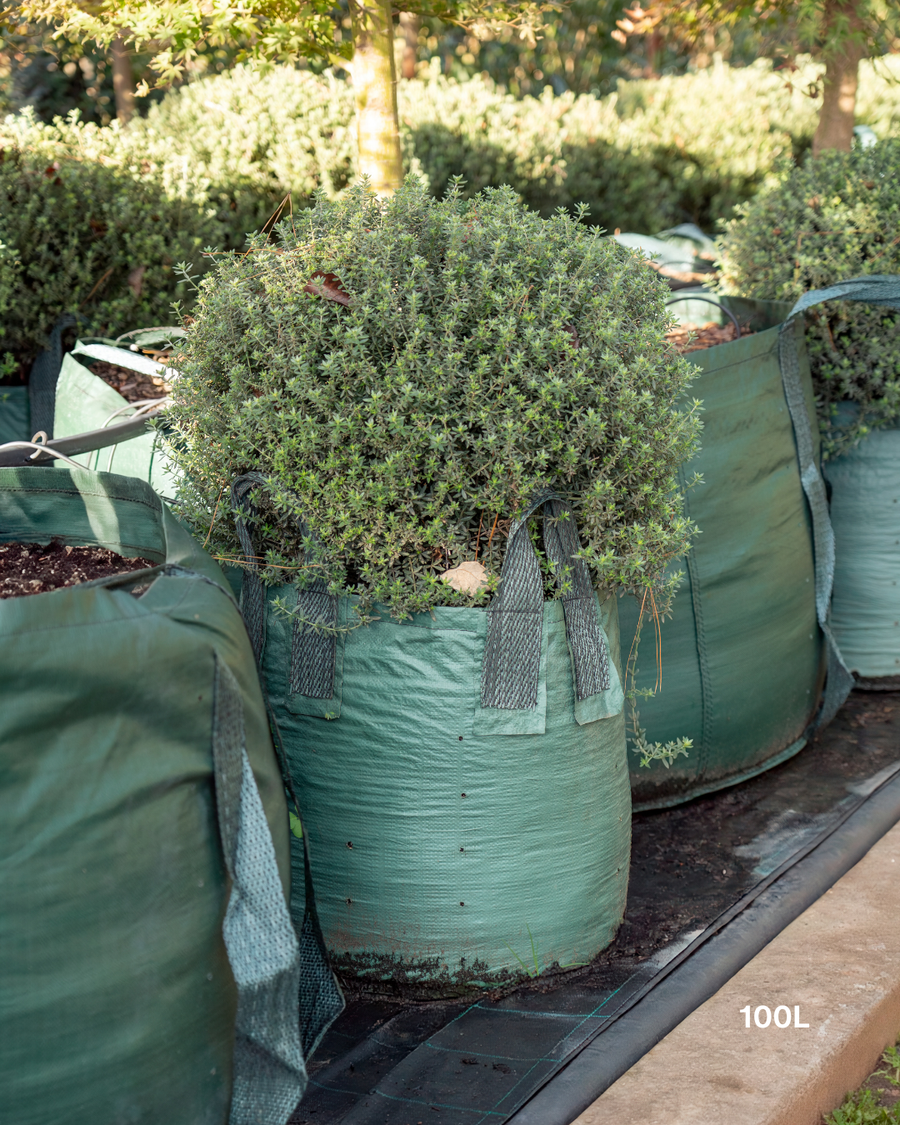
- 90L/100L
Approximate only. Minimum height important? Confirm with us.
Height guide & disclaimer
Height guide disclaimer: Height ranges are approximate only. As living products, plant heights naturally vary between individual plants, batches, and seasons. No guarantee is given that supplied plants will fall within the stated range. If minimum heights are required, you must confirm current batch heights with Evergreen Trees Direct prior to purchase. Variation in height is normal and is not grounds for return, refund, replacement, or compensation.
Quantity
Couldn't load pickup availability
About this tree
About this tree
- Mature height
- 6m to 9m (approx.)
- Mature width
- 4m to 6m (approx.)
Olea europaea 'Mission' is a dual purpose olive. It crops reliably on its own and its fruit ripens from green to glossy black, suiting both table olives and oil. Silvery grey green leaves hold year round, so it earns its place as a feature tree as well as a fruiting one.
It grows upright with a single trunk and a rounded canopy, reaching about 6 to 9 metres tall and 4 to 6 metres wide in open ground. It is more upright than most olives and one of the more cold hardy varieties. Pruning keeps it at whatever height suits the garden or a large pot.
Give it full sun and soil that drains freely. Once established it handles drought, heat, wind, coastal exposure and poor soil, and tolerates light to moderate frost. Use it as a feature or avenue tree, in a Mediterranean or courtyard garden, or in a small home grove.
Frequently Asked Questions
About Mission Olive
How big does a Mission olive grow?
About 6 to 9 metres tall and 4 to 6 metres wide in open ground. Regular pruning holds it smaller, and it adapts to large pots.
Does it need another tree to fruit?
No. It is self fertile and crops on its own. Planting another variety nearby, such as 'Manzanillo' or 'Frantoio', can lift yields.
Are the olives for eating or oil?
Both. Pick green or black for curing as table olives, or let them ripen fully black for oil.
When does it fruit?
Small cream flowers appear in spring and the fruit ripens through late autumn into winter.
Is it drought tolerant?
Yes, once established. Water regularly for the first two summers. Fruiting trees crop better with deep watering through dry spells.
Is it frost tolerant?
Yes. 'Mission' is one of the more cold hardy olives and handles light to moderate frost once established.
When should I prune it?
In late winter or early spring. Thin the centre to let light in and remove suckers from the base. Olives fruit on the previous year's growth, so avoid heavy cuts every year.
Mature height & width
Mature height & width
- Mature height
- 6m to 9m (approx.)
- Mature width
- 4m to 6m (approx.)
Pot sizes & dimensions
Pot sizes & dimensions
| Pot / bag size | Width | Depth |
|---|---|---|
| 30cm Pot | 33cm | 30cm |
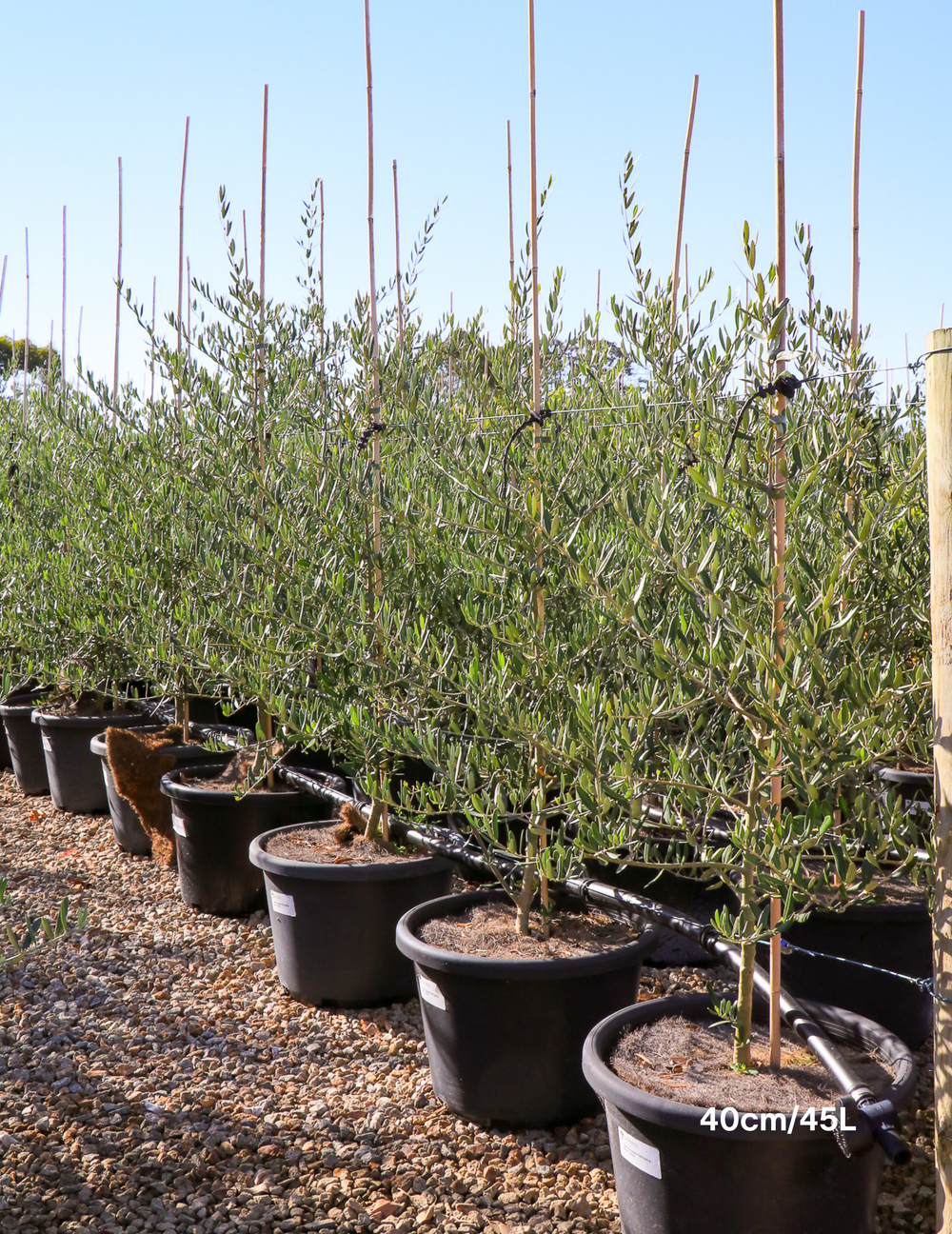
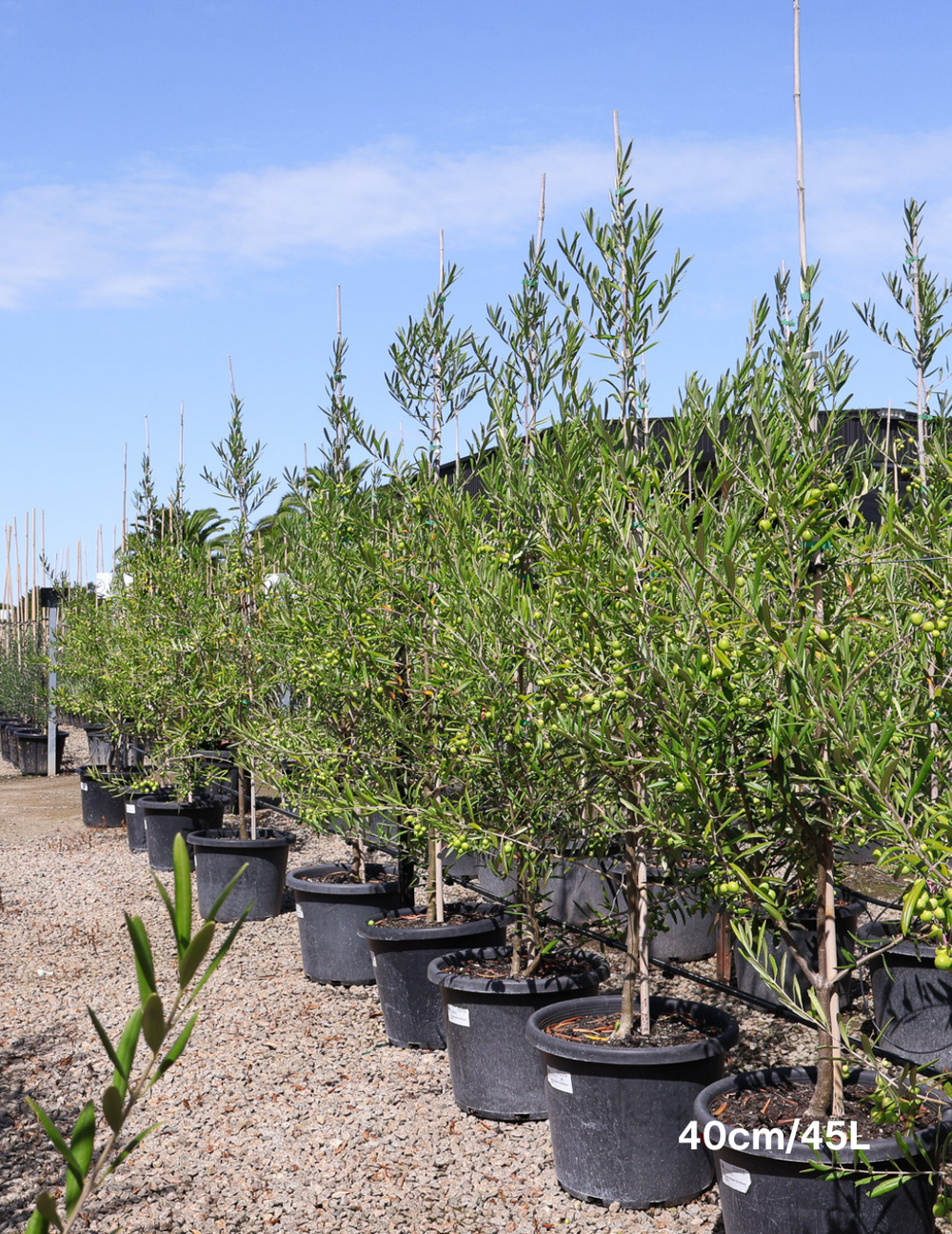
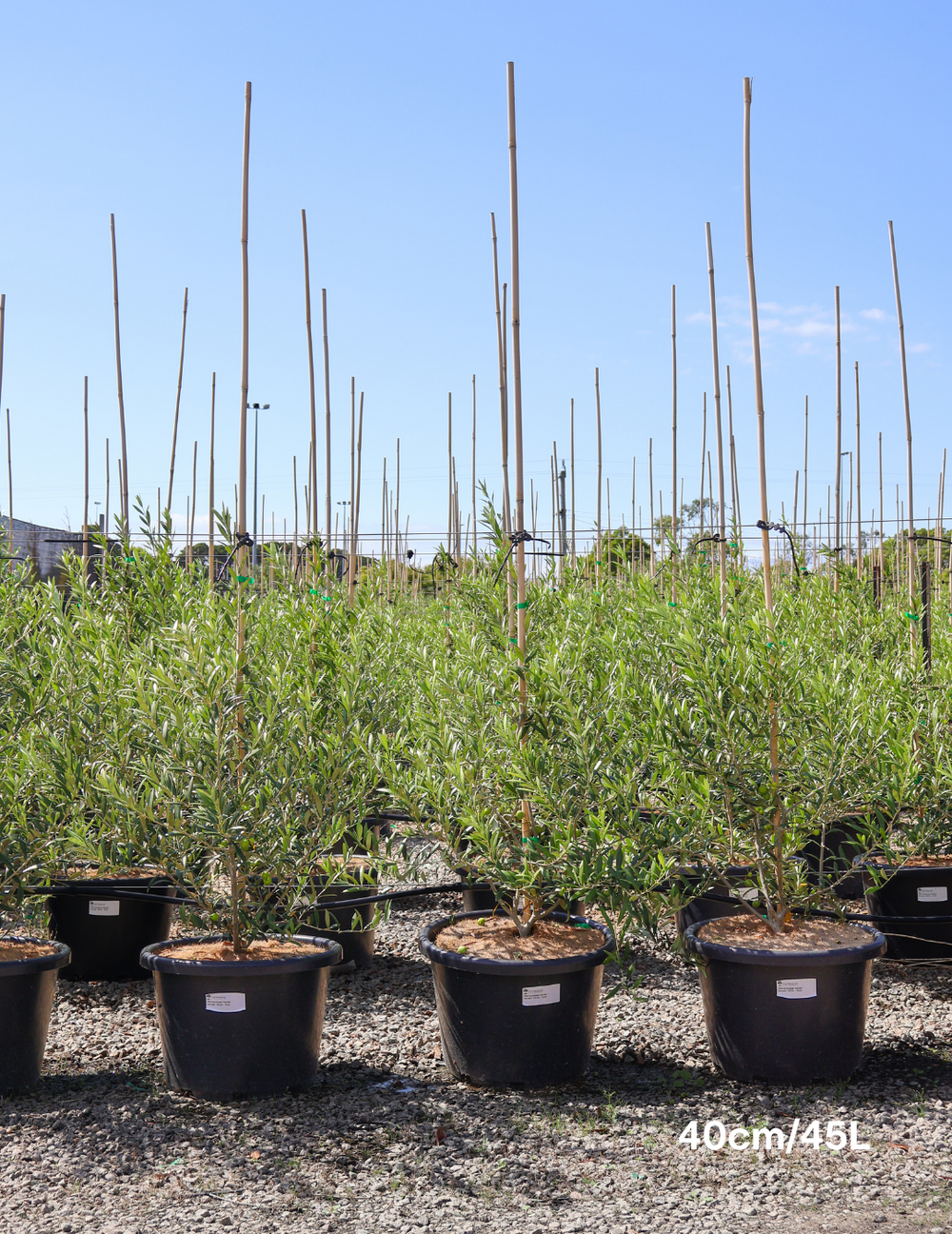
| 40cm/45L Pot | 44cm | 41.5cm |
| 50cm Pot / 70L Pot | 55cm | 41.8cm |
| 100L Bag | 50.6cm | 52.8cm |
| 150L Bag | 66cm | 55cm |
| 200L Bag | 71.5cm | 60.5cm |
| 300L Bag | 88cm | 63.8cm |
| 400L Bag | 99cm | 66cm |
| 500L Bag | 122cm | 66cm |
| 750L Bag | 134cm | 69cm |
| 1000L Bag | 146.3cm | 71.5cm |
| 2000L Bag | 176cm | 82.5cm |
General planting reference from our existing size guide. Actual containers can vary by supplier and batch; confirm exact dimensions if required.
Delivery & pickup
Delivery & pickup
Trade enquiries
Trade enquiries
We supply advanced trees to landscapers, developers, architects, and councils Australia-wide. Trade clients receive fast quotes, expert advice, and access to premium stock with reliable freight.
Freight estimate
Based on the items currently in your cart.
Final delivery cost is confirmed at checkout using your full address.
Not sure how many trees you need?
Plan your hedge
Enter the length of your boundary, then choose how closely you want to plant.
Enter your boundary length to see how many trees you need.
Measure only the boundary you intend to plant—exclude gates and gaps. Spacing is centre to centre. Quantities are rounded up for one row, allowing roughly half the spacing at each end. Site conditions and pruning affect the final hedge.
About Olea europaea 'Mission'
Olea europaea 'Mission' is a dual purpose olive. It crops reliably on its own and its fruit ripens from green to glossy black, suiting both table olives and oil. Silvery grey green leaves hold year round, so it earns its place as a feature tree as well as a fruiting one.
It grows upright with a single trunk and a rounded canopy, reaching about 6 to 9 metres tall and 4 to 6 metres wide in open ground. It is more upright than most olives and one of the more cold hardy varieties. Pruning keeps it at whatever height suits the garden or a large pot.
Give it full sun and soil that drains freely. Once established it handles drought, heat, wind, coastal exposure and poor soil, and tolerates light to moderate frost. Use it as a feature or avenue tree, in a Mediterranean or courtyard garden, or in a small home grove.
Frequently Asked Questions
About Mission Olive
How big does a Mission olive grow?
About 6 to 9 metres tall and 4 to 6 metres wide in open ground. Regular pruning holds it smaller, and it adapts to large pots.
Does it need another tree to fruit?
No. It is self fertile and crops on its own. Planting another variety nearby, such as 'Manzanillo' or 'Frantoio', can lift yields.
Are the olives for eating or oil?
Both. Pick green or black for curing as table olives, or let them ripen fully black for oil.
When does it fruit?
Small cream flowers appear in spring and the fruit ripens through late autumn into winter.
Is it drought tolerant?
Yes, once established. Water regularly for the first two summers. Fruiting trees crop better with deep watering through dry spells.
Is it frost tolerant?
Yes. 'Mission' is one of the more cold hardy olives and handles light to moderate frost once established.
When should I prune it?
In late winter or early spring. Thin the centre to let light in and remove suckers from the base. Olives fruit on the previous year's growth, so avoid heavy cuts every year.
- Foliage
Evergreen (foliage year round)
- Position
- Form
- Use
- Mature height
- 6m to 9m (approx.)
- Mature width
- 4m to 6m (approx.)
Planting Information
Recommended Planting Spacing For Your Olea europaea 'Mission' - Olive Tree
Olea europaea 'Mission' - Olive Tree is expected to grow 30cm to 50cm per year (approx.).
Long Term Care For Your Olea europaea 'Mission' - Olive Tree
Planting Your Olea europaea 'Mission' - Olive Tree in Different Soil
Uses in my Garden
Uses in my Garden
Olea europaea 'Mission' - Olive Tree works in an:
Is Olea europaea 'Mission' - Olive Tree Evergreen or Deciduous?
Olea europaea 'Mission' - Olive Tree is an Evergreen (foliage year round) Tree
Mature Height & Width
Mature Height: 6m to 9m (approx.)
Mature Width: 4m to 6m (approx.)
Olea europaea 'Mission' - Olive Tree is expected to grow 30cm to 50cm per year (approx.).
Growth Rate of Olea europaea 'Mission' - Olive Tree
Olea europaea 'Mission' - Olive Tree is expected to grow 30cm to 50cm per year (approx.).
They are considered to have a:
Frost Tolerance & Ideal Climate to plant Olea europaea 'Mission' - Olive Tree
Is Olea europaea 'Mission' - Olive Tree frost tolerant?
Olea europaea 'Mission' - Olive Tree is Frost Tolerant – Can handle light to moderate frost once established.
Does Olea europaea 'Mission' - Olive Tree Flower?
Olea europaea 'Mission' carries small, lightly scented cream flowers in spring. Fruit sets through summer and ripens from green to glossy black in late autumn and winter.
Does Olea europaea 'Mission' - Olive Tree flower?
Flowering Period:
Flower Type:
Flower Colour:
Cream
Is Olea europaea 'Mission' - Olive Tree an Australian Native Tree?
No
Olea europaea 'Mission' - Olive Tree is Native to Olea europaea is native to the Mediterranean basin. 'Mission' was selected at the Spanish missions of California and is grown worldwide for table olives and oil.
What is the Wildlife Value of Olea europaea 'Mission' - Olive Tree ?
Ripe olives left on the tree feed birds through winter, and the dense silvery canopy gives small birds shelter.
How much Sunlight does Olea europaea 'Mission' - Olive Tree need?
Olea europaea 'Mission' - Olive Tree will thrive best in:
Preferred Soil?
Olea europaea 'Mission' needs soil that drains freely and prefers neutral to alkaline pH. It tolerates poor, rocky and sandy ground, but heavy clay or waterlogged sites cause root rot.
Is Olea europaea 'Mission' - Olive Tree Drought Tolerant?
Is Olea europaea 'Mission' - Olive Tree Drought tolerant?
Once established, 'Mission' is highly drought tolerant. Water deeply through the first two summers. Trees grown for fruit crop better with deep watering during flowering and fruit set.
Frequently Asked Questions
How big does a Mission olive grow?
About 6 to 9 metres tall and 4 to 6 metres wide in open ground.
Does it need another tree to fruit?
No. It is self fertile.
Are the olives for eating or oil?
Both.
When does it fruit?
Fruit ripens in late autumn and winter.
Is it drought tolerant?
Yes, once established.
Is it frost tolerant?
Yes, light to moderate frost.
When should I prune it?
Late winter or early spring.
Compare sizes side by side
90L/100L
2.5m - 3.2m Approx.
Heights are approximate and vary between individual trees.
Olea europaea 'Mission' is loved for its Most loved as a self fertile, dual purpose olive with black fruit for the table or oil, on an upright, silvery evergreen frame.
We take pride in supplying A+ grade advanced trees. When stock at our farm is not yet ready, we work with our trusted trade suppliers to source the best available trees for your garden.
Plant Your Olea europaea 'Mission' - Olive Tree With:
Rhaphiolepis indica 'Snow Maiden'
Rhaphiolepis indica 'Snow Maiden' is a compact evergreen shrub that delivers a fresh burst of fragrant pure white flowers from late winter into spring. The dense mounding habit and glossy dark green foliage give it a lush, polished year-round appearance.
Snow Maiden grows to just 1-1.5 metres tall and wide, holding a naturally tidy rounded form with minimal pruning. The compact size makes it an excellent choice for low clipped hedges, borders, mass plantings, and containers, and it works well as a standout specimen in mixed plantings. Small dark berries follow the flowers.
Snow Maiden performs well in full sun to part shade and is drought hardy once established, thriving in coastal gardens and a wide range of well-drained soils. It is salt tolerant, low maintenance, and needs only moderate water while establishing.
Frequently Asked Questions
About Rhaphiolepis indica 'Snow Maiden'
How tall does Snow Maiden Rhaphiolepis grow?
Rhaphiolepis indica 'Snow Maiden' grows to 1-1.5 metres tall and wide, forming a naturally compact dense mound.
How fast does Snow Maiden grow?
Snow Maiden has a moderate growth rate of 20-40cm per year once established.
When does Snow Maiden flower?
Snow Maiden produces masses of pure white flowers from late winter into spring, followed by small dark berries.
Is Snow Maiden good for low hedges?
Yes. Snow Maiden is one of the best compact evergreen shrubs for low hedges, borders, and mass plantings, holding a tidy rounded form with minimal pruning.
Is Snow Maiden drought and salt tolerant?
Yes. Snow Maiden is both drought tolerant and salt tolerant once established, making it well suited to coastal gardens and low-water landscapes.
How far apart should I plant Snow Maiden for a low hedge?
Plant 50-70cm apart for a continuous low hedge, or 80cm-1 metre for a softer informal border.
Where does Snow Maiden grow best in Australia?
Snow Maiden thrives across most Australian climates in full sun to part shade, tolerating heat, coastal exposure, and a wide range of well-drained soils.

Rhaphiolepis indica 'Snow Maiden'
Rhaphiolepis indica 'Snow Maiden'
Rhaphiolepis indica 'Snow Maiden' is a compact evergreen shrub that delivers a fresh burst of fragrant pure white flowers from late winter into spring. The dense mounding habit and glossy dark green foliage give it a lush, polished year-round appearance.
Snow Maiden grows to just 1-1.5 metres tall and wide, holding a naturally tidy rounded form with minimal pruning. The compact size makes it an excellent choice for low clipped hedges, borders, mass plantings, and containers, and it works well as a standout specimen in mixed plantings. Small dark berries follow the flowers.
Snow Maiden performs well in full sun to part shade and is drought hardy once established, thriving in coastal gardens and a wide range of well-drained soils. It is salt tolerant, low maintenance, and needs only moderate water while establishing.
Frequently Asked Questions
About Rhaphiolepis indica 'Snow Maiden'
How tall does Snow Maiden Rhaphiolepis grow?
Rhaphiolepis indica 'Snow Maiden' grows to 1-1.5 metres tall and wide, forming a naturally compact dense mound.
How fast does Snow Maiden grow?
Snow Maiden has a moderate growth rate of 20-40cm per year once established.
When does Snow Maiden flower?
Snow Maiden produces masses of pure white flowers from late winter into spring, followed by small dark berries.
Is Snow Maiden good for low hedges?
Yes. Snow Maiden is one of the best compact evergreen shrubs for low hedges, borders, and mass plantings, holding a tidy rounded form with minimal pruning.
Is Snow Maiden drought and salt tolerant?
Yes. Snow Maiden is both drought tolerant and salt tolerant once established, making it well suited to coastal gardens and low-water landscapes.
How far apart should I plant Snow Maiden for a low hedge?
Plant 50-70cm apart for a continuous low hedge, or 80cm-1 metre for a softer informal border.
Where does Snow Maiden grow best in Australia?
Snow Maiden thrives across most Australian climates in full sun to part shade, tolerating heat, coastal exposure, and a wide range of well-drained soils.
Rhaphiolepis indica 'Snow Maiden'
Buxus japonica Japanese Box Topiary Balls
Buxus japonica Japanese Box Topiary Balls
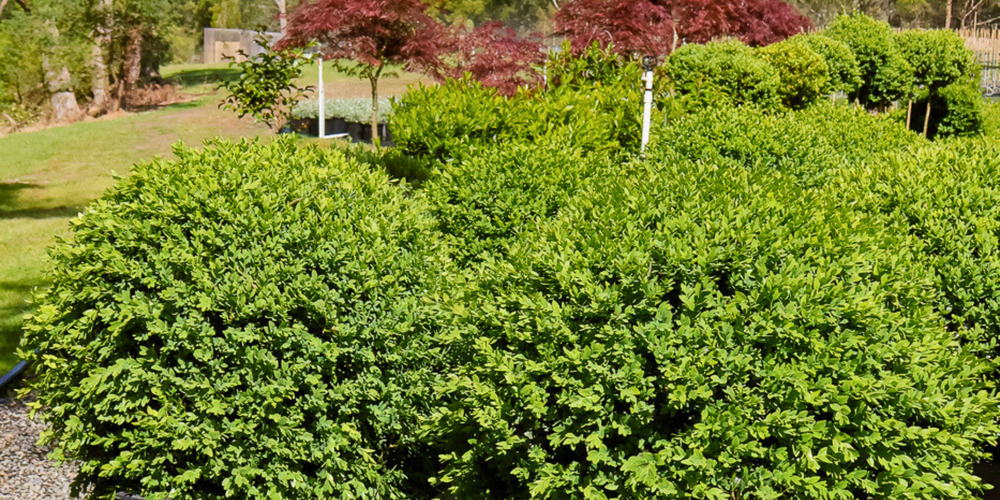
Buxus microphylla var. japonica, sold as Japanese Box, is a dense evergreen shrub clipped here into clean topiary balls. The small, rounded, mid green leaves sit tightly along short stems, so the surface holds a crisp edge after cutting. Growth is naturally compact, which is what allows the ball shape to hold between trims.
It grows in full sun to part shade and accepts most soils that drain, from sandy loam through to improved clay. Cool temperate, temperate and subtropical districts all suit it, and established plants handle light to moderate frost. Growth runs about 15 to 25 centimetres a year, slow enough that the shape stays where you put it.
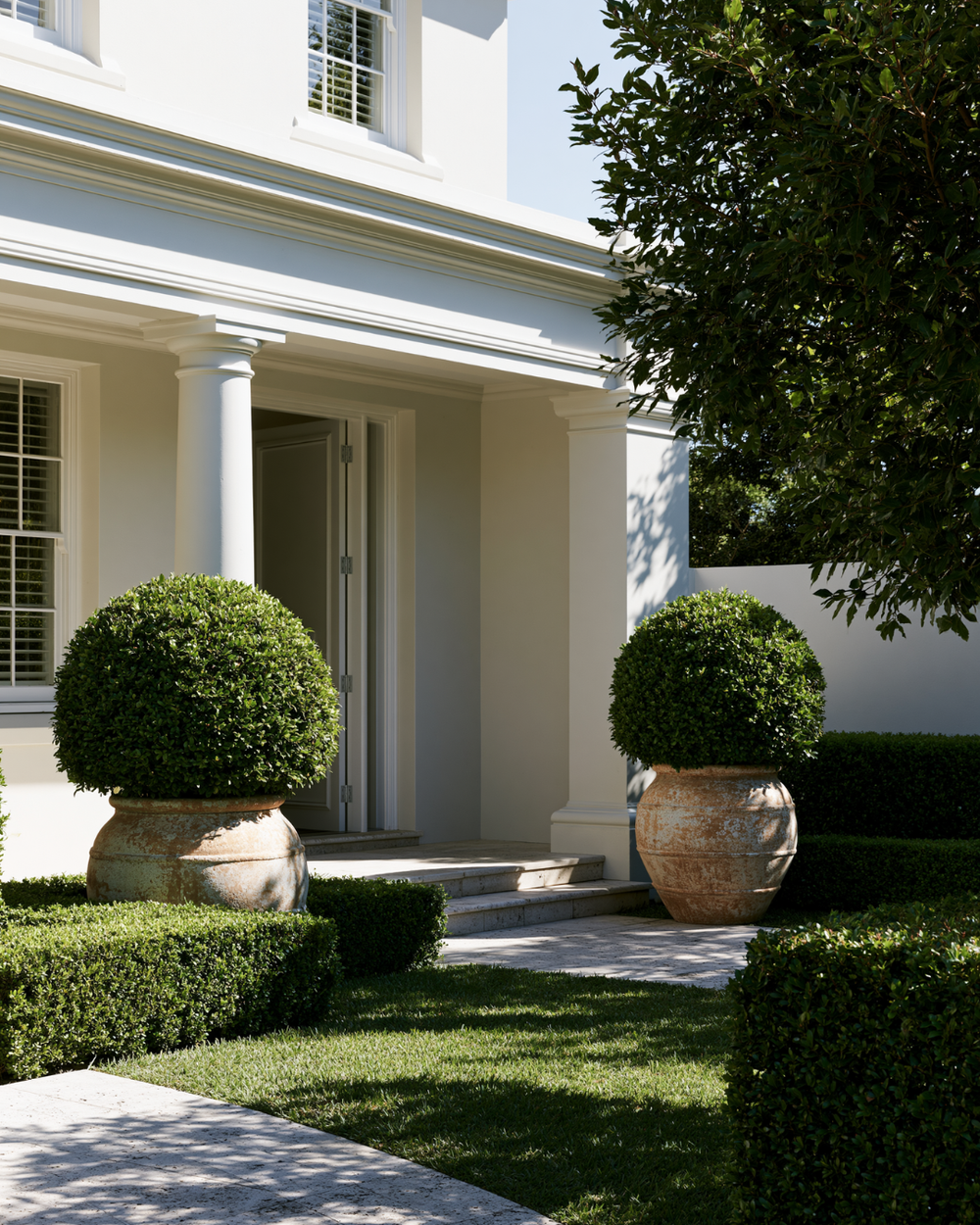
Balls are used to edge beds and paths, mark an entry, sit either side of a doorway, or repeat down a courtyard to give a planting rhythm. They also underplant feature trees neatly. Because the form arrives already grown, a bed reads finished from the day it goes in rather than years later.
Frequently Asked Questions
About Japanese Box Topiary Balls
What is a Japanese Box topiary ball?
It is Buxus microphylla var. japonica grown on and clipped into a sphere. The plant does the same job as any box shrub, evergreen, small leaved and tolerant of cutting, but it arrives already shaped. Ball diameters run from around 30 centimetres up to large advanced specimens, and the shape is then held with two trims a year.
How big do Japanese Box topiary balls get?
The ball is held at whatever diameter it is clipped to, commonly 30 to 70 centimetres, with larger specimens available in bigger containers. In the ground, overall height sits close to the ball diameter. Left entirely unclipped the species would slowly reach roughly 1.5 to 2 metres tall and wide over many years.
How fast does Japanese Box grow?
About 15 to 25 centimetres a year, which is slow to moderate. That pace is an advantage in topiary because the outline drifts gradually rather than running away between cuts. Two trims a year, one in early spring and one in late summer, are usually enough to keep the surface tight and the profile even.
Does it need sun or shade?
Full sun to part shade both work. Full sun gives the densest, tightest surface, which matters when the appeal of the plant is a clean clipped edge. In hot inland gardens some afternoon shade prevents leaf scorch and bronzing. Deep shade thins the growth out and the ball loses its crisp outline.
Is Japanese Box frost tolerant?
Yes. Established plants handle light to moderate frost without damage, which covers most temperate and cool temperate gardens including Canberra, Melbourne and the southern tablelands. Newly planted stock is more exposed, so water it well going into winter and mulch the root zone. Any frost burnt tips can simply be trimmed off in spring.
Can Japanese Box topiary balls grow in pots?
Yes, they are one of the better plants for a container. A pot 40 to 50 centimetres wide suits a single ball for a courtyard, entry or balcony. Use a quality potting mix, water once the top few centimetres dry out, and feed in spring and again in summer. Repot or refresh the mix every few years.
How do I care for Japanese Box topiary balls?
Trim twice a year with sharp shears, cutting lightly and often rather than hard. Feed in early spring with a slow release fertiliser and keep water up through summer. Mulch to about 50 millimetres, keeping it clear of the stem. Watch for box psyllid on soft new growth and treat early if the tips start to cup.
Buxus japonica Japanese Box Topiary Balls

Buxus sempervirens English Box Topiary Balls
Buxus sempervirens English Box Topiary Balls
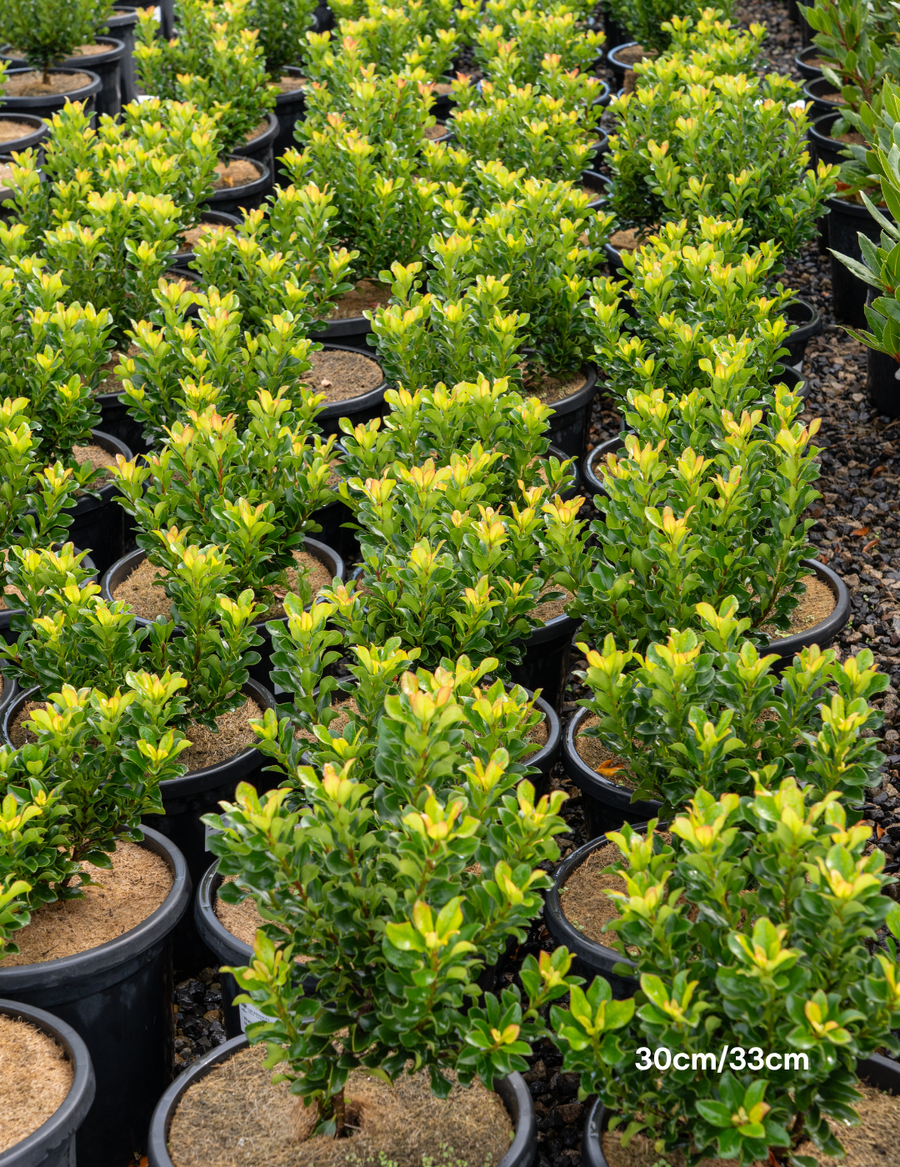
Buxus sempervirens English Box Topiary Balls are pre-clipped formal evergreen specimens, available in three mature sizes and ready to place. The tight, fine, dark green foliage holds a precise rounded form year-round and gives the classic formal topiary look that no other Buxus replicates. As one of our most consistently strong-selling products, our English Box topiary balls are well-shaped, well-rooted, and arrive in proportion to the pot size.
English Box performs best in cool to temperate climates and is slow growing at around 15 to 25 cm per year in good conditions, which is exactly why it holds sharp formal shapes so well. It thrives in full sun to part shade with well-drained, slightly acidic to neutral loamy soil, and is frost hardy, drought tolerant once established, and excellent in containers. Two light clips per year, in spring and again in late summer, keep the ball form crisp.
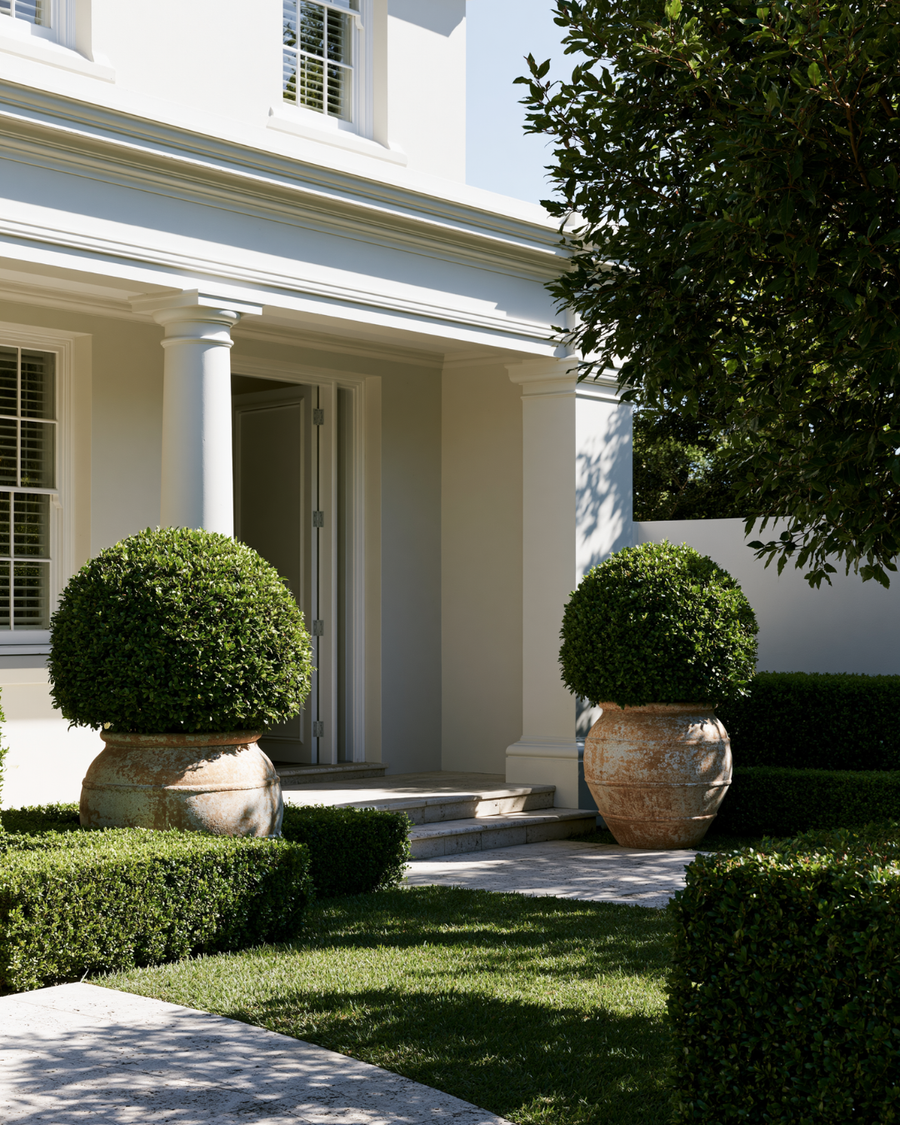
Use them flanking entrances, lining formal pathways, anchoring symmetrical garden beds, defining parterre and knot gardens, and in pairs in classic urns and decorative pots at front doors. Buxus sempervirens is the original topiary plant and remains the benchmark for traditional and contemporary formal design, with a level of finesse and density that fast-growing alternatives cannot replicate.
Frequently Asked Questions
About Buxus sempervirens English Box Topiary Balls
What size are the English Box topiary balls when they arrive?
Our English Box topiary balls arrive pre-clipped and ready to place at the size you order. The 30cm/33cm pots have ball diameters of approximately 30 to 45 cm, the 40cm/45L pots have ball diameters of 40 to 55 cm, and the 50cm/75L pots have ball diameters of 50 to 70 cm. They are well-rooted and in proportion to the pot.
How fast does Buxus sempervirens grow?
English Box is slow-growing, adding approximately 15 to 25 cm per year once established in good conditions. This slow growth rate is one of the reasons it holds sharp formal shapes so well, and why mature pre-clipped specimens command a premium over seedling-grown stock.
What is the difference between English Box, Japanese Box, and Shaggy Box?
English Box (Buxus sempervirens) has the smallest, finest leaves and the tightest formal texture, ideal for traditional parterres and clipped balls. Japanese Box (Buxus microphylla japonica) has slightly larger leaves, grows faster, and handles heat better. Shaggy Box (Buxus bodinieri) has soft, rounded leaves, much better blight resistance, and is the best choice for humid subtropical climates where English Box can struggle.
Where does English Box grow best in Australia?
English Box performs best in cool to temperate regions including Victoria, the ACT, the NSW Southern Highlands and Central Tablelands, Tasmania, and the elevated parts of South Australia and Western Australia. In humid coastal or hot subtropical regions, consider Buxus bodinieri Shaggy Box or Japanese Box instead for better long-term performance.
How do I prune English Box topiary balls?
Lightly clip in spring and again in late summer or early autumn to maintain the ball shape. Avoid pruning in the heat of summer or during frost periods. Use sharp shears for the cleanest formal finish, and step back regularly to check the symmetry of the form.
Can English Box grow in pots?
Yes. English Box is the classic potted topiary plant and pre-clipped balls look particularly striking in pairs at entrances and on terraces. Use a minimum 30L pot for the 30cm/33cm size and scale up from there, with a quality potting mix and a slow-release fertiliser applied twice yearly.
Is English Box susceptible to disease?
English Box can be affected by box blight, particularly in humid conditions where foliage stays wet. To reduce risk, ensure good air circulation around each plant, avoid overhead watering, and prune to maintain airflow through the canopy. In high-humidity regions, Buxus bodinieri Shaggy Box is a more disease-resistant alternative.
Buxus sempervirens English Box Topiary Balls

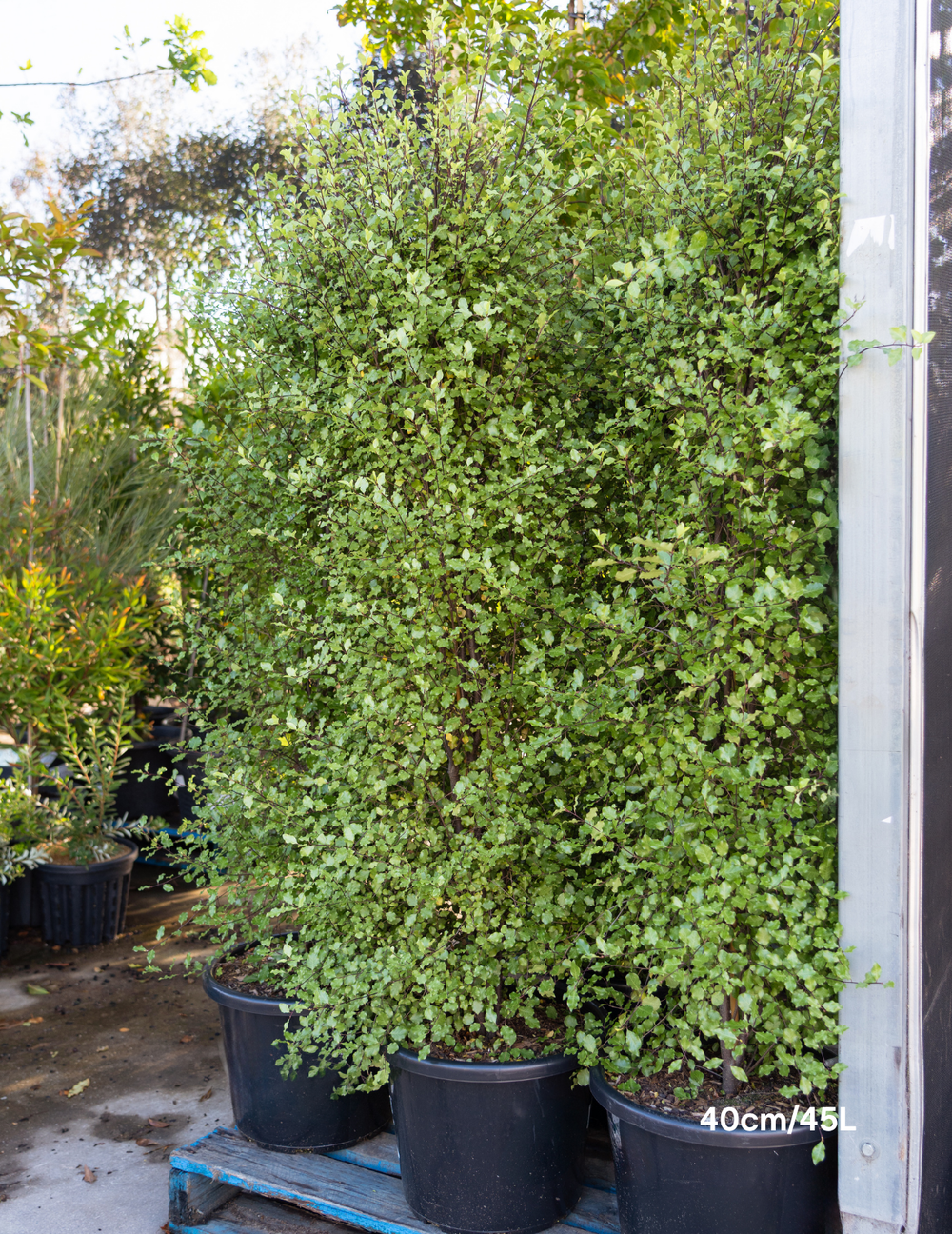
Pittosporum tenuifolium 'Silver Sheen'
Pittosporum tenuifolium 'Silver Sheen'
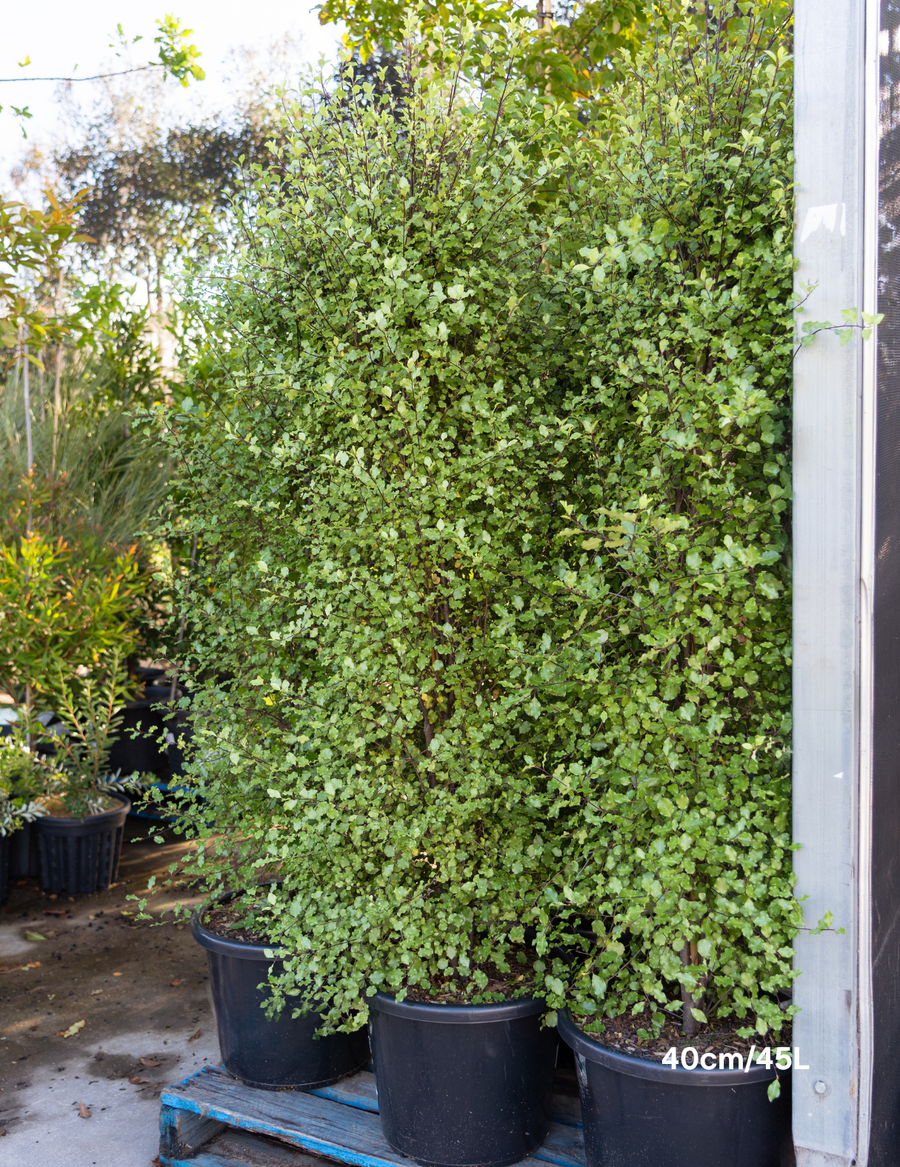
Pittosporum tenuifolium 'Silver Sheen' carries small shimmering silver-green leaves on near-black stems, giving a light airy screen that moves in the wind rather than reading as a solid green wall. It is one of the most widely specified screening plants in Australian landscape design for exactly that reason.
'Silver Sheen' grows to 4 to 6 metres tall but only 1.5 to 2 metres wide at 30 to 60 centimetres per year, which makes it a genuine solution for narrow beds along fence lines and between buildings where height is needed but width is not available. Small cream flowers appear in spring and are lightly fragrant.
'Silver Sheen' grows in full sun to part shade and tolerates light to moderate frost once established, performing from subtropical Queensland through Sydney, Melbourne, Gippsland and Adelaide. It clips well, holds density under regular trimming, and is equally effective as a formal hedge or a loose screen.
Frequently Asked Questions
About Pittosporum tenuifolium 'Silver Sheen'
How tall does Pittosporum 'Silver Sheen' grow?
'Silver Sheen' grows to 4 to 6 metres tall and only 1.5 to 2 metres wide, which makes it one of the best options for narrow screening where a tall hedge is needed in a shallow bed.
How fast does 'Silver Sheen' grow?
It grows at 30 to 60 centimetres per year once established, reaching a usable screening height within three to four years with regular water and feeding.
How narrow can I keep 'Silver Sheen'?
It naturally holds to 1.5 to 2 metres wide and can be trimmed to under a metre with regular clipping, which is why it is so often used in tight side-boundary positions.
How far apart should I plant 'Silver Sheen' for a hedge?
Plant 1 to 1.5 metres apart for a dense informal screen, or 80 centimetres apart for a tighter formal hedge. Closer spacing fills in faster but needs more trimming.
Is 'Silver Sheen' frost tolerant?
'Silver Sheen' handles light to moderate frost once established. Young plants benefit from protection through their first winter in colder inland districts.
Does 'Silver Sheen' grow in shade?
Yes. It performs in full sun through to part shade. In shadier positions growth is slightly more open, which suits a softer informal screen.
Where does 'Silver Sheen' grow best in Australia?
It performs from subtropical Queensland through Northern NSW, Sydney, the South Coast and tablelands, Melbourne and surrounds, the Western District, Gippsland and Adelaide.
Pittosporum tenuifolium 'Silver Sheen'
Laurus nobilis 'Miles Choice' Bay Tree
Laurus nobilis 'Miles Choice' Bay Tree
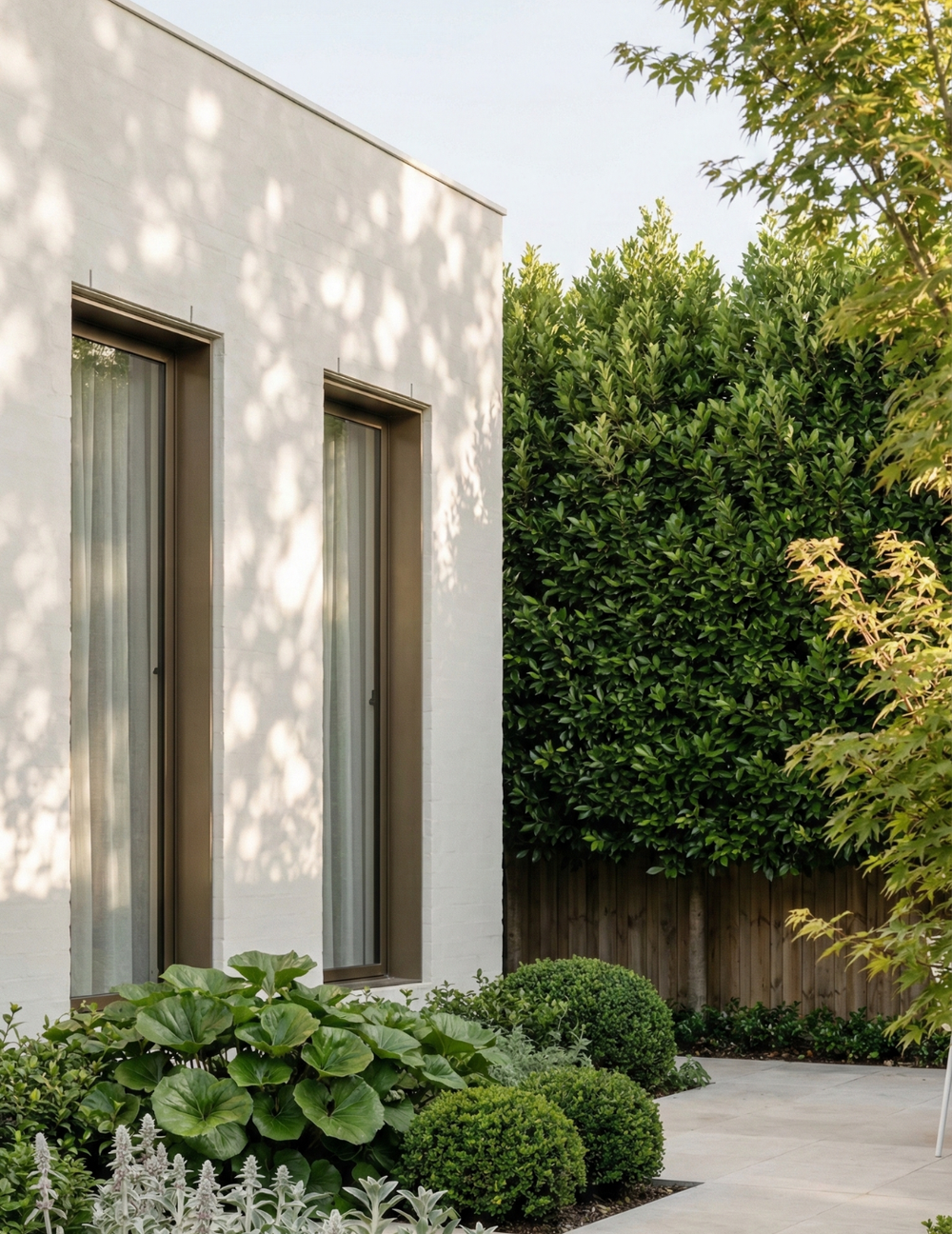
Laurus nobilis 'Miles Choice' is considered an improved form of the traditional bay tree, selected for its more compact, upright growth. This variety is known for producing denser, tidier hedging with less effort, which is why it has become one of our best-selling choices for structured residential and commercial landscapes.
Its dark green, glossy, aromatic foliage creates a strong, uniform backdrop that instantly elevates surrounding plantings and holds its shape beautifully year-round. It is ideal for clipped formal hedges, privacy screening, and pleached rows, responding exceptionally well to pruning and maintaining a clean, polished finish with regular trimming.
'Miles Choice' performs reliably in full sun to part shade and tolerates a wide range of conditions, including coastal and windy sites once established. The foliage is also edible, making it both a practical and ornamental option.
Low-maintenance, resilient, and highly refined, it is a go-to hedging tree for projects where structure, longevity, and a premium finish matter.
Frequently Asked Questions
About Laurus nobilis 'Miles Choice' Bay Tree
How tall does Miles Choice Bay Tree grow?
Miles Choice grows to 4-6 metres tall and is most commonly maintained as a 2-4 metre clipped hedge. Its compact upright form holds a tighter shape than standard Laurus nobilis.
How fast does Miles Choice grow?
Miles Choice has a moderate growth rate of 30-50cm per year once established.
Is Miles Choice the same as standard bay tree?
Miles Choice is an improved cultivar of Laurus nobilis with a tighter, more compact habit. The foliage is still fully edible and aromatic, but the plant produces denser, tidier hedges with less pruning than the standard form.
Are Miles Choice leaves edible?
Yes. Like the standard bay tree, Miles Choice leaves are fully edible and can be used in cooking. Pick fresh leaves as needed for stocks, soups, slow-cooked dishes, and marinades.
How far apart should I plant Miles Choice for a hedge?
Plant 60-80cm apart for a dense formal hedge, or 1 metre apart for a more relaxed screen.
Can Miles Choice grow in pots?
Yes. Miles Choice performs well in large pots (60L+) and is a popular choice for formal entrances, courtyards, and balcony screening.
How do I prune Miles Choice Bay Tree?
Trim two to three times through the warmer months, taking a little each time rather than one hard cut. Use sharp secateurs on individual stems so the large leaves are not sliced in half and left browning on the face of the hedge. Miles Choice reshoots readily from older wood, so an overgrown plant can be brought back into shape over a season or two.
Laurus nobilis 'Miles Choice' Bay Tree

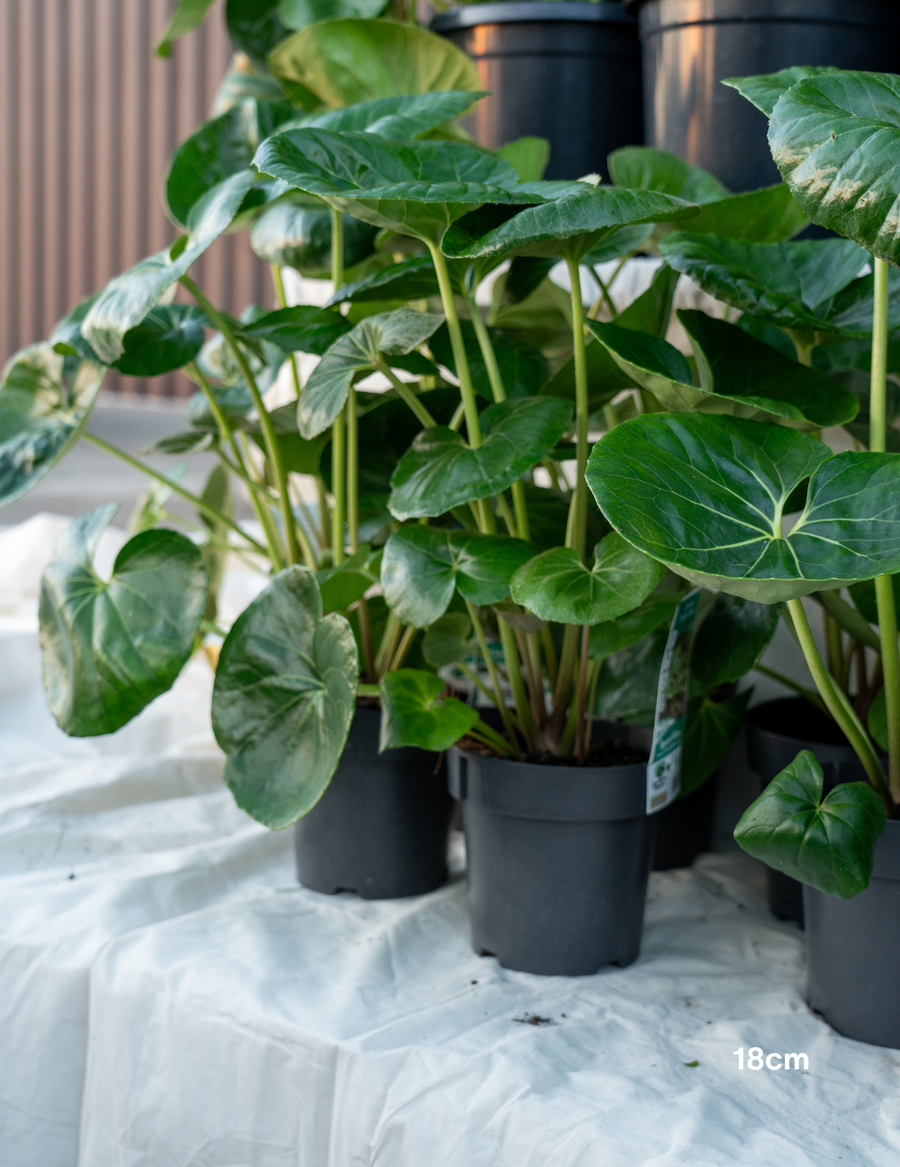
Ligularia reniformis
Ligularia reniformis
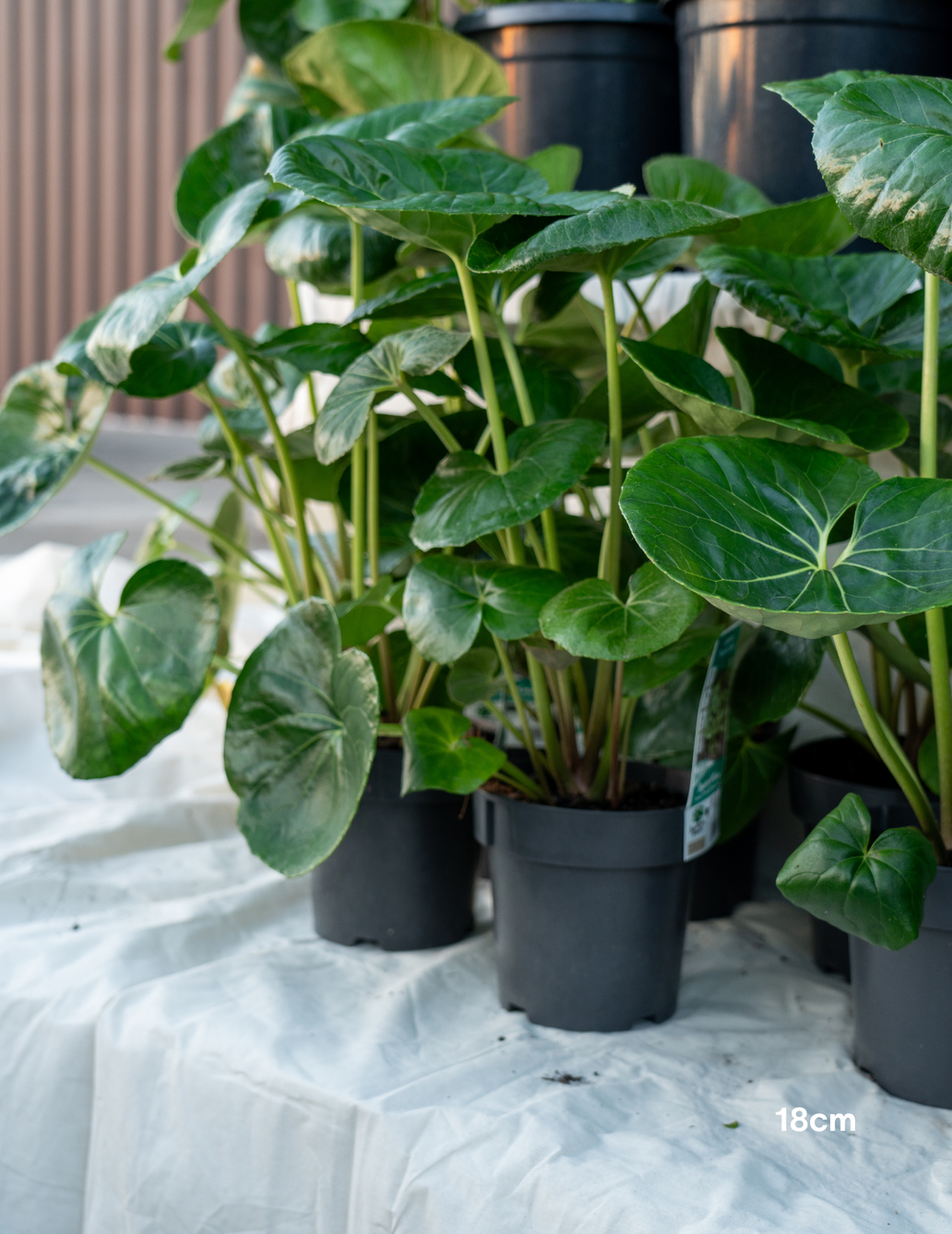
Ligularia reniformis carries enormous glossy kidney-shaped leaves that give a shaded garden the bold tropical texture usually only available in full sun. The Tractor Seat Plant is grown for foliage first, with tall stems of bright yellow daisy flowers through summer as a bonus.
Ligularia reniformis forms a clump 0.6 to 1 metre tall and 1 to 1.5 metres wide, spreading slowly at 10 to 20 centimetres per year. That steady habit makes it reliable as a mass underplanting beneath established trees, an edging along a shaded path, or a single specimen in a large pot.
This is a full shade plant. It wants consistent moisture and protection from hot afternoon sun, which scorches the leaves, and it is frost sensitive, so in cold districts it needs a protected position. Given shade and water it is close to maintenance free.
Frequently Asked Questions
About Ligularia reniformis
How big does Ligularia reniformis grow?
It forms a clump 0.6 to 1 metre tall and 1 to 1.5 metres wide. The individual leaves can reach 40 centimetres across, which is where the bold texture comes from.
Why is it called the Tractor Seat Plant?
The common name comes from the large round kidney-shaped leaves, which resemble the seat of an old tractor. The botanical name reniformis means kidney-shaped.
Does Ligularia reniformis need shade?
Yes. It performs best in full shade and will scorch in hot afternoon sun. It is one of the most useful foliage plants available for genuinely dark positions.
When does it flower?
Tall stems of bright yellow daisy-like flowers rise well above the foliage through summer. The foliage remains the main feature for the rest of the year.
Is Ligularia reniformis frost tolerant?
No. It is frost sensitive and may be damaged by frost. In cold districts plant it in a protected position, or grow it in a pot that can be moved under cover.
How much water does it need?
It wants consistently moist soil and does not tolerate drying out. Mulch well and water regularly through summer, particularly in pots and under established trees where roots compete.
How far apart should I plant it for a mass planting?
Plant 0.8 to 1 metre apart for a continuous shaded groundcover mass. Closer spacing fills in faster but the clumps will crowd within a few seasons.
Ligularia reniformis
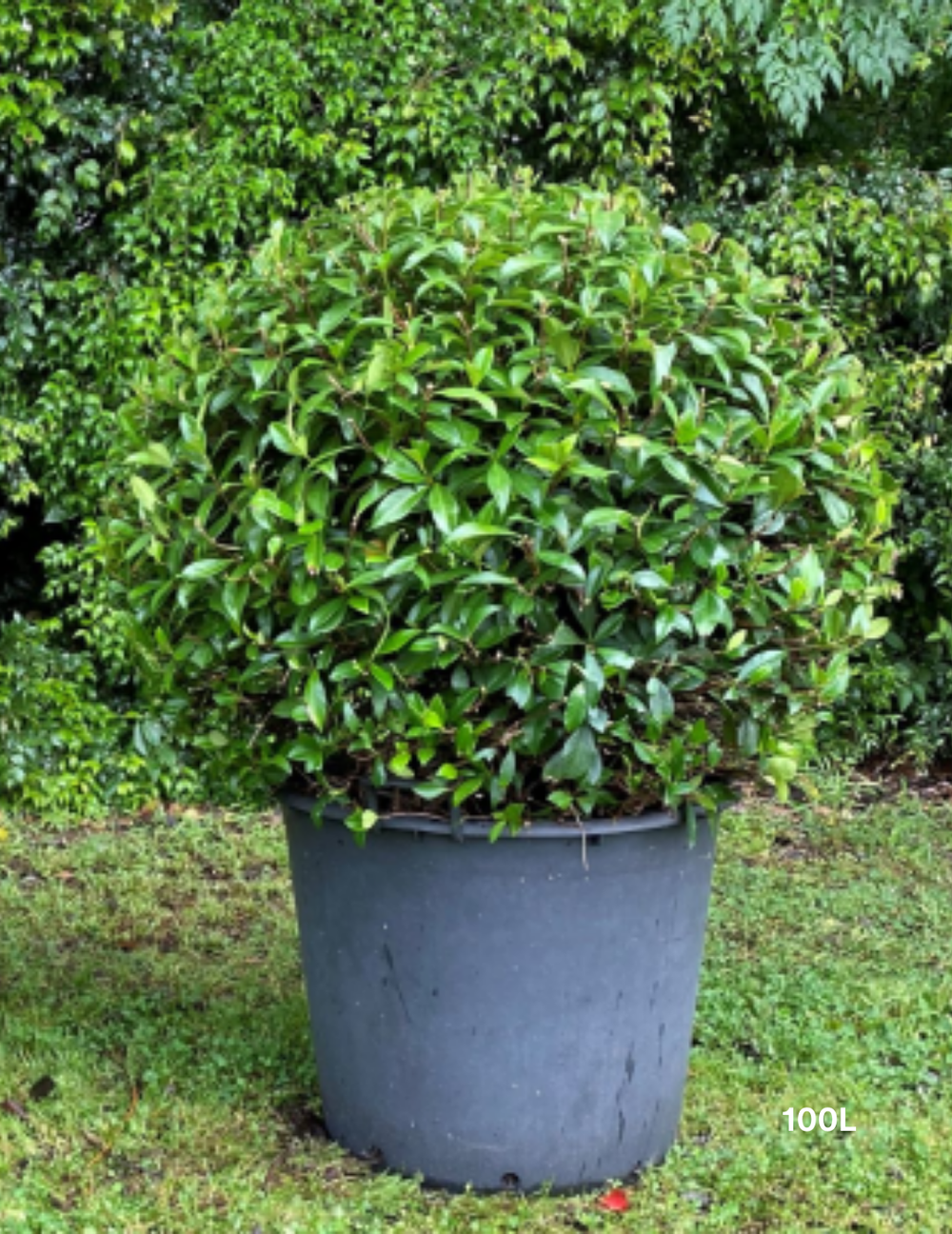
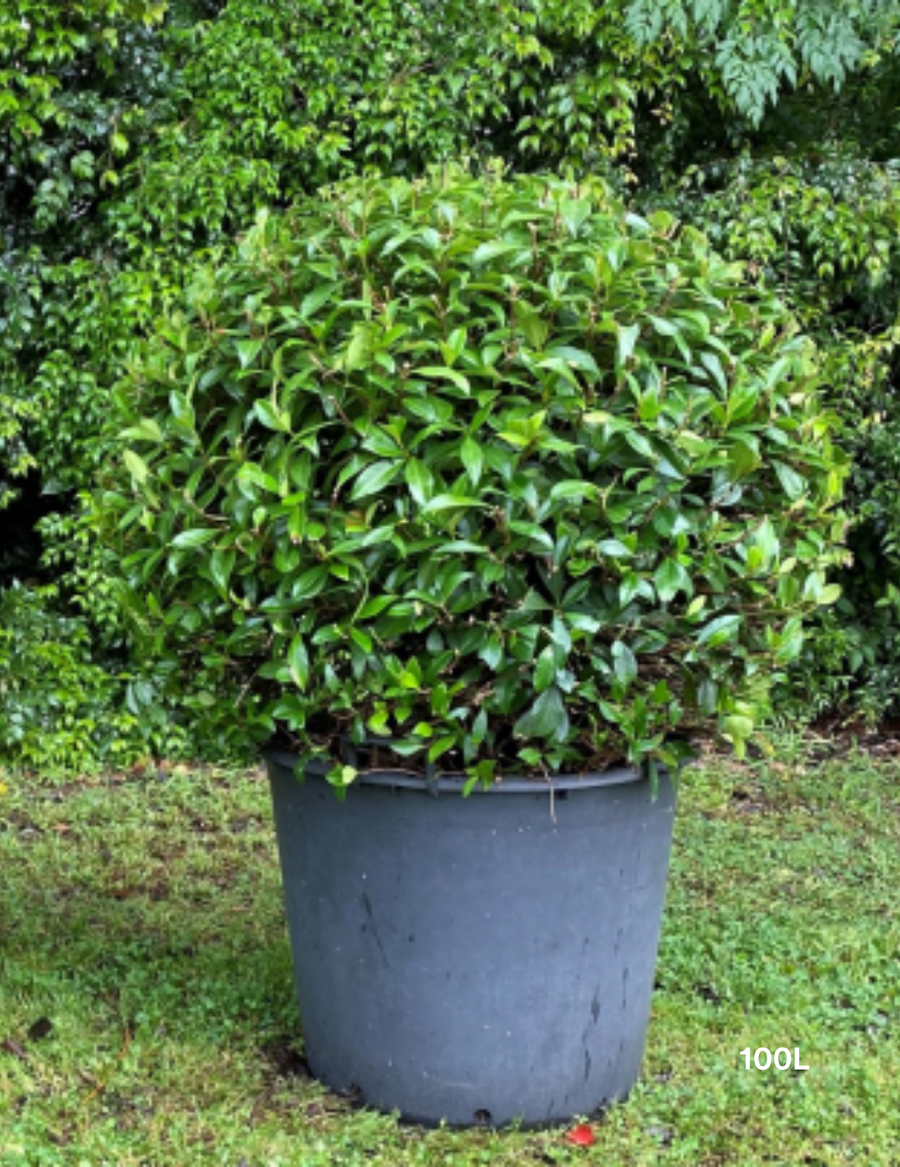
Trachelospermum jasminoides Balls – Star Jasmine Balls
Trachelospermum jasminoides Balls – Star Jasmine Balls
Trachelospermum jasminoides 'Balls' is Star Jasmine grown and clipped into a dense evergreen sphere. The small glossy leaves sit tight on a woody framework, holding a clean rounded outline year round. White pinwheel flowers open in spring and carry a strong sweet scent right across a courtyard.
Ball specimens hold at about 1 to 1.5 metres tall and wide with light clipping. Full sun to part shade suits them, in any free draining soil. Growth is slow to moderate at 30 to 50 centimetres a year. They handle coastal exposure, light frost and dry spells once the roots are down.
Repeat them along a driveway, either side of an entry, or in pots on a terrace where a formal shape is wanted straight away. They read as structure in a planting scheme without the height of a hedge, and because the form is already trained, a new garden looks settled from the day it goes in.
Frequently Asked Questions
About Star Jasmine Balls
What are Star Jasmine Balls?
They are Trachelospermum jasminoides, the common Star Jasmine, grown and clipped into a dense evergreen sphere on a woody framework. Instead of climbing, the plant is trained into a self supporting rounded shape. The foliage is small, glossy and dark green, and the plant carries scented white flowers through spring.
How big do Star Jasmine Balls grow?
They hold at roughly 1 to 1.5 metres tall and 1 to 1.5 metres wide. Growth is slow to moderate at 30 to 50 centimetres a year, so a light clip once or twice a year keeps the ball tight at whatever size within that range suits the setting.
Do Star Jasmine Balls need sun or shade?
Full sun to part shade both work. Full sun gives the densest foliage and the heaviest flowering, while part shade produces slightly softer, more open growth and fewer flowers. Avoid deep shade, where the ball thins out and loses its outline. Morning sun with afternoon protection suits hot inland gardens.
Can Star Jasmine Balls be grown in pots?
Yes, and pots are one of the main uses. A container 50 to 60 centimetres wide with a quality free draining mix will hold a ball for years. Water more often than you would in the ground, especially in summer, and feed in spring and again in late summer. Refresh the mix every few years.
Are Star Jasmine Balls evergreen?
Yes, the foliage is held year round. The glossy dark green leaves take on a bronze tinge in cold weather and green up again in spring, but the plant never goes bare. That is what makes it useful as permanent structure in a scheme, particularly in winter once perennials have died back.
When do Star Jasmine Balls flower?
Flowering runs through spring, roughly September to November, and often carries into early summer in warmer districts. The white pinwheel flowers are small but produced in quantity, and the scent is strong on still evenings. Flowering is heaviest on plants in full sun that were not clipped hard just before bud set.
How do I prune and care for Star Jasmine Balls?
Clip lightly with hedging shears once after flowering and again in late summer if needed, taking only the new growth to keep the outline crisp. Water deeply in dry weather, mulch the base, and feed in early spring. The sap is milky and can irritate skin, so wear gloves when trimming.
Trachelospermum jasminoides Balls – Star Jasmine Balls
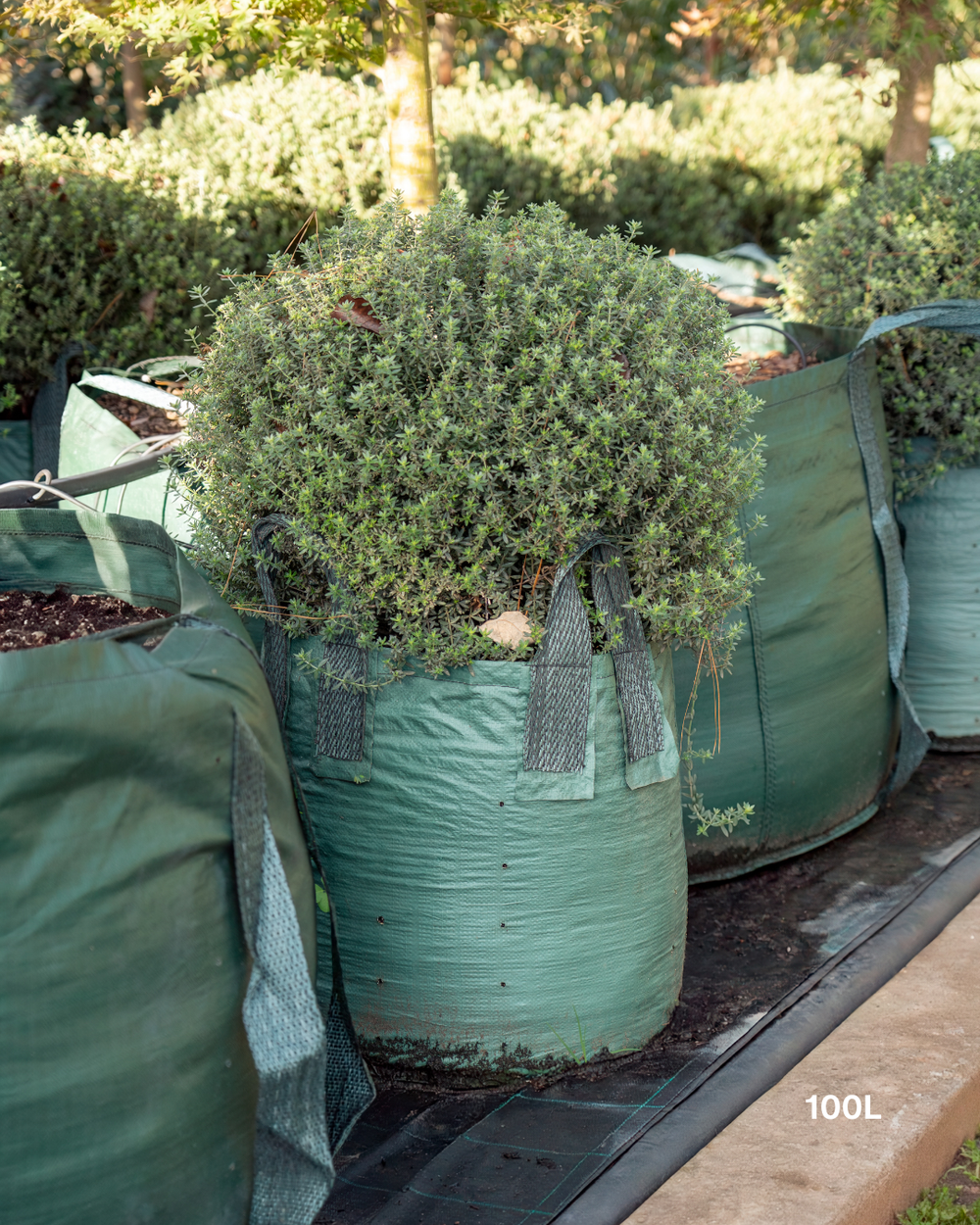
Westringia fruticosa – Coastal Rosemary
Westringia fruticosa – Coastal Rosemary
Westringia fruticosa, Coastal Rosemary, is an Australian native evergreen shrub from the headlands and dunes of the east coast. It builds a dense rounded bush of fine grey green leaves held in whorls, with small white to pale lilac flowers. Despite the common name it is not the culinary herb.
Mature plants sit at 1.5 to 2 metres tall and 1.5 to 2 metres wide, growing 30 to 60 centimetres a year, and they clip smaller without complaint. Full sun to part shade and sharp drainage are the requirements. Salt wind, sandy soil, drought and light to moderate frost are all handled.
It is a standard on coastal projects, road verges, council garden beds and exposed banks that need erosion cover. Plant 1 to 1.5 metres apart for an informal screen, or 80 centimetres for a clipped hedge. A single plant fills a 40 to 50 centimetre pot on a courtyard or balcony.
Frequently Asked Questions
About Coastal Rosemary
What is Coastal Rosemary?
Westringia fruticosa is an Australian native evergreen shrub from the headlands and dunes of the east coast. It forms a dense rounded bush of fine grey green leaves held in whorls, with small white to pale lilac flowers. Despite the common name it is not culinary rosemary and is not used in cooking.
How big does Coastal Rosemary grow?
Mature plants reach 1.5 to 2 metres tall and 1.5 to 2 metres wide. It clips readily to smaller dimensions and is often maintained at around a metre as a hedge or a low mound. Growth is moderate, roughly 30 to 60 centimetres a year, so it holds a trimmed shape well.
Is Coastal Rosemary suitable for coastal positions?
It is one of the best shrubs available for exposed coastal work. It grows naturally on sea cliffs and copes with salt laden wind, sand and reflected heat. It is used constantly on beachfront reserves, dune stabilisation projects and seaside gardens where little else holds a tidy shape.
When does Coastal Rosemary flower?
The main flush is spring and summer, roughly September through February, with scattered flowering at other times of the year in mild districts. The flowers are small, white to pale lilac and sit among the foliage rather than above it. Clipped hedges flower less than plants left to grow informally.
How far apart should I plant Coastal Rosemary for a hedge?
Space plants 80 centimetres apart for a tight formal hedge, or 1 to 1.5 metres apart for a dense informal screen. On banks and batters used for erosion cover, 1 metre in a staggered grid gives full ground coverage within about two growing seasons.
Can Coastal Rosemary grow in pots?
Yes. A pot 40 to 50 centimetres wide suits a single plant for a courtyard, entry or balcony. Use a free draining mix, because the roots will not tolerate sitting wet. Container plants need watering more often than those in the ground, plus a light trim to hold their shape.
How do I prune and care for Coastal Rosemary?
Trim lightly two or three times a year, taking the soft new growth and avoiding cuts into bare old wood, which reshoots poorly. Water through the first summer, then only in extended dry spells. On most soils it needs no feeding at all, and it resents heavy watering and poor drainage.
Westringia fruticosa – Coastal Rosemary

Evergreen Trees Direct Has Been Featured In:


Perfect Substitutes for Olea europaea 'Mission' - Olive Tree
Olea 'Bambalina' Olive Tree
Olea 'Bambalina' Olive Tree
Olea europaea 'Bambalina' gives the silver-green foliage and Mediterranean character of a mature olive on a naturally compact frame, without the size or the fruit drop that makes standard olives difficult in a small garden. It is the practical way to get the olive look into a courtyard.
'Bambalina' reaches around 4 metres if left entirely unpruned and is easily held at 2 metres or lower with light annual trimming, spreading 2 to 3 metres wide at a slow 20 to 40 centimetres per year. That slow steady growth is exactly what makes it reliable in pots and low formal hedges.
'Bambalina' is evergreen, drought tolerant once established, and handles light to moderate frost. It wants full sun and free-draining soil, and needs very little water or feeding once its roots are down, which suits low-maintenance and water-wise garden designs.
Frequently Asked Questions
About Olea 'Bambalina'
How big does Olea 'Bambalina' grow?
'Bambalina' reaches around 4 metres tall and 2 to 3 metres wide if left completely unpruned. It is most often kept at 1.5 to 2 metres, which it holds easily with light annual trimming.
How fast does 'Bambalina' grow?
It is slow-growing at 20 to 40 centimetres per year. That slow rate is a benefit in pots and formal hedging, where it means far less trimming than a vigorous alternative.
Can 'Bambalina' be grown in a pot?
Yes. Its compact habit and slow growth make it one of the best olives for large pots on patios, entries and courtyards. Use a free-draining mix and let it dry out between waterings.
Does 'Bambalina' produce fruit?
'Bambalina' is grown as an ornamental and produces little to no fruit, which makes it far cleaner than standard olive varieties near paving, paths and entertaining areas.
Is 'Bambalina' drought tolerant?
Yes. Once established it is highly drought tolerant and needs only occasional deep watering through extended dry periods. Overwatering is a more common problem than underwatering.
Can 'Bambalina' be used as a hedge?
Yes. Plant 80 centimetres to 1 metre apart for a low formal silver hedge. Its slow growth means the hedge holds its shape between trims far longer than most alternatives.
Is 'Bambalina' frost tolerant?
It handles light to moderate frost once established. In colder inland districts protect young plants through their first winter or grow them in pots that can be moved.
Olea 'Bambalina' Olive Tree


Olea europaea 'Correggiola' Olive
Olea europaea 'Correggiola' Olive
Olea europaea 'Correggiola' is an Italian oil olive from Tuscany, also sold under the name Frantoio. It makes a rounded evergreen tree with narrow silver-green leaves, a trunk that gnarls with age, and creamy white flowers in spring. The fruit is small to medium with a high oil content.
Full sun and free-draining soil are the requirements. It grows 30 to 60 centimetres a year to 4 to 6 metres tall and 3 to 4 metres wide, and it is drought tolerant once established. Mediterranean, warm temperate and dry inland climates suit it, and it accepts light to moderate frost.
Plant it in a home oil grove, an ornamental garden, a driveway avenue at 3 metres, or a large container on a terrace. It also clips into a hedge at 1 to 1.5 metre spacing. A buyer wanting a tree that carries a garden and produces a crop gets both from this one.
Frequently Asked Questions
About Correggiola Olive
What is a Correggiola olive?
'Correggiola' is a Tuscan cultivar of Olea europaea grown mainly for oil, and it is the same variety many nurseries list as Frantoio. It carries small to medium fruit with a high oil percentage and a mild, well balanced flavour. As a tree it is upright when young and rounded with age.
How big does the Correggiola olive grow?
It reaches 4 to 6 metres tall and 3 to 4 metres wide when grown as a tree and left to its own devices. In groves and gardens most growers keep it lower, near 3 metres, so the fruit stays within reach. Regular pruning holds it at whatever height the site suits without harming the crop.
When does it fruit and when is it harvested?
Flowering is in spring, around October and November, with fruit setting over summer. Olives ripen from late autumn into early winter, roughly May and June, turning from green to purple black. Green olives for the table are picked earlier. Trees usually start bearing three to five years after planting.
Does it need another olive to pollinate it?
'Correggiola' is self-fertile and will set a crop on its own, which is part of why it is planted so widely. Yields improve noticeably with a second variety nearby for cross-pollination, since olive pollen moves on the wind. In a home garden a single tree gives a useful harvest.
Is it drought tolerant?
Yes. Once the root system is established, which takes about two years, it copes with long dry summers and is one of the more reliable trees for low water gardens. Regular water during flowering and fruit fill improves oil yield, so irrigation still pays if you are growing for oil rather than looks.
Can it be grown in a pot?
It grows well in a large container, and pot culture is common on terraces and around pools. Use a pot of at least 500 millimetres, a free-draining mix, and water consistently, since containers dry quickly. Feed in spring and root prune every few years. Expect a smaller tree and a lighter crop.
How do I prune and care for a Correggiola olive?
Prune in late winter or early spring, opening the centre so light reaches the inner wood where next season's fruit forms. Remove suckers from the base and any strong water shoots. Feed in early spring, water through flowering and fruit set, and keep mulch back from the trunk. Established trees need little else.
Olea europaea 'Correggiola' Olive

Olea europaea 'Del Morocco'
Olea europaea 'Del Morocco'
Olea europaea 'Del Morocco' is a hardy evergreen olive with glossy green leaves that flash silver underneath. It builds a round-topped canopy on twisted branches and carries creamy white flowers through spring and into summer. The fruit is large and dual purpose, used both for the table and for pressing.
Give it full sun, or part shade at a pinch, and soil that drains. Growth is 30 to 60 centimetres a year to 3 to 6 metres tall and 3 to 4 metres wide. It shrugs off wind, light to moderate frost and dry spells once established, and it resists most pests and disease.
It earns a place as a shelter tree, a shade tree over a seating area, a topiary or bonsai subject, or a feature in a Mediterranean garden. Set feature trees 3 to 4 metres apart. For a tough evergreen that also produces food, it does more work than most ornamental trees.
Frequently Asked Questions
About Del Morocco Olive
What is the Del Morocco olive?
'Del Morocco' is a cultivar of Olea europaea grown for both eating and oil. It carries larger fruit than most oil varieties, and the tree itself is notably tough. Foliage is glossy green above with silver undersides, and the canopy is round-topped with the twisted branch structure olives are known for.
How big does it grow?
It grows 3 to 6 metres tall and 3 to 4 metres wide, with the final height depending on soil, water and how often it is pruned. Left alone it forms a broad rounded head. Trimmed annually it holds easily at 2.5 to 3 metres, which keeps the fruit within reach from the ground.
Is it frost tolerant?
Yes, within limits. It takes light to moderate frost once established and is grown through the cooler parts of Victoria, South Australia and inland New South Wales. Young trees are the vulnerable ones, so protect them for the first couple of winters in frost-prone gardens. Severe repeated frost will damage new growth.
When does it flower and fruit?
Creamy white flowers appear from spring into early summer, roughly October to December, and are wind pollinated. Fruit sets over summer and ripens from autumn into winter, turning from green to black. Trees generally begin cropping three to five years from planting, with yields building as the canopy fills out.
Is it suitable for coastal gardens?
Olives handle coastal conditions well, tolerating salt-laden wind and sandy soils provided drainage is good, and 'Del Morocco' is no exception. It is often used as a windbreak or shelter planting on exposed sites. Avoid low spots where water sits after rain, since waterlogged roots do more damage than salt or wind.
Can it be shaped or used for topiary?
Yes. Olives respond well to clipping and this variety is regularly trained as a standard, a ball on a stem, or a bonsai subject. Cut in late winter or early spring, working in small stages rather than removing large limbs at once. Formal shapes need two or three light trims through the growing season.
How do I care for a Del Morocco olive?
Water through the first two summers, then only in prolonged dry weather. Feed in early spring with a complete fertiliser and top up the mulch, keeping it clear of the trunk. Prune in late winter to keep the centre open and the height manageable. Remove basal suckers whenever they appear.
Olea europaea 'Del Morocco'

Olea europaea 'Garden Harvest'
Olea europaea 'Garden Harvest'
Olea europaea 'Garden Harvest' is a fruiting olive bred for the home garden rather than the grove, producing reliable crops of medium-sized olives on a frame narrow enough to sit against a courtyard wall. Silvery-green evergreen foliage carries the Mediterranean look year round.
'Garden Harvest' reaches around 5 metres if left entirely unpruned and is easily held at 2 to 3 metres with annual trimming, staying just 2 to 3 metres wide. Growth is steady at 30 to 60 centimetres per year, so it holds its shape between prunes and performs reliably in a large pot.
'Garden Harvest' is evergreen and drought tolerant once established, handling light to moderate frost. It wants full sun and free-draining soil, and needs very little water or feeding once its roots are down, which suits water-wise and low-maintenance planting.
Frequently Asked Questions
About Olea europaea 'Garden Harvest'
How big does Olea 'Garden Harvest' grow?
It reaches around 5 metres tall and 2 to 3 metres wide if left unpruned, and is commonly held at 2 to 3 metres with annual trimming, which also keeps fruit within reach.
Does 'Garden Harvest' produce edible olives?
Yes. It produces reliable crops of medium-sized fruit suitable for curing at home. Like all olives the fruit must be cured before eating.
Is 'Garden Harvest' self-fertile?
Yes, it will set fruit on its own, though crops improve noticeably with a second olive variety flowering nearby to assist pollination.
Can it be grown in a pot?
Yes. Its compact habit and steady growth make it well suited to large pots in full sun. Use a free-draining mix and let it dry out between waterings.
Is 'Garden Harvest' drought tolerant?
Yes. Once established it is highly drought tolerant and needs only occasional deep watering. Overwatering is a more common problem than underwatering.
When should I prune an olive tree?
Prune in late winter before new growth begins, opening the centre to light and removing crossing branches. Olives fruit on the previous season's wood, so avoid removing all of it.
Is 'Garden Harvest' frost tolerant?
It handles light to moderate frost once established. In colder inland districts protect young trees through their first winter.
Olea europaea 'Garden Harvest'

Follow Us On Instagram
@evergreentreesdirect ↗
Tips & Tricks
Best Trees for Creating a Privacy Screen: 10 Picks Across Fast Formal, Native and Narrow Column Options
Read the story
How to Incorporate Trees into Your Modern Landscape Design
Read the story
The Importance of Root Health: How to Choose Quality Trees
Read the story