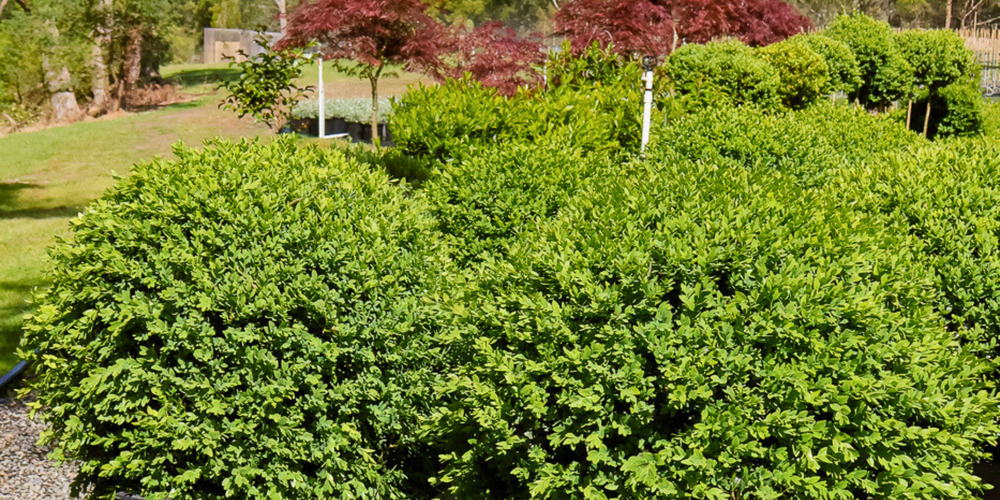
Crassula ovata ‘Gollum Gold’ – Gollum Gold Jade
Crassula ovata ‘Gollum Gold’ – Gollum Gold Jade
Evergreen · Full Sun / Part Shade
Mature size: 1m–1.5m high × 1m–1.5m wide
- Evergreen
- Full Sun / Part Shade
- Mature height1m–1.5m
- Mature width1m–1.5m
- Frost Sensitive
- Good in pots
- Flowers

Distinctive tubular golden foliage with red highlights creates a unique sculptural display throughout the year.
Regular price
$140.00
Sale price
$140.00
Regular price
Tax included.
Shipping calculated at checkout.
Pot size
Available batches
- Current height guide
- Please enquire
- Pot size
- 30cm/33cm
Approximate only. Minimum height important? Confirm with us.
Height guide & disclaimer
Height guide disclaimer: Height ranges are approximate only. As living products, plant heights naturally vary between individual plants, batches, and seasons. No guarantee is given that supplied plants will fall within the stated range. If minimum heights are required, you must confirm current batch heights with Evergreen Trees Direct prior to purchase. Variation in height is normal and is not grounds for return, refund, replacement, or compensation.
Quantity
Couldn't load pickup availability
Mature height & width
Mature height & width
- Mature height
- 1m to 1.5m
- Mature width
- 1m to 1.5m
Pot sizes & dimensions
Pot sizes & dimensions
| Pot / bag size | Width | Depth |
|---|---|---|
| 30cm Pot | 33cm | 30cm |
| 40cm/45L Pot | 44cm | 41.5cm |
| 50cm Pot / 70L Pot | 55cm | 41.8cm |
| 100L Bag | 50.6cm | 52.8cm |
| 150L Bag | 66cm | 55cm |
| 200L Bag | 71.5cm | 60.5cm |
| 300L Bag | 88cm | 63.8cm |
| 400L Bag | 99cm | 66cm |
| 500L Bag | 122cm | 66cm |
| 750L Bag | 134cm | 69cm |
| 1000L Bag | 146.3cm | 71.5cm |
| 2000L Bag | 176cm | 82.5cm |
General planting reference from our existing size guide. Actual containers can vary by supplier and batch; confirm exact dimensions if required.
Delivery & pickup
Delivery & pickup
Trade enquiries
Trade enquiries
We supply advanced trees to landscapers, developers, architects, and councils Australia-wide. Trade clients receive fast quotes, expert advice, and access to premium stock with reliable freight.
Freight estimate
Based on the items currently in your cart.
Final delivery cost is confirmed at checkout using your full address.
About Crassula ovata ‘Gollum Gold’
Crassula ovata 'Gollum Gold' is an evergreen succulent shrub with tubular leaves that flare into a small trumpet at the tip. The foliage carries yellow and gold tones, with red tips developing in strong light. Woody stems build an upright, shrubby form, and small white star flowers appear in winter.
Colour is strongest in full sun; part shade keeps the plant green and softer looking. Free draining soil is essential and growth is slow, roughly 15 to 30 centimetres a year. It takes heat, salt wind and dry spells once established, and will shrug off the odd light frost, though cold wet winters cause damage.
It suits succulent beds, rockeries, courtyard corners and pots by a doorway where the leaf shape can be seen up close. Coastal gardens use it in gravel beds alongside agaves and aloes. Where a planting needs colour without flowering or watering, this carries the bed through the whole year.
Frequently Asked Questions
About Crassula ovata 'Gollum Gold'
What is Crassula ovata 'Gollum Gold'?
It is a golden leaved form of the Gollum Jade, an evergreen succulent shrub with tubular leaves that flare into a trumpet at the tip. The foliage carries yellow and gold tones with red tips in strong light. Small white star flowers appear in winter, and the habit is upright and shrubby.
Does it need sun or shade?
Full sun gives the strongest gold and red colouring. In part shade the plant grows happily enough but stays green, which loses most of the point of the cultivar. In very hot inland gardens a little afternoon shade prevents leaf scorch, but it needs direct sun for at least half the day.
How big does it grow?
Around 60 centimetres to 1 metre tall and a similar width in the ground, reached slowly over several years. Container plants stay smaller again. It builds a dense, upright shrub with woody stems at the base, so it holds a defined shape without needing support or regular clipping.
How fast does it grow?
About 15 to 30 centimetres a year in good conditions, which is slow. Warmth, sun and free draining soil with the occasional deep watering give the best rate, and growth almost stops through winter. For immediate presence in a planting, start with an advanced plant rather than waiting for a small one to fill out.
Is it frost tolerant?
It handles the odd light frost once established, but it is not dependable in cold districts and a hard frost will damage the foliage. Wet winter soil combined with cold is the main killer. Where frost is regular, grow it in a pot under cover or plant it against a warm north facing wall.
Can it grow in pots?
Yes, and pots suit it well because you control the drainage completely. Use a cactus and succulent mix in a container with open drainage holes, and water only when the mix is dry through. A pot in full sun on a paved courtyard usually colours better than the same plant in a garden bed.
How do I care for Crassula ovata 'Gollum Gold'?
Keep it in sun, in soil that drains, and water sparingly. Skip fertiliser in the ground, or give potted plants a weak succulent feed in spring. Prune lightly in spring to hold the shape and remove any stems that revert to plain green. Check the leaf joints for mealybug from time to time.
| Mature height | 1m to 1.5m |
|---|---|
| Mature width | 1m to 1.5m |
| Position | Full Sun / Part Shade |
| Growth per year | 15cm to 30cm per year under suitable conditions |
| Frost | Frost Sensitive |
| Foliage | Evergreen (foliage year round) |
| Form | Shrub · Upright |
| Uses | Feature Tree · Plant in Pots (or) Suitable for Pots · Underplanting |
- Foliage
Evergreen (foliage year round)
- Position
- Form
- Use
- Mature height
- 1m to 1.5m
- Mature width
- 1m to 1.5m
Planting Information
Recommended Planting Spacing For Your Crassula ovata ‘Gollum Gold’ – Gollum Gold Jade
Crassula ovata ‘Gollum Gold’ – Gollum Gold Jade is expected to grow 15cm to 30cm per year under suitable conditions.
Long Term Care For Your Crassula ovata ‘Gollum Gold’ – Gollum Gold Jade
Planting Your Crassula ovata ‘Gollum Gold’ – Gollum Gold Jade in Different Soil
Uses in my Garden
Uses in my Garden
Crassula ovata ‘Gollum Gold’ – Gollum Gold Jade works in an:
Is Crassula ovata ‘Gollum Gold’ – Gollum Gold Jade Evergreen or Deciduous?
Crassula ovata ‘Gollum Gold’ – Gollum Gold Jade is an Evergreen (foliage year round) Tree
Mature Height & Width
Mature Height: 1m to 1.5m
Mature Width: 1m to 1.5m
Crassula ovata ‘Gollum Gold’ – Gollum Gold Jade is expected to grow 15cm to 30cm per year under suitable conditions.
Growth Rate of Crassula ovata ‘Gollum Gold’ – Gollum Gold Jade
Crassula ovata ‘Gollum Gold’ – Gollum Gold Jade is expected to grow 15cm to 30cm per year under suitable conditions.
They are considered to have a:
Frost Tolerance & Ideal Climate to plant Crassula ovata ‘Gollum Gold’ – Gollum Gold Jade
Is Crassula ovata ‘Gollum Gold’ – Gollum Gold Jade frost tolerant?
Crassula ovata ‘Gollum Gold’ – Gollum Gold Jade is Frost Sensitive – May suffer damage from frost, best in frost-free or protected spots.
Does Crassula ovata ‘Gollum Gold’ – Gollum Gold Jade Flower?
Crassula ovata ‘Gollum Gold’ produces clusters of small star-shaped white to pale pink flowers during late autumn and winter. The blooms create a delicate seasonal display above the distinctive foliage, although the plant is primarily valued for its unusual tubular golden-yellow leaves that develop attractive red highlights in bright conditions.
Does Crassula ovata ‘Gollum Gold’ – Gollum Gold Jade flower?
Flowering Period:
Flower Type:
Flower Colour:
White
Is Crassula ovata ‘Gollum Gold’ – Gollum Gold Jade an Australian Native Tree?
No
Crassula ovata ‘Gollum Gold’ – Gollum Gold Jade is Native to
What is the Wildlife Value of Crassula ovata ‘Gollum Gold’ – Gollum Gold Jade ?
Its seasonal flowers attract bees and other beneficial pollinators during the flowering period, supporting biodiversity within succulent and waterwise landscapes. The dense evergreen branching also provides sheltered microhabitats for beneficial insects within garden settings.
How much Sunlight does Crassula ovata ‘Gollum Gold’ – Gollum Gold Jade need?
Crassula ovata ‘Gollum Gold’ – Gollum Gold Jade will thrive best in:
Preferred Soil?
Crassula ovata ‘Gollum Gold’ performs best in free-draining sandy or loam soils with a neutral to slightly alkaline pH. It will also tolerate poorer soils and exposed garden positions provided drainage remains excellent. Avoid heavy clay or persistently wet conditions, as excess moisture can lead to root and stem problems. Allow the soil to dry between watering once established to maintain healthy growth, vibrant foliage colour and long-term vigour.
Is Crassula ovata ‘Gollum Gold’ – Gollum Gold Jade Drought Tolerant?
Is Crassula ovata ‘Gollum Gold’ – Gollum Gold Jade Drought tolerant?
As a young plant it benefits from occasional watering to establish a healthy root system, particularly during extended dry periods. Once established, Gollum Gold Jade Plant shows excellent drought tolerance and performs reliably through prolonged dry conditions with minimal supplementary watering.
Frequently Asked Questions
Frequently Asked Questions
Compare sizes side by side
30cm/33cm
Enquire for current heights
Heights are approximate and vary between individual trees.
Crassula ovata ‘Gollum Gold’ is loved for its Distinctive tubular golden foliage with red highlights creates a unique sculptural display throughout the year.
We take pride in supplying A+ grade advanced trees. When stock at our farm is not yet ready, we work with our trusted trade suppliers to source the best available trees for your garden.
Plant Your Crassula ovata ‘Gollum Gold’ – Gollum Gold Jade With:
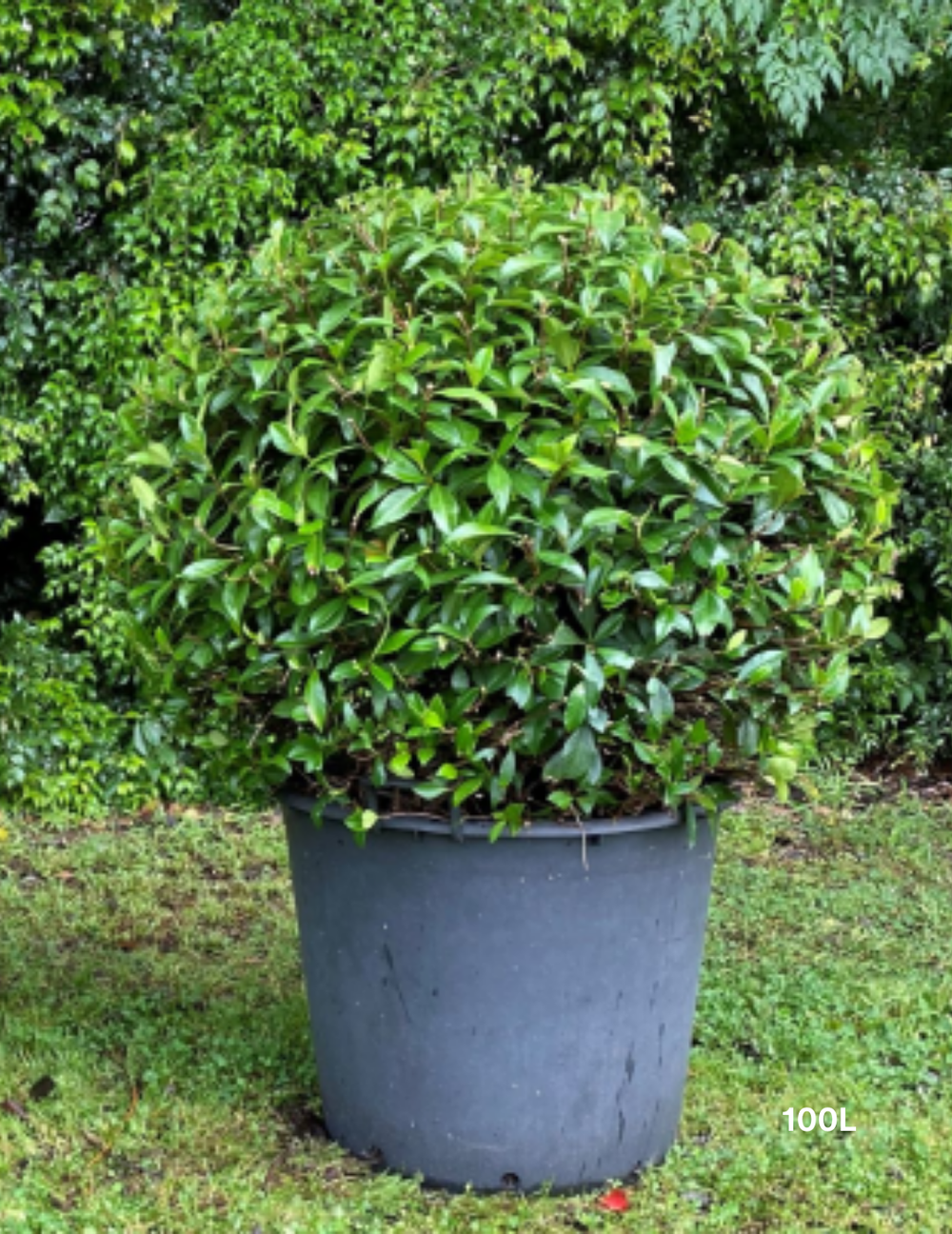
Trachelospermum jasminoides Balls – Star Jasmine Balls
Trachelospermum jasminoides Balls – Star Jasmine Balls
Trachelospermum jasminoides 'Balls' is Star Jasmine grown and clipped into a dense evergreen sphere. The small glossy leaves sit tight on a woody framework, holding a clean rounded outline year round. White pinwheel flowers open in spring and carry a strong sweet scent right across a courtyard.
Ball specimens hold at about 1 to 1.5 metres tall and wide with light clipping. Full sun to part shade suits them, in any free draining soil. Growth is slow to moderate at 30 to 50 centimetres a year. They handle coastal exposure, light frost and dry spells once the roots are down.
Repeat them along a driveway, either side of an entry, or in pots on a terrace where a formal shape is wanted straight away. They read as structure in a planting scheme without the height of a hedge, and because the form is already trained, a new garden looks settled from the day it goes in.
Frequently Asked Questions
About Star Jasmine Balls
What are Star Jasmine Balls?
They are Trachelospermum jasminoides, the common Star Jasmine, grown and clipped into a dense evergreen sphere on a woody framework. Instead of climbing, the plant is trained into a self supporting rounded shape. The foliage is small, glossy and dark green, and the plant carries scented white flowers through spring.
How big do Star Jasmine Balls grow?
They hold at roughly 1 to 1.5 metres tall and 1 to 1.5 metres wide. Growth is slow to moderate at 30 to 50 centimetres a year, so a light clip once or twice a year keeps the ball tight at whatever size within that range suits the setting.
Do Star Jasmine Balls need sun or shade?
Full sun to part shade both work. Full sun gives the densest foliage and the heaviest flowering, while part shade produces slightly softer, more open growth and fewer flowers. Avoid deep shade, where the ball thins out and loses its outline. Morning sun with afternoon protection suits hot inland gardens.
Can Star Jasmine Balls be grown in pots?
Yes, and pots are one of the main uses. A container 50 to 60 centimetres wide with a quality free draining mix will hold a ball for years. Water more often than you would in the ground, especially in summer, and feed in spring and again in late summer. Refresh the mix every few years.
Are Star Jasmine Balls evergreen?
Yes, the foliage is held year round. The glossy dark green leaves take on a bronze tinge in cold weather and green up again in spring, but the plant never goes bare. That is what makes it useful as permanent structure in a scheme, particularly in winter once perennials have died back.
When do Star Jasmine Balls flower?
Flowering runs through spring, roughly September to November, and often carries into early summer in warmer districts. The white pinwheel flowers are small but produced in quantity, and the scent is strong on still evenings. Flowering is heaviest on plants in full sun that were not clipped hard just before bud set.
How do I prune and care for Star Jasmine Balls?
Clip lightly with hedging shears once after flowering and again in late summer if needed, taking only the new growth to keep the outline crisp. Water deeply in dry weather, mulch the base, and feed in early spring. The sap is milky and can irritate skin, so wear gloves when trimming.
Trachelospermum jasminoides Balls – Star Jasmine Balls
Westringia fruticosa – Coastal Rosemary
Westringia fruticosa – Coastal Rosemary
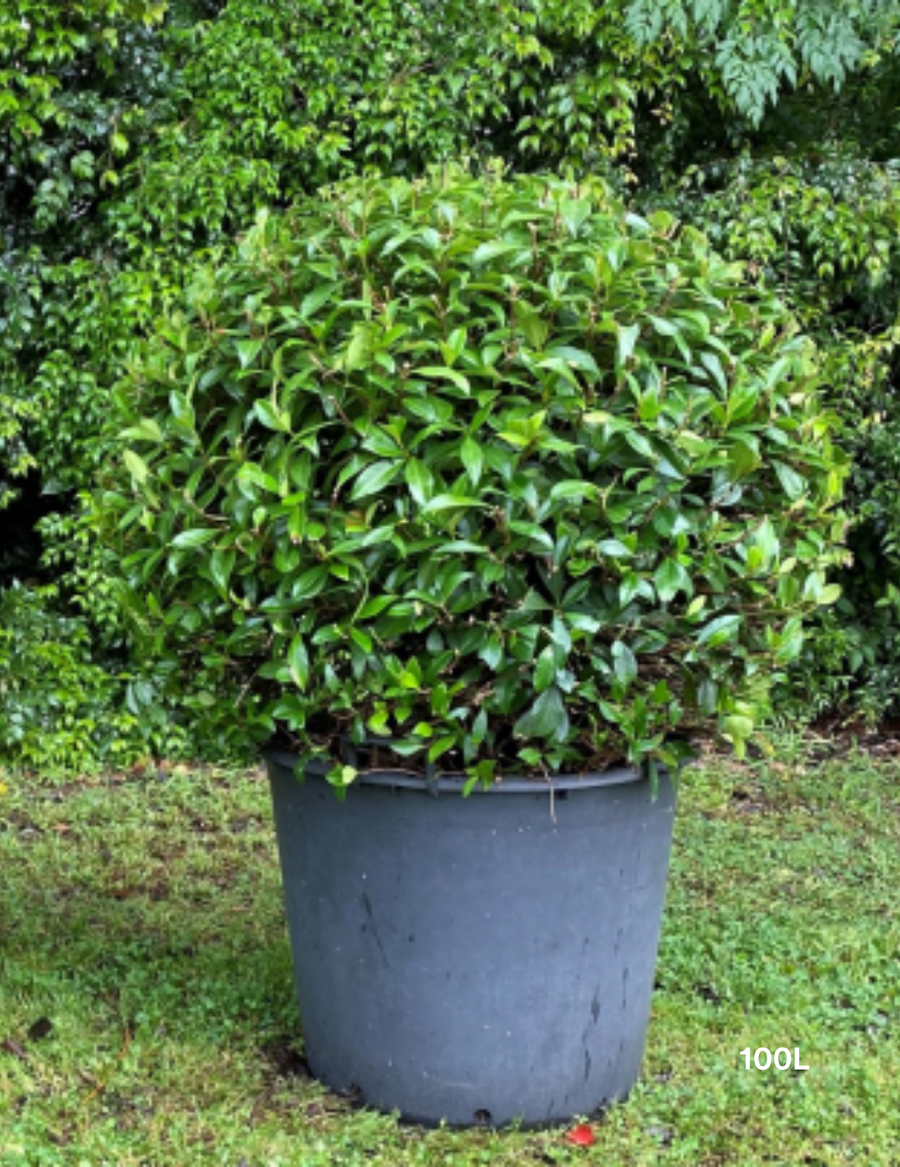
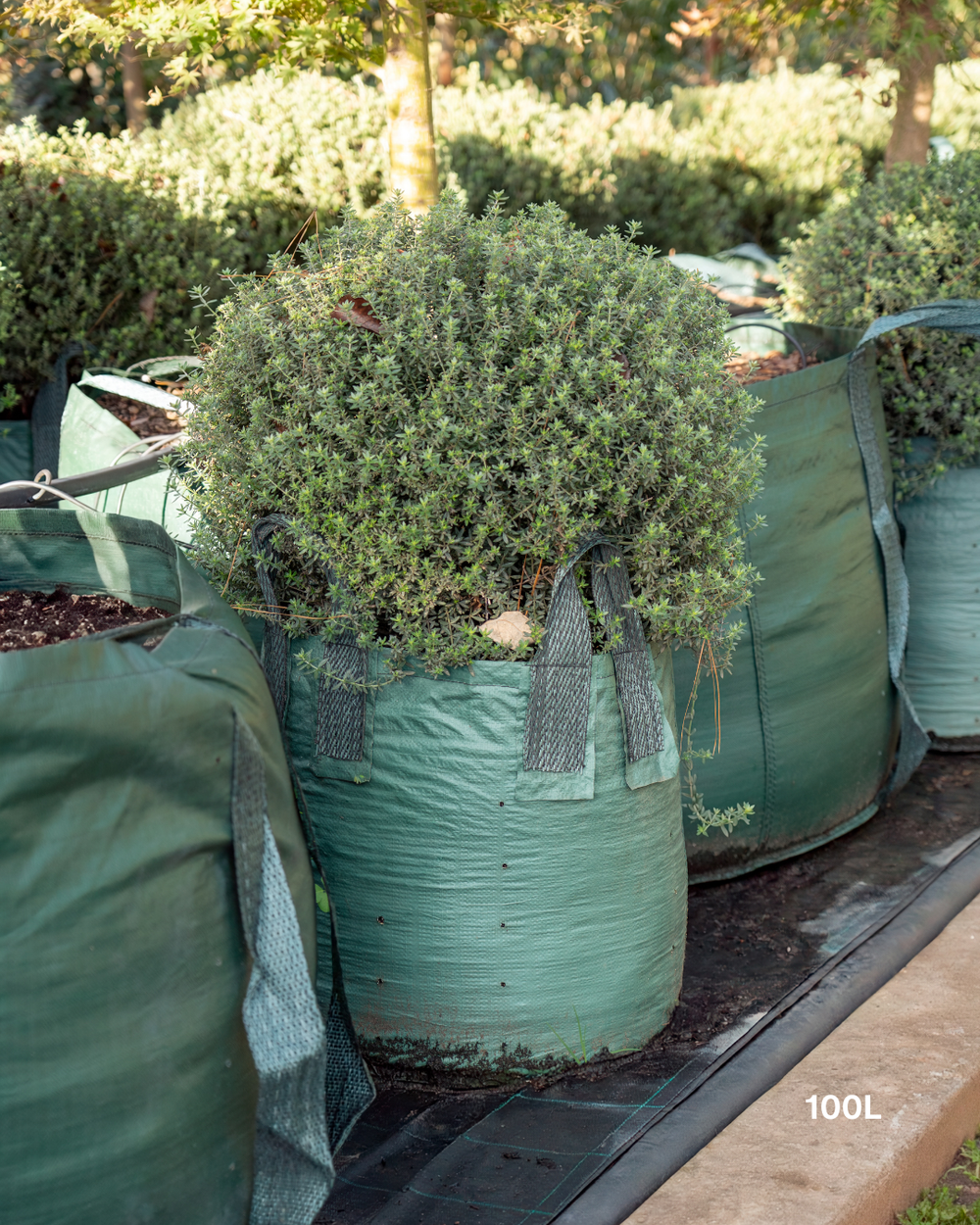
Westringia fruticosa, Coastal Rosemary, is an Australian native evergreen shrub from the headlands and dunes of the east coast. It builds a dense rounded bush of fine grey green leaves held in whorls, with small white to pale lilac flowers. Despite the common name it is not the culinary herb.
Mature plants sit at 1.5 to 2 metres tall and 1.5 to 2 metres wide, growing 30 to 60 centimetres a year, and they clip smaller without complaint. Full sun to part shade and sharp drainage are the requirements. Salt wind, sandy soil, drought and light to moderate frost are all handled.
It is a standard on coastal projects, road verges, council garden beds and exposed banks that need erosion cover. Plant 1 to 1.5 metres apart for an informal screen, or 80 centimetres for a clipped hedge. A single plant fills a 40 to 50 centimetre pot on a courtyard or balcony.
Frequently Asked Questions
About Coastal Rosemary
What is Coastal Rosemary?
Westringia fruticosa is an Australian native evergreen shrub from the headlands and dunes of the east coast. It forms a dense rounded bush of fine grey green leaves held in whorls, with small white to pale lilac flowers. Despite the common name it is not culinary rosemary and is not used in cooking.
How big does Coastal Rosemary grow?
Mature plants reach 1.5 to 2 metres tall and 1.5 to 2 metres wide. It clips readily to smaller dimensions and is often maintained at around a metre as a hedge or a low mound. Growth is moderate, roughly 30 to 60 centimetres a year, so it holds a trimmed shape well.
Is Coastal Rosemary suitable for coastal positions?
It is one of the best shrubs available for exposed coastal work. It grows naturally on sea cliffs and copes with salt laden wind, sand and reflected heat. It is used constantly on beachfront reserves, dune stabilisation projects and seaside gardens where little else holds a tidy shape.
When does Coastal Rosemary flower?
The main flush is spring and summer, roughly September through February, with scattered flowering at other times of the year in mild districts. The flowers are small, white to pale lilac and sit among the foliage rather than above it. Clipped hedges flower less than plants left to grow informally.
How far apart should I plant Coastal Rosemary for a hedge?
Space plants 80 centimetres apart for a tight formal hedge, or 1 to 1.5 metres apart for a dense informal screen. On banks and batters used for erosion cover, 1 metre in a staggered grid gives full ground coverage within about two growing seasons.
Can Coastal Rosemary grow in pots?
Yes. A pot 40 to 50 centimetres wide suits a single plant for a courtyard, entry or balcony. Use a free draining mix, because the roots will not tolerate sitting wet. Container plants need watering more often than those in the ground, plus a light trim to hold their shape.
How do I prune and care for Coastal Rosemary?
Trim lightly two or three times a year, taking the soft new growth and avoiding cuts into bare old wood, which reshoots poorly. Water through the first summer, then only in extended dry spells. On most soils it needs no feeding at all, and it resents heavy watering and poor drainage.
Westringia fruticosa – Coastal Rosemary
Westringia ‘Wynyabbie Blue’ – Wynyabbie Blue Coastal Rosemary
Westringia ‘Wynyabbie Blue’ – Wynyabbie Blue Coastal Rosemary
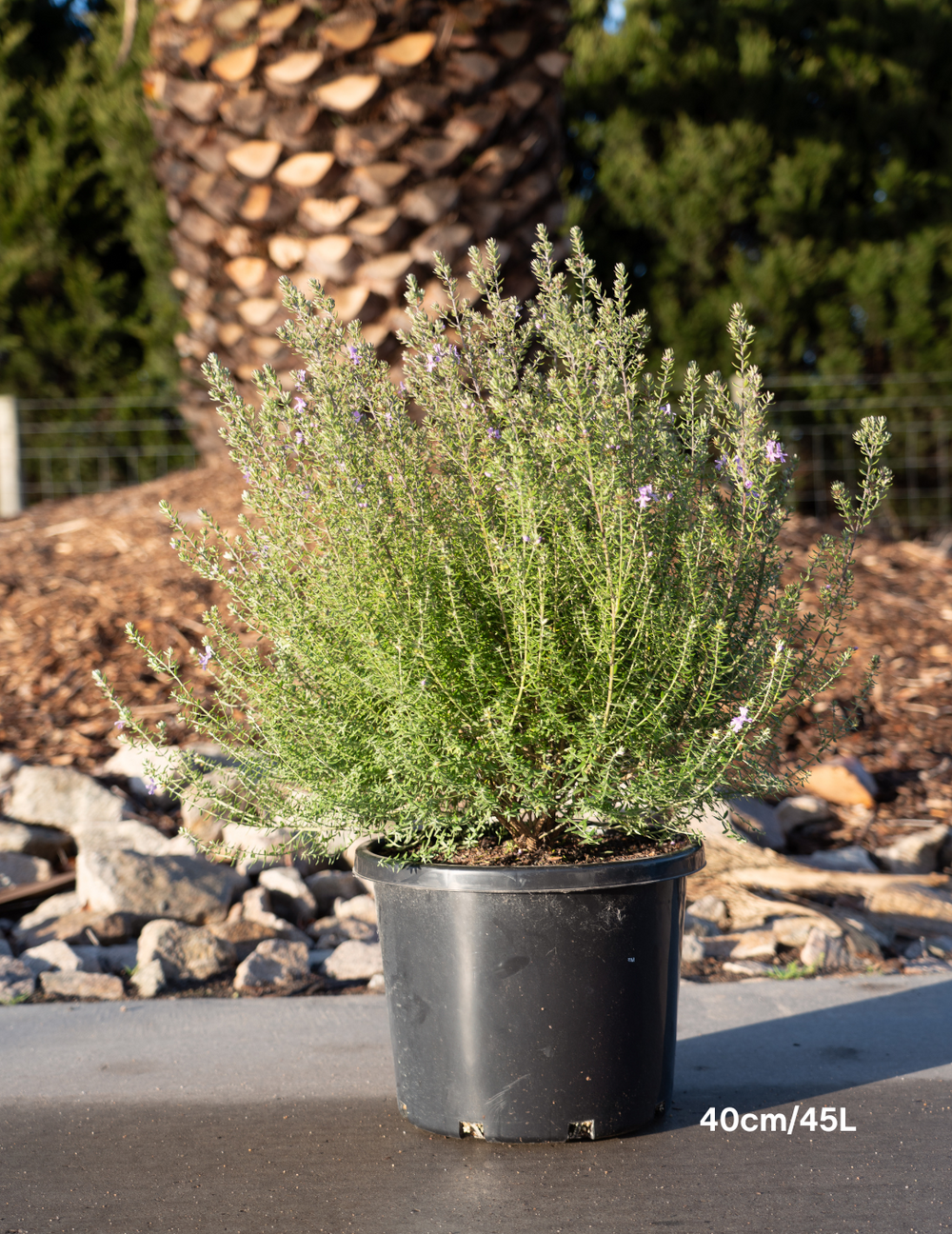
Westringia 'Wynyabbie Blue' is a hardy Australian native shrub grown for its lilac blue flowers, which are larger and more freely carried than those of the common white forms. Narrow grey green leaves sit in neat whorls on a dense rounded frame that holds its shape through the year.
Expect 1.5 to 2 metres in height and width at maturity, at 30 to 60 centimetres a year. Full sun brings the heaviest flowering, though part shade is accepted. Drainage matters above everything else, after which it takes salt wind, sandy or gravelly ground, drought and light to moderate frost.
Mass plantings on batters, median strips and coastal frontages are where it earns its keep, and it clips into a low hedge of about a metre without losing its flowering. Plant 1 to 1.5 metres apart for an informal screen. One plant fills a 40 to 50 centimetre pot neatly.
Frequently Asked Questions
About Wynyabbie Blue Coastal Rosemary
What is Westringia Wynyabbie Blue?
Westringia 'Wynyabbie Blue' is a hardy Australian native shrub grown for its lilac blue flowers, which are larger and more freely carried than those of the common white forms. Narrow grey green leaves sit in neat whorls on a dense rounded frame. It is evergreen and holds its structure all year.
How big does Wynyabbie Blue grow?
It reaches 1.5 to 2 metres tall and 1.5 to 2 metres wide at maturity, growing 30 to 60 centimetres a year. It clips comfortably to around a metre if you want a lower hedge, and it will hold that height indefinitely given two or three light trims a year.
When does Wynyabbie Blue flower?
From spring right through autumn, roughly September to May, with sporadic flowers in winter in mild districts. The lilac blue flowers open in flushes rather than all at once, so there is usually some colour on the plant. Flowering is heaviest in full sun on lean, well drained soil.
Is Wynyabbie Blue drought tolerant?
Yes. Once the roots are established it needs very little water and copes with extended dry periods, which is why it is used on unirrigated median strips and road verges. Drainage matters more than watering, since the plant will die in soggy ground long before it dies of thirst.
Is Wynyabbie Blue suitable for coastal positions?
It is. Salt laden wind, sandy soils and reflected heat are all handled, and it is planted routinely on foreshore reserves and beachside gardens. In very exposed frontal positions the plant stays lower and denser than it would inland, which generally suits the situation anyway.
How far apart should I plant Wynyabbie Blue for a hedge?
Use 80 centimetres between plants for a clipped formal hedge, or 1 to 1.5 metres for a dense informal screen. For mass planting on banks and median strips, 1 metre in a staggered pattern gives full coverage within about two growing seasons and shades out most weeds.
How do I prune and care for Wynyabbie Blue?
Trim lightly after each flowering flush, taking soft growth only. Cutting back into bare old wood leaves gaps that will not fill in, so stay on top of it rather than letting it get away. Water through the first summer, then rarely. Avoid rich soils and heavy fertiliser.
Westringia ‘Wynyabbie Blue’ – Wynyabbie Blue Coastal Rosemary

Evergreen Trees Direct Has Been Featured In:


Perfect Substitutes for Crassula ovata ‘Gollum Gold’ – Gollum Gold Jade
Follow Us On Instagram
@evergreentreesdirect ↗
Tips & Tricks
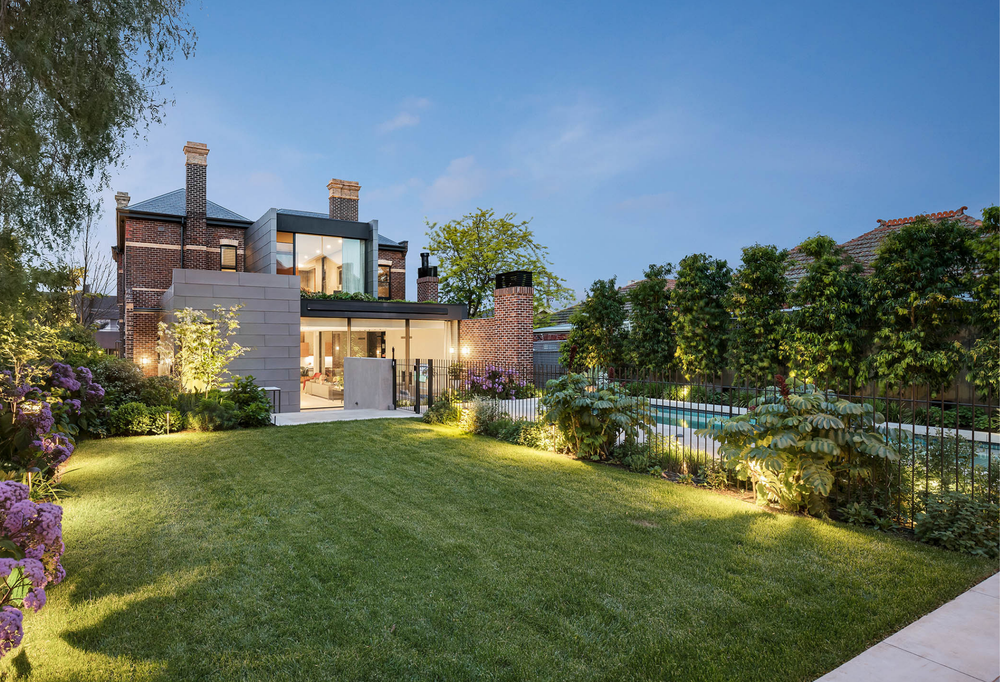
Best Trees for Creating a Privacy Screen: 10 Picks Across Fast Formal, Native and Narrow Column Options
Read the story
How to Incorporate Trees into Your Modern Landscape Design
Read the story
The Importance of Root Health: How to Choose Quality Trees
Read the story