

Ceiba speciosa – Silk Floss Tree
Ceiba speciosa – Silk Floss Tree
Couldn't load pickup availability
Current Stock Height Guides
Current Stock Height Guides
Height guide disclaimer: Height ranges are approximate only. As living products, plant heights naturally vary between individual plants, batches, and seasons. No guarantee is given that supplied plants will fall within the stated range. If minimum heights are required, you mustconfirm current batch heights with Evergreen Trees Direct prior to purchase. Variation in height is normal and is not grounds for return, refund, replacement, or compensation.
Mature Height & Width
Mature Height & Width
Mature Height: 10m to 20m
Mature Width: 8m to 15m
Ceiba speciosa – Silk Floss Tree is expected to grow 60cm to 1.2m per year under suitable conditions.
Root Ball Dimensions
Root Ball Dimensions
Use this as a reference when digging your planting hole. We recommend digging at least 10% wider than the dimensions below to encourage strong root development.
- 30cm Pot: 33cm (W) × 30cm (D)
- 40cm/45L Pot: 44cm (W) × 41.5cm (D)
- 50cm Pot / 70L Pot: 55cm (W) × 41.8cm (D)
- 100L Bag: 50.6cm (W) × 52.8cm (D)
- 150L Bag: 66cm (W) × 55cm (D)
- 200L Bag: 71.5cm (W) × 60.5cm (D)
- 300L Bag: 88cm (W) × 63.8cm (D)
- 400L Bag: 99cm (W) × 66cm (D)
- 500L Bag: 122cm (W) × 66cm (D)
- 750L Bag: 134cm (W) × 69cm (D)
- 1000L Bag: 146.3cm (W) × 71.5cm (D)
- 2000L Bag: 176cm (W) × 82.5cm (D)
Trade
Trade
We supply advanced trees to landscapers, developers, architects, and councils Australia-wide. Trade clients receive fast quotes, expert advice, and access to premium stock with reliable freight.
Shipping
Shipping
Shipping is calculated at checkout based on the pallet space your order occupies in the truck and your delivery location.
There is no charge to calculate your freight.
Contact
Contact
Have a question or a list to send through to us?
Email: sales@evergreentrees.com.au
Phone: (03) 7042 3318
Share this product
About Your New Ceiba speciosa – Silk Floss Tree
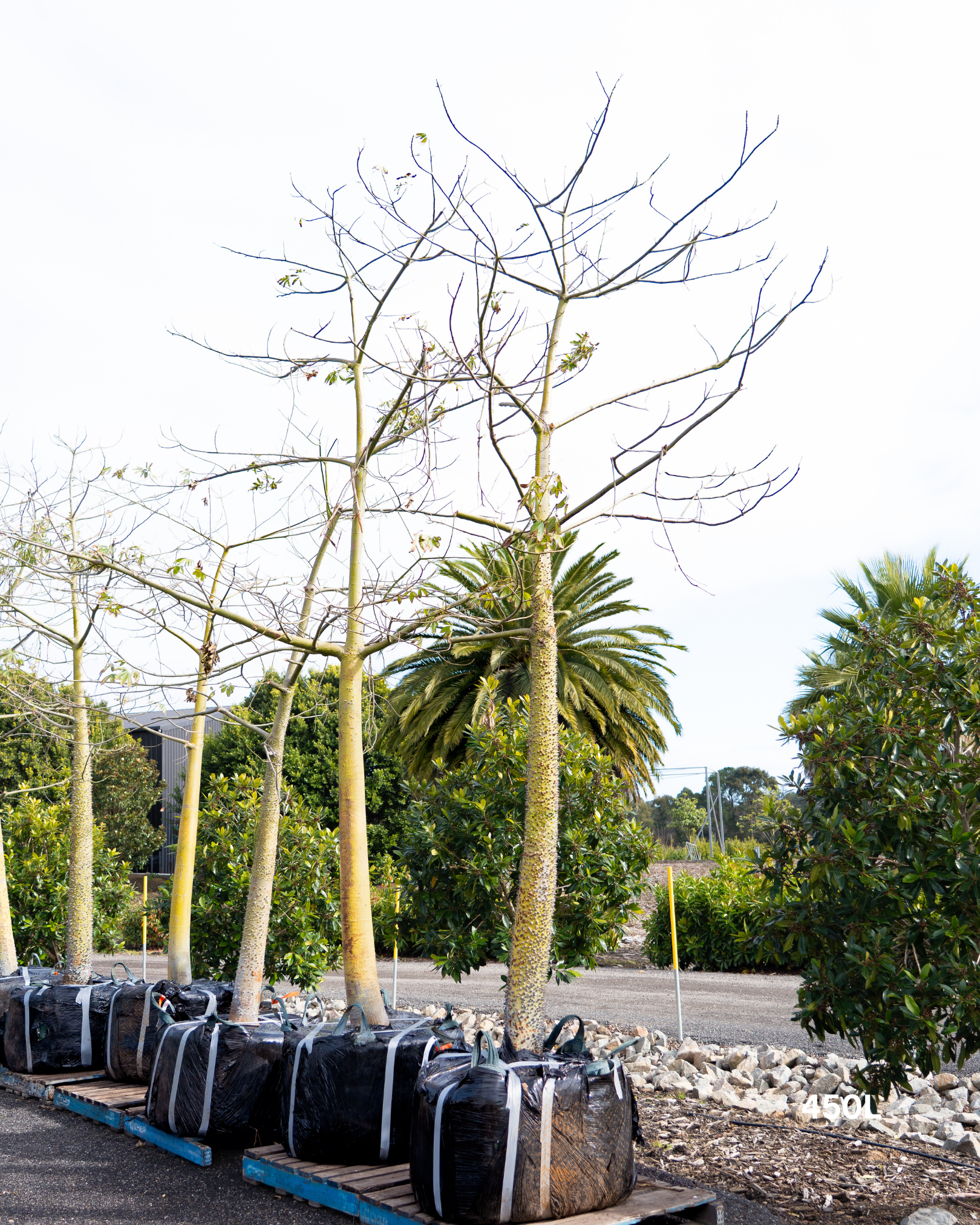
Ceiba speciosa, the Silk Floss Tree, is a broad deciduous feature tree from South America with a swollen bottle shaped trunk, green bark and stout conical spines on young wood. Large pink flowers with cream throats, shaped much like a hibiscus, cover the thinning canopy through late summer and autumn.
It needs full sun and free-draining soil, and grows fast at 60 centimetres to 1.2 metres a year while young. Heat, drought and urban conditions suit it once established. Young trees are frost sensitive and established trees take only light frost, so it belongs in subtropical, warm temperate and frost-free coastal gardens.
Use it as a specimen in parks, on large residential blocks, in resort and civic landscapes and along wide avenues where the trunk and the flowering can both be seen. Site it back from paths and play areas because of the trunk spines. Few trees give this much presence in so few years.
Frequently Asked Questions
About Silk Floss Tree
What is the Silk Floss Tree?
Ceiba speciosa is a deciduous South American tree in the mallow family, related to the baobabs and the kapok tree. It is grown for three things: a swollen green trunk studded with conical spines, large pink flowers in late summer and autumn, and seed pods that split open to release silky white floss.
When does it flower?
Late summer into autumn, broadly February to May, with the peak usually in March and April. The tree often sheds much of its foliage as it comes into flower, so the blooms sit on near bare branches and read from a long way off. Trees generally need several years in the ground before flowering begins.
Is it frost tolerant?
Only marginally. Young trees are damaged by frost and should not be planted where frosts are regular. Established trees with thickened bark handle light frost, but a heavy or repeated frost kills the growing tips and can take out a young tree entirely. Warm coastal and subtropical positions are the safe choice.
How fast does it grow?
Fast. It puts on 60 centimetres to 1.2 metres a year in warm conditions with reasonable water, so it reaches a useful size within five or six years. Growth slows once the trunk starts to thicken. The soft, quick growth means young trees need staking and shelter from strong wind while they establish.
How big does it get?
In Australian conditions it usually reaches 10 to 15 metres tall and 8 to 10 metres wide, with older specimens in warm districts going higher. The trunk thickens dramatically with age and can exceed a metre across at the base. Allow generous room, since the canopy spreads almost as wide as the tree is tall.
Does it have thorns?
Yes. Young trunks and branches carry stout conical spines, which is a distinguishing feature of the species and also a planning consideration. Keep it away from footpaths, playgrounds, driveways and anywhere people brush past. The spines become less prominent as bark thickens on very old trees, though they do not disappear.
How do I care for a Silk Floss Tree?
Plant in full sun with good drainage, stake young trees and water regularly through the first two summers. After that it is largely self sufficient in a warm climate. Prune in late winter to lift the canopy and remove crossing limbs, wearing gloves. Avoid heavy fertiliser, which pushes soft growth at the expense of flowering.
Evergreen Trees Direct Has Been Featured In:


Uses in my Garden
Uses in my Garden
Ceiba speciosa – Silk Floss Tree works in an:
Is Ceiba speciosa – Silk Floss Tree Evergreen or Deciduous?
Is Ceiba speciosa – Silk Floss Tree Evergreen or Deciduous?
Ceiba speciosa – Silk Floss Tree is an Deciduous (Defoliates throughout colder months) Tree
Mature Height & Width
Mature Height & Width
Mature Height: 10m to 20m
Mature Width: 8m to 15m
Ceiba speciosa – Silk Floss Tree is expected to grow 60cm to 1.2m per year under suitable conditions.
Growth Rate of Ceiba speciosa – Silk Floss Tree
Growth Rate of Ceiba speciosa – Silk Floss Tree
Ceiba speciosa – Silk Floss Tree is expected to grow 60cm to 1.2m per year under suitable conditions.
They are considered to have a:
Frost Tolerance & Ideal Climate to plant Ceiba speciosa – Silk Floss Tree
Frost Tolerance & Ideal Climate to plant Ceiba speciosa – Silk Floss Tree
Is Ceiba speciosa – Silk Floss Tree frost tolerant?
Ceiba speciosa – Silk Floss Tree is Frost Sensitive – May suffer damage from frost, best in frost-free or protected spots.
Does Ceiba speciosa – Silk Floss Tree Flower?
Does Ceiba speciosa – Silk Floss Tree Flower?
Ceiba speciosa produces masses of large showy pink flowers with creamy-white centres during autumn. The blooms create a spectacular display across the canopy, bringing vibrant seasonal colour and strong ornamental impact. Flowering is often enhanced as the foliage begins to thin, allowing the blossoms to become a striking feature.
Does Ceiba speciosa – Silk Floss Tree flower?
Flowering Period:
Flower Type:
Flower Colour:
Pink
Is Ceiba speciosa – Silk Floss Tree an Australian Native Tree?
Is Ceiba speciosa – Silk Floss Tree an Australian Native Tree?
No
Ceiba speciosa – Silk Floss Tree is Native to Brazil, Argentina, Paraguay, and Bolivia.
What is the Wildlife Value of Ceiba speciosa – Silk Floss Tree ?
What is the Wildlife Value of Ceiba speciosa – Silk Floss Tree ?
Its large nectar-rich flowers attract bees and other beneficial pollinators throughout the flowering season, supporting biodiversity within ornamental landscapes. The broad canopy also provides seasonal shelter and habitat for birds and beneficial insects throughout the year.
How much Sunlight does Ceiba speciosa – Silk Floss Tree need?
How much Sunlight does Ceiba speciosa – Silk Floss Tree need?
Ceiba speciosa – Silk Floss Tree will thrive best in:
Preferred Soil?
Preferred Soil?
Ceiba speciosa performs best in well-drained loam or sandy soils with a neutral to slightly alkaline pH. It will also tolerate poorer soils provided drainage remains reliable. Avoid heavy clay or persistently wet conditions unless significantly improved, as excess moisture can reduce root health and overall vigour. Allow the soil to dry slightly between watering once established to maintain healthy growth and flowering performance.
Is Ceiba speciosa – Silk Floss Tree Drought Tolerant?
Is Ceiba speciosa – Silk Floss Tree Drought Tolerant?
Is Ceiba speciosa – Silk Floss Tree Drought tolerant?
As a young tree it benefits from regular watering to establish a healthy root system, particularly during warmer weather. Once established, Silk Floss Trees show excellent drought tolerance and perform reliably through extended dry periods with minimal supplementary watering.

Planting Information
How To Plant Your Ceiba speciosa – Silk Floss Tree
How To Plant Your Ceiba speciosa – Silk Floss Tree
Recommended Planting Spacing For Your Ceiba speciosa – Silk Floss Tree
Recommended Planting Spacing For Your Ceiba speciosa – Silk Floss Tree
Ceiba speciosa – Silk Floss Tree is expected to grow 60cm to 1.2m per year under suitable conditions.
Long Term Care For Your Ceiba speciosa – Silk Floss Tree
Long Term Care For Your Ceiba speciosa – Silk Floss Tree
Planting Your Ceiba speciosa – Silk Floss Tree in Different Soil
Planting Your Ceiba speciosa – Silk Floss Tree in Different Soil
Frequently Asked Questions
Frequently Asked Questions