- Mature height
- 5m to 8m
- Mature width
- 3m to 5m
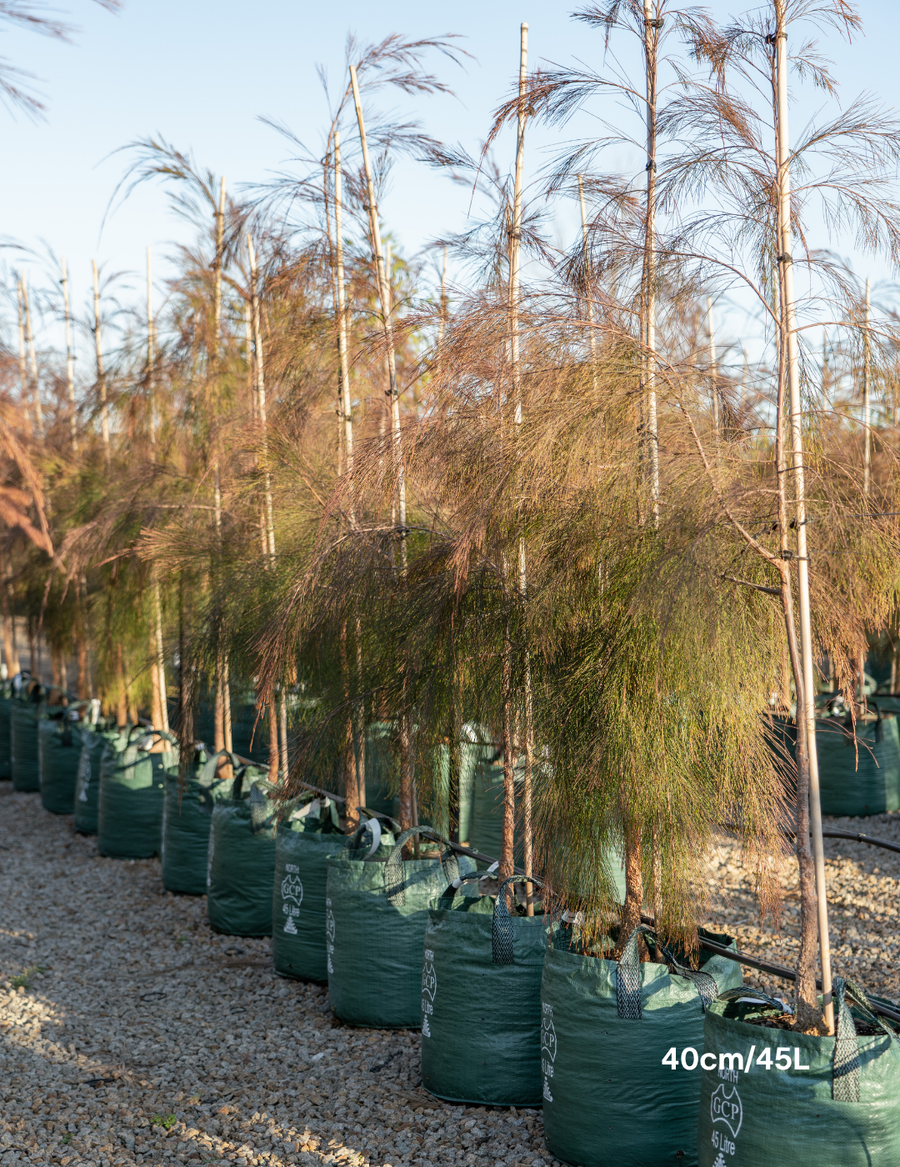
Allocasuarina littoralis, the Black She Oak, is an upright native tree with fine, dark green branchlets that hang in soft weeping sprays. Dark furrowed bark sits beneath a narrow, open canopy. Female trees carry small red flowers in winter, followed by short woody cones that hold on the branches for months.
It handles full sun, poor sandy soil, salt wind and long dry spells, and copes with light to moderate frost once established. Growth runs around 40 to 70 centimetres a year. It grows through temperate and subtropical eastern Australia, and root nodules fix nitrogen, so extra feeding is rarely needed.
It is planted for windbreaks, screening, erosion control and revegetation, and as an avenue tree at about 3 metre spacing. Glossy black cockatoos feed on the cones. On rural blocks and council work it gives structure and habitat value with very little ongoing input.
Frequently Asked Questions
About Black She Oak
How big does Black She Oak grow?
Mature height is 5 to 8 metres with a spread of 3 to 5 metres, giving a fairly narrow upright shape. That makes it useful on suburban blocks where a taller native is wanted without a wide canopy. In exposed coastal or windy sites it often settles at the lower end of that range.
How fast does it grow?
It adds roughly 40 to 70 centimetres a year once the roots are away, which is moderate to quick for a native tree of this size. Growth is fastest in the first few years with regular water through the first two summers. On dry, shallow or very exposed sites it slows noticeably.
How far apart should I plant it for a screen?
For a dense informal screen, plant 1 to 1.5 metres apart. For a tighter formal hedge, 80 centimetres apart works well. For an avenue with a uniform soft-textured line, allow 3 metres between trees. Closer spacing fills in sooner but the trees stay narrower, so match the spacing to the height you want.
Is it drought tolerant?
Yes. Once established it holds up through long dry periods, which is why it is used on rural blocks and in revegetation work. The fine branchlets lose little moisture and the deep root system finds water well below the surface. Water through the first two summers to build that root system.
Is it suitable for coastal positions?
Yes. It occurs naturally in coastal country along the east coast and tolerates salt wind and sandy soil. Plant it behind the primary dune rather than in front of it, where constant salt spray would burn the branchlets. It works well as a first line windbreak for more tender plants further inland.
When does it flower?
Trees are either male or female. Female trees produce small red flowers through winter, followed by short woody cones that stay on the branches for months and feed glossy black cockatoos. Male trees carry rusty brown flower spikes at the branchlet tips. Seedling trees cannot be sexed until they first flower.
How do I care for Black She Oak?
Very little is needed. Water through the first two summers, mulch clear of the trunk and stake only on exposed sites. Skip the fertiliser, since root nodules supply their own nitrogen and phosphorus rich feeds can harm it. Remove lower limbs if you want a clear trunk, otherwise leave the tree alone.