



Skip to content

OUR END OF FINANCIAL YEAR SALE IS LIVE!

20% OFF ORDERS OVER $1,500 - DISCOUNT APPLIES AUTOMATICALLY AT CHECKOUT

Best Trees for Small Gardens: 12 Compact Picks That Layer Height and Make the Space Feel Bigger

Best Trees for Small Gardens: 12 Compact Picks That Layer Height and Make the Space Feel Bigger

Small gardens reward design discipline, not crowding. The strongest small-garden plantings layer three tiers: a feature tree, structural mid-tier shrubs and a foliage ground layer. Eleven compact picks across all three tiers that turn a courtyard into a designed garden.

compact treescontainer plantingcourtyardfeature treessmall garden

Small gardens reward design discipline, not crowding.

The strongest courtyards do the opposite of what most people instinct toward. Fewer plants. Layered intentionally. Breathing room between them.

The result is a space that reads designed and feels larger than it is.

Twelve picks below, covering all three tiers of a layered small-garden composition.

  1. Acer palmatum: sculptural deciduous feature, layered horizontal canopy.
  2. Magnolia 'Little Gem': compact polished evergreen Magnolia.
  3. Magnolia 'Teddy Bear': plush brown-backed compact Magnolia.
  4. Olea 'Tolley's Upright': narrow columnar Mediterranean olive, low-fruiting.
  5. Lagerstroemia 'Acoma': true dwarf Crepe Myrtle, white summer flowers.
  6. Buxus 'English Box' Topiary Balls: formal sphere geometry.
  7. Citrus 'Courtyard Lime': compact productive evergreen built for small gardens.
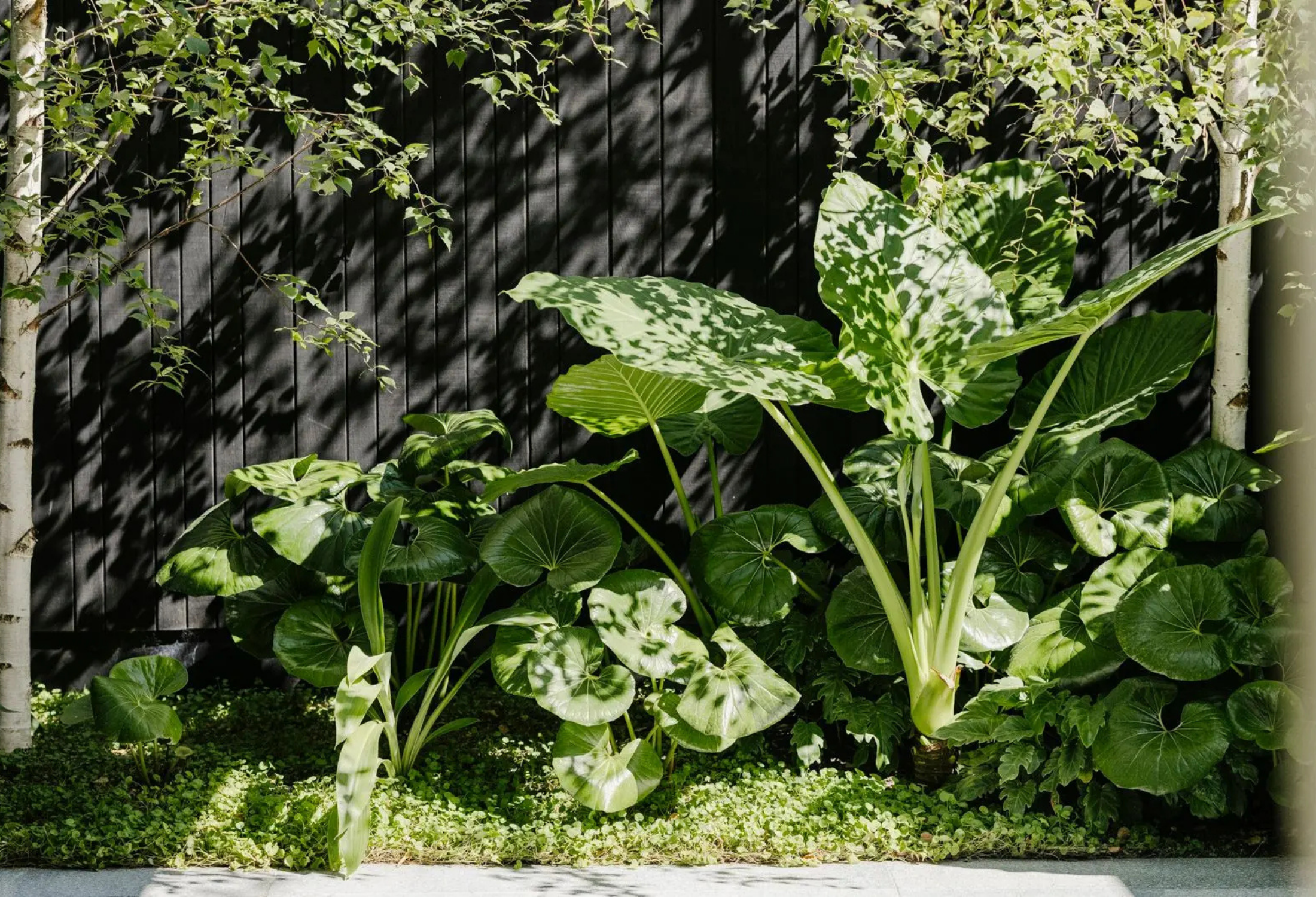
  8. Ligularia reniformis: bold dinner-plate foliage at ground level.
  9. Camellia sasanqua 'Setsugekka': espalier-trainable evergreen, white winter flowers.
  10. Agave attenuata: soft sculptural Foxtail Agave, the modern courtyard succulent.
  11. Rosmarinus officinalis: Mediterranean herb fragrance plus blue winter flowers.
  12. Lavandula (Lavender): silver aromatic foliage and purple flower spikes, the classic Mediterranean herb partner to Rosemary.

Shop the Look

The Layered Courtyard Bundle

One feature tree, three to five matched structural shrubs, and a mass-planted ground layer is one of the most reliable small-garden compositions there is. Build it in three product groups, picking one from each tier of the twelve picks below. Swap freely.

Tier 1 (feature, pick one)
Acer palmatum · Magnolia 'Little Gem' · Magnolia 'Teddy Bear' · Olea 'Tolley's Upright' · Lagerstroemia 'Acoma'

Tier 2 (structure, buy 3 to 5)
Buxus 'English Box' Topiary Balls · Citrus 'Courtyard Lime' · Camellia 'Setsugekka'

Tier 3 (ground, buy 5 to 7)
Ligularia reniformis · Agave attenuata · Rosmarinus officinalis · Lavandula

Browse the small garden collection

The three-tier formula for a small garden

Tier 1: pick one feature tree under 5m
A single sculptural feature tree under 5m is the small garden's hero. The right pick depends on your climate, light and personal style.

Deciduous options that deliver dramatic seasonal change include Acer palmatum (architectural layered canopy and autumn red) and Lagerstroemia 'Acoma' (white summer flowers plus cinnamon winter bark).

Evergreen options that hold structure year-round include Magnolia 'Little Gem' and 'Teddy Bear' (polished glossy presence) and Olea 'Tolley's Upright' (narrow columnar Mediterranean silver). The principle that matters most: pick ONE as the centrepiece, not five.
Tier 2: structural mid-tier shrubs in matched repetition
This is the layer most small gardens skip, and it's the layer that separates a designed garden from a crowded planting. Pick a structural shrub between 1 and 2m mature size and repeat it in a group of three or five for visual rhythm.

Strong options include Buxus 'English Box' Topiary Balls (formal sphere geometry), Citrus 'Courtyard Lime' (productive evergreen plus fruit) and Camellia 'Setsugekka' (winter flowers on year-round evergreen).

The principle: choose ONE and repeat it. Matched repetition reads as designed; one-of-each reads as cluttered.
Tier 3: ground-level foliage heroes mass-planted
The lowest layer matters most because it's what you see when you're sitting down. Pick a bold foliage hero and mass-plant it in groups of five or seven.

Strong options include Ligularia reniformis (dinner-plate dark green foliage on a tropical-look perennial), Agave attenuata (soft Foxtail rosette without spines, the modern courtyard signature), Rosmarinus officinalis (Mediterranean herb fragrance plus blue winter flowers) and Lavandula (silver aromatic foliage plus purple flower spikes).

The principle: mass-plant a single species, don't dot one of each.
Stay in scale: under 5m for the feature, under 2m for everything else
Anything taller than 5m dominates a small garden visually. The picks on this list all hold under 5m at the canopy and under 2m at the mid-tier and ground. Use this as your scale rule when considering any other species.
Leave breathing room and repeat the elements
A small garden with empty paving or lawn between layered planting feels more spacious than one crammed with smaller plants. Less, repeated, is more. Three matched balls reads as designed. Twelve different shrubs reads as cluttered.

1. Acer palmatum (Japanese Maple)

Acer palmatum is the small garden's most reliable feature tree. The layered horizontal canopy delivers four distinct seasons (soft green spring, sculptural summer, fiery autumn red, elegant winter silhouette) all on a tree that stays in scale with a courtyard. The hero feature for small gardens.

Type
Compact deciduous feature tree
Height
3 to 5m
Width
3 to 4m
Growth rate
Slow to moderate
Foliage
Soft green spring/summer, fiery red autumn, bare elegant winter structure
Flowers
Insignificant
Form
Layered horizontal canopy
Conditions
Part shade to filtered sun, well-drained slightly acid soil, frost hardy
Maintenance
Very low. Light tip prune only.
Best for
Small garden feature tree, courtyard centrepiece, layered four-season interest.

Why choose it

Most small gardens need a hero. Acer palmatum is the most architecturally beautiful small feature tree we sell, with the longest visual season of any compact deciduous option. The layered horizontal canopy doesn't just stay in scale with a small space, it makes the space feel intentional and designed.

Perfect pair

Plant with three matched Buxus 'English Box' Topiary Balls beneath, and mass-planted Ligularia reniformis at the lowest layer for a layered Japanese-inspired courtyard.

Tips for planting

Position with morning sun and afternoon shade. Mulch heavily and never let the soil dry out. Light prune only, the form is the feature.

Four seasons of beauty on a tree that stays in scale.

Shop Acer palmatum

2. Magnolia grandiflora 'Little Gem' (Little Gem Magnolia)

'Little Gem' is the compact polished evergreen Magnolia bred specifically for smaller gardens. Large glossy dark green leaves with bronze undersides, fragrant cream summer flowers, upright tidy habit, and the formal evergreen presence of the full-sized Magnolia grandiflora at a courtyard-appropriate scale.

Type
Compact evergreen feature tree
Height
4 to 5m
Width
2 to 3m
Growth rate
Slow to moderate
Foliage
Glossy dark green with bronze undersides, evergreen
Flowers
Fragrant cream summer flowers
Form
Upright pyramidal habit
Conditions
Full sun to part shade, well-drained slightly acid soil, frost hardy
Maintenance
Low. Minimal pruning required.
Best for
Small garden formal evergreen feature, polished hedge alternative, courtyard centrepiece.

Why choose it

Full-sized Magnolia grandiflora grows to 12m or more, far too big for a small garden. 'Little Gem' carries the same polished evergreen foliage and fragrant white summer flowers on a tree that stays at 4 to 5m. The compact size means it works as a feature, an espalier or even a clipped hedge.

Perfect pair

Plant as a pair flanking a doorway, or underplant with Camellia 'Setsugekka' for layered glossy evergreen with winter flower season.

Tips for planting

Position in full sun for the strongest form. Mulch heavily and water consistently through summer. Light prune after flowering if desired.

Polished evergreen Magnolia in courtyard scale.

Shop Magnolia grandiflora 'Little Gem'

3. Magnolia grandiflora 'Teddy Bear' (Teddy Bear Magnolia)

'Teddy Bear' is the densest, plushest compact Magnolia. Large glossy dark green leaves with dramatic rusty-brown felted undersides, a tighter habit than 'Little Gem', and the same fragrant cream summer flowers. The pick for small gardens that want a softer, plusher polished evergreen feature.

Type
Compact evergreen feature tree
Height
4 to 5m
Width
2 to 3m
Growth rate
Slow
Foliage
Glossy dark green with rusty-brown felted undersides, evergreen
Flowers
Fragrant cream summer flowers
Form
Dense compact upright
Conditions
Full sun to part shade, well-drained slightly acid soil, frost hardy
Maintenance
Low. Minimal pruning required.
Best for
Small garden polished evergreen feature, formal entrance pairs, espalier.

Why choose it

'Teddy Bear' takes the polished compact Magnolia further than 'Little Gem'. The leaves are larger, the brown felted undersides are more dramatic, and the overall habit is denser and more sculptural. The pick for small gardens that want a richer, more textural polished evergreen feature.

Perfect pair

Plant in matched pairs flanking an entrance, or alongside Magnolia 'Little Gem' for a layered compact Magnolia palette.

Tips for planting

Position in full sun for the densest habit and most flowering. Mulch heavily. The brown undersides are dramatic in motion, position where breeze flips the leaves into view.

The plushest compact polished evergreen Magnolia.

Shop Magnolia grandiflora 'Teddy Bear'

4. Olea europaea 'Tolley's Upright' (Tolley's Upright Olive)

Tolley's Upright is the columnar olive built for narrow small gardens. Same silver-grey leaves and Mediterranean water-wise constitution as a standard olive, but on a tight upright form that fits courtyards, narrow side beds and tight planting strips. The low-fruiting habit also means no olive drop on paving, which keeps the space clean.

Type
Compact columnar evergreen Mediterranean tree
Height
4 to 6m
Width
1.5 to 2m
Growth rate
Moderate
Foliage
Silver-grey leaves, evergreen
Flowers
Small cream flowers, very few olives
Form
Narrow columnar
Conditions
Full sun, well-drained soil, frost and drought hardy
Maintenance
Low. Light prune to maintain column shape.
Best for
Compact Mediterranean small garden feature, narrow side beds, courtyard centrepiece without fruit mess.

Why choose it

Standard olives need wide spreading room and drop fruit on paving. Tolley's Upright carries the full silver Mediterranean constitution on a narrow column that fits the tightest courtyard, side bed or paved entry. The low-fruiting habit keeps the space clean. The sculptural columnar form holds year-round without intervention.

Perfect pair

Plant in matched pairs flanking an entry with Rosmarinus officinalis at the base for a compact Mediterranean courtyard composition.

Tips for planting

Full sun, sharp drainage. Plants pot-grow beautifully in large terracotta. Light prune to maintain the column.

The narrow Mediterranean column for the smallest courtyard.

Shop Olea europaea 'Tolley's Upright'

5. Lagerstroemia indica 'Acoma' (Acoma Dwarf White Crepe Myrtle)

'Acoma' is the true dwarf Crepe Myrtle for small gardens. Mature size at 2 to 3m, profuse white summer flowers, smooth cinnamon winter bark, autumn colour, and the four-season interest of full-sized Crepe Myrtles on a tree that fits a courtyard. The compact-garden answer to a feature Lagerstroemia.

Type
Compact deciduous feature tree
Height
2 to 3m
Width
1.5 to 2m
Growth rate
Moderate
Foliage
Mid green summer, orange-red autumn, bare smooth winter trunk
Flowers
Profuse white summer panicles
Form
Multi-trunk vase
Conditions
Full sun, well-drained soil, frost hardy
Maintenance
Low. Never top, light prune in late winter only.
Best for
Small garden four-season feature, dwarf alternative to standard Crepe Myrtles, courtyard centrepiece.

Why choose it

Full-sized Lagerstroemia 'Natchez' grows to 6 to 8m, far too big for a small garden. 'Acoma' carries the same multi-trunk vase form, profuse summer flowering and smooth cinnamon winter bark on a true dwarf at 2 to 3m. Four-season interest at the right scale.

Perfect pair

Plant as a single feature with Rosmarinus officinalis mass-planted at the base for a layered Mediterranean compact garden.

Tips for planting

Never top a Lagerstroemia, even a dwarf. Light prune in late winter only. Position in full sun for the strongest flowering.

Four-season Crepe Myrtle at courtyard scale.

Shop Lagerstroemia indica 'Acoma'

6. Buxus sempervirens (English Box) (English Box Topiary Balls)

English Box Topiary Balls are the formal sphere geometry that anchors evergreen gardens. Tight dense dark green foliage holds clipped form year-round. Use them flanking entrances, lining a path, or massed for the kind of rhythmic structural repetition that turns a planting into a designed space.

Type
Evergreen topiary
Height
0.6 to 1.2m (depending on size)
Width
0.6 to 1.2m (depending on size)
Growth rate
Slow
Foliage
Dense small dark green leaves, evergreen
Flowers
Insignificant
Form
Tight formal sphere, hand clipped
Conditions
Full sun to part shade, well-drained soil, frost hardy
Maintenance
Low. Two clips per year to maintain sphere.
Best for
Formal evergreen structure, entrance flanking pairs, courtyard centrepieces.

Why choose it

Topiary delivers two functions evergreen shrubs alone can't: geometric structure that reads as designed (not just planted), and a sense of permanence that no perennial or seasonal feature can match. English Box is the slowest, densest, most disciplined topiary subject we sell, which is why it carries every formal garden tradition from English country to French parterre.

Perfect pair

Plant in pairs flanking an entrance, or in matched rows under Laurus 'Miles Choice' Bay standards.

Tips for planting

Two clips per year (spring and autumn) maintains tight form. Keep mulched and watered through summer dry. Avoid full afternoon sun in hot climates.

Formal sphere geometry that holds year-round.

Shop Buxus sempervirens (English Box)

7. Citrus latifolia 'Courtyard Lime' (Courtyard Lime)

The Courtyard Lime is the productive evergreen citrus built specifically for small gardens. Compact dense habit, glossy evergreen foliage that holds structure year-round, and prolific Tahitian lime fruit through the warmer months. The small garden's working productive feature plus polished evergreen mid-tier in one plant.

Type
Compact productive evergreen citrus
Height
2 to 3m
Width
1.5 to 2m
Growth rate
Moderate
Foliage
Glossy dark green leaves, evergreen
Flowers
Fragrant white flowers, prolific Tahitian lime fruit
Form
Compact dense rounded
Conditions
Full sun, well-drained slightly acid soil, frost tender
Maintenance
Low. Annual feed, light pruning.
Best for
Compact productive courtyard citrus, mid-tier evergreen structure plus fresh limes.

Why choose it

Most citrus trees grow too large for a small garden. The Courtyard Lime is the compact selection bred to deliver full productive value (proper Tahitian limes) on a plant that stays in courtyard scale. Year-round glossy evergreen foliage plus a working kitchen ingredient in the same plant.

Perfect pair

Plant beside Olea 'Bambalina' for a compact Mediterranean productive palette, or in a large pot beside the kitchen door.

Tips for planting

Full sun, sheltered from cold winds. Feed twice a year with citrus food. Pot growing works beautifully if soil drainage is concerns.

Productive evergreen citrus sized for a courtyard.

Shop Citrus latifolia 'Courtyard Lime'

8. Ligularia reniformis (Tractor Seat Ligularia)

Ligularia reniformis is the dinner-plate-leaved foliage hero for the small garden ground layer. Enormous round glossy dark green leaves on bold upright stems deliver tropical-look drama and the kind of leaf scale that makes the rest of the planting feel bigger. The signature ground-layer plant for small modern gardens.

Type
Bold-foliage perennial
Height
1 to 1.5m
Width
1 to 1.5m
Growth rate
Moderate
Foliage
Huge glossy dark green round leaves
Flowers
Yellow daisy-like flowers, summer
Form
Bold upright clump
Conditions
Part shade preferred, moist well-drained soil, frost hardy
Maintenance
Low. Cut back old foliage in late winter.
Best for
Bold ground-layer foliage, tropical-look feature, mass planting under a feature tree.

Why choose it

Small gardens need a foliage hero at ground level. Ligularia reniformis has some of the largest leaves of any garden perennial, which means a small mass planting delivers enormous visual impact. The bold leaf scale also tricks the eye, making the rest of the planting feel larger by contrast.

Perfect pair

Mass-plant under Acer palmatum for layered Japanese-inspired courtyard, or beside Buxus 'English Box' Topiary Balls for textural contrast (bold foliage against tight topiary).

Tips for planting

Position in part shade with reliable moisture. Mulch heavily to keep the root zone cool. Cut back any tired foliage in late winter.

Dinner-plate foliage that makes a small garden feel bigger.

Shop Ligularia reniformis

9. Camellia sasanqua 'Setsugekka' (Setsugekka Sasanqua Camellia)

Setsugekka delivers two evergreen design jobs at once. Dense glossy dark green foliage carries the garden's structure year-round, then from late autumn through winter the plant covers itself in pure white single flowers with gold stamens. The evergreen that turns the cold season into a feature.

Type
Evergreen flowering shrub / hedge / espalier
Height
2 to 3m
Width
1.5 to 2m
Growth rate
Moderate
Foliage
Glossy dark green, evergreen
Flowers
Pure white with gold stamens, late autumn through winter
Form
Upright dense habit, can be clipped
Conditions
Part sun to full sun, well-drained slightly acid soil, frost hardy
Maintenance
Low. Light shape after flowering.
Best for
Year-round evergreen structure with winter flower season, espaliers, formal evergreen hedges.

Why choose it

Camellias are a winter flowering staple, and they double as polished evergreen structure for the rest of the year. 'Setsugekka' carries the largest, most luminous white flowers in the sasanqua range, opening from late autumn through winter when nothing else in the garden is flowering. Combined with year-round glossy evergreen foliage, it's two seasons of feature value in one plant.

Perfect pair

Plant under Magnolia 'Coolwyn Gloss' as layered glossy evergreen, or as espalier beside a courtyard wall.

Tips for planting

Position in morning sun with afternoon shade in hot climates. Mulch heavily, never let dry through summer.

Year-round evergreen plus pure white winter flowers.

Shop Camellia sasanqua 'Setsugekka'

10. Agave attenuata (Foxtail Agave)

The Foxtail Agave is the signature modern courtyard agave. Soft sculptural rosette of pale silver-green leaves curving outward in a fountain form, with no dangerous spines (unlike most agaves), and a dramatic arching flower spike that gives the species its common name. The architectural ground-layer succulent built for contemporary small gardens.

Type
Sculptural succulent
Height
1 to 1.5m
Width
1.5 to 2m
Growth rate
Moderate
Foliage
Soft pale silver-green leaves, no spines
Flowers
Tall arching cream flower spike at maturity
Form
Soft outward-curving rosette
Conditions
Full sun to part shade, sharp drainage, frost tender
Maintenance
Almost none.
Best for
Sculptural modern courtyard ground layer, pot specimens, contemporary small-garden centrepiece.

Why choose it

Most agaves carry dangerous spines that make them unsafe near paths and seating. Agave attenuata is the soft-leaved exception, which is why it has become the signature succulent of contemporary courtyard design. Soft pale silver-green rosette form, fountain-like outward curve, and the trademark arching foxtail flower spike on mature plants. Safe, sculptural and unmistakably modern.

Perfect pair

Plant in a stone or terracotta pot as a centrepiece, or beside Acer palmatum 'Waterfall' for textural contrast (soft fountain agave against cascading fine maple foliage).

Tips for planting

Sharp drainage essential. Raise the bed or add coarse sand in heavy soils. Frost tender, protect in cool climates or grow in a movable pot.

The signature modern courtyard agave, soft and safe.

11. Rosmarinus officinalis (Rosemary)

Rosemary is the Mediterranean ground-layer workhorse. Silver-grey evergreen needle-like foliage releases aromatic oils every time you brush past, blue flowers cover the plant through winter, and the leaves work in the kitchen. The plant is bulletproof, drought-tolerant, and reads as polished or rustic depending on how it's planted.

Type
Evergreen Mediterranean herb shrub
Height
0.5 to 1m
Width
1 to 1.5m
Growth rate
Moderate
Foliage
Fine silver-grey aromatic needles
Flowers
Blue flowers, late autumn through winter
Form
Mounded shrub, clippable
Conditions
Full sun, sharp-drained soil, drought hardy
Maintenance
Almost none. Tip prune to shape.
Best for
Mediterranean ground layer, mass planting under an Olive, courtyard herb garden.

Why choose it

Rosemary is the ultimate small-garden multi-purpose plant. Mediterranean evergreen structure year-round, dramatic blue winter flower season, aromatic foliage you brush past on the way to the table, leaves you cook with. Plus it survives almost anything: drought, frost, poor soil, neglect. Three or five plants mass-planted is one of the cleanest courtyard ground layers there is.

Perfect pair

Mass-plant under Olea 'Bambalina' for a compact Mediterranean courtyard, or beside Lagerstroemia 'Acoma' for layered seasonal interest.

Tips for planting

Full sun, sharp drainage. Tip prune after flowering to maintain density. Harvest leaves freely, it keeps the plant young.

Mediterranean evergreen, winter flowers, kitchen herb, one plant.

Shop Rosmarinus officinalis

12. Lavandula angustifolia (English Lavender)

The silver-flowering Provencal layer that defines the Mediterranean herb garden. Aromatic silver foliage, intensely fragrant purple flowering spikes in summer, and the visual signal of authentic French Mediterranean character.

Type
Evergreen aromatic shrub
Height
60 to 80 cm
Width
60 to 80 cm
Growth rate
Moderate
Foliage
Silver-grey narrow aromatic
Flowers
Intensely fragrant purple flower spikes through summer
Form
Compact rounded mound
Conditions
Full sun, free-draining soil, drought-tolerant
Best for
Mediterranean herb layer, Provence-style border, fragrance beside outdoor seating, pebble-mulch ground filler

Why choose it

Lavender at the base of an Olive grove or beside a Pencil Pine row is the most evocative Mediterranean ground-layer composition possible. Silver foliage plus summer fragrance defines authentic Provence.

Perfect pair

Pair Lavender with matched Pencil Pine row, Olive grove or Bay Standards in matching pots for complete Mediterranean composition.

Tips for planting

Plant in full sun in free-draining soil. Cut back hard in late winter for fresh growth. Pebble mulch suits the Mediterranean style.

The signature Provencal Mediterranean herb.

Compare at a glance

CultivarHeightWidthFormFoliageBest if you…
Acer palmatum
Japanese Maple
3 to 5m3 to 4mLayered horizontal canopySoft green spring/summer, fiery red autumn, bare elegant winter structureSmall garden feature tree, courtyard centrepiece, layered four-season interest.
Magnolia grandiflora 'Little Gem'
Little Gem Magnolia
4 to 5m2 to 3mUpright pyramidal habitGlossy dark green with bronze undersides, evergreenSmall garden formal evergreen feature, polished hedge alternative, courtyard centrepiece.
Magnolia grandiflora 'Teddy Bear'
Teddy Bear Magnolia
4 to 5m2 to 3mDense compact uprightGlossy dark green with rusty-brown felted undersides, evergreenSmall garden polished evergreen feature, formal entrance pairs, espalier.
Olea europaea 'Tolley's Upright'
Tolley's Upright Olive
4 to 6m1.5 to 2mNarrow columnarSilver-grey leaves, evergreenCompact Mediterranean small garden feature, narrow side beds, courtyard centrepiece without fruit mess.
Lagerstroemia indica 'Acoma'
Acoma Dwarf White Crepe Myrtle
2 to 3m1.5 to 2mMulti-trunk vaseMid green summer, orange-red autumn, bare smooth winter trunkSmall garden four-season feature, dwarf alternative to standard Crepe Myrtles, courtyard centrepiece.
Buxus sempervirens (English Box)
English Box Topiary Balls
0.6 to 1.2m (depending on size)0.6 to 1.2m (depending on size)Tight formal sphere, hand clippedDense small dark green leaves, evergreenFormal evergreen structure, entrance flanking pairs, courtyard centrepieces.
Citrus latifolia 'Courtyard Lime'
Courtyard Lime
2 to 3m1.5 to 2mCompact dense roundedGlossy dark green leaves, evergreenCompact productive courtyard citrus, mid-tier evergreen structure plus fresh limes.
Ligularia reniformis
Tractor Seat Ligularia
1 to 1.5m1 to 1.5mBold upright clumpHuge glossy dark green round leavesBold ground-layer foliage, tropical-look feature, mass planting under a feature tree.
Camellia sasanqua 'Setsugekka'
Setsugekka Sasanqua Camellia
2 to 3m1.5 to 2mUpright dense habit, can be clippedGlossy dark green, evergreenYear-round evergreen structure with winter flower season, espaliers, formal evergreen hedges.
Agave attenuata
Foxtail Agave
1 to 1.5m1.5 to 2mSoft outward-curving rosetteSoft pale silver-green leaves, no spinesSculptural modern courtyard ground layer, pot specimens, contemporary small-garden centrepiece.
Rosmarinus officinalis
Rosemary
0.5 to 1m1 to 1.5mMounded shrub, clippableFine silver-grey aromatic needlesMediterranean ground layer, mass planting under an Olive, courtyard herb garden.
Lavandula angustifolia
English Lavender
60 to 80 cm60 to 80 cmCompact rounded moundSilver-grey narrow aromaticMediterranean herb layer, Provence-style border, fragrance beside outdoor seating, pebble-mulch ground filler

How to plant and care for them

Plan in tiers before planting
Sketch the three tiers on paper before buying plants. Decide your feature tree, your repeated structural mid-tier, and your ground-layer mass plant. Then buy in matched quantities.
Improve soil before planting
Small gardens often have poor courtyard soil. Improve heavy clay with coarse sand and gypsum. Add compost. Mediterranean picks need sharp drainage; Camellias and Magnolias prefer slightly acid and consistently moist.
Plant level and mulch heavily
Rootball flush with surrounding soil. Mulch out to the drip line with 75 to 100mm of organic mulch.
Water through establishment
Deep watering through the first two summers. After two years, Mediterranean picks (Olea, Rosemary, Lavandula, Agave) hold on minimal water. Camellias and Magnolias prefer consistent moisture year-round.
Prune by category, not on schedule
Buxus and Camellia balls, twice yearly clip to maintain form. Magnolias, minimal pruning. Acer palmatum, light tip prune only. Citrus, light annual prune. Lagerstroemia, never top.

Frequently asked questions

Can these trees grow in pots?
Yes. All five tolerate large containers with sharp drainage.
How close can I plant them to fences?
Allow 1.5 to 2m clearance for mature width.
What about a really tiny courtyard?
Acer palmatum, Forest Pansy, or a single feature Lipan Crepe Myrtle.

The wrap up

Small gardens feel bigger when planting is layered, not crowded. Twelve picks across feature tree, structural mid-tier shrub and ground-level foliage tiers that turn a courtyard into a designed garden.