Skip to content

Ficus microcarpa ‘Flash’

Ficus microcarpa ‘Flash’ – Pleached Ficus

Evergreen · Full Sun / Part Shade

Mature size: Clear stem typically 1.8m–2.2m with canopy trained above high × Canopy panel typically 1.5m–3m wide depending on training wide

  • Evergreen
  • Full Sun / Part Shade
  • Mature heightClear stem typically 1.8m–2.2m with canopy trained above
  • Mature widthCanopy panel typically 1.5m–3m wide depending on training
  • Frost Sensitive
  • Flowers
Ficus microcarpa ‘Flash’ pleached is an evergreen screening tree with a structured canopy, ideal for courtyards, privacy, and modern garden design.About ↘

Most loved for its elevated pleached canopy that creates structured privacy while maintaining open space beneath.

Regular price $810.00
Sale price $810.00 Regular price
Tax included. Shipping calculated at checkout.
Pot size
Available batches
Size: 90L
Current height guide
Please enquire
Pot size
90L

Approximate only. Minimum height important? Confirm with us.

Height guide & disclaimer

Height guide disclaimer: Height ranges are approximate only. As living products, plant heights naturally vary between individual plants, batches, and seasons. No guarantee is given that supplied plants will fall within the stated range. If minimum heights are required, you must confirm current batch heights with Evergreen Trees Direct prior to purchase. Variation in height is normal and is not grounds for return, refund, replacement, or compensation.

Quantity
About this tree

Build your tree order

Mix sizes. Grow your savings.

Size / batchEachQuantity
90LApprox. height: Enquire for current heights$810.00

Height guide & disclaimer

Height guide disclaimer: Height ranges are approximate only. As living products, plant heights naturally vary between individual plants, batches, and seasons. No guarantee is given that supplied plants will fall within the stated range. If minimum heights are required, you must confirm current batch heights with Evergreen Trees Direct prior to purchase. Variation in height is normal and is not grounds for return, refund, replacement, or compensation.

Subtotal before savings$0.00

See also

Perfect pairs

Most customers usually also buy

Total A$0.00

Ask a question

The fields marked * are required.

Not sure how many trees you need?

Plan your hedge

Enter the length of your boundary, then choose how closely you want to plant.

Choose your planting spacing

Enter your boundary length to see how many trees you need.

Measure only the boundary you intend to plant—exclude gates and gaps. Spacing is centre to centre. Quantities are rounded up for one row, allowing roughly half the spacing at each end. Site conditions and pruning affect the final hedge.

Compare trees

Choose two trees and compare the same pot size.

    About Ficus microcarpa ‘Flash’

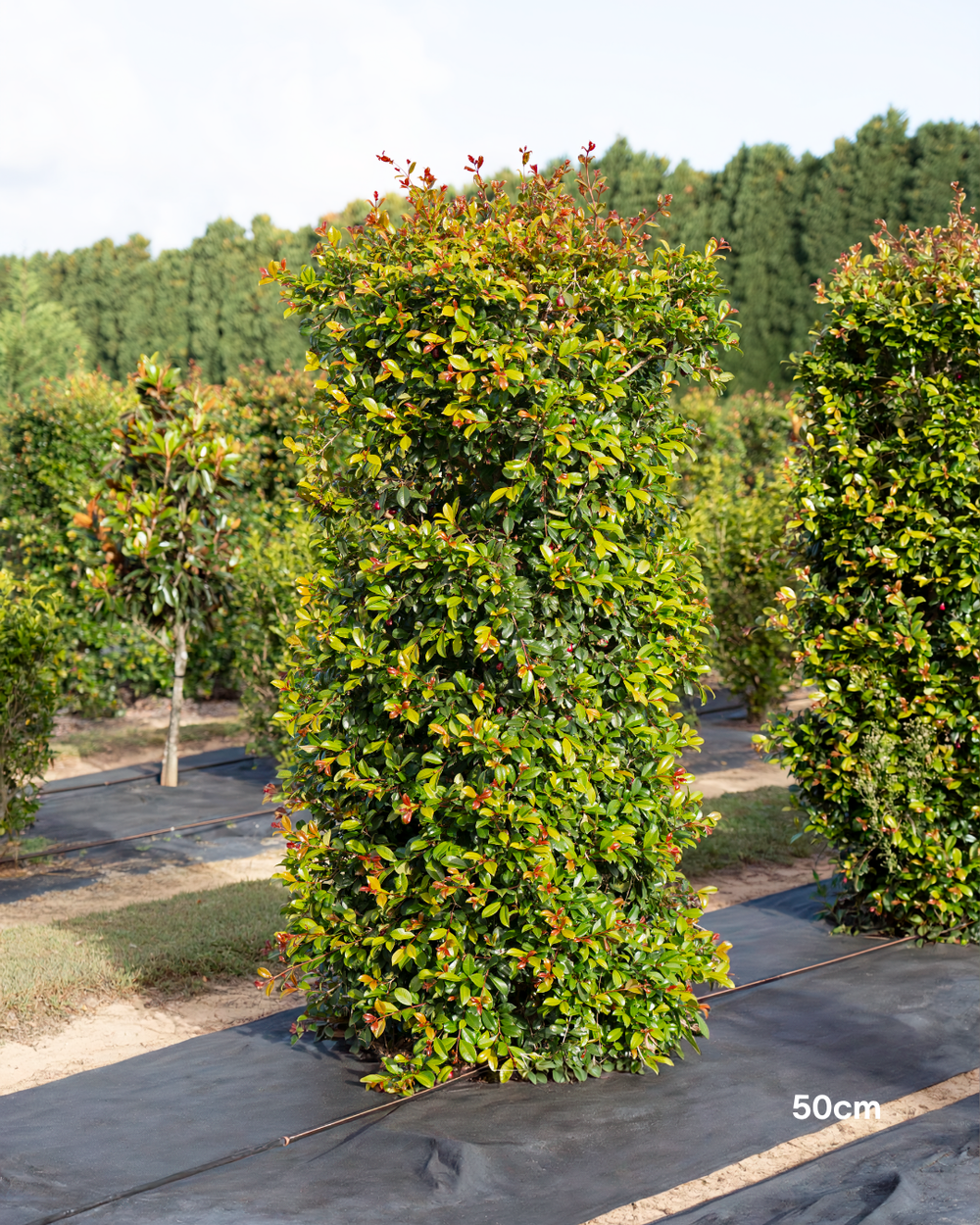
    Ficus microcarpa 'Flash' in pleached form is an evergreen fig trained to a clear straight stem with a flat rectangular canopy held above it. The leaves are small, glossy and deep green, knitting together into a solid panel that works like a hedge lifted into the air.

    It grows best in full sun to part shade in well drained soil kept moist while it settles. Heat, wind and urban conditions do not trouble it, but frost does, so keep it to frost free or protected positions in warm temperate and subtropical zones. Growth runs 60 to 90 centimetres a year.

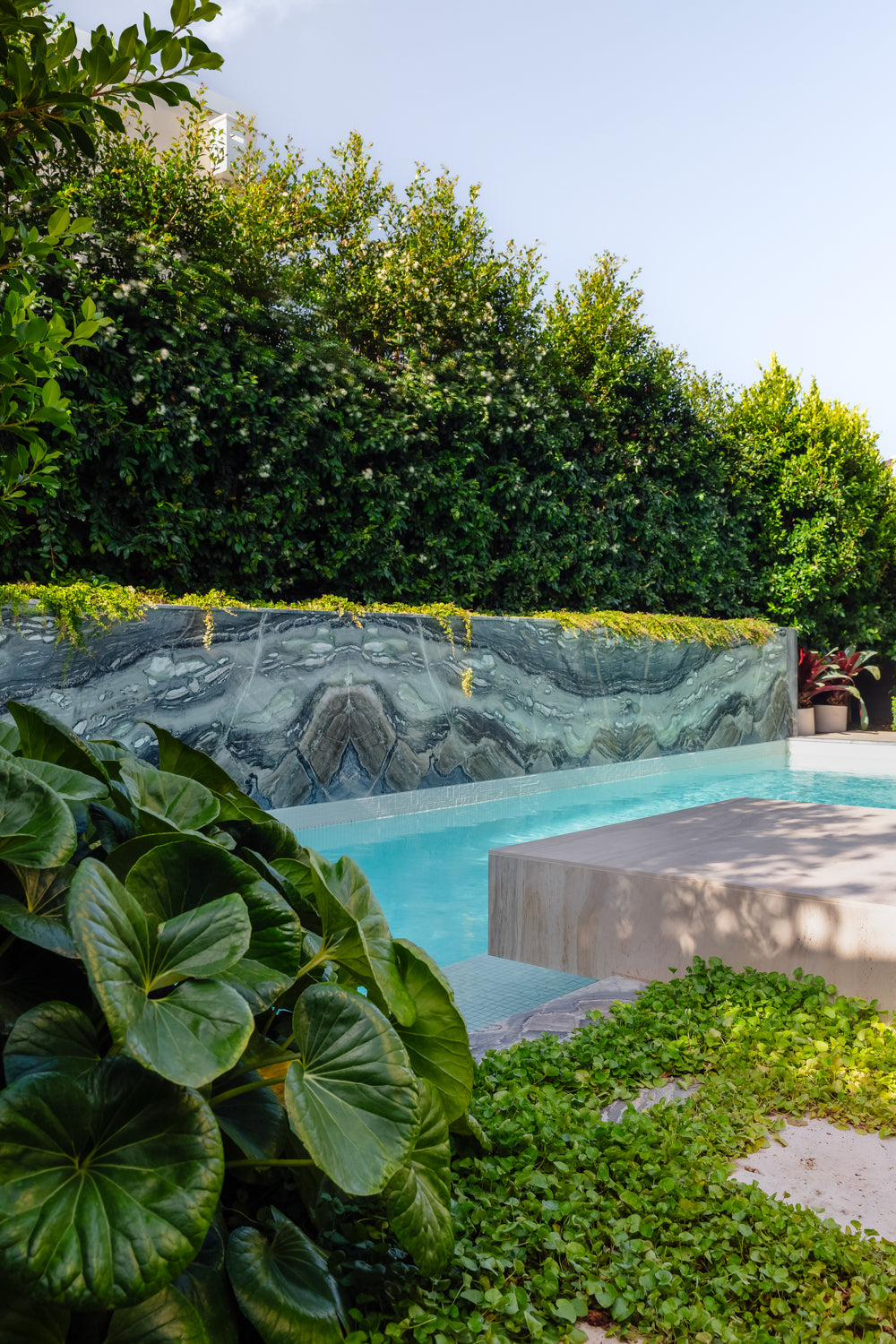
    Pleached panels go along boundaries, driveways and pool fences to block an upper storey window or a neighbouring outlook while leaving the ground below open for garden beds or parking. Set at 2 to 2.5 metre centres they knit into a continuous screen. Few plants solve overlooking as neatly.

    Frequently Asked Questions

    About Pleached Ficus Flash

    What is a pleached ficus?

    Pleaching is a training method where a tree is grown on a single clear stem with its branches tied and trimmed to a flat frame overhead. Applied to Ficus microcarpa 'Flash', it produces an evergreen panel of small glossy leaves raised above head height, with open ground left underneath it.

    How tall is it and how wide is the canopy?

    As supplied and maintained, these trees generally stand around 2.5 to 3.5 metres overall, with a clear trunk to about 1.5 to 1.8 metres and a trained canopy panel roughly 1.2 to 1.8 metres wide. The panel can be grown taller and wider over time, or held at the delivered dimensions by trimming.

    How fast does it grow?

    It puts on 60 to 90 centimetres a year in warm conditions, which is moderate to fast for an evergreen screening tree. That vigour is what fills the pleached frame quickly after planting, and it is also the reason the form needs trimming two or three times through the growing season.

    Is it frost tolerant?

    No. Ficus microcarpa 'Flash' is frost sensitive and cold snaps burn the foliage, particularly on young or freshly planted trees. Keep it to frost free or protected positions in warm temperate, coastal and subtropical areas. In marginal districts a courtyard or a wall backed position gives enough shelter to work.

    How far apart should pleached trees be planted for a screen?

    Set them at roughly 2 to 2.5 metre centres so the canopy panels meet and knit into a continuous band within a season or two. Tighter spacing closes the gap faster but crowds the root zone. Line the trunks up carefully at planting, because any misalignment shows badly in a formal screen.

    Does it have invasive roots?

    Figs generally have vigorous roots, so keep pleached ficus at least 2 to 3 metres away from sewer lines, pool shells and slab edges, or run a root barrier along the boundary. In planter boxes the root run stays contained, though the trees then depend entirely on irrigation and regular feeding.

    How do I maintain a pleached ficus?

    Trim the face and top of the panel two or three times over the warmer months to keep the edges crisp, and rub off any shoots appearing on the clear trunk. Water deeply while it establishes, mulch the root zone and feed in spring. Check the ties on the frame so they do not cut in.

    Key growing information
    Mature heightClear stem typically 1.8m to 2.2m with canopy trained above
    Mature widthCanopy panel typically 1.5m to 3m wide depending on training
    PositionFull Sun / Part Shade
    Growth per year60cm to 90cm per year (moderate to fast)
    FrostFrost Sensitive
    FoliageEvergreen (foliage year round)
    FormUpright
    UsesScreening or Privacy · Feature Tree · Driveway Border · Council or Civic Landscapes
    Rootball width & depthView dimensions →
    Foliage

    Evergreen (foliage year round)

    Position
    • Full Sun
    • Part Shade
    Form
    • Upright
    Use
    • Screening or Privacy
    • Feature Tree
    • Driveway Border
    • Council or Civic Landscapes
    Mature height
    Clear stem typically 1.8m to 2.2m with canopy trained above
    Mature width
    Canopy panel typically 1.5m to 3m wide depending on training

    Planting Information

    How To Plant Your Ficus microcarpa ‘Flash’ – Pleached Ficus

    Site: Choose a well-drained position in full sun to part shade with room for the canopy to develop.

    Soil preparation: Enrich the planting area with quality compost and aged manure for a strong establishment phase.

    Hole: Dig twice as wide as the root ball and the same depth.

    Planting: Position level with the surrounding soil, backfill gently, firm in, then water deeply to settle the roots.

    Recommended Planting Spacing For Your Ficus microcarpa ‘Flash’ – Pleached Ficus

    Hedging and screening: 1 to 1.5 metres apart for a dense informal screen, or 80 centimetres apart for a tighter formal hedge.

    Feature tree: 3 to 4 metres apart to allow the full canopy and form to develop.

    Avenue planting: 3 metres apart for a uniform soft-textured avenue.

    Ficus microcarpa ‘Flash’ – Pleached Ficus is expected to grow 60cm to 90cm per year (moderate to fast).

    • Medium Growth Rate
    • Fast Growth Rate

    Long Term Care For Your Ficus microcarpa ‘Flash’ – Pleached Ficus

    Watering: Water deeply twice weekly through the first 12 months. Once established, reduce to once weekly in dry periods. Mulch helps maintain consistent moisture.

    Mulching: Apply a 5 to 7 centimetre layer of organic mulch over the root zone, keeping it 5 centimetres clear of the trunk.

    Pruning: Tip prune in late winter and again in summer to build dense growth. For a formal hedge, light shaping two to three times a year keeps lines crisp.

    Fertilising: Apply a slow-release general-purpose fertiliser in early spring and again in autumn for steady growth and consistent foliage colour.

    Pest and disease: Hardy against most pests and diseases. Occasional inspection for psyllids or scale in warm humid conditions is all that's needed.

    Planting Your Ficus microcarpa ‘Flash’ – Pleached Ficus in Different Soil

    Ficus microcarpa performs best in well-drained loam or sandy loam with a slightly acidic to neutral pH. Adaptable to a wide range of soils when drainage is improved with organic matter.

    Sandy soil: Free-draining and ideal. Mulch well to maintain consistent moisture.

    Clay soil: Improve drainage with gypsum and organic compost before planting.

    Loam: The preferred soil for steady root development and consistent growth.

    pH: Slightly acidic to neutral preferred. Mulch with composted leaf litter to maintain levels naturally.

    Uses in my Garden

    Uses in my Garden

    • Screening or Privacy
    • Feature Tree
    • Driveway Border
    • Council or Civic Landscapes

    Ficus microcarpa ‘Flash’ – Pleached Ficus works in an:

    • Formal Garden – structured, symmetrical design with clipped shapes.
    • Contemporary / Architectural Garden – striking forms for bold design statements.
    • Mediterranean Style Garden – timeless courtyard look with stone, pots, and bold greenery.

    Is Ficus microcarpa ‘Flash’ – Pleached Ficus Evergreen or Deciduous?

    Ficus microcarpa ‘Flash’ – Pleached Ficus is an Evergreen (foliage year round) Tree

    Mature Height & Width

    Mature Height: Clear stem typically 1.8m to 2.2m with canopy trained above

    Mature Width: Canopy panel typically 1.5m to 3m wide depending on training

    Ficus microcarpa ‘Flash’ – Pleached Ficus is expected to grow 60cm to 90cm per year (moderate to fast).

    Growth Rate of Ficus microcarpa ‘Flash’ – Pleached Ficus

    Ficus microcarpa ‘Flash’ – Pleached Ficus is expected to grow 60cm to 90cm per year (moderate to fast).

    They are considered to have a:

    • Medium Growth Rate
    • Fast Growth Rate

    Frost Tolerance & Ideal Climate to plant Ficus microcarpa ‘Flash’ – Pleached Ficus

    Is Ficus microcarpa ‘Flash’ – Pleached Ficus frost tolerant?

    Ficus microcarpa ‘Flash’ – Pleached Ficus is Frost Sensitive – May suffer damage from frost, best in frost-free or protected spots.

    Does Ficus microcarpa ‘Flash’ – Pleached Ficus Flower?

    Ficus microcarpa ‘Flash’ does not produce ornamental flowers. Like other fig species, its tiny blooms are enclosed within specialised structures and are not visible, with the tree instead valued for its lush foliage and structured pleached form.

    Does Ficus microcarpa ‘Flash’ – Pleached Ficus flower?

    • Yes - Flowers

    Flowering Period:

    • Not Applicable

    Flower Type:

    • Not Applicable

    Flower Colour:

    Not Applicable

    Is Ficus microcarpa ‘Flash’ – Pleached Ficus an Australian Native Tree?

    No

    Ficus microcarpa ‘Flash’ – Pleached Ficus is Native to Tropical and subtropical regions of Asia, where Ficus microcarpa grows naturally in warm forest environments.

    What is the Wildlife Value of Ficus microcarpa ‘Flash’ – Pleached Ficus ?

    Its dense evergreen foliage provides valuable shelter for small birds and beneficial insects, creating protected habitat within the garden. The structured canopy also contributes to urban biodiversity by offering nesting and resting sites within vertical green spaces.

    How much Sunlight does Ficus microcarpa ‘Flash’ – Pleached Ficus need?

    Ficus microcarpa ‘Flash’ – Pleached Ficus will thrive best in:

    • Full Sun
    • Part Shade

    Preferred Soil?

    Ficus microcarpa ‘Flash’ performs best in well-drained loam or sandy loam soils with a neutral pH. It will also tolerate a range of soil types if enriched with organic matter to improve structure and moisture retention. Avoid heavy clay or waterlogged sites unless significantly improved, as excess moisture can stress the root system. Keep soil evenly moist during establishment, then gradually reduce watering as the tree matures.

    Is Ficus microcarpa ‘Flash’ – Pleached Ficus Drought Tolerant?

    Is Ficus microcarpa ‘Flash’ – Pleached Ficus Drought tolerant?

    As a young tree it benefits from regular watering to establish a healthy root system, particularly during warmer weather. Once established, Ficus microcarpa ‘Flash’ shows good drought tolerance and performs reliably through dry periods, although occasional supplementary watering will support the healthiest foliage and strongest growth.

    Frequently Asked Questions

    Frequently Asked Questions

    Q: What is a pleached tree?
    A: A pleached tree has a clear trunk with a trained flat canopy above, creating a living screen or architectural panel.

    Q: How often should pleached Ficus be pruned?
    A: Regular trimming throughout the growing season keeps the canopy dense and maintains the trained shape.

    Q: Is Ficus ‘Flash’ suitable for screening?
    A: Yes, the pleached form is widely used to create elevated privacy screens in courtyards and boundary plantings.

    Q: Can it tolerate frost?
    A: It prefers frost-free climates and should be planted in protected locations in cooler regions.

    Delivery & help

    Pot sizes & dimensions

    Pot / bag size Width Depth
    30cm Pot33cm30cm
    40cm/45L Pot44cm41.5cm
    50cm Pot / 70L Pot55cm41.8cm
    100L Bag50.6cm52.8cm
    150L Bag66cm55cm
    200L Bag71.5cm60.5cm
    300L Bag88cm63.8cm
    400L Bag99cm66cm
    500L Bag122cm66cm
    750L Bag134cm69cm
    1000L Bag146.3cm71.5cm
    2000L Bag176cm82.5cm

    General planting reference. Container dimensions can vary by supplier and batch.

    Compare sizes side by side

    * Heights are approximate and vary between individual trees.

    90L

    Enquire for current heights

    $810.00

    They’re loved for their elevated pleached canopy that creates structured privacy while maintaining open space beneath.

    Perfect pairs

    Enriched Planting Mix (AO Certified)

    Enriched Planting Mix is a certified organic blend of Pure Magic Compost, composted animal manure, gypsum, composted coarse bark and a wetting agent, bagged in 30L. It is built to be dug through existing garden soil at planting time rather than used on its own, and the gypsum...

    Read product details

    Enriched Planting Mix is a certified organic blend of Pure Magic Compost, composted animal manure, gypsum, composted coarse bark and a wetting agent, bagged in 30L. It is built to be dug through existing garden soil at planting time rather than used on its own, and the gypsum is what sets it apart from a plain compost.

    Gypsum helps break up heavy clay so water and roots can move through it, while the compost and manure return organic matter and nutrient to tired ground. The coarse bark holds structure and keeps air around the root zone, and the wetting agent keeps moisture in the soil longer after rain or watering.

    Use it when planting trees, shrubs, roses, fruit trees and exotic garden plants, particularly into clay. Dig a hole twice the width of the pot and 7 centimetres deeper, then mix roughly one third planting mix through the excavated soil. Spread 7 centimetres of that improved soil in the base before setting the plant in.

    Frequently Asked Questions

    About Enriched Planting Mix

    What is Enriched Planting Mix made from?

    It is a blend of Pure Magic Compost, composted animal manure, gypsum, composted coarse bark and a wetting agent. Each part has a job. The compost and manure supply organic matter and nutrient, the gypsum works on clay structure, the bark keeps air around the roots and the wetting agent holds moisture in the soil.

    What plants is it suitable for?

    It suits exotic garden plants, including roses, ornamental and deciduous trees, fruit trees, shrubs and perennials, and it earns its keep most on heavy clay sites. It is a planting mix rather than a potting mix, so its job is improving soil at planting time. Phosphorus sensitive natives are the one clear exception.

    Is it safe for natives?

    No, not for the phosphorus sensitive ones. The composted animal manure in this blend lifts phosphorus well above what Proteaceae such as Banksia, Grevillea, Hakea and Protea will tolerate, and the result can be leaf burn, dieback and plant death. Use the Native Potting Mix for those species, or plant them into unimproved local soil.

    Is it certified organic?

    Yes. It is a certified organic product with no chemical additives, which is why the manure and compost in it are fully composted rather than raw. That makes it sound around fruit trees and vegetable beds, and it means you are adding genuine organic matter to your soil rather than a synthetic conditioner.

    How much do I need?

    Work on roughly one third planting mix to two thirds of the soil you dug out of the hole. For a shrub out of a 200 millimetre pot that is only a few litres. An advanced tree going into a large hole will take considerably more. Judge the quantity by the volume of the hole rather than the size of the plant.

    Can I use it in pots?

    It is not a potting mix and should not be used on its own in a container. The blend is designed to be diluted through garden soil, and used straight in a pot it holds too much water and settles badly. For containers, reach for a premium potting mix, or the native mix if you are potting natives.

    Does it need to be watered in?

    Yes. Water the plant well several hours before you plant it, then water thoroughly again once the hole is backfilled and the soil firmed down. That first deep watering settles the improved soil around the root ball and drives out air pockets. Keep the water up over the first few months while the roots establish.

    youtube Load video:

    Evergreen Trees Direct Has Been Featured In:

    Perfect Substitutes for Ficus microcarpa ‘Flash’ – Pleached Ficus

    Follow Us On Instagram

    @evergreentreesdirect ↗
    Evergreen Trees DirectEvergreen Trees DirectEvergreen Trees DirectEvergreen Trees DirectEvergreen Trees Direct
    youtube Load video:

    Shopping cart (0)

    Complete your order

    Freight added at checkout, based on your delivery address and order quantities.

    Checkout