Acer truncatum × Acer platanoides ‘Warrenred’
Acer truncatum x A. platanoides 'Warrenred' Pacific Sunset
Deciduous · Full Sun / Part Shade
Mature size: 8m–9m high × 7m–8m wide
- Deciduous
- Full Sun / Part Shade
- Mature height8m–9m
- Mature width7m–8m
- Frost Hardy
- Flowers

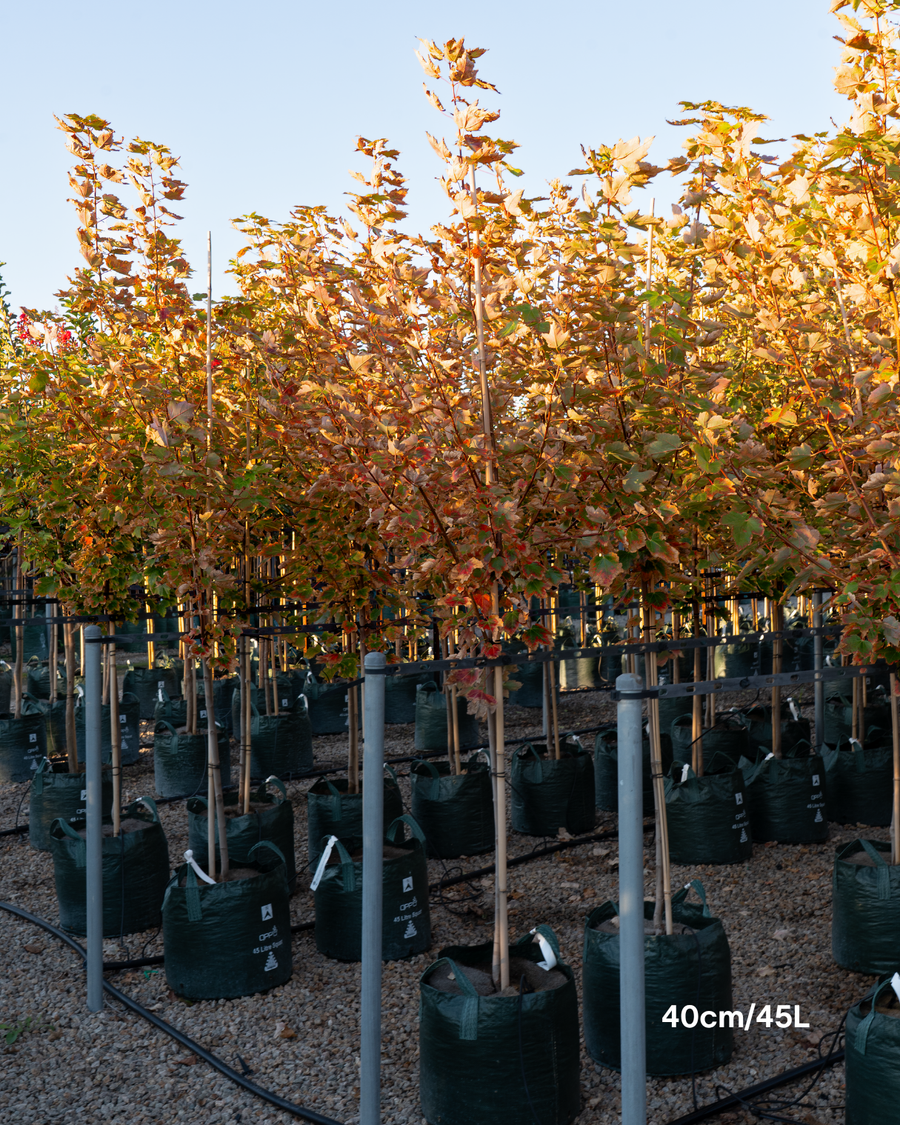
Most loved for its brilliant orange-red autumn foliage and attractive rounded crown with glossy green summer leaves.
Regular price
$310.00
Sale price
$310.00
Regular price
Tax included.
Shipping calculated at checkout.
Pot size
Available batches
- Current height guide
- Please enquire
- Pot size
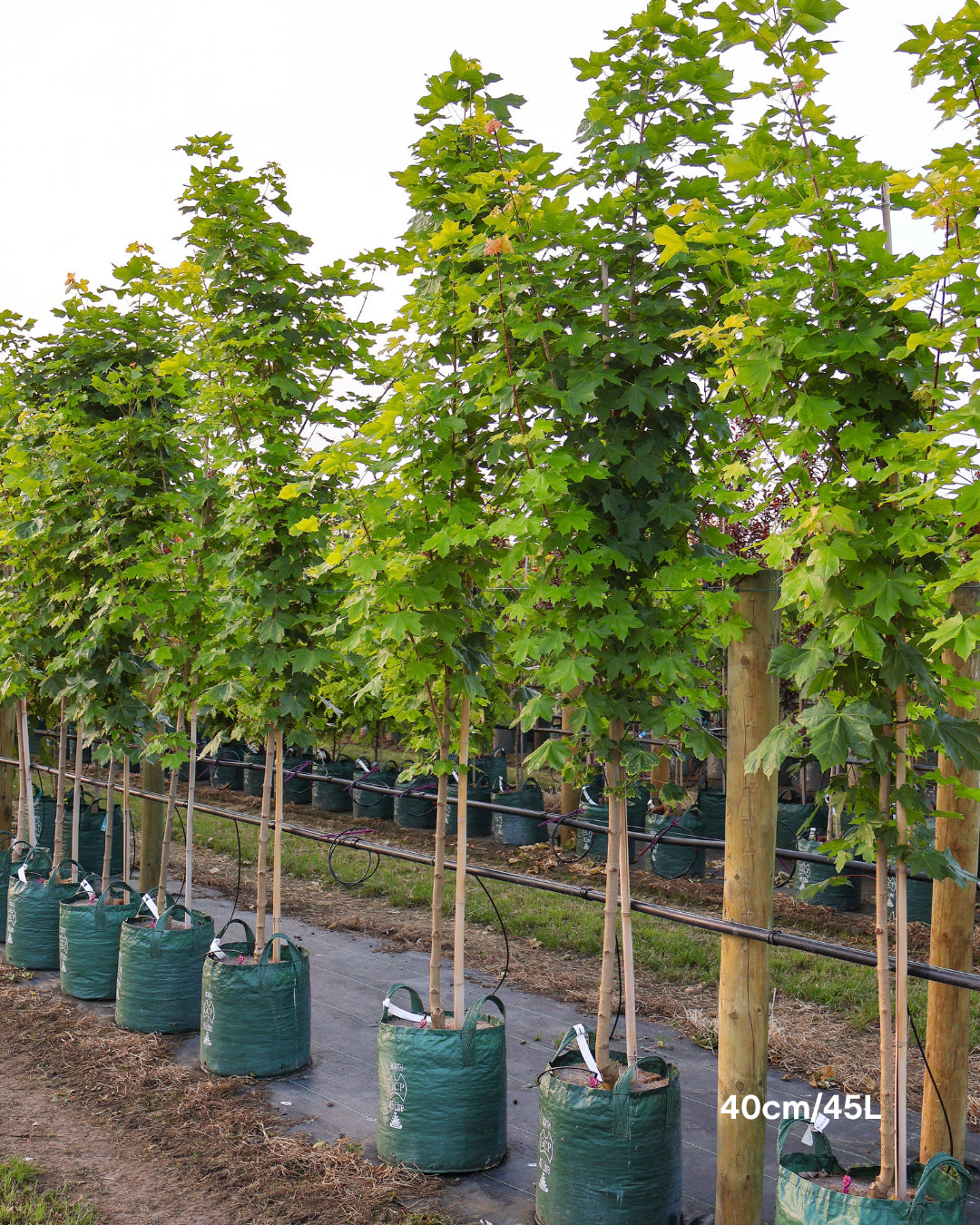
- 40cm/45L
Approximate only. Minimum height important? Confirm with us.
Height guide & disclaimer
Height guide disclaimer: Height ranges are approximate only. As living products, plant heights naturally vary between individual plants, batches, and seasons. No guarantee is given that supplied plants will fall within the stated range. If minimum heights are required, you must confirm current batch heights with Evergreen Trees Direct prior to purchase. Variation in height is normal and is not grounds for return, refund, replacement, or compensation.
Quantity
About this treeCouldn't load pickup availability
Mature height & width
Mature height & width
- Mature height
- 8m to 9m
- Mature width
- 7m to 8m
Pot sizes & dimensions
Pot sizes & dimensions
| Pot / bag size | Width | Depth |
|---|---|---|
| 30cm Pot | 33cm | 30cm |
| 40cm/45L Pot | 44cm | 41.5cm |
| 50cm Pot / 70L Pot | 55cm | 41.8cm |
| 100L Bag | 50.6cm | 52.8cm |
| 150L Bag | 66cm | 55cm |
| 200L Bag | 71.5cm | 60.5cm |
| 300L Bag | 88cm | 63.8cm |
| 400L Bag | 99cm | 66cm |
| 500L Bag | 122cm | 66cm |
| 750L Bag | 134cm | 69cm |
| 1000L Bag | 146.3cm | 71.5cm |
| 2000L Bag | 176cm | 82.5cm |
General planting reference from our existing size guide. Actual containers can vary by supplier and batch; confirm exact dimensions if required.
Delivery & pickup
Delivery & pickup
See also
See also
Not sure about Pacific Sunset Maple? See also October Glory Maple, Canadian Maple ↗ or Fairview Flame Maple, Canadian Maple ↗
Perfect pairs
Perfect pairs
Most customers usually also buy
- Enriched Planting Mix (AO Certified)
- Casuarina glauca 'Cousin It'
- Camellia sasanqua 'Setsugekka'
- Grevillea x 'Moonlight'
- Pittosporum tenuifolium 'Silver Sheen'


Total A$0.00
Trade enquiries
Trade enquiries
We supply advanced trees to landscapers, developers, architects, and councils Australia-wide. Trade clients receive fast quotes, expert advice, and access to premium stock with reliable freight.
Freight estimate
Based on the items currently in your cart.
Final delivery cost is confirmed at checkout using your full address.

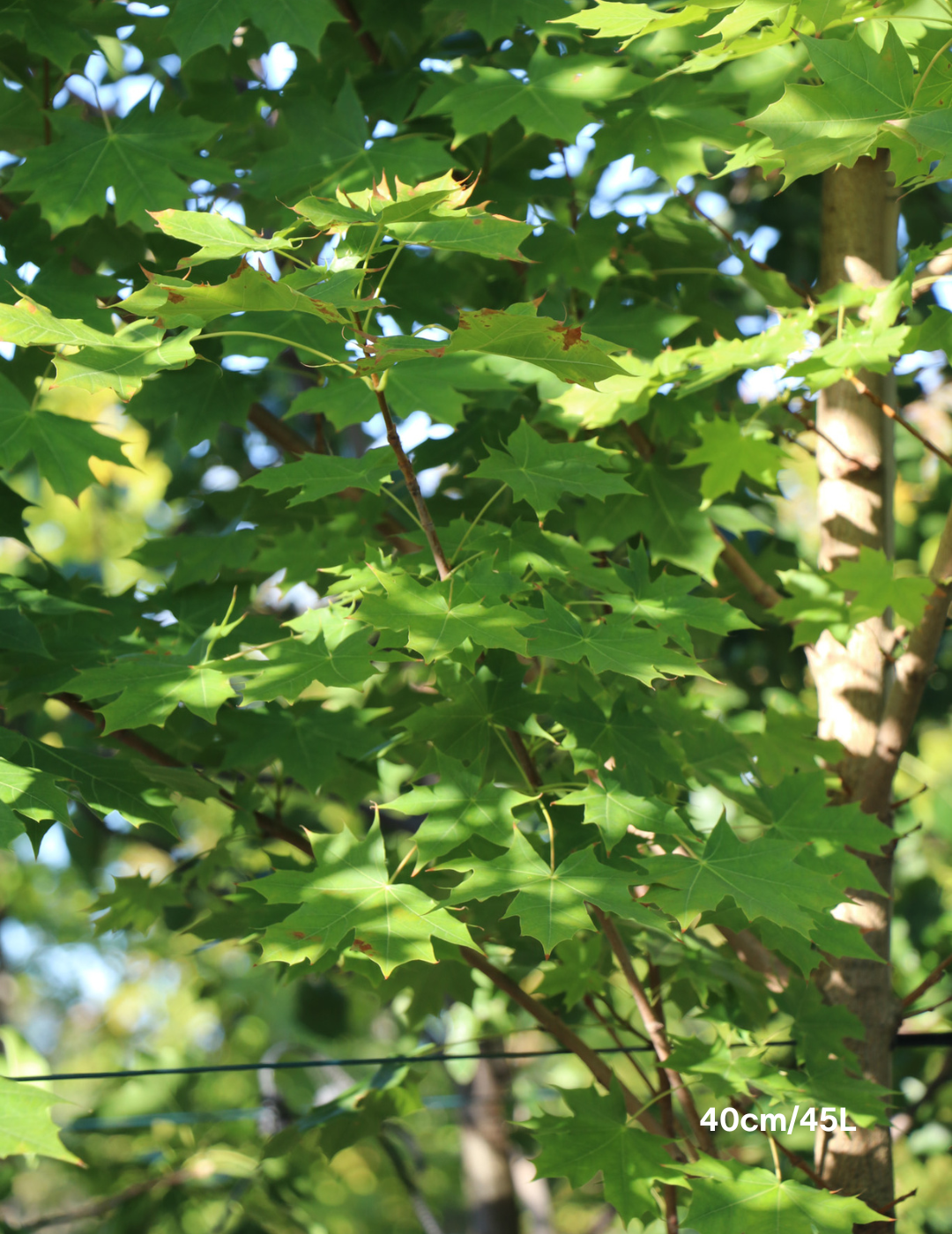
About Acer truncatum × Acer platanoides ‘Warrenred’
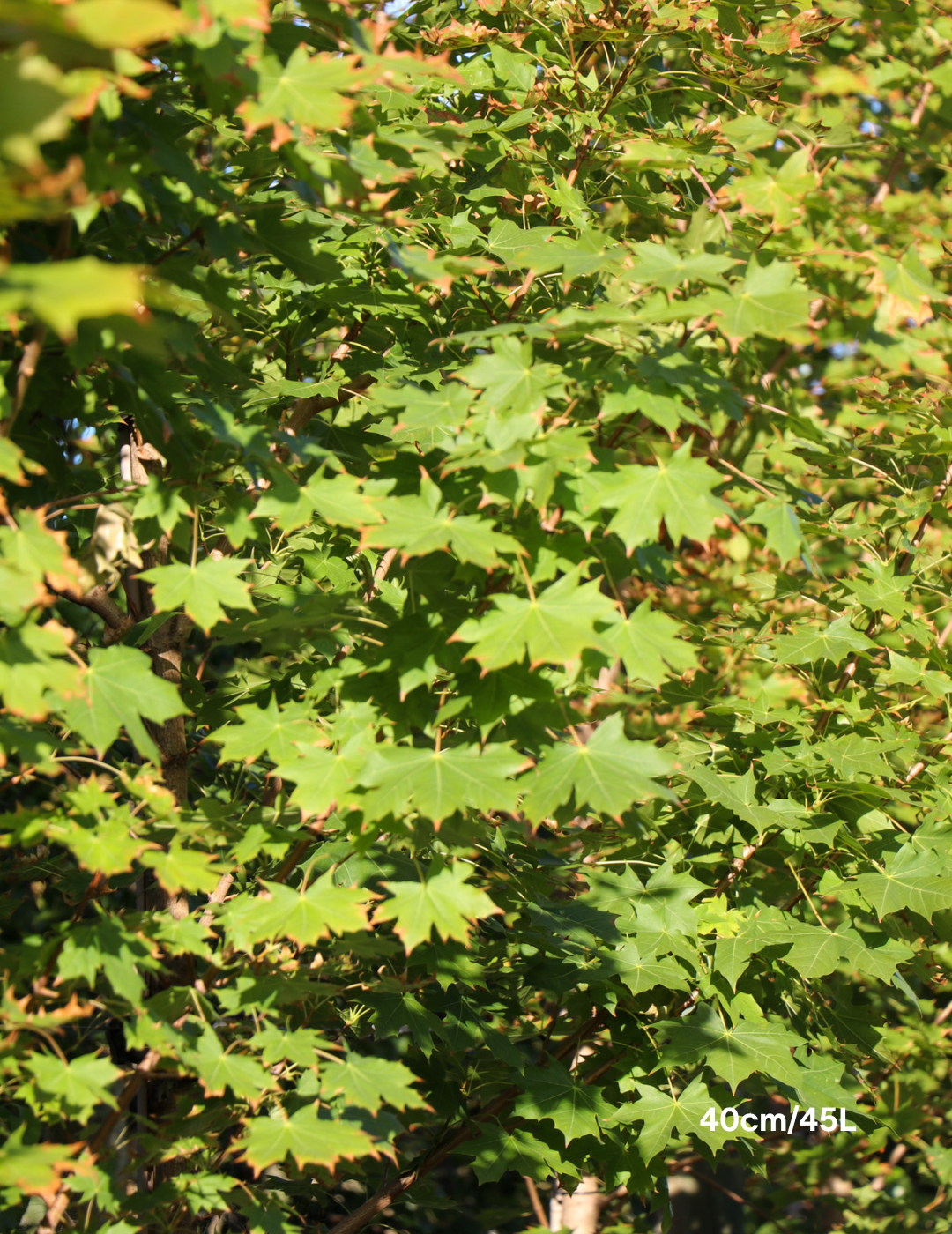
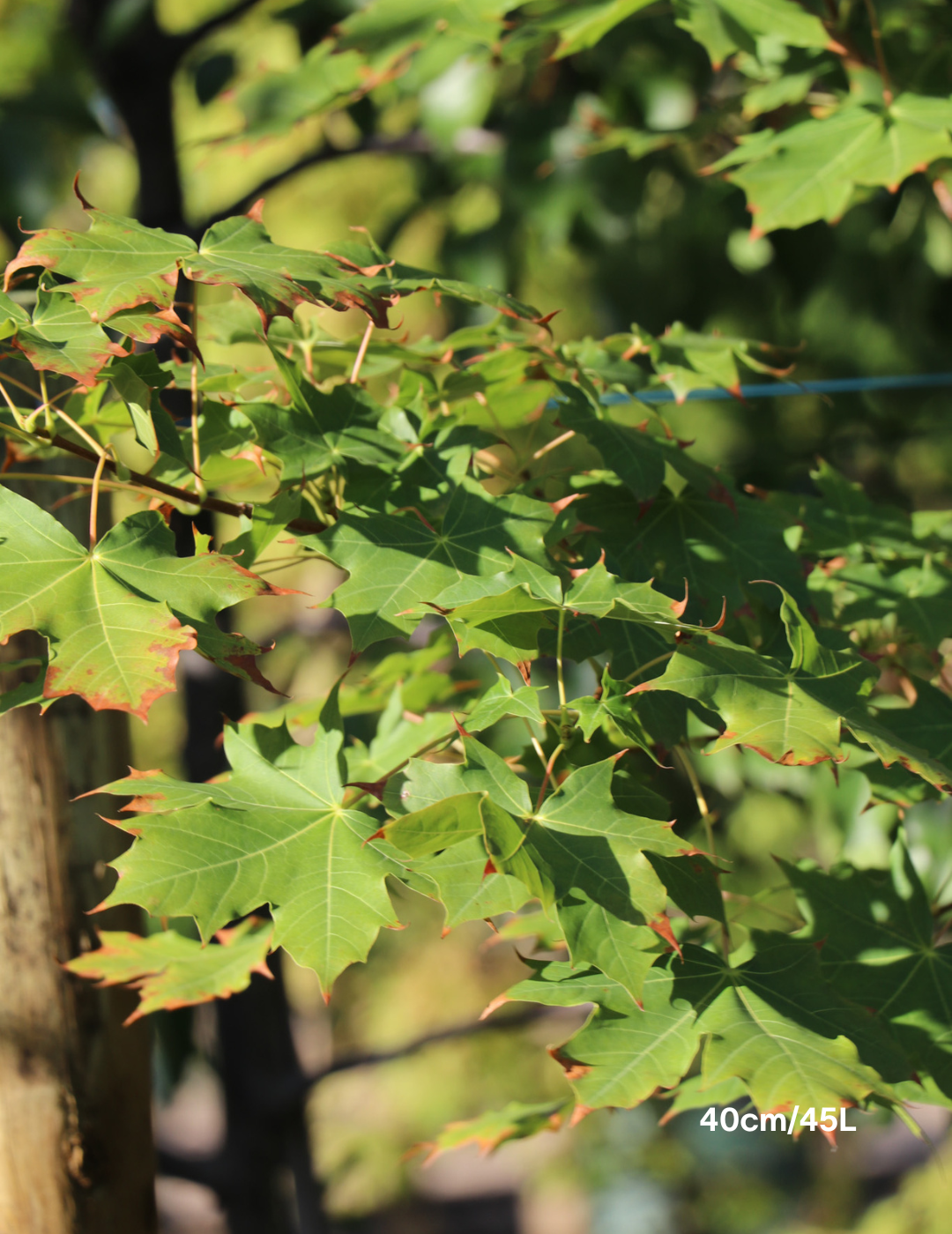
Acer truncatum x Acer platanoides 'Warrenred', sold as Pacific Sunset maple, is a deciduous shade tree with a dense, broadly rounded crown. The lobed leaves are glossy dark green and unusually thick, holding condition through summer heat before turning orange to red in autumn. Yellow flowers open in spring before the leaves.
It handles full sun, heat, wind and reflected warmth off paving better than most maples, and takes a wide soil range provided drainage is reasonable. Growth is moderate at 40 to 60 centimetres a year. Frost hardy and drought tolerant once established, it suits temperate and cool temperate climates across southern Australia.
The compact crown makes it useful in streetscapes, car parks, driveway plantings and suburban gardens where a full sized shade tree would not fit. It also lines an avenue neatly at 3 metre spacing. For urban projects it gives canopy and autumn colour without outgrowing the space it was given.
Frequently Asked Questions
About Pacific Sunset Maple
What is Pacific Sunset maple?
Pacific Sunset is the trade name for Acer truncatum crossed with Acer platanoides, selected as the cultivar Warrenred. It is a deciduous shade tree with a dense rounded crown, thick glossy green leaves and orange to red autumn colour. It was bred for urban toughness and a compact crown, and carries small yellow flowers in spring.
How big does Pacific Sunset maple grow?
It reaches 8 to 9 metres in height and 7 to 8 metres across at maturity, forming a broad rounded crown on a single clear trunk. That is roughly half the spread of a full sized Norway maple, which is what makes it workable on suburban blocks and in constrained street plantings.
How fast does Pacific Sunset maple grow?
Moderate, about 40 to 60 centimetres a year once established. Advanced stock from 100 litre or 200 litre containers gives an immediate result and settles in quickly. Growth responds well to deep watering through the first two summers, after which the tree is largely self sufficient in most temperate soils.
Does it need sun or shade?
Full sun. The thick, glossy leaf surface was selected to handle heat and reflected light, and the tree holds condition through summer where thinner leaved maples scorch. It tolerates part shade, but the crown opens up and the autumn colour is weaker. Give it an open position with room for the canopy.
Is Pacific Sunset maple drought tolerant?
Once established it is noticeably more drought tolerant than most maples, which is the main reason it is specified for streets and car parks. It still performs best with occasional deep watering through extended dry spells. Through the first two summers after planting, treat it as a tree that needs regular water.
How far apart should I plant it for an avenue?
Plant 3 metres apart for a uniform avenue where the crowns knit together, or 3 to 4 metres apart if each tree is to develop its full rounded form. For single feature trees allow at least 4 metres of clearance from buildings, given the mature spread of 7 to 8 metres.
How do I care for Pacific Sunset maple?
Stake only if the site is windy, and remove the ties within two seasons. Mulch to 75 millimetres, kept off the trunk, and water deeply through the establishment period. Feed with a balanced slow release fertiliser in early spring. Prune in late winter to remove crossing wood and to lift the canopy over paths.
| Mature height | 8m to 9m |
|---|---|
| Mature width | 7m to 8m |
| Position | Full Sun / Part Shade |
| Growth per year | 40cm to 60cm per year (moderate) |
| Frost | Frost Hardy |
| Foliage | Deciduous (Defoliates throughout colder months) |
| Form | Broad · Rounded · Upright · Oval |
| Uses | Avenue Planting · Shade Tree · Street Tree · Feature Tree · Council or Civic Landscapes |
| Rootball width & depth | View dimensions → |
- Foliage
Deciduous (Defoliates throughout colder months)
- Position
- Form
- Use
- Mature height
- 8m to 9m
- Mature width
- 7m to 8m

Planting Information
Recommended Planting Spacing For Your Acer truncatum x A. platanoides 'Warrenred' Pacific Sunset
Acer truncatum x A. platanoides 'Warrenred' Pacific Sunset is expected to grow 40cm to 60cm per year (moderate).
Long Term Care For Your Acer truncatum x A. platanoides 'Warrenred' Pacific Sunset
Planting Your Acer truncatum x A. platanoides 'Warrenred' Pacific Sunset in Different Soil
Uses in my Garden
Uses in my Garden
Acer truncatum x A. platanoides 'Warrenred' Pacific Sunset works in an:
Is Acer truncatum x A. platanoides 'Warrenred' Pacific Sunset Evergreen or Deciduous?
Acer truncatum x A. platanoides 'Warrenred' Pacific Sunset is an Deciduous (Defoliates throughout colder months) Tree
Mature Height & Width
Mature Height: 8m to 9m
Mature Width: 7m to 8m
Acer truncatum x A. platanoides 'Warrenred' Pacific Sunset is expected to grow 40cm to 60cm per year (moderate).
Growth Rate of Acer truncatum x A. platanoides 'Warrenred' Pacific Sunset
Acer truncatum x A. platanoides 'Warrenred' Pacific Sunset is expected to grow 40cm to 60cm per year (moderate).
They are considered to have a:
Frost Tolerance & Ideal Climate to plant Acer truncatum x A. platanoides 'Warrenred' Pacific Sunset
Is Acer truncatum x A. platanoides 'Warrenred' Pacific Sunset frost tolerant?
Acer truncatum x A. platanoides 'Warrenred' Pacific Sunset is Frost Hardy – Survives heavy and frequent frost without damage.
Does Acer truncatum x A. platanoides 'Warrenred' Pacific Sunset Flower?
Acer ‘Pacific Sunset’ produces small clusters of yellow-green spring flowers that appear before the new foliage unfurls. Although modest, these early blooms provide a useful pollen source for beneficial insects and mark the beginning of its vigorous seasonal growth.
Does Acer truncatum x A. platanoides 'Warrenred' Pacific Sunset flower?
Flowering Period:
Flower Type:
Flower Colour:
Yellow
Is Acer truncatum x A. platanoides 'Warrenred' Pacific Sunset an Australian Native Tree?
No
Acer truncatum x A. platanoides 'Warrenred' Pacific Sunset is Native to A hybrid maple developed in North America, combining traits of Acer truncatum (Shantung Maple, native to northern China) and Acer platanoides (Norway Maple, native to Europe and western Asia).
What is the Wildlife Value of Acer truncatum x A. platanoides 'Warrenred' Pacific Sunset ?
Its broad canopy provides excellent shelter and foraging opportunities for small birds, while its spring flowers support native bees, hoverflies and other beneficial insects. The layered branches also create a stable micro-habitat that enhances overall garden biodiversity.
How much Sunlight does Acer truncatum x A. platanoides 'Warrenred' Pacific Sunset need?
Acer truncatum x A. platanoides 'Warrenred' Pacific Sunset will thrive best in:
Preferred Soil?
Acer ‘Pacific Sunset’ performs best in well-drained loam or sandy loam soils and prefers slightly acidic to neutral conditions. It may struggle in heavy clay or poorly drained areas unless improved with organic matter to boost aeration and drainage. Keep soil evenly moist during establishment, then provide deep, occasional watering as the tree matures and develops stronger drought resilience.
Is Acer truncatum x A. platanoides 'Warrenred' Pacific Sunset Drought Tolerant?
Is Acer truncatum x A. platanoides 'Warrenred' Pacific Sunset Drought tolerant?
As a young tree it requires regular watering, but once established Acer ‘Pacific Sunset’ develops good drought tolerance. It performs reliably in warm, dry conditions and maintains strong canopy health with deep, occasional watering during extended heat.
Frequently Asked Questions
Frequently Asked Questions
Delivery & help
Pot sizes & dimensions
| Pot / bag size | Width | Depth |
|---|---|---|
| 30cm Pot | 33cm | 30cm |
| 40cm/45L Pot | 44cm | 41.5cm |
| 50cm Pot / 70L Pot | 55cm | 41.8cm |
| 100L Bag | 50.6cm | 52.8cm |
| 150L Bag | 66cm | 55cm |
| 200L Bag | 71.5cm | 60.5cm |
| 300L Bag | 88cm | 63.8cm |
| 400L Bag | 99cm | 66cm |
| 500L Bag | 122cm | 66cm |
| 750L Bag | 134cm | 69cm |
| 1000L Bag | 146.3cm | 71.5cm |
| 2000L Bag | 176cm | 82.5cm |
General planting reference. Container dimensions can vary by supplier and batch.
Compare sizes side by side
* Heights are approximate and vary between individual trees.
40cm/45L
1.8m - 3.0m Approx.
$310.00
100L
2.0m - 3.6m Approx.
$760.00
200L
3.1m - 3.8m Approx.
$1,460.00
They’re loved for their brilliant orange-red autumn foliage and attractive rounded crown with glossy green summer leaves.
Grown across more than 100 acres, and held to one standard: premium A+ grade stock.
Perfect pairs
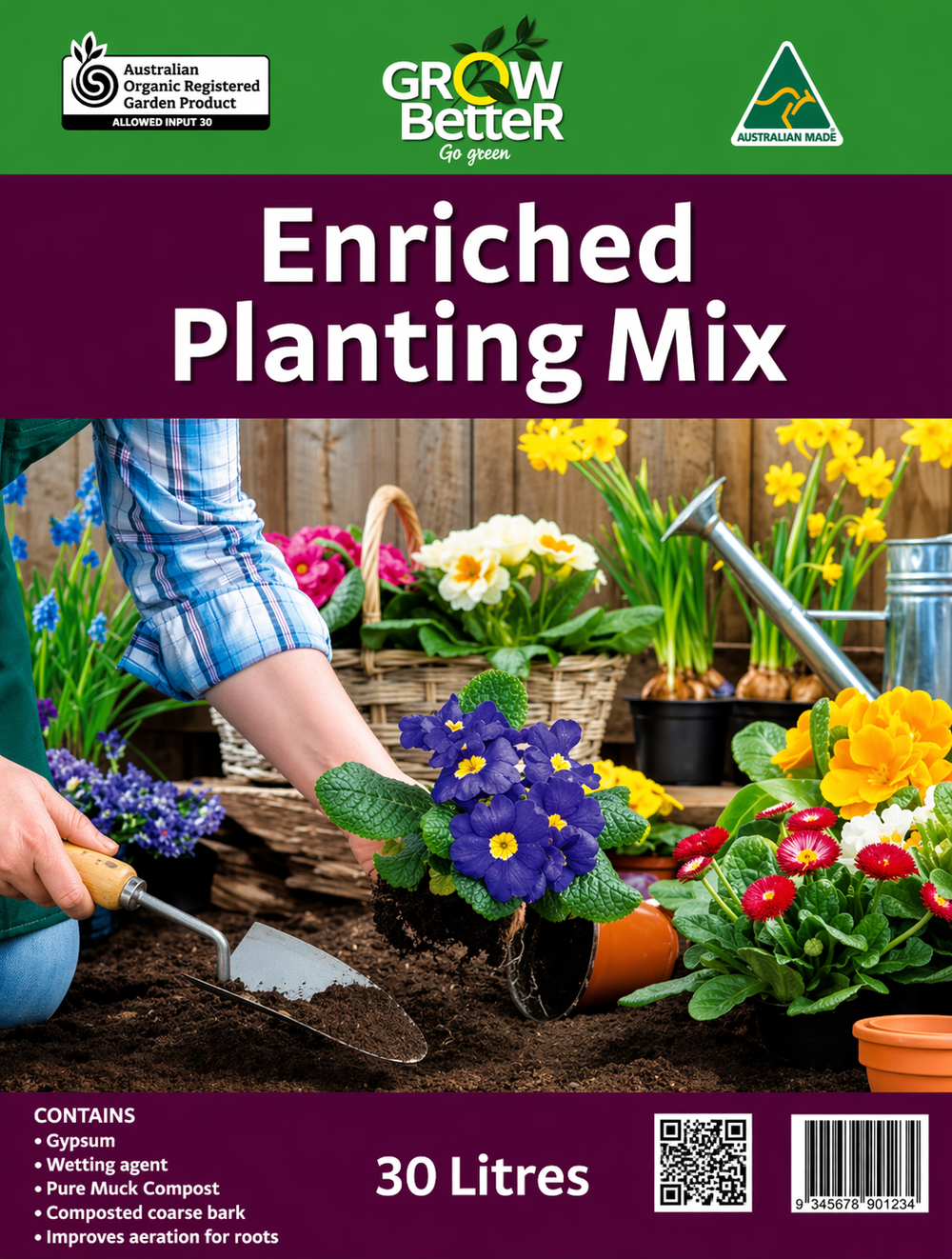
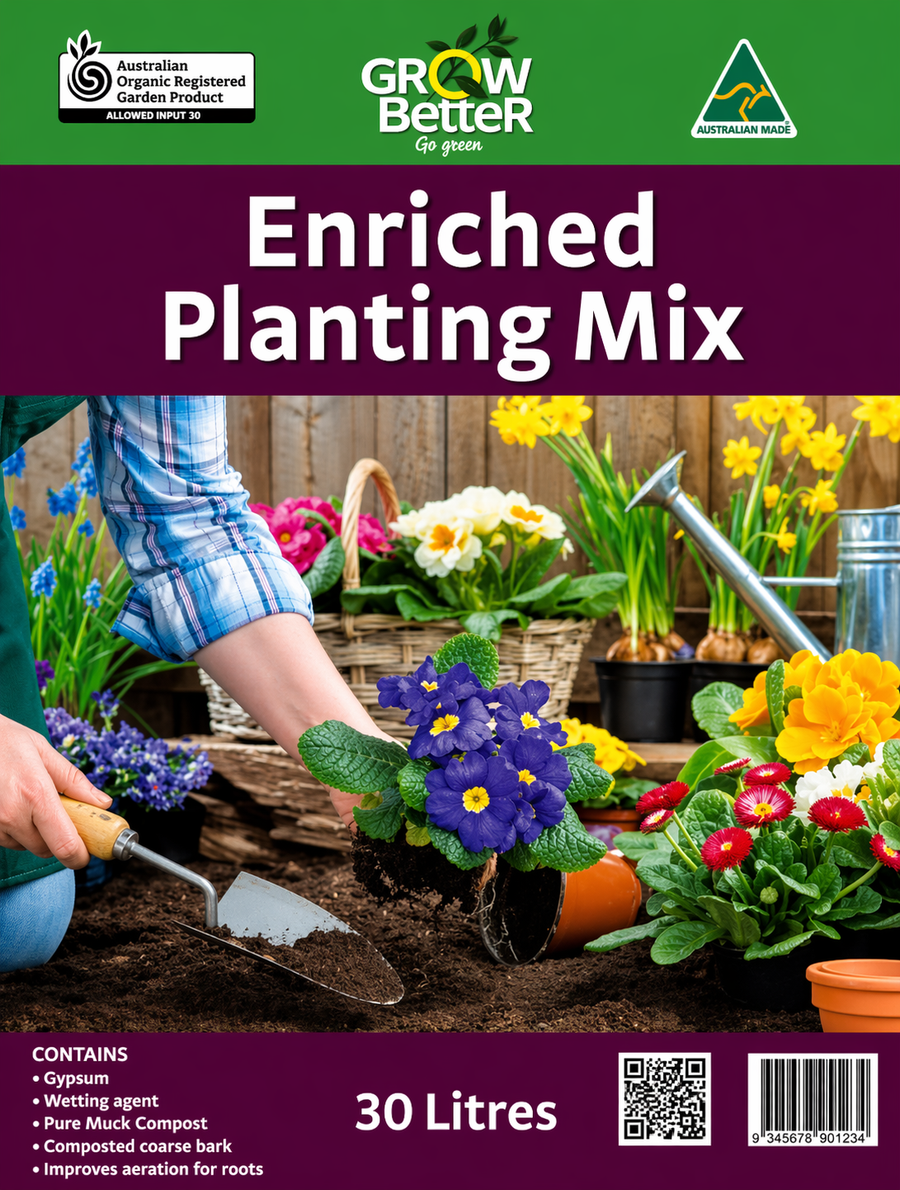
Enriched Planting Mix (AO Certified)
Enriched Planting Mix is a certified organic blend of Pure Magic Compost, composted animal manure, gypsum, composted coarse bark and a wetting agent, bagged in 30L. It is built to be dug through existing garden soil at planting time rather than used on its own, and the gypsum...
Read product details
Enriched Planting Mix is a certified organic blend of Pure Magic Compost, composted animal manure, gypsum, composted coarse bark and a wetting agent, bagged in 30L. It is built to be dug through existing garden soil at planting time rather than used on its own, and the gypsum is what sets it apart from a plain compost.
Gypsum helps break up heavy clay so water and roots can move through it, while the compost and manure return organic matter and nutrient to tired ground. The coarse bark holds structure and keeps air around the root zone, and the wetting agent keeps moisture in the soil longer after rain or watering.
Use it when planting trees, shrubs, roses, fruit trees and exotic garden plants, particularly into clay. Dig a hole twice the width of the pot and 7 centimetres deeper, then mix roughly one third planting mix through the excavated soil. Spread 7 centimetres of that improved soil in the base before setting the plant in.
Frequently Asked Questions
About Enriched Planting Mix
What is Enriched Planting Mix made from?
It is a blend of Pure Magic Compost, composted animal manure, gypsum, composted coarse bark and a wetting agent. Each part has a job. The compost and manure supply organic matter and nutrient, the gypsum works on clay structure, the bark keeps air around the roots and the wetting agent holds moisture in the soil.
What plants is it suitable for?
It suits exotic garden plants, including roses, ornamental and deciduous trees, fruit trees, shrubs and perennials, and it earns its keep most on heavy clay sites. It is a planting mix rather than a potting mix, so its job is improving soil at planting time. Phosphorus sensitive natives are the one clear exception.
Is it safe for natives?
No, not for the phosphorus sensitive ones. The composted animal manure in this blend lifts phosphorus well above what Proteaceae such as Banksia, Grevillea, Hakea and Protea will tolerate, and the result can be leaf burn, dieback and plant death. Use the Native Potting Mix for those species, or plant them into unimproved local soil.
Is it certified organic?
Yes. It is a certified organic product with no chemical additives, which is why the manure and compost in it are fully composted rather than raw. That makes it sound around fruit trees and vegetable beds, and it means you are adding genuine organic matter to your soil rather than a synthetic conditioner.
How much do I need?
Work on roughly one third planting mix to two thirds of the soil you dug out of the hole. For a shrub out of a 200 millimetre pot that is only a few litres. An advanced tree going into a large hole will take considerably more. Judge the quantity by the volume of the hole rather than the size of the plant.
Can I use it in pots?
It is not a potting mix and should not be used on its own in a container. The blend is designed to be diluted through garden soil, and used straight in a pot it holds too much water and settles badly. For containers, reach for a premium potting mix, or the native mix if you are potting natives.
Does it need to be watered in?
Yes. Water the plant well several hours before you plant it, then water thoroughly again once the hole is backfilled and the soil firmed down. That first deep watering settles the improved soil around the root ball and drives out air pockets. Keep the water up over the first few months while the roots establish.
Enriched Planting Mix (AO Certified)
$21.95
Enriched Planting Mix (AO Certified)
Enriched Planting Mix is a certified organic blend of Pure Magic Compost, composted animal manure, gypsum, composted coarse bark and a wetting agent, bagged in 30L. It is built to be dug through existing garden soil at planting time rather than used on its own, and the gypsum...
Read product details
Enriched Planting Mix is a certified organic blend of Pure Magic Compost, composted animal manure, gypsum, composted coarse bark and a wetting agent, bagged in 30L. It is built to be dug through existing garden soil at planting time rather than used on its own, and the gypsum is what sets it apart from a plain compost.
Gypsum helps break up heavy clay so water and roots can move through it, while the compost and manure return organic matter and nutrient to tired ground. The coarse bark holds structure and keeps air around the root zone, and the wetting agent keeps moisture in the soil longer after rain or watering.
Use it when planting trees, shrubs, roses, fruit trees and exotic garden plants, particularly into clay. Dig a hole twice the width of the pot and 7 centimetres deeper, then mix roughly one third planting mix through the excavated soil. Spread 7 centimetres of that improved soil in the base before setting the plant in.
Frequently Asked Questions
About Enriched Planting Mix
What is Enriched Planting Mix made from?
It is a blend of Pure Magic Compost, composted animal manure, gypsum, composted coarse bark and a wetting agent. Each part has a job. The compost and manure supply organic matter and nutrient, the gypsum works on clay structure, the bark keeps air around the roots and the wetting agent holds moisture in the soil.
What plants is it suitable for?
It suits exotic garden plants, including roses, ornamental and deciduous trees, fruit trees, shrubs and perennials, and it earns its keep most on heavy clay sites. It is a planting mix rather than a potting mix, so its job is improving soil at planting time. Phosphorus sensitive natives are the one clear exception.
Is it safe for natives?
No, not for the phosphorus sensitive ones. The composted animal manure in this blend lifts phosphorus well above what Proteaceae such as Banksia, Grevillea, Hakea and Protea will tolerate, and the result can be leaf burn, dieback and plant death. Use the Native Potting Mix for those species, or plant them into unimproved local soil.
Is it certified organic?
Yes. It is a certified organic product with no chemical additives, which is why the manure and compost in it are fully composted rather than raw. That makes it sound around fruit trees and vegetable beds, and it means you are adding genuine organic matter to your soil rather than a synthetic conditioner.
How much do I need?
Work on roughly one third planting mix to two thirds of the soil you dug out of the hole. For a shrub out of a 200 millimetre pot that is only a few litres. An advanced tree going into a large hole will take considerably more. Judge the quantity by the volume of the hole rather than the size of the plant.
Can I use it in pots?
It is not a potting mix and should not be used on its own in a container. The blend is designed to be diluted through garden soil, and used straight in a pot it holds too much water and settles badly. For containers, reach for a premium potting mix, or the native mix if you are potting natives.
Does it need to be watered in?
Yes. Water the plant well several hours before you plant it, then water thoroughly again once the hole is backfilled and the soil firmed down. That first deep watering settles the improved soil around the root ball and drives out air pockets. Keep the water up over the first few months while the roots establish.
Enriched Planting Mix (AO Certified)
Casuarina glauca 'Cousin It'
From $180.00
Casuarina glauca 'Cousin It'
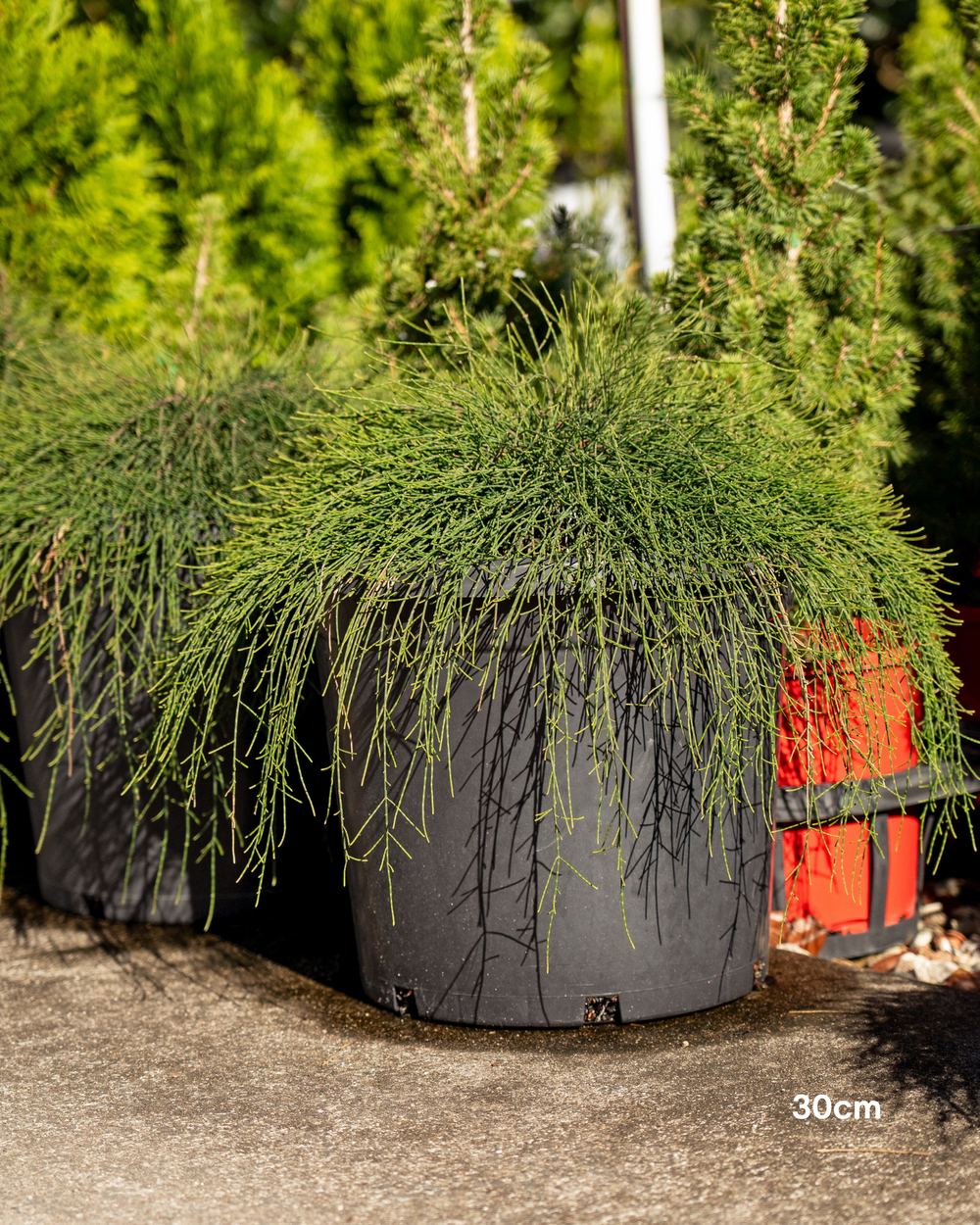
Casuarina glauca 'Cousin It' forms a dense mat of fine weeping needle-like foliage just 20 to 30 centimetres high, cascading beautifully over walls, edges and rock work. It reads as flowing texture rather than as a conventional groundcover, which is why designers use it so heavily. 'Cousin It'...
Read product details
Casuarina glauca 'Cousin It' forms a dense mat of fine weeping needle-like foliage just 20 to 30 centimetres high, cascading beautifully over walls, edges and rock work. It reads as flowing texture rather than as a conventional groundcover, which is why designers use it so heavily.
'Cousin It' spreads 2 to 4 metres wide at 30 to 50 centimetres per year, filling in steadily without becoming invasive or needing to be cut back. It suppresses weeds once established, holds soil on banks and batters, and works equally well spilling from a raised planter or a large pot.
This Australian native tolerates light to moderate frost once established, along with salt, wind, poor soils and extended dry. It grows in full sun to part shade and needs essentially no maintenance beyond the occasional tidy of a wayward runner.
Frequently Asked Questions
About Casuarina glauca 'Cousin It'
How big does Casuarina 'Cousin It' grow?
'Cousin It' stays just 20 to 30 centimetres tall and spreads 2 to 4 metres wide. It is a genuinely prostrate form and will not build up in height over time.
How fast does 'Cousin It' spread?
It spreads at 30 to 50 centimetres per year, filling in steadily. Expect two to three seasons to close a mass planting depending on spacing.
Is 'Cousin It' salt tolerant?
Yes. Casuarina glauca is naturally a coastal and estuarine species, and 'Cousin It' inherits strong salt and wind tolerance, which makes it excellent for seaside gardens.
Does 'Cousin It' suppress weeds?
Yes. Once the mat closes over it forms dense cover that suppresses most weed germination, which is a large part of its value in commercial and civic landscapes.
Can 'Cousin It' be grown in a pot?
Yes. It is particularly effective spilling over the edge of a large pot, raised planter or retaining wall, where the cascading habit can be seen.
How far apart should I plant it for groundcover?
Plant 1 to 1.5 metres apart for a continuous mass. Closer spacing closes the gaps faster but the plants will eventually merge regardless.
Is 'Cousin It' frost tolerant?
It handles light to moderate frost once established. Protect young plants through their first winter in colder inland districts.
Casuarina glauca 'Cousin It'

Camellia sasanqua 'Setsugekka'
From $210.00
Camellia sasanqua 'Setsugekka'
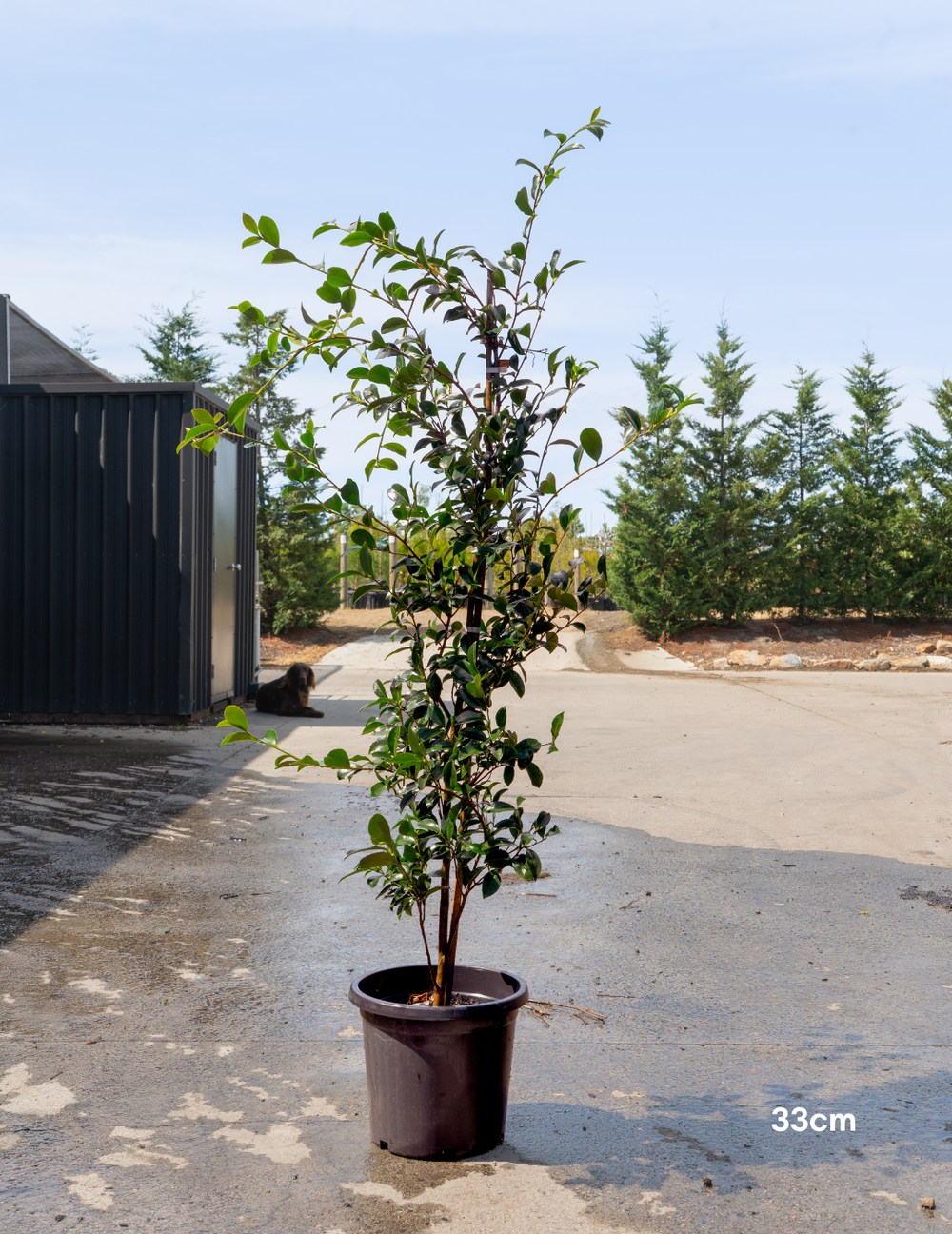
Camellia sasanqua 'Setsugekka' is a tall evergreen shrub with large, single to semi double white flowers, the petals slightly ruffled around a centre of golden stamens. Bloom runs from late autumn into early winter. Foliage is small, glossy and dark green, carried densely on an upright, gently spreading...
Read product details
Camellia sasanqua 'Setsugekka' is a tall evergreen shrub with large, single to semi double white flowers, the petals slightly ruffled around a centre of golden stamens. Bloom runs from late autumn into early winter. Foliage is small, glossy and dark green, carried densely on an upright, gently spreading frame.
It takes more sun than a japonica and will hold full sun in cooler districts, though part shade suits inland heat. Soil should be well drained and slightly acidic. Growth is 40 to 60 centimetres a year, to 2 to 4 metres tall and 1.5 to 2.5 metres wide. Light frost is tolerated.
This is the standard choice for a tall evergreen screen along a boundary or between neighbouring houses, and it clips readily into a formal hedge. It also stands alone as a feature, or fills a large pot at an entry. The height and density make it useful wherever fence line privacy is the brief.
Frequently Asked Questions
About Camellia sasanqua 'Setsugekka'
What is Camellia sasanqua 'Setsugekka'?
'Setsugekka' is a tall evergreen sasanqua camellia with large single to semi double white flowers, the petals slightly ruffled around a boss of golden stamens. It flowers from late autumn into early winter. Small glossy dark leaves are held densely on an upright, gently spreading shrub used widely for screening.
How big does 'Setsugekka' grow?
It reaches 2 to 4 metres tall and 1.5 to 2.5 metres wide, at a rate of roughly 40 to 60 centimetres a year. That upper height is what makes it a genuine screening plant rather than a border shrub. Regular trimming will hold it at any height above about 1.5 metres.
How far apart should I plant it for a hedge or screen?
Space plants 1 to 1.5 metres apart for a dense informal screen, or 80 centimetres apart for a tighter formal hedge. Tighter spacing closes the gaps faster but increases competition for water and nutrients, so prepare a continuous trench rather than individual holes and keep irrigation even along the run.
When does it flower?
Flowering starts in late autumn and carries into early winter, roughly April through to June across most of southern Australia. Sasanquas flower ahead of japonicas, so this one fills the gap before the japonica season begins. Individual flowers drop cleanly from the plant rather than browning on the bush.
Does it need sun or shade?
It takes more sun than a japonica and will hold full sun in cooler and coastal districts. In hot inland gardens give it afternoon shade to protect the foliage. It also flowers acceptably in part shade, which makes it one of the more flexible screening plants for a boundary with mixed aspect.
Can it be grown in pots?
Yes. A pot 40 to 50 centimetres wide suits a single specimen for a courtyard, entry or balcony. Use a free draining camellia and azalea mix, water regularly because containers dry out fast, and feed after flowering. Expect a smaller final size in a container than the same plant would reach in open ground.
How do I prune and care for it?
Trim once flowering finishes in early winter, taking the new growth back to shape. For a formal hedge, a second light trim in late summer keeps the face tidy. Feed with a camellia fertiliser after pruning, keep mulch over the shallow roots, and water deeply through summer dry spells.
Camellia sasanqua 'Setsugekka'

Evergreen Trees Direct Has Been Featured In:


Perfect Substitutes for Acer truncatum x A. platanoides 'Warrenred' Pacific Sunset
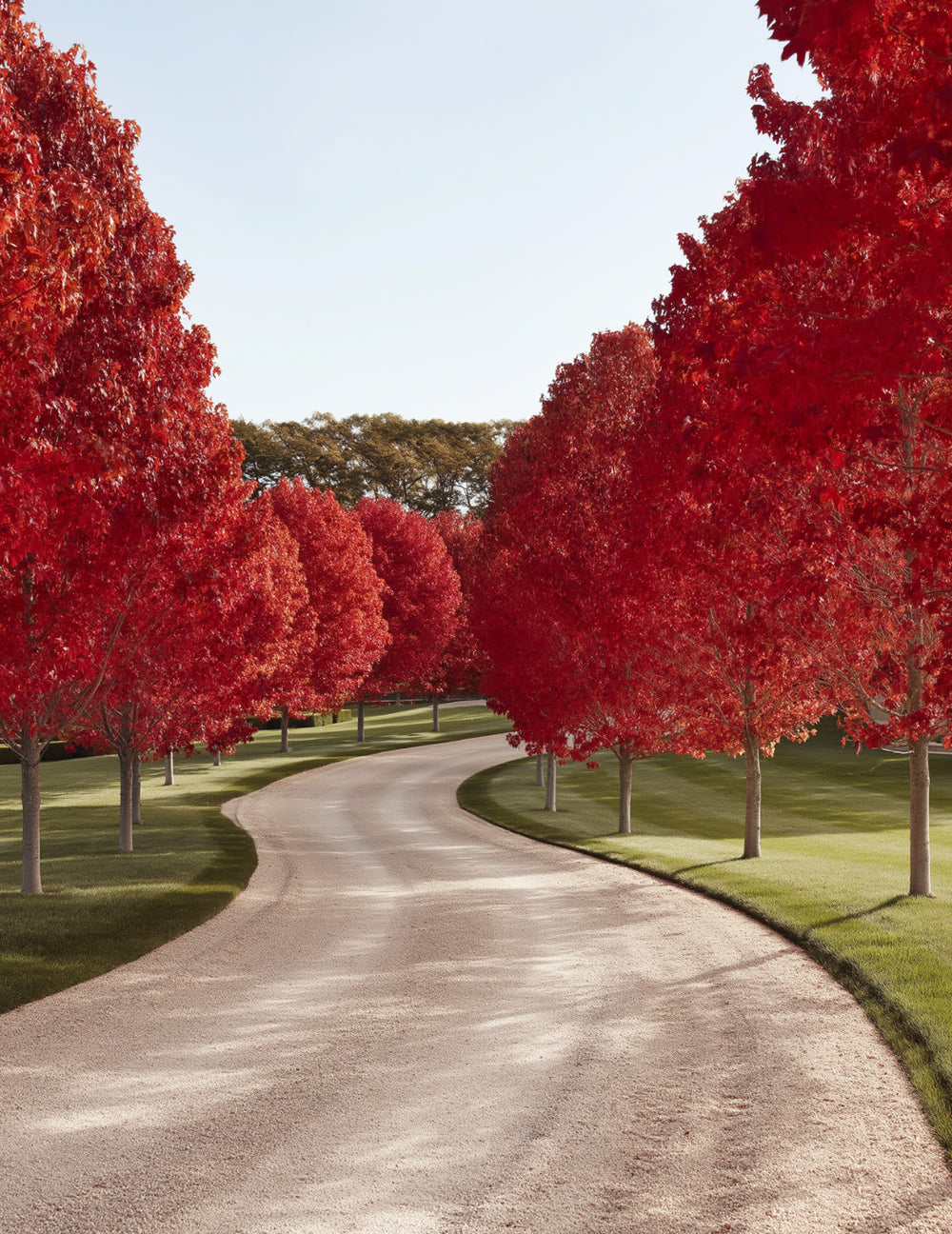
Acer rubrum 'October Glory' Canadian Maple
Acer rubrum 'October Glory' Canadian Maple
Acer rubrum 'October Glory' - Canadian Maple is a tall, deciduous tree with a broad, symmetrical canopy and strong vertical structure. Glossy green foliage transitions to vivid red and violet in late autumn, often lasting longer than other red maple cultivars. Small red flowers appear in early spring...
Read product details
Acer rubrum 'October Glory' - Canadian Maple is a tall, deciduous tree with a broad, symmetrical canopy and strong vertical structure. Glossy green foliage transitions to vivid red and violet in late autumn, often lasting longer than other red maple cultivars. Small red flowers appear in early spring before the leaves emerge.
They look excellent in avenue plantings, along driveways, or as feature trees in large landscapes where late-season colour and reliable shade are important. With moderate to fast growth and consistent form, this cultivar suits a wide range of civic and residential applications requiring autumn impact and minimal structural pruning.
Ideal for temperate regions where dependable colour and form are essential.
Frequently Asked Questions
About Acer rubrum 'October Glory' Canadian Maple
How tall does October Glory grow?
October Glory grows to 10-15 metres tall and 8-10 metres wide, with a broad symmetrical canopy and strong vertical structure.
How fast does October Glory grow?
October Glory has a moderate to fast growth rate, adding 60cm-1 metre per year in good conditions.
When does October Glory turn red?
Glossy green foliage transitions to vivid red and violet in late autumn, typically May to June across southern Australia, often holding colour longer than other red maple cultivars.
Is October Glory deciduous?
Yes. October Glory is fully deciduous, dropping its colourful autumn foliage in winter and producing small red flowers in early spring before new leaves emerge.
How far apart should I plant October Glory for an avenue?
Plant 5-8 metres apart for a full canopy avenue, or 3-4 metres for a denser shade screen.
Where does October Glory grow best in Australia?
October Glory thrives in cool to temperate regions, performing well in VIC, NSW, ACT, Tasmania, and parts of WA. It tolerates a wider range of climates than many other maples.
Does October Glory have invasive roots?
October Glory has a spreading, fairly shallow root system rather than an aggressive tap root, and it is not regarded as a problem tree in most home gardens. It does need room. Allow at least 4 to 5 metres from paths, paving and drainage lines so the surface roots and the broad mature canopy can develop without lifting hard surfaces.
Acer rubrum 'October Glory' Canadian Maple


Acer rubrum 'Fairview Flame' - Canadian Maple
Acer rubrum 'Fairview Flame' - Canadian Maple
Acer rubrum 'Fairview Flame' combines brilliant scarlet autumn foliage with the fastest growth of the commonly grown red maples, which removes the usual wait before an avenue starts to read. The symmetrical upright habit needs no formative pruning to hold its shape. 'Fairview Flame' grows to 12 to...
Read product details
Acer rubrum 'Fairview Flame' combines brilliant scarlet autumn foliage with the fastest growth of the commonly grown red maples, which removes the usual wait before an avenue starts to read. The symmetrical upright habit needs no formative pruning to hold its shape.
'Fairview Flame' grows to 12 to 15 metres tall and 8 to 10 metres wide at 45 to 75 centimetres per year, developing a strong central leader and evenly spaced branching. That structural consistency is why it is a standard specification for streetscapes and civic avenue planting.
'Fairview Flame' is frost hardy, surviving heavy and frequent frost without damage, and colours most intensely where autumn nights are cold. It grows in full sun and prefers deep moist soil, tolerating wetter ground better than most maples.
Frequently Asked Questions
About Acer rubrum 'Fairview Flame'
How big does 'Fairview Flame' grow?
'Fairview Flame' reaches 12 to 15 metres tall and 8 to 10 metres wide with an upright symmetrical canopy. It is slightly larger and more upright than 'Autumn Red'.
How is 'Fairview Flame' different from 'Autumn Red'?
'Fairview Flame' grows faster and taller with a more upright symmetrical habit, while 'Autumn Red' is slightly smaller and more rounded. Both colour brilliant scarlet in autumn.
How fast does 'Fairview Flame' grow?
It grows at 45 to 75 centimetres per year, making it one of the faster red maple selections and a practical choice where an avenue is needed within a reasonable timeframe.
When does it colour?
Foliage turns brilliant scarlet through autumn and holds well before dropping. Colour is most intense in cool districts with cold autumn nights.
Is 'Fairview Flame' frost hardy?
Yes. It survives heavy and frequent frost without damage and performs reliably in cold tablelands and inland districts.
Does it need pruning?
Very little. The symmetrical upright form develops naturally. Remove crossing or damaged wood in winter, but formative pruning is not required.
How far apart should I plant it for an avenue?
Plant 8 to 10 metres apart for a continuous avenue, and keep trees at least 10 metres from buildings, paving and underground services.
Acer rubrum 'Fairview Flame' - Canadian Maple
Acer x freemanii 'Jeffersred' Autumn Blaze
Acer x freemanii 'Jeffersred' Autumn Blaze
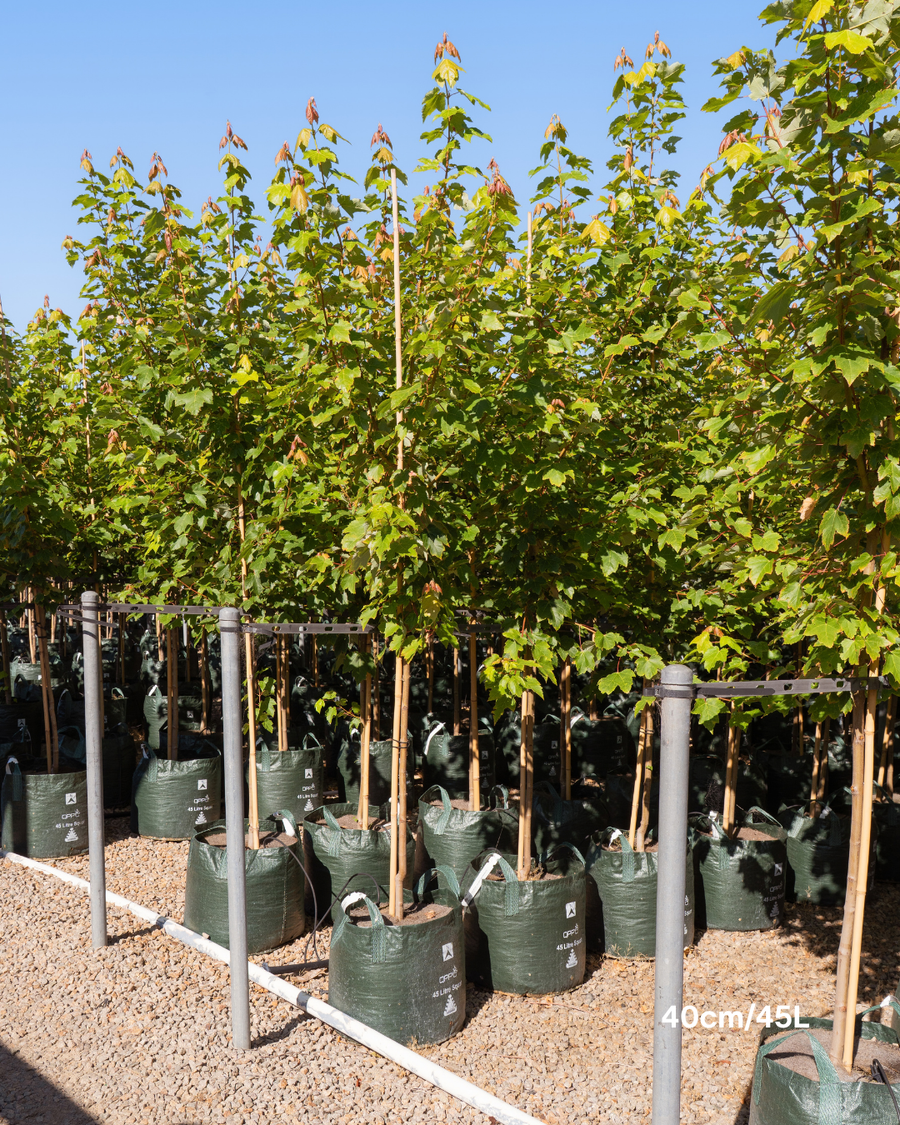
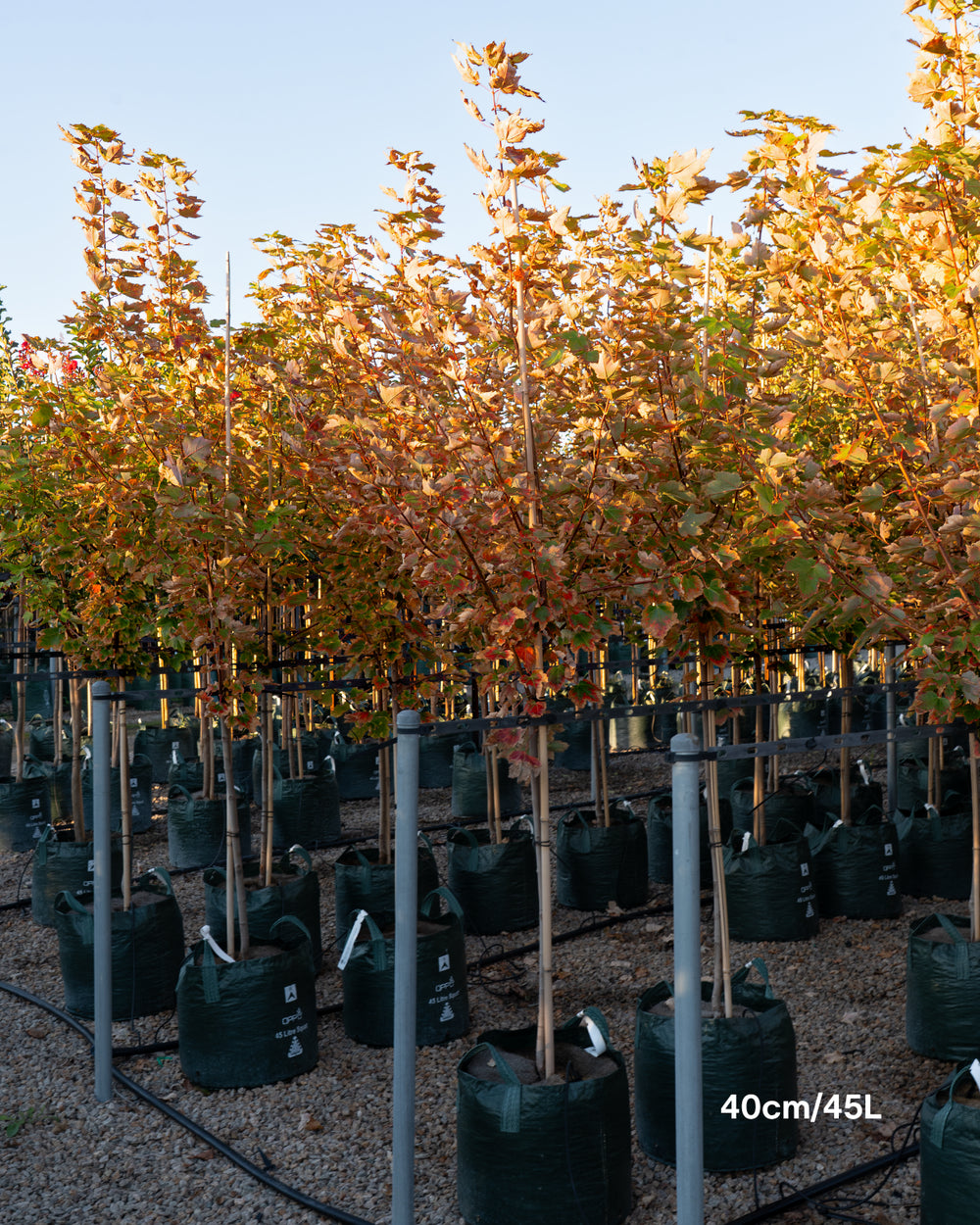
Acer × freemanii 'Jeffersred', sold as Autumn Blaze, is a fast growing deciduous hybrid maple with a strong central leader, an upright oval crown and clean lobed foliage. Its reputation rests on autumn colour, when the whole canopy turns an even red orange, holding that colour for several...
Read product details
Acer × freemanii 'Jeffersred', sold as Autumn Blaze, is a fast growing deciduous hybrid maple with a strong central leader, an upright oval crown and clean lobed foliage. Its reputation rests on autumn colour, when the whole canopy turns an even red orange, holding that colour for several weeks before leaf fall.
It wants full sun and deep soil with reliable moisture, and it grows well on clay provided drainage is adequate. Growth is fast at 1 to 1.5 metres a year while young. The tree is fully frost hardy and suits cool and temperate districts, though it needs summer water in hot inland positions.
This is a tree for avenues, streetscapes, large gardens, parks and civic open space, planted where reliable autumn colour and a uniform canopy shape matter. Nurseries and councils favour it because trees come true to form and colour up consistently even in warmer zones. Allow 8 to 10 metres between trees for full canopy.
Frequently Asked Questions
About Autumn Blaze Maple
What is Autumn Blaze Maple?
Autumn Blaze is a named cultivar of Acer × freemanii, a hybrid between the American Red Maple and Silver Maple. It combines the strong branch structure and brilliant autumn colour of Red Maple with the vigour and adaptability of Silver Maple. It is a deciduous shade and avenue tree, propagated vegetatively so every tree performs alike.
How big does Autumn Blaze Maple grow?
At maturity it reaches 12 to 20 metres tall and 9 to 12 metres wide, forming a broad upright oval crown. It is a large tree and needs to be sited accordingly, well clear of buildings, overhead services and small courtyards. Given room and good soil it reaches usable canopy size within about eight years.
How fast does it grow?
Growth is fast, around 1 to 1.5 metres a year while the tree is young and well watered, which is why it is chosen for projects that need canopy quickly. Growth slows as the crown matures. The speed comes with softer wood than a slow grown maple, so early formative pruning is worth the effort.
Is it evergreen or deciduous?
It is deciduous. The tree drops its leaves through the colder months and leafs out again in spring, which lets winter sun through to buildings and paving beneath it. That seasonal cycle is part of its value in streetscapes and around houses, giving summer shade and winter light from the same tree.
When does it colour up?
Autumn colour comes through in autumn, generally April into May in southern Australia, with the timing shifting a few weeks depending on the district and the season. The turn is quick and remarkably even across the whole crown, moving from green to red orange. Cool nights ahead of leaf fall produce the strongest colour.
Does it have invasive roots?
The root system is vigorous and largely shallow, inherited from its Silver Maple parent, so it should not be planted close to paving, drains or building footings. Given 3 to 4 metres of clearance from hard surfaces and a decent soil volume it causes no trouble. Deep, infrequent watering encourages roots down rather than out.
How do I care for Autumn Blaze Maple?
Water deeply through the first three summers, particularly in hot inland districts, and mulch widely to keep the root zone cool. Formative prune in the first few years to hold a single leader and remove narrow, tight forks before they become weak limbs. Stake young trees in exposed sites and remove ties after two seasons.
Acer x freemanii 'Jeffersred' Autumn Blaze

Liquidambar styraciflua Sweetgum
Liquidambar styraciflua Sweetgum
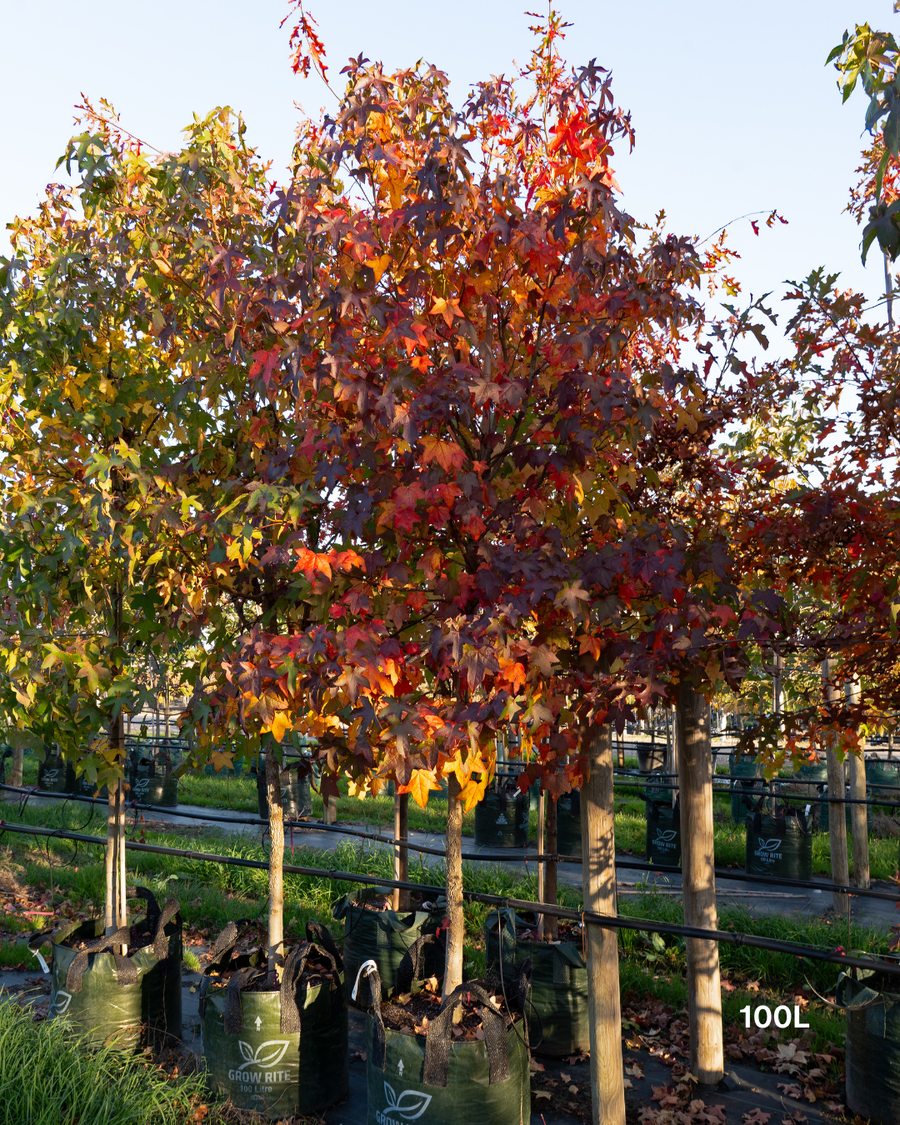
Liquidambar styraciflua, the Sweetgum, is one of the most spectacular autumn-colour trees available for Australian gardens. The glossy star-shaped foliage holds rich green through summer, then transitions to a brilliant blend of yellow, orange, red and deep burgundy in autumn, often holding colour for several weeks. Sweetgum grows...
Read product details
Liquidambar styraciflua, the Sweetgum, is one of the most spectacular autumn-colour trees available for Australian gardens. The glossy star-shaped foliage holds rich green through summer, then transitions to a brilliant blend of yellow, orange, red and deep burgundy in autumn, often holding colour for several weeks.
Sweetgum grows to 12-20 metres tall and 8-12 metres wide with an upright pyramidal form that broadens with age. The straight trunk, strong branching, and dependable colour make it an excellent shade tree and feature specimen for medium to large gardens, parks, and avenue plantings.
Sweetgum performs best in cool to temperate regions including VIC, NSW, ACT, Tasmania, and elevated parts of SA and WA, where cool autumns produce the strongest colour. It tolerates frost and moderate drought once established. Keep it clear of paving, as the spiky seed pods drop in autumn.
Frequently Asked Questions
About Liquidambar styraciflua Sweetgum
How tall does Sweetgum grow?
Liquidambar styraciflua grows to 12-20 metres tall and 8-12 metres wide with an upright pyramidal form that broadens with age.
How fast does Sweetgum grow?
Sweetgum is moderately fast-growing, adding 60cm to 1 metre per year once established.
When does Sweetgum turn colour?
Glossy green star-shaped foliage transitions to a spectacular blend of yellow, orange, red and deep burgundy in autumn (April to June across southern Australia), often holding colour for several weeks.
Is Sweetgum deciduous?
Yes. Sweetgum is fully deciduous, dropping its colourful autumn foliage in winter to reveal a sculptural branching structure.
Is Sweetgum suitable for residential gardens?
Sweetgum suits medium to large gardens, parks, and street planting due to its mature size. Allow room for the canopy and keep it clear of paving, as the spiky seed pods drop in autumn.
Where does Sweetgum grow best in Australia?
Sweetgum performs best in cool to temperate regions including VIC, NSW, ACT, Tasmania, and elevated parts of SA and WA, where cool autumns produce the strongest colour.
How far apart should I plant Sweetgum for an avenue?
Plant 5-8 metres apart for a full canopy avenue, or 4 metres for a denser shade screen.
Liquidambar styraciflua Sweetgum
Follow Us On Instagram
@evergreentreesdirect ↗
Tips & Tricks
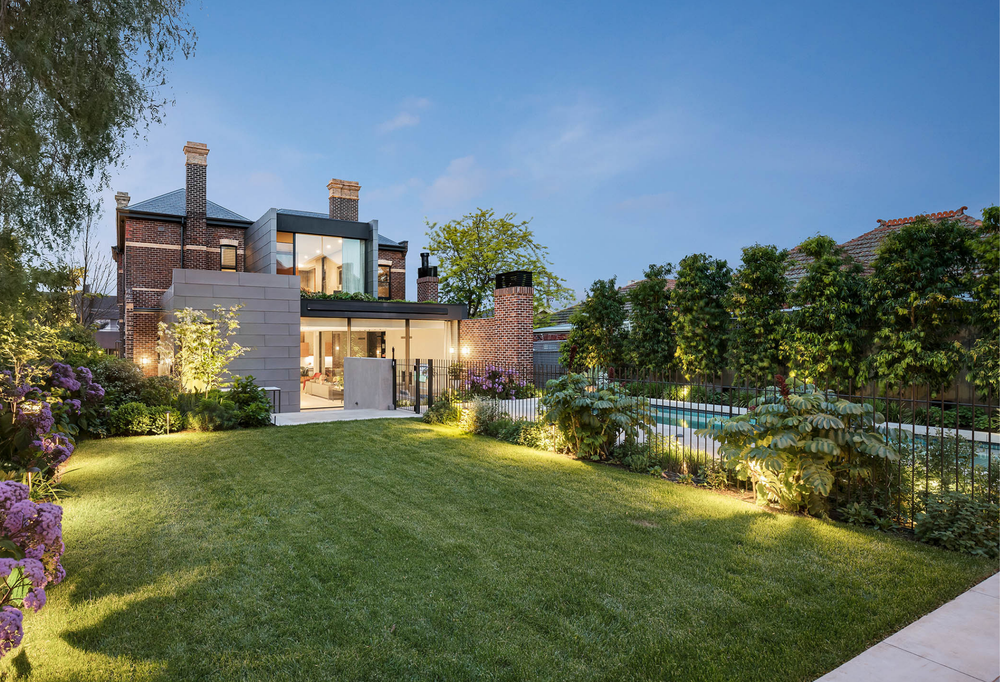
Best Trees for Creating a Privacy Screen: 10 Picks Across Fast Formal, Native and Narrow Column Options
Read the story
How to Incorporate Trees into Your Modern Landscape Design
Read the story
The Importance of Root Health: How to Choose Quality Trees
Read the story