



Skip to content

Volume Discounts Apply At Checkout

Top Evergreen Trees to Add Texture to Your Landscape: 10 Picks for Bold-Fine Contrast

Top Evergreen Trees to Add Texture to Your Landscape: 10 Picks for Bold-Fine Contrast

Ten textural picks — bold Magnolia, fine Acer and Rosemary, felted Kalanchoe, geometric succulents, broad Ligularia and Alocasia, refined Bay. Maximum texture range in one palette.

BayEvergreen TreesFoliage TextureLandscape DesignMagnoliaOlive

Texture is the most underused design tool in Australian gardens. Most plantings combine green leaves at similar scales — and end up reading as a single texture. The right ten picks give you the full range, from massive Magnolia paddle and Alocasia heart to fine Rosemary needle and Acer lace, with felted Kalanchoe and geometric succulents in between.

Stachys 'Lambs Ears' completes the silver-velvet ground texture layer when in stock — add it as supplementary planting where available.

Five design rules drive textural planting: anchor with bold (Magnolia 'Teddy Bear', Alocasia, Agave), counter with fine (Acer, Rosemary), add a felted or velvet (Kalanchoe), layer broad leaves at ground level (Ligularia), and finish with geometric succulents (Crassula, Opuntia).

The ten picks

Ordered by texture role: bold large-leaf, fine lace, broad glossy ground, massive paddle, felted velvet, geometric succulent, paddle succulent, architectural rosette, fine needle, refined oval.

  1. Magnolia 'Teddy Bear': boldest large-leaf evergreen with copper undersides.
  2. Acer palmatum: finest deciduous palmate lace texture.
  3. Ligularia reniformis: massive glossy kidney-shape ground perennial.
  4. Alocasia macrorrhizos: the largest leaf scale of any plant in cultivation.
  5. Kalanchoe beharensis: felted velvet silver-grey leaf — a texture nothing else replicates.
  6. Crassula 'Blue Bird': powdery blue-grey geometric succulent at compact scale.
  7. Opuntia 'Burbank Spineless': iconic flat paddle succulent, safe spineless cultivar.
  8. Agave americana: massive blue-grey architectural rosette.
  9. Rosmarinus officinalis: finest evergreen needle texture as ground-level counterpoint.
  10. Laurus 'Miles Choice': refined glossy oval mid-point that pairs with everything.

How to layer evergreen texture in the garden

Anchor with one bold leaf
One only: Magnolia 'Teddy Bear' (cool climate), Alocasia macrorrhizos (warm climate), or Agave americana (drought). Multiple bold anchors compete — single specimen reads stronger.
Counter with fine texture
Acer palmatum (deciduous) or Rosmarinus (evergreen): the fine-leaf counterpoint that makes the bold anchor read as bold. Plant within 2 to 3m of the anchor.
Add the felted or velvet
Kalanchoe beharensis is the only true felted-leaf plant: add as single specimen for the third textural element — not bold, not fine, but velvet.
Layer broad-leaf at ground level
Ligularia reniformis (cool climate) or Alocasia (warm climate): massive ground-level leaves that anchor the planting from below.
Finish with geometric succulents
Crassula 'Blue Bird', Opuntia 'Burbank Spineless' and Agave americana: compact geometric forms add rhythm and architectural precision against more chaotic textures.

1. Magnolia grandiflora 'Teddy Bear' (Teddy Bear Magnolia)

Bold glossy texture from thick deep-green leaves with dramatic rust-brown felted undersides. The boldest large-leaf evergreen in the catalogue. Every leaf reads as a textural feature — wind movement reveals the copper underside for layered colour.

Type
Bold large-leaf evergreen
Height
4 to 5m
Width
2 to 3m
Growth rate
Slow
Foliage
Thick deep glossy green with dramatic rust-brown felted undersides
Flowers
Large fragrant cream-white in summer
Form
Compact dense pyramidal
Conditions
Full sun to part shade, well-drained, frost hardy
Maintenance
Very low.
Best for
the boldest large-leaf textural anchor in cultivation, or a single-specimen texture statement in a courtyard.

Why choose it

Teddy Bear delivers the boldest leaf scale of any tree on this list. The thick glossy upper surface and dramatic copper-brown underside read as two distinct textures on one plant — wind reveals the contrast, light shifts the colour through the day.\n\nFor textural anchor work, no other tree on this list comes close to the visual weight of a Teddy Bear leaf.

Perfect pair

Pair with Acer palmatum for the most dramatic bold-fine textural contrast, or with Laurus 'Miles Choice' for layered glossy evergreen at two scales.

Tips for planting

Single specimen reads better than groups. Plant against a wall or fence to highlight the leaf scale. Light pruning only.

Bold glossy leaves with copper undersides — the boldest texture anchor.

Shop Magnolia grandiflora 'Teddy Bear'

2. Acer palmatum (Japanese Maple)

The finest deciduous leaf texture in cultivation. Deeply-lobed palmate foliage reads as lace — each leaf a delicate cut-out shape that catches light and shadow. Brilliant red-orange autumn colour. The textural counterpoint to bold-leaf plants.

Type
Fine-textured deciduous feature tree
Height
3 to 5m
Width
3 to 4m
Growth rate
Slow
Foliage
Fine deeply-lobed palmate, fresh green spring-summer, brilliant red-orange autumn
Flowers
Insignificant
Form
Layered horizontal vase-shape
Conditions
Part shade preferred, moist well-drained, protected from harsh sun and wind
Maintenance
Low. Light pruning in winter.
Best for
the finest leaf texture in cultivation, or the textural counterpoint to bold-leaf statement plants.

Why choose it

Where Magnolia 'Teddy Bear' delivers the boldest leaf texture, Acer palmatum delivers the finest. The deeply-lobed palmate leaves read as lace — light passes through the foliage and creates dappled shadows beneath, the layered horizontal branching pattern adds architectural rhythm.\n\nThe most dramatic textural contrast in any planting comes from pairing Acer with Magnolia 'Teddy Bear'.

Perfect pair

Pair with Magnolia 'Teddy Bear' for the strongest bold-fine textural contrast in cultivation, or under-plant with Ligularia reniformis for layered fine-broad contrast.

Tips for planting

Protect from harsh sun and wind. Moist well-drained acidic soil. Slow growing — buy mature size.

The finest leaf texture in cultivation. Lace at scale.

Shop Acer palmatum

3. Ligularia reniformis (Tractor Seat Plant)

Massive glossy kidney-shaped leaves on long stems. The single biggest broad-leaf textural feature for shaded positions. Glossy upper surface catches light, scale rivals tropical Alocasia but with cool-climate hardiness.

Type
Bold broad-leaf textural ground perennial
Height
0.6 to 0.8m
Width
0.8 to 1.2m
Growth rate
Moderate
Foliage
Massive glossy kidney-shaped, deep green
Flowers
Yellow daisy-like in summer
Form
Clumping with arching leaf stems
Conditions
Part shade to shade, moist rich
Maintenance
Cut back spent growth in winter.
Best for
massive broad-leaf ground texture for shaded areas, or the cool-climate alternative to tropical Alocasia.

Why choose it

Ligularia reniformis delivers the boldest broad-leaf ground texture in cool-climate gardens. Where Alocasia macrorrhizos works in warm climates, Ligularia is the cool-climate equivalent — same dramatic leaf scale, but reliable in cooler positions and lighter conditions.\n\nGlossy upper surface reflects light, and the kidney-shape rolls light differently to oval and palmate leaves.

Perfect pair

Under-plant Acer palmatum for layered fine-broad textural contrast, or pair with Ligularia mass plantings for textural mass.

Tips for planting

Part shade essential in hot climates. Moist rich soil. Mass plant for greatest impact.

Massive glossy kidney leaves — the cool-climate broad-leaf texture anchor.

Shop Ligularia reniformis

4. Alocasia macrorrhizos (Giant Elephant Ear)

Massive heart-shaped paddle leaves up to 1m long. The largest leaf scale of any plant in cultivation. Reads as architectural sculpture and tropical statement at once. Frost-free warm-climate option for maximum leaf impact.

Type
Massive paddle-leaf tropical feature
Height
2 to 3m
Width
1.5 to 2m
Growth rate
Moderate
Foliage
Massive heart-shaped glossy bright green
Flowers
Insignificant spathe
Form
Upright clumping with arching leaf stems
Conditions
Part shade to full sun warm humid, rich moist, frost-free
Maintenance
Remove spent leaves at base.
Best for
the largest leaf scale of any plant in cultivation, or maximum textural impact in a warm-climate garden.

Why choose it

Alocasia macrorrhizos delivers the absolute maximum leaf scale on this list. A single mature leaf is up to 1m long — the kind of textural statement that anchors an entire planting from one plant.\n\nLimitation: frost-free positions only. In cool climates use Ligularia reniformis as the equivalent broad-leaf texture.

Perfect pair

Pair with Agave americana for layered massive-leaf tropical-succulent contrast, or with Strelitzia nicolai for layered paddle-leaf statement.

Tips for planting

Frost-free positions only. Rich moist soil. Part shade in hottest climates.

The largest leaf scale in cultivation. Maximum textural impact.

Shop Alocasia macrorrhizos

5. Kalanchoe beharensis (Felt Bush)

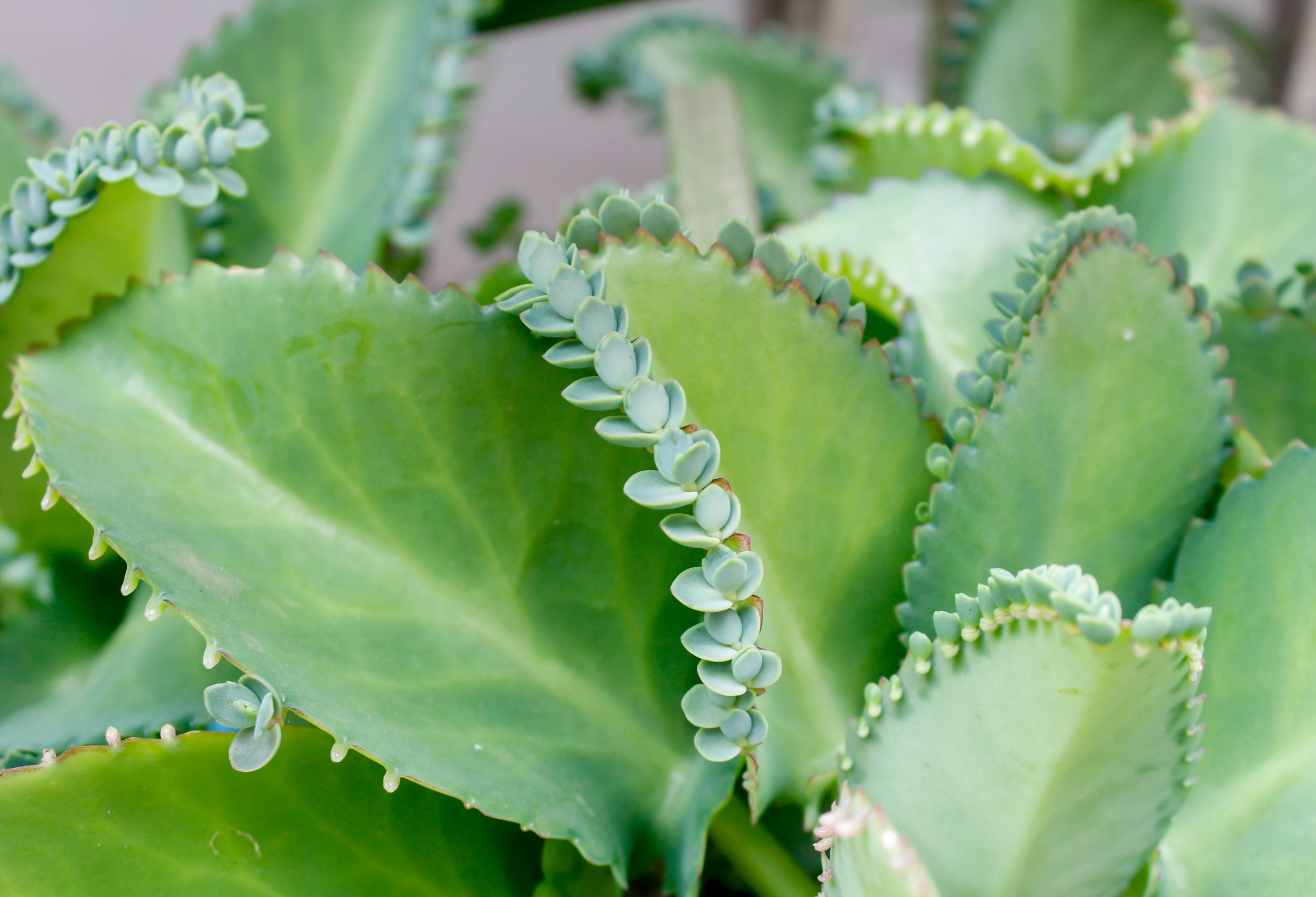
Felted velvety silver-grey leaves with serrated edges and dramatic sculptural form. The boldest velvet-textured succulent in cultivation. Architectural form reads as garden sculpture, the felted surface is a texture nothing else replicates.

Type
Felted-leaf architectural succulent
Height
1.5 to 2m
Width
1 to 1.5m
Growth rate
Slow
Foliage
Felted velvety silver-grey, serrated edges
Flowers
Insignificant yellow-green
Form
Sculptural upright
Conditions
Full sun, well-drained, drought tolerant once established
Maintenance
Very low. Minimal water once established.
Best for
felted velvet leaf texture that nothing else replicates, or a sculptural drought-tolerant architectural feature.

Why choose it

Kalanchoe beharensis is the only felted-leaf plant on this list. The velvety surface reads as fabric, not foliage — a texture so unusual it works as a single-specimen feature against any background.\n\nSilver-grey colour, serrated leaf shape and architectural form layer three design features into one plant.

Perfect pair

Pair with Agave americana for layered silver-grey architectural succulent, or specimen against a dark wall for maximum velvet-texture contrast.

Tips for planting

Very drought tolerant once established. Full sun. Avoid waterlogged positions.

Felted velvet silver-grey leaves — a texture nothing else replicates.

Shop Kalanchoe beharensis

6. Crassula 'Blue Bird' (Blue Bird Jade Plant)

Powdery blue-grey rounded succulent leaves on a compact branching frame. The cleanest blue-grey colour of any succulent in cultivation. Geometric leaf arrangement adds architectural rhythm at compact scale.

Type
Blue-grey compact succulent
Height
0.6 to 1m
Width
0.6 to 0.9m
Growth rate
Slow
Foliage
Powdery blue-grey rounded succulent
Flowers
Pale pink-white in winter
Form
Compact branching upright
Conditions
Full sun, well-drained, very drought tolerant
Maintenance
Very low. Minimal water once established.
Best for
the cleanest blue-grey succulent colour in cultivation, or compact architectural succulent for pots.

Why choose it

Crassula 'Blue Bird' delivers the cleanest blue-grey colour of any succulent on this list. Compact size makes it work in pots and tight rockery positions where bigger succulents overwhelm.\n\nThe geometric leaf arrangement — rounded leaves stacked on branching stems — adds rhythm that works beside more chaotic textures.

Perfect pair

Pair with Agave americana for layered blue-grey succulent across two scales, or with Opuntia 'Burbank Spineless' for blue-grey + paddle succulent contrast.

Tips for planting

Full sun for best blue colour. Very drought tolerant. Avoid waterlogged soil.

Powdery blue-grey compact succulent — architectural rhythm at small scale.

Shop Crassula 'Blue Bird'

7. Opuntia 'Burbank Spineless' (Burbank Spineless Prickly Pear)

Iconic flat paddle succulent without the dangerous spines of standard Opuntia. The most recognisable succulent silhouette in cultivation, sculptural at any size, and safe to plant beside paths.

Type
Spineless paddle-leaf architectural succulent
Height
2 to 3m
Width
1.5 to 2m
Growth rate
Moderate
Foliage
Flat blue-green paddle pads
Flowers
Yellow flowers followed by edible red fruit
Form
Sculptural branching paddle stack
Conditions
Full sun, well-drained, very drought tolerant
Maintenance
Very low. Minimal water once established.
Best for
iconic flat paddle succulent silhouette, or sculptural drought-tolerant texture without the danger of spines.

Why choose it

Opuntia 'Burbank Spineless' delivers the most recognisable succulent silhouette in cultivation — the flat paddle shape that says desert, sculpture and architecture all at once. Spineless cultivar makes it safe to plant beside paths and seating.\n\nFlat paddle texture contrasts beautifully with felted Kalanchoe, geometric Crassula and rosette Agave on this list.

Perfect pair

Pair with Agave americana for layered architectural succulent, or with Crassula 'Blue Bird' for paddle-vs-rounded succulent contrast.

Tips for planting

Spineless cultivar safe beside paths. Full sun. Very drought tolerant. Avoid waterlogged soil.

Iconic flat paddle silhouette — the safe sculptural succulent.

Shop Opuntia 'Burbank Spineless'

8. Agave americana (Century Plant)

Massive blue-grey rigid rosette of swordlike succulent leaves. The single most architectural succulent in cultivation. Symmetrical geometric form reads as living sculpture, and the powdery blue-grey colour is unmatched at scale.

Type
Massive architectural succulent
Height
1.5 to 2m
Width
2 to 3m
Growth rate
Slow
Foliage
Massive blue-grey rigid succulent in symmetrical rosette
Flowers
Spectacular 6m flower spike once per lifetime
Form
Symmetrical rigid rosette
Conditions
Full sun, well-drained, very drought tolerant
Maintenance
Very low. Minimal water once established.
Best for
the most architectural succulent in cultivation, or maximum sculptural blue-grey scale.

Why choose it

Agave americana delivers the most architectural texture on this list. The massive symmetrical rosette and rigid swordlike leaves are pure geometric sculpture — nothing else delivers the same combination of scale, colour and architectural precision.\n\nFor textural anchor work in succulent or drought-tolerant planting, Agave is the non-negotiable centrepiece.

Perfect pair

Pair with Opuntia 'Burbank Spineless' for layered rosette-paddle architectural succulent, or with Kalanchoe beharensis for rigid-felted texture contrast.

Tips for planting

Very drought tolerant. Spines on leaf tips — plant away from paths. Single specimens read better than groups.

Massive blue-grey architectural rosette — succulent sculpture.

Shop Agave americana

9. Rosmarinus officinalis (Rosemary)

Fine needle-foliage that reads as the textural opposite of bold Magnolia and broad Alocasia. Deep green needles with silver undersides, aromatic, pale blue flowers across most of the year. The finest evergreen texture on this list.

Type
Fine-needle aromatic evergreen herb
Height
0.8 to 1.5m
Width
1 to 1.5m
Growth rate
Moderate
Foliage
Fine needle deep green with silver undersides, aromatic
Flowers
Pale blue, year-round
Form
Dense rounded shrub or trailing
Conditions
Full sun, well-drained, very drought tolerant
Maintenance
Light pruning to shape.
Best for
the finest evergreen texture as ground-level counterpoint to bold-leaf statements, or low hedge under taller textural anchors.

Why choose it

Rosemary delivers the finest evergreen texture on this list — dense fine needles that contrast against every other leaf shape on the list. Pair against Magnolia 'Teddy Bear' for the strongest fine-bold evergreen contrast in cultivation.\n\nAromatic foliage and year-round pale blue flowers add the experiential layer that pure-texture plants miss.

Perfect pair

Plant as low hedge under Magnolia 'Teddy Bear' for fine-bold evergreen contrast, or pair with Laurus 'Miles Choice' for fine-glossy herb-textured pairing.

Tips for planting

Full sun and good drainage. Very drought tolerant. Light pruning keeps it dense.

Fine evergreen needles, blue flowers and fragrance — the textural counterpoint.

Shop Rosmarinus officinalis

10. Laurus nobilis 'Miles Choice' (Miles Choice Bay Laurel)

Refined glossy oval evergreen leaves on a tidy upright form. The textural mid-point between bold Magnolia and fine Rosemary — oval glossy leaves at moderate scale that work everywhere. Aromatic, formal, holds clipping.

Type
Refined oval-leaf evergreen
Height
3 to 5m
Width
1.5 to 2.5m
Growth rate
Moderate
Foliage
Glossy dark green oval, aromatic culinary
Flowers
Small cream in spring
Form
Dense upright
Conditions
Full sun to part shade, well-drained, frost hardy
Maintenance
Light pruning to shape.
Best for
the textural mid-point between bold and fine leaf, or refined glossy evergreen that holds a clipped shape.

Why choose it

Laurus 'Miles Choice' is the textural neutral on this list — moderate-sized glossy oval leaves that read as refined evergreen and pair well with everything else. The cultivar's tight habit holds a clean clipped shape better than the standard species.\n\nUseful as the textural anchor when Magnolia 'Teddy Bear' is too bold and Rosemary is too fine for the position.

Perfect pair

Plant between Magnolia 'Teddy Bear' and Rosmarinus for layered bold-medium-fine texture transition, or as matched pair flanking a path.

Tips for planting

Full sun to part shade. Frost hardy. Clips to formal column or ball, or grows naturally as compact upright.

Refined glossy oval leaves — the textural mid-point that pairs with everything.

Shop Laurus nobilis 'Miles Choice'

Compare at a glance

CultivarHeightWidthFormFoliageBest if you…
Magnolia grandiflora 'Teddy Bear'
Teddy Bear Magnolia
4 to 5m2 to 3mCompact dense pyramidalThick deep glossy green with dramatic rust-brown felted undersidesthe boldest large-leaf textural anchor in cultivation, or a single-specimen texture statement in a courtyard.
Acer palmatum
Japanese Maple
3 to 5m3 to 4mLayered horizontal vase-shapeFine deeply-lobed palmate, fresh green spring-summer, brilliant red-orange autumnthe finest leaf texture in cultivation, or the textural counterpoint to bold-leaf statement plants.
Ligularia reniformis
Tractor Seat Plant
0.6 to 0.8m0.8 to 1.2mClumping with arching leaf stemsMassive glossy kidney-shaped, deep greenmassive broad-leaf ground texture for shaded areas, or the cool-climate alternative to tropical Alocasia.
Alocasia macrorrhizos
Giant Elephant Ear
2 to 3m1.5 to 2mUpright clumping with arching leaf stemsMassive heart-shaped glossy bright greenthe largest leaf scale of any plant in cultivation, or maximum textural impact in a warm-climate garden.
Kalanchoe beharensis
Felt Bush
1.5 to 2m1 to 1.5mSculptural uprightFelted velvety silver-grey, serrated edgesfelted velvet leaf texture that nothing else replicates, or a sculptural drought-tolerant architectural feature.
Crassula 'Blue Bird'
Blue Bird Jade Plant
0.6 to 1m0.6 to 0.9mCompact branching uprightPowdery blue-grey rounded succulentthe cleanest blue-grey succulent colour in cultivation, or compact architectural succulent for pots.
Opuntia 'Burbank Spineless'
Burbank Spineless Prickly Pear
2 to 3m1.5 to 2mSculptural branching paddle stackFlat blue-green paddle padsiconic flat paddle succulent silhouette, or sculptural drought-tolerant texture without the danger of spines.
Agave americana
Century Plant
1.5 to 2m2 to 3mSymmetrical rigid rosetteMassive blue-grey rigid succulent in symmetrical rosettethe most architectural succulent in cultivation, or maximum sculptural blue-grey scale.
Rosmarinus officinalis
Rosemary
0.8 to 1.5m1 to 1.5mDense rounded shrub or trailingFine needle deep green with silver undersides, aromaticthe finest evergreen texture as ground-level counterpoint to bold-leaf statements, or low hedge under taller textural anchors.
Laurus nobilis 'Miles Choice'
Miles Choice Bay Laurel
3 to 5m1.5 to 2.5mDense uprightGlossy dark green oval, aromatic culinarythe textural mid-point between bold and fine leaf, or refined glossy evergreen that holds a clipped shape.

How to plant and care for them

Pick by climate
Cool climate: Magnolia, Acer, Ligularia, Bay, Rosemary, Agave, Crassula, Opuntia, Kalanchoe. Warm climate adds: Alocasia macrorrhizos.
Plant level
Rootball level with surrounding soil: succulents need extra drainage — mound the soil slightly to avoid wet feet.
Match water needs
Don't mix water groups: Acer, Ligularia, Magnolia, Bay take regular water. Rosemary, Crassula, Opuntia, Agave, Kalanchoe are drought tolerant. Plant by group to make watering easy.
Mulch out to the drip line
75 to 100mm coarse organic mulch: keep mulch 50mm clear of trunks. Use gravel mulch for the succulent group for visual consistency.
Maintenance by group
Light pruning: Bay and Magnolia for shape. Acer for structure. Succulents need almost no maintenance.

Frequently asked questions

What's the strongest texture contrast in cultivation?
Magnolia 'Teddy Bear' paired with Acer palmatum. The bold thick glossy Magnolia leaf against the fine deeply-lobed Acer palmate is the most dramatic bold-fine contrast in any Australian planting.
Cool climate vs warm climate texture options?
Cool climate uses Ligularia reniformis as the massive broad-leaf ground anchor. Warm climate gardens can use Alocasia macrorrhizos for even bigger leaf scale, plus more reliable performance from Kalanchoe beharensis.
How do I plan a textural planting?
Anchor with one bold leaf (Magnolia, Alocasia or Agave). Counter with fine texture nearby (Acer or Rosemary). Add felted texture (Kalanchoe). Layer broad ground leaves (Ligularia). Finish with geometric succulents (Crassula, Opuntia) for rhythm.
Will these all work in the same planting?
Mix and match by water group. Group A (regular water): Acer, Ligularia, Magnolia, Bay. Group B (drought tolerant): Rosemary, Crassula, Opuntia, Agave, Kalanchoe. Alocasia bridges across groups in warm climate.

The wrap up

Ten textural picks — bold Magnolia, fine Acer and Rosemary, felted Kalanchoe, geometric succulents, broad Ligularia and Alocasia, refined Bay. Maximum texture range in one palette.