



Skip to content

OUR END OF FINANCIAL YEAR SALE IS LIVE!

20% OFF ORDERS OVER $1,500 - DISCOUNT APPLIES AUTOMATICALLY AT CHECKOUT

Best Trees to Improve Your Property's Street Appeal: 10 Picks for Instant Front-Garden Impact

Best Trees to Improve Your Property's Street Appeal: 10 Picks for Instant Front-Garden Impact

A practical guide to designing the street view of your home. The four layers that build curb appeal: height over the fence, the hedge at the kerb, a matched pair at the entrance, and the softening climbers, ground cover and pots that finish the composition.


curb appealfeature treesfront yard treesproperty valuestreet trees

The kerb is where a property's reputation is decided. People walk past, drive by, and the impression forms before they've thought about it. Established trees, a green threshold, and a clean line of plants at the fence read as a cared-for home. The same house with a bare front yard reads as forgettable.

This guide is for anyone wanting to lift the street appeal of an Australian home. From the tall trees you can see over the fence, to the entrance pair that frames the front door, to the climbers and ground covers that soften the hard surfaces, we walk through the layers that build a properly designed front garden.

Height first: what people see from the street

The first decision in a curb-appeal project is what people see above the fence, from the other side of the road. A property without a tall element reads as flat. A property with a single tall feature tree, even at a distance, reads as a designed home.

Moss White Birch, Ginkgo biloba and Phoenix canariensis are the three standouts. Moss White brings a slender white-trunked vertical that fits a small front yard. Ginkgo brings autumn drama and an old-money look. Phoenix canariensis brings Mediterranean luxury where there's no front fence to hide behind. Choose by climate, scale, and the look you want.

A well-landscaped garden can add up to 20% to a property's value.

— Domain

The hedge at the fence line

The second layer is the fence itself. The aim is to lift it from a hard boundary into a green threshold. Two moves achieve this: a low hedge in front of the fence, and a softer informal hedge or screening row behind or alongside it.

Buxus sempervirens in a tight line in front of the fence adds the band of clipped green that turns a kerb-line into a designed garden. Behind it, Ficus Hillii Flash brings a lush lime green hit with new growth that reads from across the street. Waterhousea floribunda is the softer alternative, a weeping native Lilly Pilly that brings movement instead of structure. Layered together, the front fence stops looking like a fence.

A matched pair at the entrance

The single most under-used street-appeal move is a matched pair of plants flanking the front path or driveway. Two identical Acer palmatums in matched form, or a pair of Bay Standards, or two Buxus topiary balls, read as commissioned design from the moment they're planted.

Symmetry signals deliberate. A pair of plants tells the eye that the property is composed, even before the planting matures. Combine the pair with a hard frame, a path edge or a step, and the entrance reads as the front door of a considered home.

Soften with climbers, ground cover and pots

The final layer is the softening. Hard surfaces (paths, walls, fences, paving) need plant coverage to bring the design alive. Climbers carry the work upward, ground covers hold the eye at street level, and pots add composed accents at the front door.

Boston Ivy on a side wall delivers the iconic crimson-autumn moment. Star Jasmine on the front fence delivers year-round green and a summer perfume that hits anyone walking past. Stachys lamb's ears and Ligularia reniformis at the front of garden beds bring textural contrast, silver against deep green, that signals careful planting. And finally, a pair of French Anduze pots planted with a Bay Standard or Buxus topiary at the front door is the move that makes the kerb. We import these from the south of France precisely for this purpose.

Before you start: what you'll need

Site assessment
Before you plant anything, walk to the kerb.

• Take photos from both directions of the street
• Note the height of the fence and the angle people approach from
• Identify hard surfaces that need softening (paths, walls, retaining walls)
• Identify where matched pairs will sit (front path, driveway entrance, front door)
• Plan the layers: height over the fence, the kerb line, the matched pair, the soft layer
Quality soil and mulch
Front garden plants need to perform first season.

• Aged compost worked into each planting hole
• 75 to 100 mm of premium mulch over all garden beds
• Slow-release fertiliser for trees and shrubs in early spring
• Gypsum if your front yard is clay
A few good tools
Buy these once, use them for years.

• Sharp bypass secateurs for hedge trimming
• Sharp pruning saw for tree work
• Hand shears or a hedge trimmer for the front hedge
• Hardwood stakes and soft ties for new trees
• A sharp spade for clean planting holes
The right pots for the entrance
The pot matters as much as the plant.

• Matching pots for the front door (always a pair)
• Generous size: 50 to 80 L minimum for a tree
• Multiple drainage holes
• Premium potting mix

French Anduze pots are our signature recommendation for entrance work. We import them direct from the south of France.

How to keep your tree happy

Water through the first two summers
New front garden plants need deep, consistent watering.

In the ground: a deep soak twice a week through summer for the first two years, then weekly once established.

In pots: check daily in summer, water until water runs from the drainage holes.

After two summers, most established plants are largely self-sufficient. The matched-pair entrance plants are worth babying longest, since asymmetric decline ruins the look.
Feed in spring
One big spring feed sets the year up.

• Slow-release tree and shrub fertiliser in early spring as growth restarts
• Citrus food for any citrus in the front garden
• Native plant feed for natives (no phosphorus)
• Liquid feed pots every 6 weeks through summer
Mulch every year
Mulch is the easiest curb-appeal upgrade.

75 to 100 mm of mulch over all front garden beds:

• Suppresses weeds
• Retains moisture
• Reads as recently maintained
• Lifts a green planting visually

Top up annually before winter rain.
Replace damaged plants quickly
The front garden is the face of the home. Gaps undermine the design.

If a plant in a matched pair dies, replace both with new matched specimens. If a hedge plant fails, replace it the same week. Front-garden consistency is what separates a designed home from one that's slowly slipping.
Light pruning to hold form
A little, often, is better than once a year.

Light hand-shaping passes every few weeks during the growing season:

• Tidy any growth pushing out of the hedge line
• Pinch matched pair tips for uniform size
• Train climbers along their intended path
• Cut back ground covers spilling onto paths

Perfect pairs for the front garden

Buxus low band + Ficus Flash hedge
The two-tier fence line.

Plant a tight line of Buxus sempervirens in front of the fence at street level. Behind it, plant a Ficus Hillii Flash hedge to come over the top of the fence.

Why it works: two heights of green, one formal and one lush, layered into a single front boundary that reads as designed from across the road.
Acer palmatum matched pair + Stachys lamb's ears
The refined entrance.

Two identical Acer palmatums flanking the front path. Underneath, a sweep of Stachys byzantina (lamb's ears) as a soft silver carpet.

Why it works: layered foliage tones (silver at the base, green to red at canopy), with the matched pair signalling deliberate design.
Bay Standards in French Anduze pots
The classical front door.

Two matching French Anduze olive jars, two matching Bay Standards planted into them, placed either side of the front door.

Why it works: hand-glazed European pots and trained evergreen topiary read as European luxury. Works for any home style, from heritage to modern.
Moss White Birch grove + Boston Ivy wall
The autumn moment.

A clump of three Moss White Birches in the front yard, with Boston Ivy covering a side wall or retaining wall behind them.

Why it works: the white trunks read all year. The Birch leaves turn gold and the Boston Ivy turns crimson at the same time, delivering a double autumn moment.
Phoenix canariensis + Buxus base
The Mediterranean driveway.

Two Phoenix canariensis flanking a driveway entry, underplanted with a band of Buxus hedging at the base.

Why it works: the palm carries height for a tall first impression. The Buxus at the base finishes the planting and turns a driveway into a designed approach.
Ginkgo biloba + Star Jasmine on fence
The classical front garden.

A single Ginkgo biloba set back as the height feature. Trachelospermum jasminoides (Star Jasmine) trained along the front fence.

Why it works: year-round green and summer perfume at street level. Autumn gold from the Ginkgo above.
Waterhousea hedge + Ligularia ground layer
The soft native frontage.

A Waterhousea floribunda weeping hedge behind the front fence. In the bed at the base, a sweep of Ligularia reniformis with its big round leaves.

Why it works: two soft textures, both native or native-style, with movement in the canopy and bold foliage at the ground.
Magnolia 'Teddy Bear' + Buxus topiary pair
The polished urban frontage.

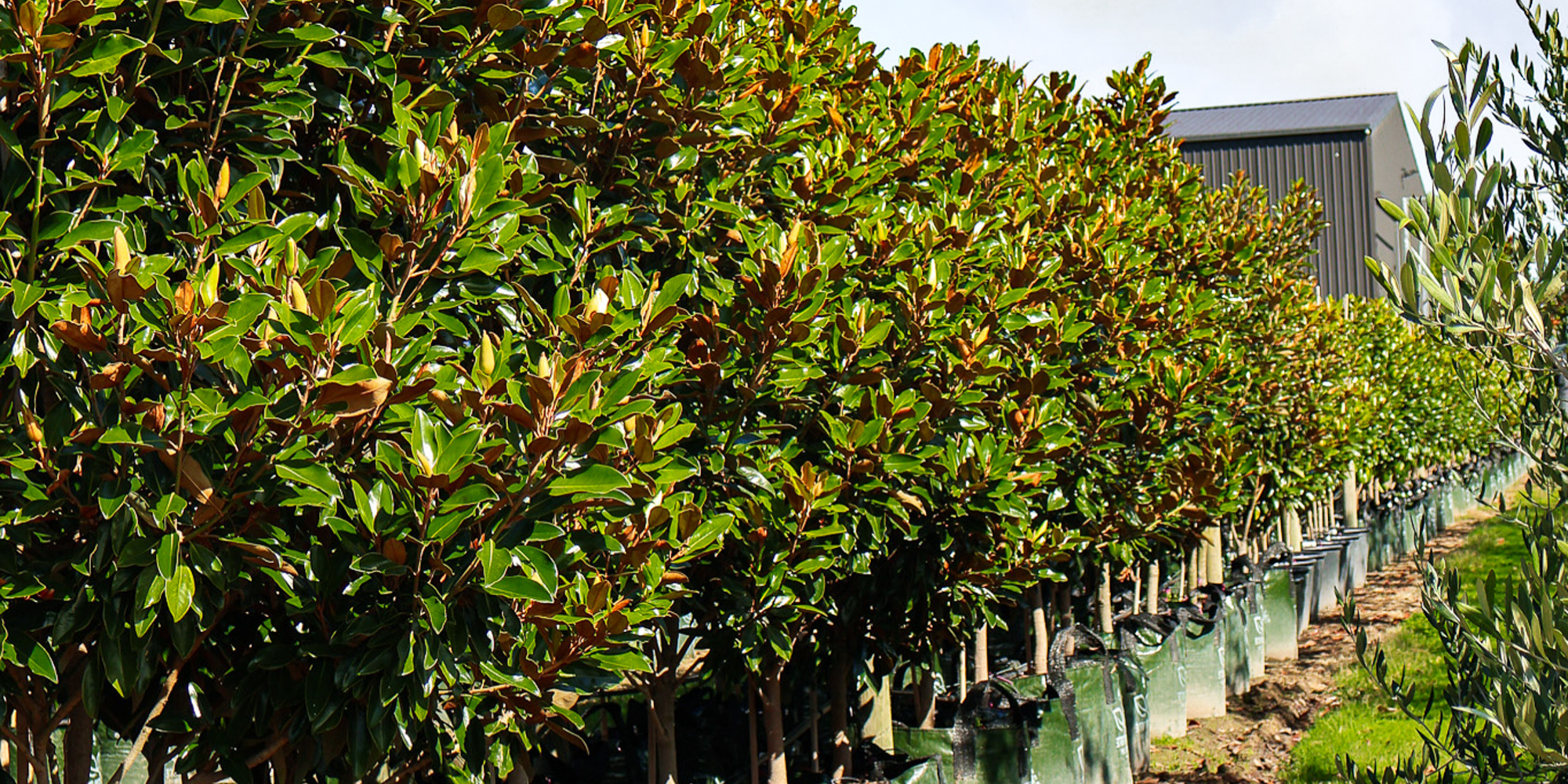
A single Magnolia 'Teddy Bear' as the central front-yard feature. Two Buxus japonica topiary balls flanking it (or a pair at the front path).

Why it works: glossy big-leaf magnolia provides the focal point. The Buxus topiary delivers symmetry and tight form around it.

Caring for your tree through the seasons

Spring (refresh)
The big maintenance season.

• Apply slow-release tree and shrub fertiliser
• Plant new layers if extending the design
• Refresh mulch back to 75 to 100 mm
• First hedge trim of the year
• Liquid feed pots fortnightly
• Inspect for early pests
Summer (water and shape)
Deep watering, light shape.

• Deep soak garden beds twice weekly
• Check pots daily
• Light hedge trim mid-summer
• Tie in climbers as they grow
• Deadhead flowering perennials
• Take photos from the kerb for next season's plan
Autumn (colour and harvest the look)
The most photogenic season for a deciduous front garden.

• Enjoy the autumn colour from Birch, Ginkgo, Acer and Boston Ivy
• Top-dress garden beds with aged compost
• Final hedge trim before winter
• Reduce watering as temperatures cool
• Replenish mulch before winter rain
Winter (prune and plan)
The structural season.

• Major prune on deciduous trees while dormant
• Plant new bare-root or deciduous additions
• Order replacements for any gaps
• Pressure-clean paths and walls (the climbers will hide the marks again in spring)
• Take photos for comparison

Pruning: when, how, and why it matters

Hedges (two trims a year minimum)
The front hedge sets the tone.

• Spring trim after the first flush of growth
• Mid-summer trim to hold form through autumn
• Autumn touch-up if growth is fast

Use sharp hand shears for small hedges, a hedge trimmer for longer runs. Cut slightly wider at the base than the top so light reaches the lower foliage.
The matched pair: prune both identically
If one looks pruned and one looks rough, the design fails.

Always prune the matched pair in the same session, with the same tools, to the same height and shape. Step back between cuts and check both sides for symmetry.
Climbers
Climbers need direction.

• Trim after flowering to keep the form
• Cut hard in late winter to control spread
• Train new shoots in the direction you want before they harden
• Remove dead winter wood from deciduous climbers in early spring
Trees in front gardens
Less is more, done annually.

• Late winter formative prune while dormant
• Remove crossing, damaged or inward-growing branches
• Maintain the canopy at the height you want, not more
• Open up the lower trunk for clear ground-level views

Our favourite picks

1. Betula pendula 'Moss White' (Moss White Silver Birch)

Compact upright Silver Birch with pure white bark and fine green canopy. Tall enough to read over a 1.8 m fence and announce the property from the street.

Type
Deciduous tree
Height
8 to 10 m
Width
3 to 4 m
Growth rate
Moderate
Foliage
Fine green turning gold in autumn
Form
Slender upright
Conditions
Full sun, well-drained soil
Best for
Front garden height feature, bare front yards, modern frontages

Why we love it

The white trunk reads at street distance. The narrow form fits a small front yard.

Perfect pair

Plant a group of three Moss Whites for grove effect, or one as the singular front-yard feature.

Tips for planting

Set back from the kerb to allow the canopy to mature. Mulch heavily, water through first two summers.

White bark, instant front-yard hierarchy.

Shop Betula pendula 'Moss White'

2. Ginkgo biloba (Maidenhair Tree)

Ancient deciduous tree with fan-shaped leaves that turn brilliant gold in autumn. Tall, architectural, and unmistakable from the kerb in October.

Type
Deciduous tree
Height
10 to 15 m in 30 years
Width
5 to 7 m
Growth rate
Slow to moderate
Foliage
Fan-shaped green turning brilliant gold in autumn
Form
Upright pyramidal becoming spreading with age
Conditions
Full sun, any well-drained soil
Best for
Front-yard feature, autumn colour, established-look gardens

Why we love it

A signal of considered planting. Gold autumn colour stops people walking past.

Perfect pair

Plant a single Ginkgo as the front-yard hero with Buxus hedging at the fence line.

Tips for planting

Always plant the male form (no fruit). Set back from the fence to allow mature spread.

An autumn that stops the street.

Shop Ginkgo biloba

3. Phoenix canariensis (Canary Island Date Palm)

Iconic large date palm with a thick trunk and a massive crown of arching fronds. The single biggest move for instant street appeal where there's no fence to hide behind.

Type
Palm
Height
8 to 15 m
Width
6 to 8 m crown
Growth rate
Slow
Foliage
Long arching pinnate fronds
Form
Single trunk crown
Conditions
Full sun, well-drained soil
Best for
Resort-style frontages, palm-belt suburbs, properties with no front fence

Why we love it

Tall and dramatic. Reads as Mediterranean luxury from the street. Works where a hedge would feel boxed-in.

Perfect pair

Plant a matched pair flanking a driveway, with Buxus hedging at the base.

Tips for planting

Choose advanced size for instant impact. Water deeply through summer.

Coastal luxury, full size, day one.

Shop Phoenix canariensis

4. Acer palmatum (Japanese Maple)

Sculptural deciduous tree with delicate layered branching and brilliant autumn colour. Plant a matched pair flanking the front path for the single most under-used street appeal move.

Type
Deciduous tree
Height
2 to 4 m
Width
1.5 to 2 m
Growth rate
Slow
Foliage
Soft palmate green turning red and orange in autumn
Form
Layered open canopy
Conditions
Morning sun, afternoon shade. Sheltered from hot wind.
Best for
Matched-pair entrance features, courtyard fronts, layered shaded entries

Why we love it

Two identical Acer palmatums flanking a path read as commissioned design. Autumn colour delivers an annual showstopper.

Perfect pair

Always plant in matched pairs at the entrance. Layer Buxus or Stachys lamb's ears at their base.

Tips for planting

Buy two of the same age and form for a true matched pair. Sheltered position from western sun.

A pair frames the door.

Shop Acer palmatum

5. Ficus microcarpa 'Flash' (Ficus Hillii Flash)

Lush lime green hedge with new growth that flushes bright and stays glossy. The most visually arresting Ficus hedge for a front fence.

Type
Evergreen tree
Height
2 to 4 m as hedge
Width
1 to 1.5 m
Growth rate
Fast
Foliage
Small glossy green with bright lime new growth
Form
Tight upright hedge
Conditions
Full sun to part shade, well-drained soil
Best for
Front fence hedge, screening, modern frontages

Why we love it

The lime new growth reads instantly across the street. A premium-feeling alternative to standard Hillii.

Perfect pair

Layer with Buxus topiary balls in front for tiered formality.

Tips for planting

Trim twice a year to maintain tight form. Stake young plants until established.

Lime green, lush, instantly noticed.

Shop Ficus microcarpa 'Flash'

6. Waterhousea floribunda (Weeping Lilly Pilly)

Soft weeping native hedge with cascading new growth in pink and bronze. A gentler alternative to a clipped formal hedge.

Type
Evergreen tree
Height
3 to 5 m as hedge
Width
1.5 to 2 m
Growth rate
Moderate to fast
Foliage
Soft weeping green with bronze and pink new growth
Form
Weeping informal hedge
Conditions
Full sun to part shade, well-drained soil
Best for
Softer front-fence screening, native garden frontages, informal lush hedges

Why we love it

Brings movement and softness where a clipped hedge would feel hard. Australian native and psyllid-resistant.

Perfect pair

Pair with Buxus hedging at the kerb for a layered formal-to-informal transition.

Tips for planting

Allow weeping habit to develop. Trim only to shape, not to clip flat.

A soft green wave at the fence line.

Shop Waterhousea floribunda

7. Buxus sempervirens (English Box (Hedging Form))

Classic dense evergreen hedging plant. Planted in a line at the front of the property, in front of the fence, it adds the low band of clipped green that turns a kerb into a designed garden.

Type
Evergreen shrub
Height
60 cm to 1.2 m as a low hedge
Width
40 to 60 cm
Growth rate
Slow
Foliage
Small dense glossy green
Form
Clipped low hedge
Conditions
Full sun to part shade, well-drained soil
Best for
Front-of-fence low hedge, parterre lines, formal kerb-line plantings

Why we love it

Adds green at the street level even where a fence is the only feature. Reads as deliberate, formal, kept.

Perfect pair

Use as the low band in front of a Ficus Flash or Waterhousea hedge for a layered front fence.

Tips for planting

Plant 25 to 30 cm apart for a tight hedge. Two trims a year to maintain form.

The low green line that finishes a front fence.

Shop Buxus sempervirens

8. Parthenocissus tricuspidata (Boston Ivy)

Self-clinging deciduous climber that covers walls, fences and retaining walls with glossy green leaves that turn deep crimson in autumn.

Type
Deciduous climber
Height
Climbs to 10 m
Width
Spreads to 5 m
Growth rate
Fast
Foliage
Three-lobed glossy green turning deep red in autumn
Form
Self-clinging climber
Conditions
Full sun to part shade, any soil
Best for
Front walls, retaining walls, side fences, garages

Why we love it

The single most photogenic wall coverage. Autumn colour stops people in the street.

Perfect pair

Combine with Buxus hedging at the wall base for layered green to crimson.

Tips for planting

Plant 50 cm from the wall, train shoots toward the wall for the first season. Falls off in winter; new growth covers again by spring.

A wall of crimson in May.

Shop Parthenocissus tricuspidata

9. Trachelospermum jasminoides (Star Jasmine)

Evergreen climber with glossy dark green leaves and fragrant white star flowers in summer. The hard-working front-fence cover that perfumes the path.

Type
Evergreen climber
Height
Climbs to 6 m
Width
Spreads to 3 m
Growth rate
Moderate
Foliage
Glossy dark green
Flowers
White star-shaped, fragrant, in summer
Form
Twining climber
Conditions
Full sun to part shade, well-drained soil
Best for
Front fences, side fences, pillars, garden bed edges

Why we love it

Year-round green coverage with a summer perfume that hits you walking past the gate.

Perfect pair

Train along the front fence with Buxus topiary balls at the base.

Tips for planting

Provide initial trellis support. Trim after flowering to keep tidy.

Green year-round, perfumed in summer.

Shop Trachelospermum jasminoides

10. Ligularia reniformis (Tractor Seat Ligularia)

Bold round glossy leaves the size of dinner plates. A textural ground-layer plant for shaded front garden beds and pot plantings.

Type
Evergreen perennial
Height
50 to 70 cm
Width
50 to 70 cm
Growth rate
Moderate
Foliage
Large round glossy dark green
Flowers
Yellow daisy-like in summer
Form
Mounded clumping
Conditions
Part shade to shade, moist well-drained soil
Best for
Shaded front beds, under Acer palmatum, beside front doors

Why we love it

Sculptural foliage at ground level. Lifts a front garden out of the everyday.

Perfect pair

Layer Ligularia at the base of Acer palmatum for a refined shaded entry.

Tips for planting

Keep moist in summer. Mulch heavily.

Big leaves, small spaces.

Shop Ligularia reniformis

11. Stachys byzantina (Lamb's Ears)

Silver felted ground cover with soft furry leaves. Adds a calm silver layer at the front of sunny garden beds and around the base of feature trees.

Type
Evergreen perennial
Height
20 to 30 cm
Width
40 to 60 cm
Growth rate
Fast
Foliage
Silver felted, soft to touch
Flowers
Tall pink-purple spikes in summer
Form
Mat-forming ground cover
Conditions
Full sun, free-draining soil
Best for
Sunny front bed edges, beneath Birch or Acer, lining a path

Why we love it

Silver foliage lifts a green planting and reads as designed. Children stop to touch it walking past.

Perfect pair

Underplant Moss White Birch with a sweep of Lamb's Ears for a silver-on-white moment.

Tips for planting

Plant in full sun in free-draining soil. Resents wet feet.

Soft silver under your feature tree.

12. Le Chene Vert Anduze Olive Jar (French Anduze Pot)

Hand-glazed French Anduze olive jar. The right pot at the front door turns a planted tree into a designed statement. We import these from the south of France.

Type
Container
Height
Varies by size
Width
Varies by size
Growth rate
N/A
Foliage
N/A
Form
Hand-glazed traditional olive jar
Conditions
Outdoor use, plant with premium potting mix
Best for
Front door pairs, courtyard centrepieces, paired driveway entries

Why we love it

A pot of this calibre transforms an entry. Plant a Bay standard or Buxus topiary into one of these and the front door reads as European luxury.

Perfect pair

Plant in matching pairs flanking the front door, with a Bay Standard or Buxus topiary inside.

Tips for planting

Always plant in pairs for maximum impact. Use premium potting mix with extra drainage.

The container that makes the entry.

Shop Le Chene Vert Anduze Olive Jar

Frequently asked questions

Does a landscaped front garden really add property value?
Yes. Domain reports that a well-landscaped garden can add up to 20% to a property's value. A designed front garden is one of the highest-return improvements a homeowner can make.
What's the cheapest curb appeal upgrade?
A low hedge of Buxus in front of the fence. It costs a fraction of larger plants, adds an instant band of green at street level, and reads as a designed garden within a single season. Pair with fresh mulch over any existing garden beds.
Should I plant a hedge in front of or behind the fence?
Both. The strongest curb-appeal hedge setup is a low clipped Buxus line in front of the fence (street side) and a taller informal hedge like Ficus Flash or Waterhousea behind or beside it. This layers the front boundary from low green to taller screening.
What's the best matched pair for the front entrance?
For a refined modern look: two Acer palmatums for autumn colour and elegance. For classical formality: two Bay Standards in matching pots. For low-maintenance impact: two Buxus topiary balls. Always plant two identical specimens, never one of each.
How tall should my front garden trees be?
Tall enough to read above the fence from across the street. For a standard 1.8 m front fence, a tree at 4 to 6 m has good street presence. Phoenix canariensis, Ginkgo biloba and Moss White Birch all fit this height range and grow into substantial street-appeal features.
Which climber is best for a front fence?
Star Jasmine (Trachelospermum jasminoides) for year-round evergreen coverage and summer perfume. Boston Ivy (Parthenocissus tricuspidata) for deciduous wall coverage with stunning crimson autumn colour. Both are commonly used on front fences across Australian residential gardens.