Pine Bark Mulch
Pine Bark Mulch
Couldn't load pickup availability
Current Stock Height Guides
Current Stock Height Guides
Height guide disclaimer: Height ranges are approximate only. As living products, plant heights naturally vary between individual plants, batches, and seasons. No guarantee is given that supplied plants will fall within the stated range. If minimum heights are required, you mustconfirm current batch heights with Evergreen Trees Direct prior to purchase. Variation in height is normal and is not grounds for return, refund, replacement, or compensation.
Mature Height & Width
Mature Height & Width
Mature Height:
Mature Width:
Pine Bark Mulch is expected to grow .
Root Ball Dimensions
Root Ball Dimensions
Use this as a reference when digging your planting hole. We recommend digging at least 10% wider than the dimensions below to encourage strong root development.
- 30cm Pot: 33cm (W) × 30cm (D)
- 40cm/45L Pot: 44cm (W) × 41.5cm (D)
- 50cm Pot / 70L Pot: 55cm (W) × 41.8cm (D)
- 100L Bag: 50.6cm (W) × 52.8cm (D)
- 150L Bag: 66cm (W) × 55cm (D)
- 200L Bag: 71.5cm (W) × 60.5cm (D)
- 300L Bag: 88cm (W) × 63.8cm (D)
- 400L Bag: 99cm (W) × 66cm (D)
- 500L Bag: 122cm (W) × 66cm (D)
- 750L Bag: 134cm (W) × 69cm (D)
- 1000L Bag: 146.3cm (W) × 71.5cm (D)
- 2000L Bag: 176cm (W) × 82.5cm (D)
Trade
Trade
We supply advanced trees to landscapers, developers, architects, and councils Australia-wide. Trade clients receive fast quotes, expert advice, and access to premium stock with reliable freight.
Shipping
Shipping
Shipping is calculated at checkout based on the pallet space your order occupies in the truck and your delivery location.
There is no charge to calculate your freight.
Contact
Contact
Have a question or a list to send through to us?
Email: sales@evergreentrees.com.au
Phone: (03) 7042 3318
Share this product
About Your New Pine Bark Mulch
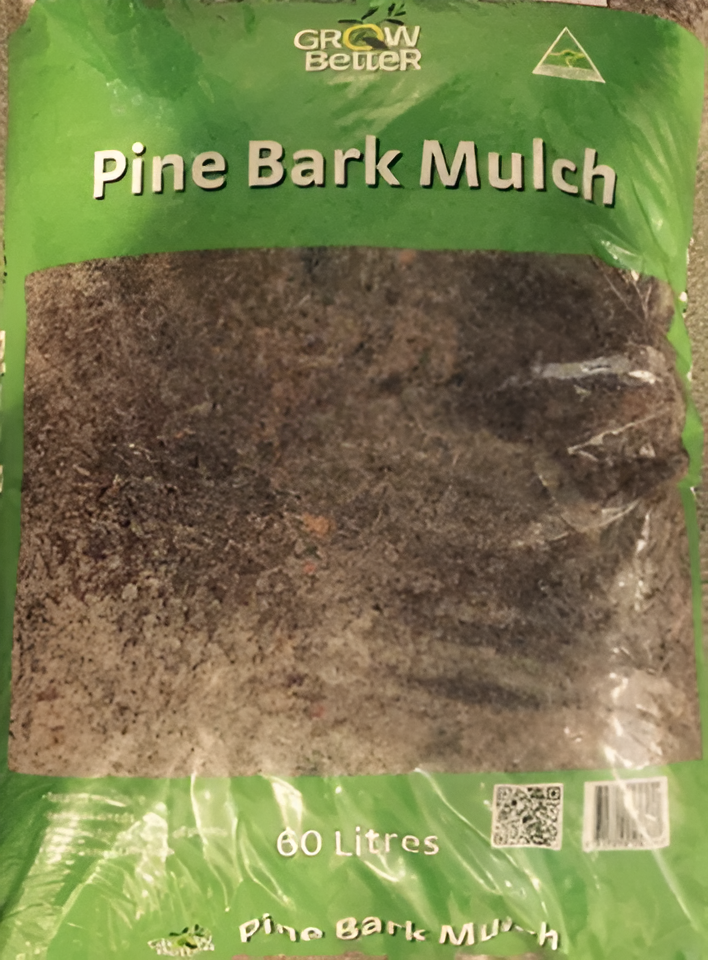
Pine Bark Mulch is screened pine bark sold in 60L bags. It is a single ingredient product with nothing blended through it, so what goes onto the garden is bark at a consistent particle size and nothing else. It sits flat on the soil surface, stays where you put it on level ground and gives beds an even finish.
Mulch does its work from the surface down. A bark layer shades the soil, slows evaporation and keeps moisture available to roots for longer between waterings. It blocks light from weed seed so far fewer weeds germinate, and it steadies soil temperature through summer heat and winter cold. It carries no fertiliser and feeds nothing directly.
Use it on garden beds, around trees, shrubs, hedges, natives and fruit trees, and over the surface of large pots that dry out quickly. Spread it 50 to 75 millimetres deep and keep it a hand width clear of trunks and stems rather than piled against them. Top it up as the layer breaks down.
Frequently Asked Questions
About Pine Bark Mulch
What is Pine Bark Mulch made from?
Pine bark, screened to a consistent particle size, with nothing else added. There is no soil, sand or fertiliser blended through it, so it behaves purely as a surface mulch. The uniform grade is what lets it sit flat and stay in place, and it gives a bed an even colour and a tidy finish once spread.
How deep should I spread it?
Between 50 and 75 millimetres suits most beds. Thinner than that and light still reaches weed seed, so weeds keep germinating through it. Much thicker and light rain struggles to reach the soil at all. Keep the mulch pulled back a hand width from trunks and stems rather than heaped up against them.
How much do I need?
A 60L bag covers a little over one square metre at 50 millimetres deep, or around eight tenths of a square metre at 75 millimetres. Measure the bed area, settle on a depth and work from there. Allow a little extra on a first application, since a fresh layer settles once it has been watered.
What plants is it suitable for?
All of them. Bark mulch is inert on the surface and does not shift soil nutrition in any meaningful way, so it goes over garden beds, around trees, shrubs, roses, fruit trees, hedges and natives alike. Keep it clear of the crowns of soft perennials and strawberries, which will rot if they sit damp under it.
Does it contain fertiliser already?
No. This is bark and nothing else, so it does no feeding at all. Mulching and feeding are separate jobs. Feed the bed first, water the fertiliser in, then mulch over the top. If the bark is already down, rake it back before feeding so the fertiliser reaches soil rather than sitting on bark.
Is it safe for natives?
Yes. Bark mulch carries no added phosphorus, so it is safe over Banksia, Grevillea, Hakea, Protea and other sensitive natives that an enriched mix or a general fertiliser would damage. Natives respond well to mulching, since it keeps their surface roots cool and moist through summer. Keep it clear of the stems.
How often should I reapply?
Bark breaks down slowly, so most beds need topping up every twelve to eighteen months rather than every season. Watch the depth rather than the calendar. Once the layer has thinned to around 25 millimetres, weeds start coming through and it is time to add more. Loosen the old layer with a rake before topping up.
Evergreen Trees Direct Has Been Featured In:


Uses in my Garden
Uses in my Garden
Pine Bark Mulch works in an:
Is Pine Bark Mulch Evergreen or Deciduous?
Is Pine Bark Mulch Evergreen or Deciduous?
Pine Bark Mulch is an Tree
Mature Height & Width
Mature Height & Width
Mature Height:
Mature Width:
Pine Bark Mulch is expected to grow .
Growth Rate of Pine Bark Mulch
Growth Rate of Pine Bark Mulch
Pine Bark Mulch is expected to grow .
They are considered to have a:
Frost Tolerance & Ideal Climate to plant Pine Bark Mulch
Frost Tolerance & Ideal Climate to plant Pine Bark Mulch
Is Pine Bark Mulch frost tolerant?
Pine Bark Mulch is
Does Pine Bark Mulch Flower?
Does Pine Bark Mulch Flower?
Does Pine Bark Mulch flower?
Flowering Period:
Flower Type:
Flower Colour:
Is Pine Bark Mulch an Australian Native Tree?
Is Pine Bark Mulch an Australian Native Tree?
Pine Bark Mulch is Native to
What is the Wildlife Value of Pine Bark Mulch ?
What is the Wildlife Value of Pine Bark Mulch ?
How much Sunlight does Pine Bark Mulch need?
How much Sunlight does Pine Bark Mulch need?
Pine Bark Mulch will thrive best in:
Preferred Soil?
Preferred Soil?
Is Pine Bark Mulch Drought Tolerant?
Is Pine Bark Mulch Drought Tolerant?
Is Pine Bark Mulch Drought tolerant?

Planting Information
How To Plant Your Pine Bark Mulch
How To Plant Your Pine Bark Mulch
Recommended Planting Spacing For Your Pine Bark Mulch
Recommended Planting Spacing For Your Pine Bark Mulch
Pine Bark Mulch is expected to grow .
Long Term Care For Your Pine Bark Mulch
Long Term Care For Your Pine Bark Mulch
Planting Your Pine Bark Mulch in Different Soil
Planting Your Pine Bark Mulch in Different Soil
Frequently Asked Questions
Frequently Asked Questions