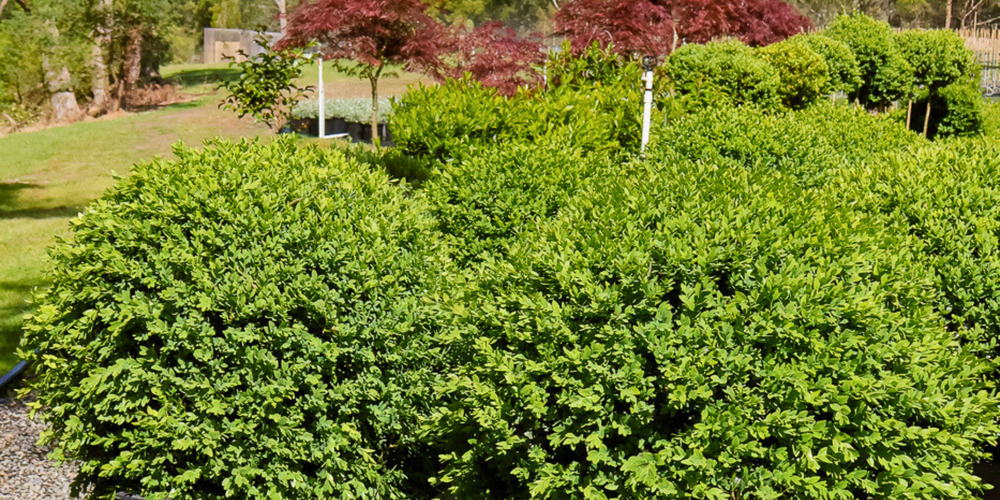
Olea europaea 'Garden Harvest' Ball is a clipped evergreen olive grown as a formal sphere. The fine silver-green foliage sits densely on short branches and holds a crisp outline all year. White flowers open in spring and are followed by small edible olives, so the plant carries both ornamental form and a useful crop.
It wants full sun and free-draining soil, and it handles heat, wind and salt air without complaint. Light to moderate frost is tolerated once established. Growth runs at about 20 to 40 centimetres a year, so one or two clips a season keep the ball tight. Water deeply while young, then sparingly.
Use it either side of a doorway, in a courtyard, along a formal path, or in a large pot on a paved terrace. It suits Mediterranean and contemporary schemes where evergreen structure matters. Because it fruits as well as holds its shape, a single plant does two jobs in a small garden.
Frequently Asked Questions
About Garden Harvest Olive Topiary Ball
What is a Garden Harvest Olive topiary ball?
It is Olea europaea 'Garden Harvest', a compact fruiting olive cultivar, grown and clipped into a dense evergreen sphere. The foliage is fine and silver-green, the branching is tight enough to hold a clean outline, and the plant still flowers in spring and sets small edible olives. You get formal structure and a crop from the same plant.
How big does the ball get?
The ball itself is usually kept between 60 centimetres and 1 metre across, depending on the size you start with and how often you clip. Left unclipped the cultivar would build into a small tree of roughly 3 to 4 metres, so regular trimming is what holds both the shape and the scale.
Does it need full sun?
Yes. Olives are Mediterranean plants and need at least six hours of direct sun a day to stay dense and to flower and fruit properly. In shade the growth opens up, the foliage loses its silver tone and the ball goes thin on the shaded side. A hot, open, well-drained position is ideal.
Is it frost tolerant?
Once established it handles light to moderate frost without damage, which covers most temperate Australian gardens including cooler inland districts. Young plants in their first winter are more vulnerable, so water them well going into the cold and avoid frost hollows. Severe repeated frost can burn the outer foliage, though the plant normally recovers in spring.
When does it flower and fruit?
Small creamy white flowers open in spring, roughly September to November depending on your district. Fruit follows over summer and colours from green to black through autumn. Clipping affects the crop, since flowers form on the previous season's wood, so if you want olives, trim lightly after harvest rather than shearing hard in spring.
Can it grow in a pot?
Yes, olive balls do well in containers and this is one of the more common ways they are used. Choose a pot at least 50 centimetres wide with free-draining mix and drainage holes that stay clear. Water when the top few centimetres dry out, feed in spring and autumn, and root prune every few years.
How do I care for a Garden Harvest Olive ball?
Plant into free-draining soil in full sun, mulch clear of the trunk and water deeply through the first two summers. After that it is largely self sufficient. Clip once or twice a year, in late spring and again in late summer, taking only the new growth. A light feed with a balanced fertiliser in spring keeps the colour good.