



Skip to content

OUR END OF FINANCIAL YEAR SALE IS LIVE!

20% OFF ORDERS OVER $1,500 - DISCOUNT APPLIES AUTOMATICALLY AT CHECKOUT

Best Trees to Reduce Your Home's Energy Costs: 5 Picks That Cut Cooling Load and Heat Bill

Best Trees to Reduce Your Home's Energy Costs: 5 Picks That Cut Cooling Load and Heat Bill

Five trees that lower cooling and heating bills through smart shade and windbreak placement.

acer rubrumbrachychitonenergy saving treesmagnoliaoliveshade treesulmus parvifoliawindbreak

A well-placed deciduous tree is the highest-return energy upgrade a home can make. Multiple studies put the saving at 25 to 40 percent of summer cooling load for a single mature canopy on the western aspect, with winter leaf drop letting low winter sun back in for free heating. The five picks below are chosen to maximise that effect at home scale.

Ulmus parvifolia (Chinese Elm) is the fastest path to roof-line shade, throwing usable canopy across the home by year four. Quercus palustris (Pin Oak) is the heritage-scale deciduous shade tree with the steadiest crimson autumn finish. Liquidambar styraciflua (Sweetgum) brings grand-scale dense canopy and a multi-colour autumn finale. Acer rubrum 'October Glory' is the upright suburban-scale Red Maple with brilliant scarlet autumn on a tighter footprint. Brachychiton populneus (Kurrajong) covers the evergreen case for hot inland climates where year-round shade beats winter sun gain.

The criteria below explain western-aspect priority, deciduous versus evergreen energy maths, canopy density choice, and the distance from the wall that delivers the strongest shade-to-roof return.

How to choose a tree that lowers energy bills

Position determines payoff: west and north matter most
The biggest energy gain comes from shading the western wall and roof, which receives the harshest afternoon summer sun. Northern aspects are second priority. Eastern aspects matter less and southern aspects need no shade and benefit from winter sun. Place Chinese Elm or Pin Oak 5 to 8 metres off the west wall.
Deciduous versus evergreen energy maths
For most climates south of Brisbane, deciduous wins. Summer canopy cuts cooling load; winter leaf drop returns 70 to 90 percent of incoming sunlight for free heating. Kurrajong wins only in hot dry inland zones where winter sun is plentiful regardless.
Canopy density and the shade it throws
Densest shade: Liquidambar, Pin Oak. Medium: October Glory. Filtered: Chinese Elm. Choose dense for the maximum cooling on the western wall; choose filtered if lawn or planting underneath matters.
Distance from the wall
Plant the trunk 5 to 8 metres from the western wall for full canopy shade across the roofline by year five to seven. Closer than 5 metres risks root conflict; further than 10 metres pushes the shade past the home in mid-afternoon.
Scale matched to the block
Standard suburban block: Chinese Elm, October Glory, Kurrajong. Larger block or rural property: Pin Oak, Liquidambar. Match the canopy to the home rather than wishing for grand scale on a small block.
Payback timeline
From an advanced 200L specimen, expect meaningful roof-line shade by year five and the strongest energy savings by year ten. Chinese Elm hits the timeline fastest; Pin Oak takes longer but the eventual canopy is grander.

1. Ulmus parvifolia (Chinese Elm)

Big summer canopy shades the house, winter bare branches let warmth through.

Type
Semi-deciduous tree
Height
8-12m
Width
6-8m
Growth rate
Moderate
Foliage
Small glossy green, yellow autumn
Form
Vase-shaped spreading
Conditions
Full sun, adaptable soil
Maintenance
Low
Best for
West and southwest sides of home for summer shade and winter sun.

Why choose it

Dense summer canopy cuts cooling costs while bare winter branches let solar gain warm the home.

Perfect pair

Plant Chinese Elm on the west side and a Magnolia Coolwyn Gloss hedge on the south for layered energy savings.

Tips for planting

Plant 4m from house foundations. Mulch out to dripline

The benchmark passive cooling tree.

Shop Ulmus parvifolia

2. Acer rubrum 'October Glory' (October Glory Maple)

Big deciduous shade tree with spectacular red autumn colour.

Type
Deciduous tree
Height
10-15m
Width
6-10m
Growth rate
Moderate to fast
Foliage
Dark green, brilliant red autumn
Form
Upright oval
Conditions
Full sun to part shade, moist soil
Maintenance
Low
Best for
Large home blocks needing serious summer shade with seasonal colour.

Why choose it

Big canopy shades home in summer, drops leaves to allow winter sun for passive solar heating.

Perfect pair

Plant October Glory on the west side and a Ulmus parvifolia on the south for layered shade.

Tips for planting

Allow 5m from foundations. Mulch out to dripline

Energy savings in fiery autumn red.

Shop Acer rubrum 'October Glory'

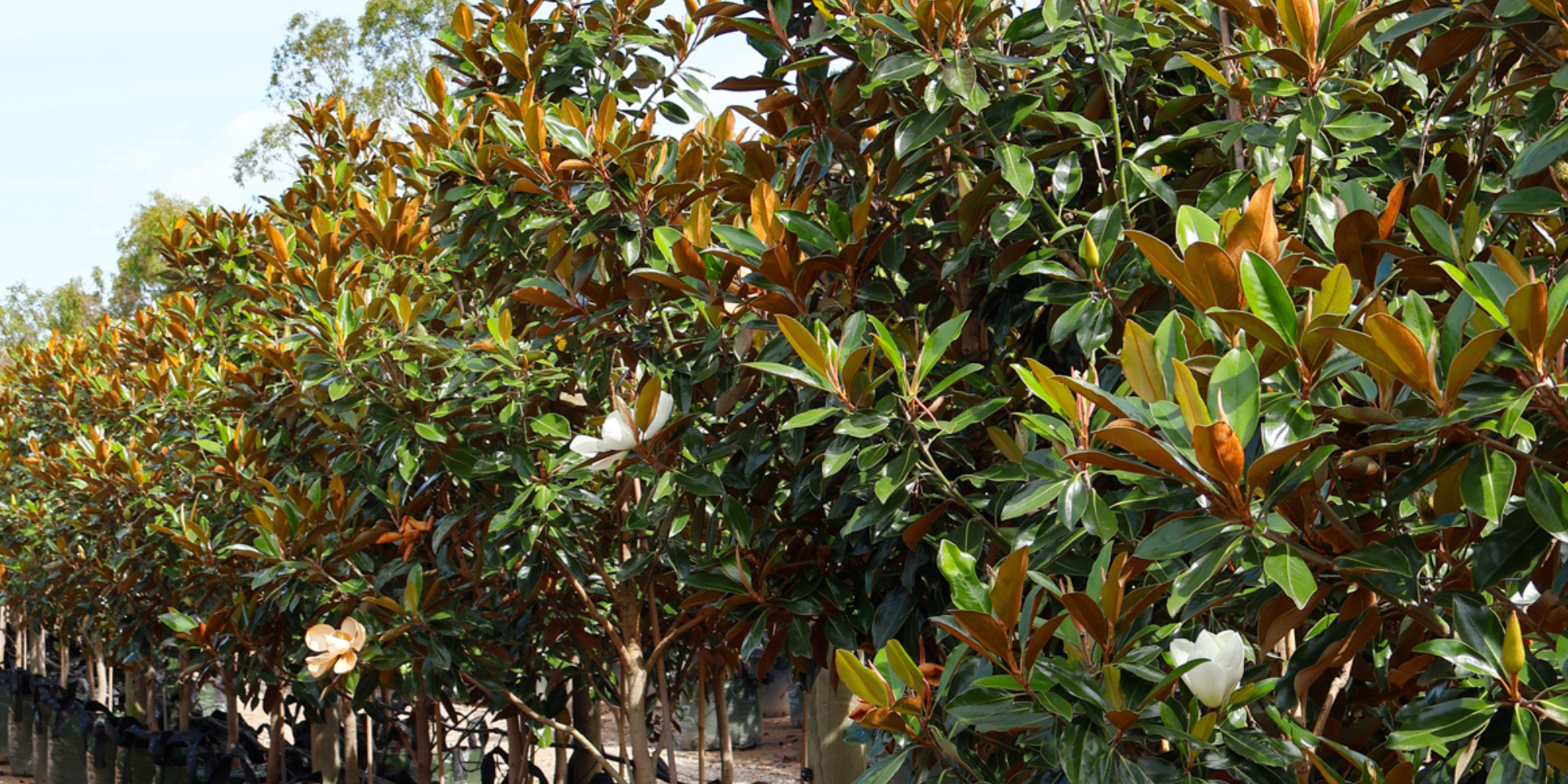
3. Magnolia grandiflora 'Coolwyn Gloss' (Coolwyn Gloss Magnolia)

Evergreen wall on the cold side of the house for winter wind protection.

Type
Evergreen tree
Height
6-8m
Width
3-4m
Growth rate
Moderate
Foliage
Large glossy dark green
Flowers
Large white fragrant summer
Form
Upright pyramidal
Conditions
Full sun to part shade
Maintenance
Low
Best for
Wind buffer on south or west facing walls.

Why choose it

Dense evergreen mass blocks winter wind that would chill the house and drive heating costs.

Perfect pair

Plant Magnolia as the winter windbreak and a Ulmus parvifolia on the west for summer shade.

Tips for planting

Mulch heavily. Allow 2m from house

Evergreen mass for winter wind blocking.

Shop Magnolia grandiflora 'Coolwyn Gloss'

4. Brachychiton populneus (Kurrajong)

Drought-hardy native with dense crown for shade without irrigation costs.

Type
Semi-evergreen tree
Height
8-15m
Width
5-8m
Growth rate
Moderate
Foliage
Glossy poplar-shape
Form
Bottle trunk, rounded crown
Conditions
Full sun, well-drained soil, drought tolerant
Maintenance
Very low
Best for
Inland sites needing low-water shade for the house.

Why choose it

Provides home shade without irrigation, removing both cooling and water costs from the equation.

Perfect pair

Plant Kurrajong as the inland shade tree and a Banksia integrifolia hedge for native windbreak.

Tips for planting

Stake young trees. Mulch heavily for first two years

Native shade without the water bill.

Shop Brachychiton populneus

5. Olea europaea (Olive Tree)

Mediterranean evergreen for dappled shade and structural windbreak in dry climates.

Type
Evergreen tree
Height
4-8m
Width
3-5m
Growth rate
Moderate
Foliage
Silver-green
Form
Rounded
Conditions
Full sun, well-drained soil, drought tolerant
Maintenance
Low
Best for
Hot dry climates where you need shade without irrigation.

Why choose it

Dappled shade cools paving and walls without blocking light entirely. Zero irrigation cost once established.

Perfect pair

Plant Olea as the dry-climate shade tree and a Murraya hedge for layered evergreen windbreak.

Tips for planting

Plant in free-draining soil. Choose fruitless cultivar if mess is an issue

Mediterranean shade with zero water cost.

Shop Olea europaea

Compare at a glance

CultivarHeightWidthFormFoliageBest if you…
Ulmus parvifolia
Chinese Elm
8-12m6-8mVase-shaped spreadingSmall glossy green, yellow autumnWest and southwest sides of home for summer shade and winter sun.
Acer rubrum 'October Glory'
October Glory Maple
10-15m6-10mUpright ovalDark green, brilliant red autumnLarge home blocks needing serious summer shade with seasonal colour.
Magnolia grandiflora 'Coolwyn Gloss'
Coolwyn Gloss Magnolia
6-8m3-4mUpright pyramidalLarge glossy dark greenWind buffer on south or west facing walls.
Brachychiton populneus
Kurrajong
8-15m5-8mBottle trunk, rounded crownGlossy poplar-shapeInland sites needing low-water shade for the house.
Olea europaea
Olive Tree
4-8m3-5mRoundedSilver-greenHot dry climates where you need shade without irrigation.

How to plant and care for them

Walk the home and identify hot-stressed aspects
Stand outside the western wall at 3pm in late summer. If the wall is hot to touch, that is your highest-priority planting spot.
Mark the planting position 5 to 8 metres off the wall
Use the mature spread from the specifications as the shade-throw rule of thumb. Confirm the canopy will throw shade across the roofline at 2 to 4pm.
Dig wide, mix gypsum into clay
Twice the width of the root ball, same depth. Loosen sides. Mix gypsum into heavy soils.
Stake low and remove early
Single low stake on the windward side. Loose flexible tie. Remove at 12 to 18 months.
Deep weekly water through year one and two
30 minutes of slow soaker per tree once a week. Mulch 75mm of coarse bark in a 1.5 metre radius.
Annual canopy lift
Each winter, remove the lowest one or two branches until the canopy lifts above the eaves of the home. Sight lines stay open; the shade still lands on the roof.

Frequently asked questions

How much can trees save?
15 to 25 percent reduction in cooling costs is realistic for a well-shaded home.
Where do I plant for maximum cooling?
West and southwest walls for summer afternoon shade.
Will these handle Australian summers?
All five tolerate 30 degrees and above once established.

The wrap up

Five shade trees chosen to deliver the strongest energy return: Chinese Elm for fast canopy, Pin Oak and Liquidambar for heritage-scale autumn drama, October Glory for suburban-scale upright shade, and Kurrajong for hot inland evergreen alternatives.