



Skip to content

Volume Discounts Apply At Checkout

Best Trees to Enhance Your Courtyard: 12 Picks for the Australian Courtyard Garden

Best Trees to Enhance Your Courtyard: 12 Picks for the Australian Courtyard Garden

A practical guide to designing an Australian courtyard. Twelve picks covering bold central feature, matched-pair entry anchors, bold and fine textural pairings, productive citrus, refined ground layer and sculptural native rainforest options.


AcerBayCourtyard TreesFeature TreesMagnoliaPatio Trees

The Australian courtyard is intimate, often paved, usually shaded on at least one side, and almost always the favourite room of the house. The right twelve picks transform it from leftover space into a designed outdoor room. Compact plants matter, matched pairs matter, and one well-chosen sculptural centrepiece matters more here than in any other planting context.

This guide is for anyone designing or extending a courtyard. From the bold-leaf central feature that defines the space, to the matched-pair anchors that frame the entry, to the productive citrus pot beside the back door, to the ground-layer textures that finish the composition, the twelve picks below cover every element of an Australian courtyard garden.

Pick one bold central feature

A courtyard supports one bold central feature. Multiple central features compete with each other in tight space and the composition reads as cluttered rather than designed. Choose one sculptural specimen as the anchor of the courtyard and build everything else around it.

The standout central feature options: Magnolia 'Teddy Bear' for compact bold-leaf evergreen with summer white flowers, Olea 'Swan Hill' for non-fruiting silver-grey Mediterranean character, Podocarpus falcatus Clouds for cloud-pruned Japanese-influenced sculpture, Cyathea cooperi Australian Tree Fern for shaded native rainforest character. Each delivers a completely different style; pick the one that suits the courtyard architecture and stop.

Match the pair at the entry

Matched pairs are the most powerful design move in a courtyard, just as in larger formal gardens. Two identical specimens flanking the courtyard entry, the back door or the central pathway create the formal portal that signals deliberate composition.

The classical courtyard pair options: Bay Standards (Laurus 'Miles Choice' trained lollipop standards) in matching pots, Buxus Topiary Balls in matching pots, Calamondin Cumquats in matching French Anduze pots for productive Mediterranean character. Always plant two identical specimens of matching age and form; the pair effect depends entirely on the symmetry.

Layer bold and fine textures in tight space

A courtyard reads at close range, so textural contrast carries the design more than scale does. Place bold-leaf species (Magnolia 'Teddy Bear', Ligularia reniformis, Cyathea cooperi) within three to four metres of fine-textured species (Acer palmatum, Pittosporum 'Miss Muffet') and the textural pairing reads instantly.

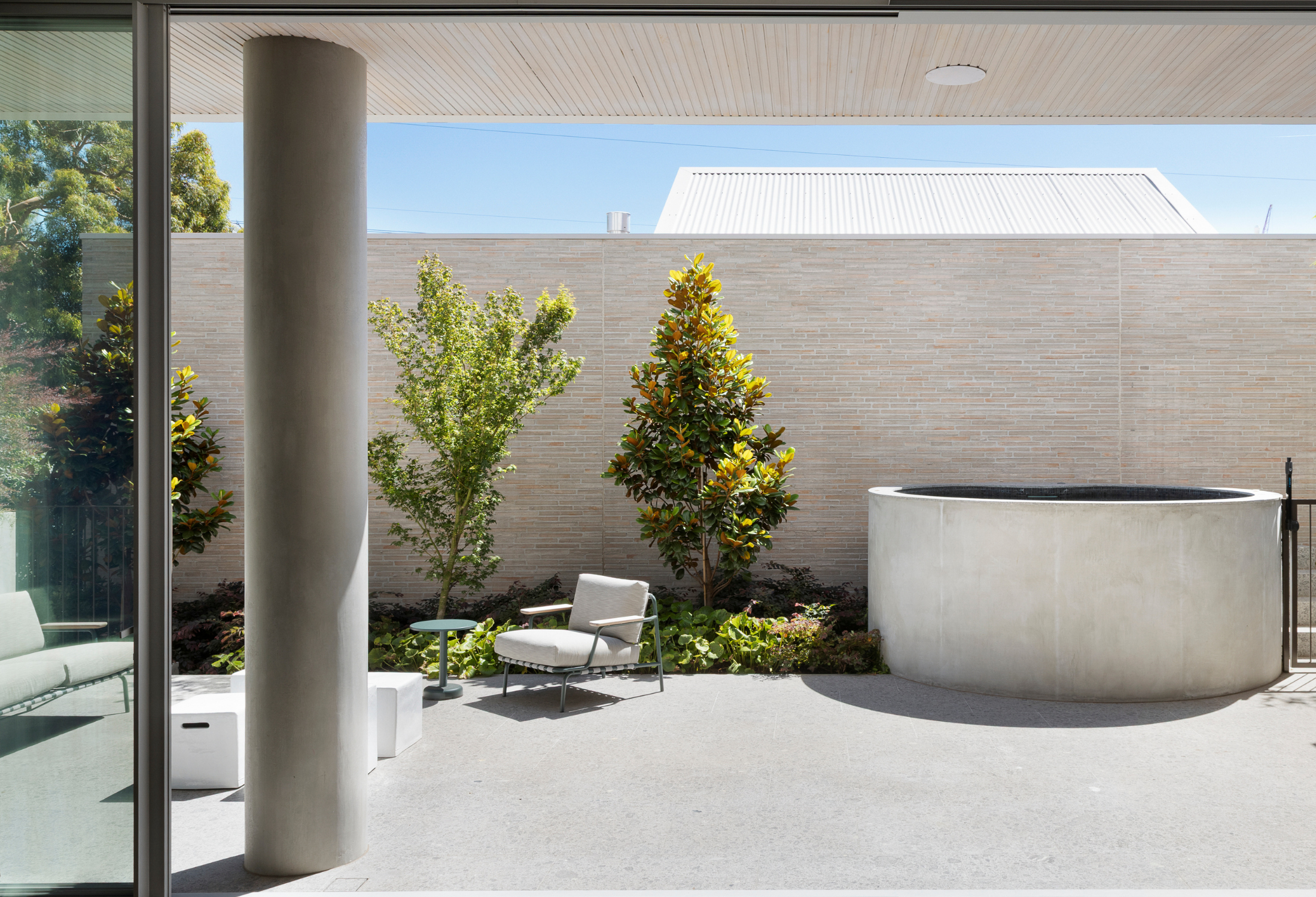
The single strongest courtyard textural pairing is Magnolia 'Teddy Bear' planted with Acer palmatum. The bold glossy leaves of the Magnolia contrast directly with the fine palmate leaves of the Acer. Both species fit courtyard scale, both deliver seasonal interest, and the pairing reads as commissioned design from the moment they're planted.

Add productive value and ground layer

An authentic Australian courtyard is productive as well as decorative. The kitchen-garden tradition of growing citrus, herbs and Bay beside the back door turns the courtyard from a visual space into a working room. Calamondin Cumquat delivers year-round productive citrus in a generous pot. Bay 'Miles Choice' brings the aromatic culinary leaves to formal entry pots.

At ground level, choose between two distinct character options. Ligularia reniformis delivers the broad-leaf shaded ground anchor that suits courtyards under canopy or south-facing positions. Pittosporum 'Miss Muffet' delivers the refined low evergreen rounded form that suits open or partly shaded positions. Both finish the courtyard composition at ground level and complement the central feature and matched pair above.

Before you start: what you'll need

Pot scale matched to each species
Different courtyard species need different pot sizes.

Bay Standards and Calamondin: 50 to 80 L. Buxus Topiary Balls and Miss Muffet: 25 to 50 L. Magnolia 'Teddy Bear': 80 L or larger. Acer palmatum: 80 L or larger. Olea 'Swan Hill' if growing in pot: 100 L or larger.

Buy the pots before the trees. Knowing the pot scale dictates which species suits which position in the courtyard. Multiple drainage holes are non-negotiable.
Premium potting mix with drainage additive
The mix matters as much as the pot.

Use premium red-ticked Australian Standards potting mix as the base. Add ten to twenty percent perlite or coarse sand for the drainage-sensitive species (Olive, Bay, Magnolia 'Teddy Bear').

Mix in aged compost for slow-release feeding. Lightly incorporate slow-release fertiliser at planting. Cheap potting mix breaks down within months and the tree fails.
Consistent mulch across all pots
Use the same mulch on every pot for visual consistency.

Buy enough mulch to cover all pots in a single delivery. Pebble mulch for Mediterranean and modern courtyards. Fine bark for naturalistic plantings. Pine bark chips for citrus.

Avoid switching mulch types within the same courtyard; mixed mulches read as patchwork. The 25 to 50 mm surface layer finishes each pot and ties the courtyard composition together.
Drip irrigation for matched watering
Daily hand-watering inevitably becomes inconsistent.

Install a drip irrigation system across all courtyard pots to deliver identical water to each tree. The consistency is what produces matched growth across the courtyard.

Set the drip on a timer for daily summer watering, weekly winter check. The investment in a quality drip system saves hours of weekly maintenance and produces a healthier, more uniform courtyard.
Two different feeds for the planting
Citrus food and slow-release general fertiliser.

Citrus food for Calamondin (and any other citrus), applied three times a year. Slow-release general fertiliser for everything else (Magnolia, Acer, Olive, Bay, Buxus, Pittosporum), applied once in early spring.

Low-phosphorus native plant food for Cyathea cooperi if included. Buy the bags and label clearly which goes where.

How to keep your tree happy

Water pots daily in summer, weekly in winter
Pots dry faster than ground; consistent watering is essential.

Daily summer check by feel. Water deeply when watering until water flows from drainage holes. Drip irrigation on a timer is the most reliable approach for courtyard pots.

In winter, check weekly. Reduce watering sharply for Mediterranean species (Olive, Bay), drought-tolerant species (Buxus), and dormant deciduous species (Acer palmatum). These species resent wet feet in cold months and root rot is the most common cause of pot tree decline.
Feed by species through the year
Match the feed to the tree.

Apply slow-release general fertiliser in early spring for most courtyard species. Citrus needs dedicated citrus food three times a year (early spring, midsummer, early autumn).

For Cyathea cooperi (Australian Tree Fern), use low-phosphorus native plant food only. Liquid seaweed every six weeks through warm months supports all species. Stop all feeding by late autumn so trees harden off for winter.
Mulch all pots annually before summer
The consistent mulch surface is part of the courtyard composition.

Refresh decorative mulch annually before summer to 25 to 50 mm depth across all pots. Use the same mulch type throughout for visual unity.

The mulch retains moisture (critical in pots), insulates roots from extreme sun on dark pots, and visually finishes each planting. Keep mulch a finger's width clear of trunks.
Light pruning to maintain courtyard scale
Pot trees need active pruning to hold form within the courtyard.

Many light passes a year, rather than one heavy reshape. Bay Standards: two to three trims a year. Buxus Topiary Balls: two to three trims a year. Magnolia 'Teddy Bear': light shape after flowering only.

Acer palmatum: late winter dormant prune only. Olive 'Swan Hill': late winter thinning prune. Cyathea cooperi: remove only completely dead fronds at the base.
Replace failed pot trees urgently
A courtyard with a dropped tree reads as broken.

If any tree in a matched pair dies or is damaged beyond recovery, replace both with new matched specimens. If a central feature fails, replace it within the same dormant season.

Courtyards are small, intimate spaces where every plant carries weight. The asymmetry of a missing tree or a single dropped pair is immediately visible. Prioritise quick replacement to maintain the composition.

Perfect pairs for the front garden

Magnolia 'Teddy Bear' + Acer palmatum
The classic courtyard textural pairing.

A Magnolia 'Teddy Bear' as the bold-leaf central feature, with an Acer palmatum planted three to four metres away as the fine-leaf textural counterpoint.

Why it works: maximum textural contrast within courtyard scale. The bold glossy Magnolia leaves contrast directly with the fine palmate Acer leaves. Both species deliver seasonal interest (Magnolia summer flowers, Acer autumn colour). The strongest single textural pairing in any Australian courtyard.
Bay Standards pair + Buxus topiary at base
The classical formal courtyard entry.

Two matched Bay Standards in formal pots flanking the courtyard entry. Two matched Buxus Topiary Balls in companion pots at ground level on either side.

Why it works: tiered formal symmetry. Bay carries the vertical, Buxus carries the lower band of green. Both species are slow-growing and forgive missed pruning windows, so the pair stays composed for years.
Calamondin in Anduze pots + Olive in matching pot
The productive Mediterranean courtyard.

Two matched Calamondin Cumquats in French Anduze pots flanking the back door, with an Olea 'Swan Hill' in a matching pot as the central courtyard feature.

Why it works: productive Mediterranean kitchen garden in three pots. The Calamondin pair delivers year-round fruit. The Swan Hill Olive delivers silver-grey Mediterranean character without the fruit drop that would mark the pavers.
Cloud Podocarpus + Pittosporum 'Miss Muffet' base
The Japanese-inspired courtyard composition.

A single cloud-pruned Podocarpus falcatus as the central sculptural feature, with a sweep of Pittosporum 'Miss Muffet' as the calm rounded green companion at ground level.

Why it works: dramatic pine silhouette draws the eye, Miss Muffet calms the planting at ground level. Both species are slow-growing and demand minimal maintenance once established. Suits courtyards where the planting is meant to age in place for decades.
Cyathea cooperi + Ligularia reniformis
The shaded native rainforest composition.

A Cyathea cooperi Australian Tree Fern as the canopy feature in a shaded courtyard, with sweeping drifts of Ligularia reniformis at ground level for the broad-leaf rainforest ground anchor.

Why it works: both species deliver rainforest character in shaded conditions where most courtyard species struggle. Native, low-maintenance, both with bold foliage at different scales. Suits south-facing courtyards or shaded urban gardens.
Swan Hill Olive + Buxus topiary balls
The Mediterranean formal courtyard.

A central Olea 'Swan Hill' as the silver-grey Mediterranean feature, with matched Buxus Topiary Balls in companion pots at the base.

Why it works: Mediterranean character with formal anchoring. The Olive delivers silver-grey foliage without fruit drop; the Buxus provides the formal symmetry. Pebble mulch ties the composition together.
Lagerstroemia 'Natchez' + Rhaphiolepis 'Oriental Pearl' ground
The four-season flowering courtyard.

A Lagerstroemia 'Natchez' (Crepe Myrtle) as the white-flowering deciduous feature, with Rhaphiolepis 'Oriental Pearl' planted in front as the compact white-flowering ground layer.

Why it works: layered white flowering at two heights and across multiple seasons. Lagerstroemia delivers summer white flowers, autumn colour and cinnamon winter bark. Rhaphiolepis brings spring white flowers at ground level. Together they sustain seasonal interest year-round.
Magnolia 'Teddy Bear' + Cloud Podocarpus
The twin sculptural courtyard.

A single Magnolia 'Teddy Bear' on one side of the courtyard, balanced by a single Cloud Podocarpus on the other. Both as singular sculptural features rather than matched pair.

Why it works: two completely different sculptural forms reading as deliberate design choices. Suits larger courtyards where the space supports two separate focal points rather than one central feature.

Caring for your tree through the seasons

Spring: feed, repot, plant new additions
The major maintenance season for courtyard pots.

Apply slow-release general fertiliser in early spring for most species. Apply citrus food for Calamondin. Repot any trees showing signs of root binding (drying out faster, slowed growth, roots through drainage holes).

Plant any new additions once frost has passed. Refresh decorative mulch on all pots to 25 to 50 mm depth. Inspect for early pest activity, particularly scale on Magnolia and citrus leaf miner. Start the regular liquid seaweed schedule for warm months.
Summer: water daily, harvest fruit
The most demanding season for courtyard pots.

Daily summer check by feel. Water deeply when watering. Drip irrigation on a timer delivers consistent watering with minimum effort. Apply liquid seaweed every six weeks.

Harvest Calamondin fruit as it colours. Watch for citrus leaf miner and scale through January and February. Move tender species into morning sun only if afternoon temperatures exceed 35 degrees.
Autumn: enjoy colour, final feed
The reward season for deciduous courtyard species.

Acer palmatum delivers brilliant autumn colour. Lagerstroemia 'Natchez' shows autumn colour and reveals cinnamon winter bark as leaves drop. Apply autumn citrus food. Apply final light feed for evergreens before winter.

Top-dress mulch before winter rain. Reduce watering as temperatures cool. Bay Standards take their second clipping of the year now. Inspect stakes and ties on any trained features.
Winter: protect tender, structural prune
The dormant season for most courtyard species.

Major structural pruning on deciduous species (Acer palmatum, Lagerstroemia) while dormant. Late winter thinning prune on Olive 'Swan Hill'. Late winter dormant prune on Bay Standards if needed.

Move frost-tender species (Calamondin in cool climates) to sheltered positions. Wrap pots in hessian or bubble wrap in extreme frost; pots freeze and dry out faster than ground. No fertilising through winter.

Pruning: when, how, and why it matters

Magnolia 'Teddy Bear': light shape after flowering
The species needs very little active pruning.

Light shape after the main summer flowering flush. Use sharp bypass secateurs and remove only crossing, damaged or inward-growing branches. Avoid heavy reductions; the natural form is the design.

Lift the lowest branches progressively as the tree matures to reveal the trunk and create the courtyard sculptural feature. Step back regularly and view the form from multiple angles.
Acer palmatum: late winter dormant prune only
Never reduce an Acer with hedge shears or hard cuts.

In late winter while the tree is dormant, remove crossing branches, dead twigs, and anything growing toward the centre of the canopy. The goal is the natural layered shape; enhance rather than impose.

Use sharp bypass secateurs and remove no more than one third of the volume in any year. The species responds badly to crude pruning. Hand-finish every cut for the clean lines an Acer demands.
Olive 'Swan Hill': late winter thinning prune
Even non-fruiting Olive benefits from annual thinning.

In late winter, thin the canopy to open the centre for light and air. Remove crossing branches, water-shoots and inward-growing wood. The goal is the open vase form: three to five main scaffold branches spreading outward.

Olive responds well to this pruning and rewards it with healthier denser foliage the following year.
Bay Standards: two to three trims a year
Trained Bay Standards need disciplined maintenance.

Trim the head shape in late spring after the growth flush (November), midsummer (January) and early autumn (March). Three trims a year holds the trained lollipop head tight.

Remove any suckers from the trunk on sight. Use sharp bypass secateurs and follow the existing shape rather than reshaping.
Buxus Topiary Balls: two to three trims a year
The same discipline as Bay Standards.

Two to three light trims a year on the soft new growth maintains the ball form. Spring after growth flush, midsummer if needed, autumn before winter slowdown.

Use sharp hand shears for tight control. Cut slightly wider at the base than the top so light reaches lower foliage. Step back regularly and rotate to check symmetry from all angles.
Cyathea cooperi: minimal, dead fronds only
Australian Tree Fern needs almost no active pruning.

Remove only completely browned-off fronds at the base of the leaf where it meets the trunk. Use a sharp pruning saw, never tear fronds off. Live green fronds should never be removed; they feed the species.

The trunk is the form; do not attempt to shape it. Allow the species to develop its natural rainforest character.

Our favourite picks

1. Magnolia grandiflora 'Teddy Bear' (Teddy Bear Magnolia)

Compact bold evergreen Magnolia with thick glossy leaves and dramatic copper undersides. The most popular courtyard Magnolia in Australia — compact 4 to 5m mature, dense pyramidal form, fragrant summer flowers. Suits both ground and large pots.

Type
Compact courtyard feature Magnolia
Height
4 to 5m
Width
2 to 3m
Growth rate
Slow
Foliage
Thick deep glossy green with copper-brown undersides
Flowers
Large fragrant cream-white in summer
Form
Compact dense pyramidal
Conditions
Full sun to part shade, well-drained, frost hardy
Maintenance
Very low.
Best for
the most popular compact courtyard Magnolia, or a single bold-leaf statement specimen in ground or large pot.

Why we love it

Teddy Bear is the courtyard Magnolia. The compact 4 to 5m size suits courtyard scale, the bold glossy leaves with copper undersides anchor the space, and the fragrant summer flowers add the experiential layer.\n\nWorks equally well in ground or in a large terracotta pot — the dense pyramidal form holds shape without supporting structure.

Perfect pair

Plant as central courtyard specimen, or pair with Acer palmatum for bold-fine leaf contrast in the same courtyard.

Tips for planting

Suits ground or large pot (60 to 80L+). Light pruning only. Frost hardy.

The compact courtyard Magnolia. Bold, glossy, fragrant.

Shop Magnolia grandiflora 'Teddy Bear'

2. Acer palmatum (Japanese Maple)

The classic courtyard Japanese Maple. Deeply-lobed palmate foliage, layered horizontal branching, brilliant red-orange autumn colour. Reads as living sculpture in a courtyard or pot — the most refined small deciduous feature in cultivation.

Type
Refined courtyard Japanese Maple
Height
3 to 5m
Width
3 to 4m
Growth rate
Slow
Foliage
Deeply-lobed palmate, fresh green spring-summer, brilliant red-orange autumn
Flowers
Insignificant
Form
Layered horizontal vase-shape
Conditions
Part shade preferred, moist well-drained, protected from harsh sun and wind
Maintenance
Low. Light pruning in winter.
Best for
the refined courtyard sculpture in plant form, or a brilliant autumn-colour feature in a protected position.

Why we love it

Acer palmatum is the most refined courtyard feature tree in cultivation. The deeply-lobed leaves read as lace, the layered horizontal branching pattern adds architectural rhythm, and the brilliant autumn colour delivers six weeks of dramatic feature work each year.\n\nProtected courtyard conditions actually favour Acer — the species needs shelter from harsh sun and wind, exactly what courtyards provide.

Perfect pair

Pair with Magnolia 'Teddy Bear' for layered fine-bold textural contrast, or with Ligularia reniformis for layered fine-broad ground texture.

Tips for planting

Protect from harsh sun and wind. Moist well-drained acidic soil. Slow growing — buy mature size for instant impact.

Refined courtyard Japanese Maple — living sculpture in lace.

Shop Acer palmatum

3. Olea europaea 'Swan Hill' (Swan Hill Non-Fruiting Olive)

Completely non-fruiting Olive with classic silver-grey foliage. The clean courtyard olive — zero fruit, zero pollen, zero mess. Adds Mediterranean character to courtyard planting without the fruit drop that makes other olives unsuitable for paved areas.

Type
Non-fruiting Mediterranean courtyard Olive
Height
5 to 7m
Width
4 to 5m
Growth rate
Moderate
Foliage
Silver-grey narrow evergreen
Flowers
Sterile — no fruit
Form
Rounded crown, can be trained as feature multi-trunk
Conditions
Full sun, well-drained, drought tolerant once established
Maintenance
Light pruning to shape.
Best for
Mediterranean character in a paved courtyard without fruit mess, or a sterile silver-grey feature beside a pool, terrace or dining area.

Why we love it

Swan Hill is the only sterile Olive cultivar on this list. Courtyards, paved areas, pool surrounds and dining terraces all benefit from a tree that delivers full Mediterranean character with zero fruit drop, zero pollen and zero staining on paving.\n\nVisual character is identical to a productive Olive — silver-grey foliage, sculptural multi-trunk form — just without any of the maintenance.

Perfect pair

Plant in matched terracotta pots at courtyard entry, or pair with Laurus Standards for layered Mediterranean-formal courtyard.

Tips for planting

Sterile cultivar — no fruit production. Drought tolerant. Suits large pot or in-ground.

Non-fruiting silver-grey Olive — the clean Mediterranean courtyard feature.

Shop Olea europaea 'Swan Hill'

4. Laurus nobilis Standards (Bay Laurel Standards)

Pre-trained Bay Laurel on a clear stem with a clipped ball crown. The classic courtyard entry feature — ready to plant in matching terracotta pots flanking the doorway, or in ground beside the central path. Aromatic culinary leaves add productive value.

Type
Pre-trained courtyard Bay standard
Height
1.5 to 2m
Width
0.6 to 0.8m
Growth rate
Moderate
Foliage
Glossy dark green oval aromatic
Flowers
Small cream spring
Form
Clear stem with clipped ball crown
Conditions
Full sun to part shade, well-drained, frost hardy
Maintenance
Light trim twice a year.
Best for
matched-pair courtyard entry features in matching terracotta pots, or formal Bay anchors beside the dining area.

Why we love it

Bay Standards are the iconic courtyard feature pair. The pre-trained lollipop form arrives ready to install in matching terracotta pots flanking the courtyard entry — the kind of formal entry move that takes 5 to 8 years to train from young plant, delivered finished.\n\nAromatic culinary leaves add productive kitchen value to the visual formal feature.

Perfect pair

Plant in matched pair in terracotta pots flanking the courtyard entry, or pair with Buxus topiary balls as smaller central feature.

Tips for planting

Pots: 50 to 80L size. Light trim twice a year to maintain ball crown. Frost hardy.

Pre-trained Bay pairs — the iconic courtyard entry feature.

Shop Laurus nobilis Standards

5. Podocarpus falcatus Clouds (Cloud-Pruned Podocarpus)

Pre-trained cloud-pruned Podocarpus — the most sculptural courtyard centrepiece in cultivation. Layered horizontal cloud forms read as Japanese-inspired living architecture. Suits ground or large pot.

Type
Cloud-pruned sculptural courtyard centrepiece
Height
1.8 to 2.5m
Width
1.2 to 1.8m
Growth rate
Slow
Foliage
Fine deep green evergreen needle
Flowers
Insignificant
Form
Pre-trained cloud topiary
Conditions
Full sun to part shade, well-drained
Maintenance
Light annual trim to maintain cloud forms.
Best for
the most sculptural courtyard centrepiece in cultivation, or a Japanese-inspired feature that anchors the entire courtyard.

Why we love it

Cloud-pruned Podocarpus is the high-end courtyard centrepiece. A single cloud-pruned specimen carries the design of an entire courtyard, and the layered horizontal cloud forms create the kind of slow-resolved beauty that rewards the people who sit in the courtyard every day.\n\nWorks equally well in ground or in a substantial decorative pot.

Perfect pair

Install as central courtyard feature with Buxus topiary balls as supporting structure at base, or specimen alone for maximum impact.

Tips for planting

Light annual trim to maintain cloud forms. Single specimen reads strongest. Suits substantial pot or in-ground.

The high-end sculptural courtyard centrepiece.

Shop Podocarpus falcatus Clouds

6. Buxus sempervirens (Topiary Balls) (English Box Topiary Balls)

Pre-trained Buxus topiary balls — the most versatile small formal feature for courtyards. Matched pairs in pots, central feature anchors, or supporting structure around larger feature trees. The classic courtyard formal punctuation.

Type
Pre-trained courtyard topiary feature
Height
0.4 to 0.8m
Width
0.4 to 0.8m
Growth rate
Slow
Foliage
Tight dense small dark green
Flowers
Insignificant
Form
Pre-trained sphere
Conditions
Full sun to part shade, well-drained
Maintenance
Light trim twice a year.
Best for
matched-pair compact formal features in courtyard pots, or supporting structure around larger feature trees.

Why we love it

Buxus topiary balls are the courtyard's most versatile formal feature. Matched pairs in terracotta pots flank a doorway or central pathway. Single specimens punctuate corner positions. Multiple balls support a central feature tree.\n\nPre-trained shape means instant formal impact — no training time required.

Perfect pair

Plant in matched terracotta pots flanking the courtyard entry, or pair with Laurus Standards for layered formal feature scale.

Tips for planting

Pots: 30 to 50L. Light trim twice a year to maintain sphere. Work just outside the existing shape.

Pre-trained formal balls — the versatile courtyard punctuation.

Shop Buxus sempervirens (Topiary Balls)

7. Lagerstroemia indica 'Natchez' (Natchez White Crepe Myrtle)

Deciduous courtyard feature with three months of pure white summer panicles, brilliant orange-red autumn colour, and dramatic cinnamon-grey mottled bark for winter interest. Four seasons of feature work — the most-valued deciduous courtyard tree in cultivation.

Type
Deciduous flowering courtyard feature
Height
5 to 8m
Width
3 to 4m
Growth rate
Moderate
Foliage
Mid-green spring-summer, brilliant orange-red autumn
Flowers
Pure white panicles, January to March
Form
Vase-shaped multi-stem with mottled cinnamon-grey bark
Conditions
Full sun, well-drained, drought tolerant once established
Maintenance
Light winter pruning.
Best for
three months of summer white flowering in a courtyard, or four-season deciduous interest including dramatic winter bark.

Why we love it

Natchez is the four-season courtyard feature. Pure white summer panicles for three months, brilliant orange-red autumn colour, dramatic cinnamon-grey mottled bark for winter, fresh green spring — the tree never stops doing visual work.\n\nThe winter bark feature is the design bonus that makes Natchez stand out from other Crepe Myrtle cultivars.

Perfect pair

Pair with Magnolia 'Teddy Bear' for deciduous-evergreen courtyard layering, or under-plant with Ligularia reniformis for layered broad-leaf textural counterpoint.

Tips for planting

Full sun for flowering. Drought tolerant once established. Light winter pruning to shape.

Four-season courtyard tree. White summer, orange autumn, cinnamon winter.

Shop Lagerstroemia indica 'Natchez'

8. Calamondin (Calamondin Cumquat)

Compact productive citrus with year-round fragrant white blossom and bright orange fruit. The iconic Mediterranean courtyard pot tree — always something to look at, always something to harvest. Glossy evergreen, suits matched-pair pots.

Type
Productive year-round courtyard citrus
Height
2 to 3m
Width
1.5 to 2m
Growth rate
Slow to moderate
Foliage
Glossy mid-green evergreen
Flowers
Fragrant white year-round, followed by bright orange fruit
Form
Compact rounded
Conditions
Full sun, well-drained, frost protection in cool climates
Maintenance
Citrus feed spring and summer.
Best for
iconic Mediterranean courtyard pot citrus with year-round blossom and fruit, or matched-pair productive features in terracotta.

Why we love it

Calamondin is the iconic Mediterranean courtyard citrus. The compact form suits terracotta pots, fragrant white blossom appears year-round, and bright orange fruit ripens across all seasons — the tree is always doing visual work.\n\nProductive too: harvest the bright fruit for marmalade, drinks or cooking.

Perfect pair

Plant in matched terracotta pots flanking entry, or pair with Laurus Standards for layered productive Mediterranean courtyard.

Tips for planting

Citrus feed three times a year. Frost protect in cool climates. Suits 60 to 80L pot.

Year-round white blossom and orange fruit. The iconic Mediterranean courtyard citrus.

Shop Calamondin

9. Pittosporum tobira 'Miss Muffet' (Miss Muffet Pittosporum)

Compact dwarf Pittosporum with glossy dark green leaves arranged in dense whorls, and fragrant cream flowers in spring. The most refined small evergreen for courtyards — tight rounded form, low maintenance, perfect pot tree.

Type
Compact refined courtyard evergreen
Height
0.6 to 1m
Width
0.6 to 1m
Growth rate
Slow
Foliage
Glossy dark green in dense whorls
Flowers
Fragrant cream-white in spring
Form
Tight dense rounded mound
Conditions
Full sun to part shade, well-drained
Maintenance
Very low.
Best for
the most refined compact courtyard evergreen, or a tidy pot specimen that needs almost no maintenance.

Why we love it

Miss Muffet is the most refined compact evergreen for courtyards. The tight dense rounded form needs almost no pruning to stay tidy, the glossy dark green whorled leaves catch light beautifully, and the spring cream flowers add a fragrant seasonal layer.\n\nIdeal for matched-pair pot placement at courtyard corners, or as ground-layer punctuation beside larger feature trees.

Perfect pair

Plant in matched-pair pots at courtyard corners, or use as low-layer punctuation under Magnolia 'Teddy Bear'.

Tips for planting

Pots: 25 to 35L. Very low maintenance. Holds shape naturally.

Compact glossy refined evergreen — the no-fuss courtyard pot tree.

Shop Pittosporum tobira 'Miss Muffet'

10. Ligularia reniformis (Tractor Seat Plant)

Massive glossy kidney-shaped leaves on long stems — the bold ground-level texture for shaded courtyard positions. Catches and reflects light beautifully, and the broad leaf scale anchors the courtyard from below.

Type
Bold broad-leaf courtyard ground feature
Height
0.6 to 0.8m
Width
0.8 to 1.2m
Growth rate
Moderate
Foliage
Massive glossy kidney-shaped, deep green
Flowers
Yellow daisy-like summer
Form
Clumping with arching leaf stems
Conditions
Part shade to shade, moist rich
Maintenance
Cut back spent growth in winter.
Best for
bold broad-leaf ground texture for shaded courtyards, or a glossy kidney-leaf anchor beside a water feature or pot grouping.

Why we love it

Ligularia reniformis is the most-used broad-leaf ground anchor for shaded courtyards in high-end design. The glossy kidney-shaped leaves catch shifting light, the leaf scale contrasts beautifully against fine-textured plants like Acer palmatum, and the broad form anchors the planting from below.\n\nMost reliable in part-shade courtyard conditions where many bolder broad-leaf plants struggle.

Perfect pair

Plant under Acer palmatum for the strongest fine-broad textural contrast, or beside a water feature for the reflective layer.

Tips for planting

Part shade essential in hot climates. Moist rich soil. Mass plant for greatest impact.

Massive glossy kidney leaves — the broad-leaf courtyard anchor.

Shop Ligularia reniformis

11. Rhaphiolepis indica 'Oriental Pearl' (Oriental Pearl Indian Hawthorn)

Compact dense evergreen with glossy dark green leaves and masses of pure white starry flowers in spring. Holds a tight rounded form naturally without clipping — the lowest-maintenance compact courtyard evergreen in cultivation. Drought tolerant and tough.

Type
Compact courtyard evergreen with spring flowering
Height
0.8 to 1.2m
Width
0.8 to 1.2m
Growth rate
Slow to moderate
Foliage
Glossy dark green leathery
Flowers
Masses of pure white starry flowers in spring
Form
Tight rounded mound, holds naturally
Conditions
Full sun to part shade, well-drained, drought tolerant once established
Maintenance
Very low. Holds shape without clipping.
Best for
the lowest-maintenance compact courtyard evergreen, or a tight rounded form that holds without trimming.

Why we love it

Rhaphiolepis 'Oriental Pearl' is the no-fuss courtyard evergreen. The tight rounded form holds naturally without clipping — plant, walk away, and the shape stays for years. White spring flowering adds a seasonal layer.\n\nWorks as low-maintenance ground-level structure in courtyards where Buxus Balls would need clipping and Miss Muffet needs more refined conditions.

Perfect pair

Plant in groups of three to five for ground-level structure, or pair with Pittosporum 'Miss Muffet' for layered compact courtyard evergreen.

Tips for planting

Full sun for best flowering. Drought tolerant once established. Holds shape naturally.

The no-fuss courtyard evergreen — holds shape without clipping.

Shop Rhaphiolepis indica 'Oriental Pearl'

12. Cyathea cooperi (Australian Tree Fern)

Iconic Australian native tree fern with massive arching fronds and dramatic dark scaly trunk. The perfect tropical-rainforest statement for a shaded courtyard. Adds dramatic foliage scale where Magnolia and Acer deliver refinement.

Type
Native tree fern courtyard feature
Height
3 to 5m in courtyard conditions
Width
2.5 to 3.5m
Growth rate
Moderate
Foliage
Massive arching bipinnate fronds
Flowers
None (spore-bearing)
Form
Single dark scaly trunk topped with arching crown
Conditions
Part shade, moist humid, sheltered from wind
Maintenance
Mist trunk in dry weather. Remove spent fronds.
Best for
primeval Australian native tree fern feature in a shaded courtyard, or dramatic foliage scale beside refined Magnolia or Acer.

Why we love it

Cyathea cooperi turns a shaded courtyard into a rainforest pocket. The combination of dark scaly trunk and massive arching fronds reads as Australian wet forest — something no other courtyard feature delivers.\n\nShaded courtyards are exactly the conditions Cyathea evolved for, so courtyard performance is reliable where tropical species struggle.

Perfect pair

Plant beside Ligularia reniformis for layered broad-leaf rainforest, or with Acer palmatum for native-Japanese textural pairing.

Tips for planting

Part shade essential. Mist trunk in dry weather. Sheltered from harsh wind. Frost-free preferred.

Native rainforest in the shaded courtyard.

Shop Cyathea cooperi

Frequently asked questions

What's the best central tree for a small courtyard?
Magnolia 'Teddy Bear' is the standout central feature for a small Australian courtyard. The species delivers bold glossy leaves, summer white flowers, compact 2 to 3 m mature size in pots, and tolerates a wide range of conditions. For Japanese-influenced courtyards, Podocarpus falcatus Clouds is the cloud-pruned alternative. For Mediterranean style, Olea 'Swan Hill' delivers silver-grey foliage without fruit drop. For shaded courtyards, Cyathea cooperi Australian Tree Fern brings native rainforest character.
Can I grow Magnolia 'Teddy Bear' in a pot long-term?
Yes, in an 80 L or larger pot with premium potting mix, the species holds courtyard scale for decades. Apply slow-release fertiliser in early spring, mulch annually, water deeply through warm months and repot every three to four years to refresh the mix and trim any circling roots. Magnolia 'Teddy Bear' is one of the most reliable bold-leaf evergreens for long-term Australian pot culture.
What's the best Olive for a paved courtyard?
Olea 'Swan Hill' is the standout choice for paved courtyards. The cultivar produces no fruit, eliminating the stains, slip hazards and clean-up demands of fruiting Olives in these positions. The silver-grey foliage delivers full Mediterranean character without any of the productive trade-offs. Plant in a generous pot (100 L or larger if growing in a pot rather than in-ground) and the species performs reliably for decades.
How do I create shade in a sunny courtyard?
Plant the central feature for canopy shade. Magnolia 'Teddy Bear' delivers dense evergreen canopy. Lagerstroemia 'Natchez' provides deciduous shade (welcome in summer, light through in winter). Olea 'Swan Hill' offers dappled Mediterranean shade. All three deliver useful canopy at courtyard scale and combine with secondary ground-layer planting underneath to complete the cooled outdoor zone.
Which productive trees suit a small courtyard?
Calamondin Cumquat is the standout productive tree for a small Australian courtyard. The species delivers year-round productive citrus, white blossom in spring, ornamental orange fruit through winter, and performs reliably in 50 to 80 L pots. Bay 'Miles Choice' as a Standard provides aromatic culinary leaves in a formal entry pot. Both pair beautifully with the courtyard ornamental palette and turn the space into a working kitchen garden.
Best ground cover for a shaded courtyard?
Ligularia reniformis is the standout ground anchor for shaded Australian courtyards. The species delivers bold round glossy leaves the size of dinner plates, yellow daisy-like flowers in summer, and thrives in part shade to shade. For refined low rounded form in partly shaded courtyards, Pittosporum 'Miss Muffet' delivers a calm rounded evergreen at 60 to 80 cm. Both species finish the courtyard composition at ground level.