



Skip to content

OUR END OF FINANCIAL YEAR SALE IS LIVE!

20% OFF ORDERS OVER $1,500 - DISCOUNT APPLIES AUTOMATICALLY AT CHECKOUT

How to Grow Healthy Hedges in Any Climate

How to Grow Healthy Hedges in Any Climate

Match the hedge to the climate. Five evergreen species for frost, temperate, warm, mixed and pest pressure conditions.

BayClimateFicusHedgesHedging TreesMurrayaSyzygiumWaterhousea

A healthy hedge starts with the right species for the climate. Match the species to the site and the hedge does most of the work itself.

Match species to climate

Frost prone sites suit a frost tolerant evergreen. Warm humid sites suit a species that handles humidity and pest pressure beautifully. Coastal sites want salt tolerance. Get the match right and pruning becomes the main ongoing job.

Bay Tree Miles Choice hedge

Cold and frost prone: Bay Tree

Slow steady evergreen that thrives in frost. Tight clip, aromatic leaves, long lived.

Temperate: Ficus Hillii

The temperate hedge default. Fast, dense, clips beautifully. Best suited to temperate and warmer zones.

Murraya paniculata hedge

Warm and humid: Murraya paniculata

Tropical performer with fragrant white flowers. Clips into a clean line in QLD and northern NSW.

Mixed and coastal: Waterhousea floribunda

Adapts across most coastal and temperate zones. Soft form, dense to the ground.

Syzygium Resilience hedge

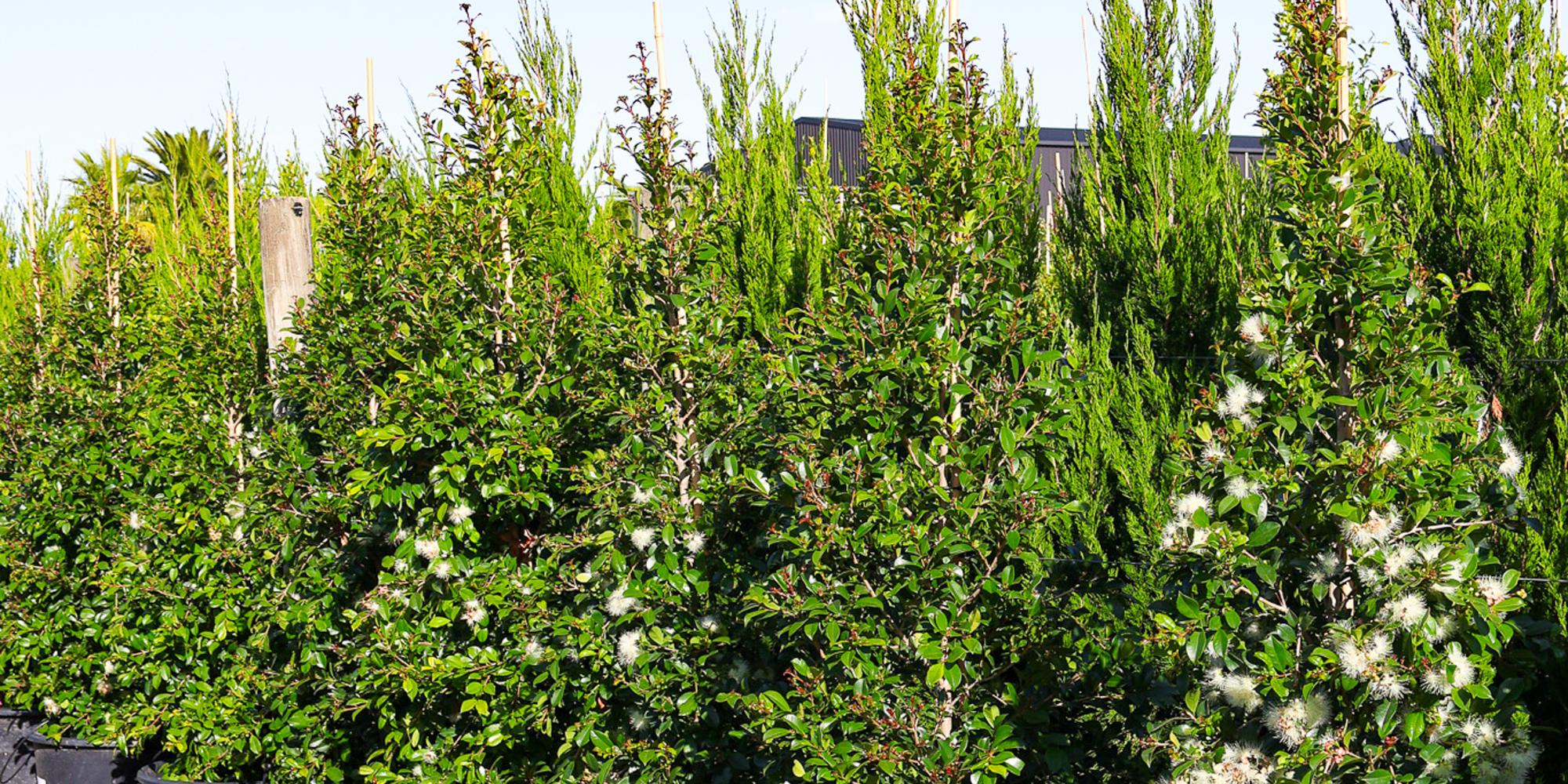
High pest pressure: Syzygium australe Resilience

Selected for strong psyllid resistance. The reliable pick in regions where standard lilly pillies struggle.

Pruning rules

Trim formal hedges two or three times a year. Always taper slightly wider at the base so light reaches the bottom. Sharpen the blades for a clean cut.

FAQ

Which hedge thrives in frost? Bay Tree is the most reliable frost tolerant formal hedge in our range.

What grows fastest? Ficus Hillii and Syzygium Resilience are the quickest to fill.

When do I prune? Late spring after the first growth flush, then again in early autumn.

1. Laurus nobilis Miles Choice (Bay Tree (frost tolerant))

Bay Tree handles frost and dry cold better than most evergreen hedges. The slow steady growth and tight clip make it the go to for cool climate formal hedges.

Type
Evergreen frost tolerant hedge
Height
1 to 3 metres, can be pruned to desired height
Width
0.6 to 1.2 metres
Growth rate
Slow
Foliage
Aromatic dark green leathery
Form
Upright dense formal hedge
Conditions
Full sun, well drained soils, frost tolerant
Maintenance
Trim twice a year
Best for
Cool climate formal hedges, courtyard plantings

Why choose it

Handles frost where lilly pillies struggle. Tight clean line.

Perfect pair

Pair with an Olea Manzanillo for a frost tolerant Mediterranean feature.

Tips for planting

Plant in autumn or spring. Avoid waterlogged ground.

A formal evergreen hedge for cooler climates.

Shop Laurus nobilis Miles Choice

2. Ficus microcarpa var. hillii (Hill's Weeping Fig (temperate))

Ficus Hillii is the standard temperate climate formal hedge. Fast, dense, takes a tight clip and forgives a lot.

Type
Evergreen temperate hedge
Height
2 to 5 metres, can be pruned to desired height
Width
0.8 to 1.5 metres
Growth rate
Fast
Foliage
Dense glossy dark green
Form
Upright clipped
Conditions
Full sun to part shade, frost sensitive when young
Maintenance
Trim twice a year
Best for
Temperate climate formal hedges, urban screens

Why choose it

Fast fill, tight clip, very reliable in temperate zones.

Perfect pair

Pair with a Magnolia Little Gem feature at the entry point.

Tips for planting

Keep clear of paving and pipes. Trim formally to maintain shape.

The temperate hedge default.

Shop Ficus microcarpa var. hillii

3. Murraya paniculata (Orange Jasmine (warm))

Orange Jasmine thrives in warm humid climates. Glossy foliage, fragrant white flowers, clips into a clean hedge line.

Type
Evergreen warm climate hedge
Height
1.5 to 3 metres, can be pruned to desired height
Width
0.6 to 1 metre
Growth rate
Moderate
Foliage
Glossy dark green
Flowers
Fragrant white through warm months
Form
Upright dense formal hedge
Conditions
Full sun to part shade, well drained soils
Maintenance
Trim two or three times a year
Best for
QLD and northern NSW hedges, fragrant courtyard hedges

Why choose it

Tropical performer that gives fragrance and form together.

Perfect pair

Pair with a Magnolia Coolwyn Gloss as an evergreen feature counterpoint.

Tips for planting

Avoid hard winter pruning in cool areas. Mulch and water through hot dry spells.

A warm climate fragrant hedge.

Shop Murraya paniculata

4. Waterhousea floribunda (Weeping Lilly Pilly (adaptable))

Waterhousea adapts across most coastal and temperate zones. Soft weeping form, glossy leaves, dense to the ground.

Type
Evergreen adaptable native hedge
Height
3 to 6 metres, can be pruned to desired height
Width
1 to 2 metres
Growth rate
Fast
Foliage
Glossy green with pink new growth
Form
Weeping informal hedge
Conditions
Full sun to part shade, most soils
Maintenance
Trim once or twice a year
Best for
Informal screens, native gardens, transition climates

Why choose it

Adapts to a wider climate range than most lilly pillies.

Perfect pair

Pair with a Banksia integrifolia as a flowering native feature.

Tips for planting

Water through dry spells in the first two years. Mulch generously.

A flexible native hedge that handles most of Australia.

Shop Waterhousea floribunda

5. Syzygium australe Resilience (Resilience Lilly Pilly (pest resistant))

Resilience was selected for psyllid resistance. Bronze new growth, dense form, the lilly pilly to plant where psyllid pressure is high.

Type
Evergreen pest resistant native hedge
Height
2 to 5 metres, can be pruned to desired height
Width
1 to 1.5 metres
Growth rate
Fast
Foliage
Glossy green with bronze new flush
Form
Upright dense formal hedge
Conditions
Full sun to part shade, most soils
Maintenance
Trim two or three times a year
Best for
Areas with psyllid pressure, formal native hedges

Why choose it

Psyllid resistant, tight clip, fast fill.

Perfect pair

Pair with a Waterhousea floribunda as a softer counterpoint.

Tips for planting

Trim regularly to maintain density. Water through dry spells in year one.

The pest resistant lilly pilly.

Shop Syzygium australe Resilience

Compare at a glance

CultivarHeightWidthFormFoliageBest if you…
Laurus nobilis Miles Choice
Bay Tree (frost tolerant)
1 to 3 metres, can be pruned to desired height0.6 to 1.2 metresUpright dense formal hedgeAromatic dark green leatheryCool climate formal hedges, courtyard plantings
Ficus microcarpa var. hillii
Hill's Weeping Fig (temperate)
2 to 5 metres, can be pruned to desired height0.8 to 1.5 metresUpright clippedDense glossy dark greenTemperate climate formal hedges, urban screens
Murraya paniculata
Orange Jasmine (warm)
1.5 to 3 metres, can be pruned to desired height0.6 to 1 metreUpright dense formal hedgeGlossy dark greenQLD and northern NSW hedges, fragrant courtyard hedges
Waterhousea floribunda
Weeping Lilly Pilly (adaptable)
3 to 6 metres, can be pruned to desired height1 to 2 metresWeeping informal hedgeGlossy green with pink new growthInformal screens, native gardens, transition climates
Syzygium australe Resilience
Resilience Lilly Pilly (pest resistant)
2 to 5 metres, can be pruned to desired height1 to 1.5 metresUpright dense formal hedgeGlossy green with bronze new flushAreas with psyllid pressure, formal native hedges

Frequently asked questions

Which hedge thrives in frost?
Bay Tree is the most reliable frost tolerant formal hedge.