



Skip to content

VOLUME DISCOUNTS APPLY AUTOMATICALLY AT CHECKOUT.

All stock is grown, maintained and graded in strict accordance with AS 4373-2007, Australian Standard for Nursery Stock.

Ornamental Pear Trees: Best Varieties, Growing and Care

Ornamental Pear Trees: Best Varieties, Growing and Care

Ornamental pears are one of the most reliable deciduous feature and avenue trees for Australian gardens. Here is everything you need on the four cultivars we grow, plus planting, care and the truth about propagation.

Autumn ColourAvenue TreesDeciduousFeature TreesOrnamental PearsPyrus

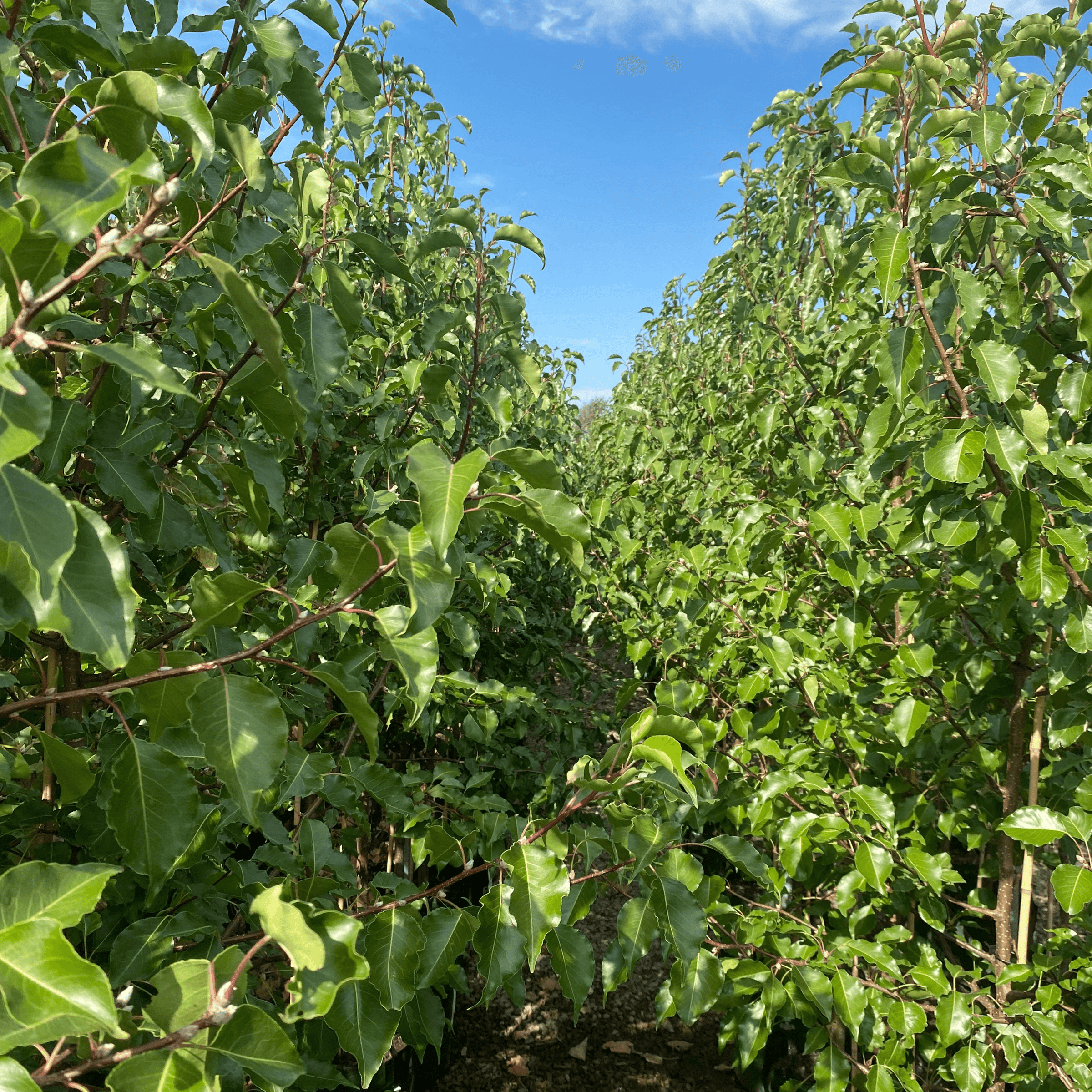
Ornamental pear trees are one of the most reliable feature tree groups available. Spring blossom, summer canopy, brilliant autumn colour, and the kind of consistent four-season interest that anchors a garden.

The four ornamental pear picks below cover the full range — the silver-leafed Mediterranean, the columnar formal upright, the cold-climate four-season, and the spreading street-tree classic.

  • Pyrus nivalis — the Snow Pear. Silver-grey foliage, pure white spring blossom, slightly weeping form.
  • Pyrus calleryana 'Capital' — the columnar Capital Pear. Tight upright form for narrow positions.
  • Pyrus ussuriensis — the Manchurian Pear. Cold-climate four-season feature.
  • Pyrus calleryana 'Chanticleer' — the Chanticleer ornamental pear. Pyramidal form, autumn red-purple, classic suburban street tree.

Compare at a glance

CultivarHeightWidthFormFoliageBest if you…
Pyrus calleryana 'Bradford'
Bradford Ornamental Pear
8 to 12 m6 to 8 mRounded to broadly ovalGlossy green, turning red, plum and orange in autumnShade trees, avenue planting, larger front yards
Pyrus calleryana 'Aristocrat'
Aristocrat Pear
8 to 10 m5 to 6 mPyramidal, neatGlossy green with wavy margins, deep red autumn colourStreet tree planting, avenues, formal driveways
Pyrus betulaefolia 'Southworth Dancer'
Southworth Dancer Pear
5 to 7 m4 to 5 mWeeping, pendulous, sculpturalSilvery-green willow-like leaves, soft yellow autumn tonesFeature planting, courtyard centrepiece, lawn specimen
Pyrus nivalis
Snow Pear
6 to 8 m4 to 6 mRounded, dense, neatSilvery grey-green throughout the warm months, soft yellow tones in autumnCool-toned planting schemes, feature trees in lawn or front garden
Pick by form
Spreading: Snow Pear, Chanticleer. Columnar narrow: Capital. Pyramidal upright: Manchurian, Chanticleer.
Foliage tone
Silver: Snow Pear. Green: Capital, Manchurian, Chanticleer.
Climate fit
All four prefer cool to warm-temperate. Manchurian and Snow Pear are the most cold-tolerant.
Block size
Snow Pear and Chanticleer at 8 to 10m. Manchurian at 8 to 12m. Capital at 8 to 10m by 2 to 3m — the narrow column for tight positions.

1. Pyrus calleryana 'Bradford' (Bradford Ornamental Pear)

Bradford is the classic broad-headed ornamental pear, with a rounded form and reliable show of white spring blossom. A great avenue or shade tree where there is space to spread.

Type
Deciduous feature and avenue tree
Height
8 to 12 m
Width
6 to 8 m
Growth rate
Moderate to fast
Foliage
Glossy green, turning red, plum and orange in autumn
Flowers
Masses of white blossom in early spring
Form
Rounded to broadly oval
Conditions
Full sun, well-drained soil, frost hardy
Maintenance
Water deeply through the first two summers, formative pruning in winter, low feed requirements
Best for
Shade trees, avenue planting, larger front yards

Why choose it

The widest crowned of the ornamental pears we carry, ideal where shade is the goal

Perfect pair

Pair with a Waterhousia floribunda hedge behind for evergreen backdrop to the spring blossom

Tips for planting

Stake in exposed sites for the first two years, mulch generously

A classic for a reason.

Shop Pyrus calleryana 'Bradford'

2. Pyrus calleryana 'Aristocrat' (Aristocrat Pear)

Aristocrat has a more pyramidal habit than Bradford, with strong central leader and wavy-edged glossy leaves. A reliable street and avenue tree across Australian conditions.

Type
Deciduous feature and avenue tree
Height
8 to 10 m
Width
5 to 6 m
Growth rate
Moderate to fast
Foliage
Glossy green with wavy margins, deep red autumn colour
Flowers
White spring blossom
Form
Pyramidal, neat
Conditions
Full sun, well-drained soil, very hardy
Maintenance
Water through establishment, light winter prune to maintain shape
Best for
Street tree planting, avenues, formal driveways

Why choose it

More predictable structure than Bradford, easier to fit narrower spaces

Perfect pair

Pair with a clipped Bay 'Miles Choice' hedge for layered formal look

Tips for planting

Stake for the first year, mulch out to the drip line

Reliable structure with seasonal show.

Shop Pyrus calleryana 'Aristocrat'

3. Pyrus betulaefolia 'Southworth Dancer' (Southworth Dancer Pear)

Southworth Dancer is the elegant weeping ornamental pear, with arching pendulous branches and silvery green foliage. A garden-stopping feature tree.

Type
Deciduous feature tree
Height
5 to 7 m
Width
4 to 5 m
Growth rate
Moderate
Foliage
Silvery-green willow-like leaves, soft yellow autumn tones
Flowers
Delicate white spring blossom
Form
Weeping, pendulous, sculptural
Conditions
Full sun, well-drained soil, very hardy and frost tolerant
Maintenance
Light pruning in winter to lift the skirt if needed, water through establishment
Best for
Feature planting, courtyard centrepiece, lawn specimen

Why choose it

The most distinctive form among the ornamental pears, perfect when you want a statement

Perfect pair

Pair with a Waterhousia hedge backdrop to show off the silver foliage

Tips for planting

Stake firmly when young to set the trunk, do not over-prune the weeping growth

The sculptural pear.

Shop Pyrus betulaefolia 'Southworth Dancer'

4. Pyrus nivalis (Snow Pear)

Snow Pear is the silver-leafed feature of the ornamental pear family. Soft grey-green foliage, dense rounded crown and pure white spring blossom that gives the tree its name.

Type
Deciduous feature tree
Height
6 to 8 m
Width
4 to 6 m
Growth rate
Moderate
Foliage
Silvery grey-green throughout the warm months, soft yellow tones in autumn
Flowers
Snow-white spring blossom in profusion
Form
Rounded, dense, neat
Conditions
Full sun, well-drained soil, very hardy, frost tolerant
Maintenance
Minimal pruning, water through establishment, low fertiliser needs
Best for
Cool-toned planting schemes, feature trees in lawn or front garden

Why choose it

Brings a silvery contrast no other ornamental pear delivers

Perfect pair

Pair with a dark green Ficus Hillii Flash hedge for striking contrast

Tips for planting

Avoid wet feet, mulch well in the first two summers

The silver-leafed showpiece.

Shop Pyrus nivalis

How to plant and care for them

Pick the position
Full sun for the strongest flowering and autumn colour. Allow mature canopy clear of buildings.
Prepare the planting hole
Twice the width of the rootball, same depth. Mix the original soil with aged compost.
Plant level
Set the rootball level with surrounding soil, never deeper.
Stake firmly
Stake for the first two years to establish a strong vertical leader.
Mulch out to the drip line
Lay 75 to 100mm of organic mulch from 50mm clear of the trunk.
Water deeply through the first two summers
Twice a week in warm weather, once a week in mild weather.
Light winter prune
Light shaping prune in late winter. Avoid hard pruning — the natural form is the feature.

The wrap up

The four ornamental pear picks cover every common form and climate brief. Pick the variety that matches your space and climate, plant well, and the four-season show carries the garden for decades.

Comments

  • Marty Barritt April 1, 2025

    I have a 30ish year old callery pear tree in the front yard. It grew, then dropped thousands to balls on a stem like a cherry cluster but the size of a garbanzo bean. Whey did this happen this year. Also, is it to late to lightly fertilize? It’s at the leafing stage.

  • Kim Lewis November 21, 2024

    I have a 12 year old hedge of ornamental trees that we had pruned a couple of years ago. Since then the foliage has thinned lower down on the trunk so much that they now longer act as an effective screen. Growth is concentrated at the top. I am unsure what to do.

  • Robert D. August 21, 2024

    I have these young seedless pear trees in our panhandle of Texas yard. I have staked around the trees to help support until stronger. How long before these trees can be independent and not so much need help in their support for growth

  • Kellie January 2, 2024

    We have y Chanticleer trees which we planted in 2019. One looks very sick, very pale green leaves, lack of leaves especially in the central region of the tree. I am unsure what is wrong?

  • Everett March 30, 2023

    Great blog! So much useful information here. I need to check with my tree removal company what are my next steps and how they can help me. I realized I have a problem by reading this. Thanks!

1 2 Next »

Leave a comment. Comments will be reviewed before being published.