



Skip to content

VOLUME DISCOUNTS APPLY AUTOMATICALLY AT CHECKOUT.

All stock is grown, maintained and graded in strict accordance with AS 4373-2007, Australian Standard for Nursery Stock.

Best Frost-Tolerant Hedging Trees: 6 Cold-Hardy Picks

Best Frost-Tolerant Hedging Trees: 6 Cold-Hardy Picks

Cold winters and frost pockets don't mean you have to skip hedging. Five tough evergreen hedgers that hold dense foliage through the coldest mornings, from Bay and Photinia to Elaeagnus and Resilience Lilly Pilly.

Cool ClimateEvergreenFrost TolerantHedgingPrivacy Trees

Cool-climate gardens need hedges that handle the cold without losing density or colour. Frost burns sensitive species back through winter and slows establishment in the cool spring. The picks below were chosen because they handle frost reliably and carry the hedge cleanly through every season.

The six frost-tolerant hedges below are the ones we recommend most often for cool to cold-climate gardens. Each one shrugs off light to moderate frost once established and holds dense foliage from the base through every winter.

  • Photinia robusta — the classic red-tip hedge. Glossy mid-green with vivid red-bronze new growth, frost-tough and the most colour you can ask of a green hedge.
  • Elaeagnus ebbingei — the silver-backed coastal hedge. Leathery silver-green foliage, perfumed autumn flowers, and a tough constitution that handles cold and coast without complaint.
  • Buxus sempervirens — the classic English Box. Dense small dark green leaves on a tight formal frame, frost-tough across the cool-temperate range.
  • Syzygium 'Resilience' — the psyllid-resistant Lilly Pilly. Glossy green with copper-bronze new growth, tolerates light frost once established.
  • Laurus 'Miles Choice' — the formal Mediterranean Bay. Aromatic foliage, holds shape through cool winters in sheltered positions.
  • Magnolia 'Teddy Bear' — the dense pyramidal Magnolia hedge. Frost-tolerant, holds glossy foliage through winter.

Compare at a glance

CultivarHeightWidthFormFoliageBest if you…
Laurus nobilis 'Miles Choice'
Miles Choice Bay Tree
4-6m. Can be pruned to desired height1.5-2mUpright columnarDeep glossy green aromatic leavesFormal hedging, cool climate gardens, frost pockets
Syzygium australe 'Resilience'
Resilience Lilly Pilly
3-5m. Can be pruned to desired height1.5-2mUpright dense columnDense glossy green with bright red new flushesPrivacy screens, frontages, suburban hedges
Photinia x fraseri 'Robusta'
Robusta Photinia
3-4m. Can be pruned to desired height1.5-2mUpright bushyGlossy dark green with bright red new flushesCold-climate hedging, colourful screens, fencelines
Elaeagnus x ebbingei
Silverberry
3-4m. Can be pruned to desired height2-3mBushy uprightMid-green leaves with silver underside, year roundCoastal-frost combinations, windbreaks, low-maintenance screens
Waterhousea floribunda
Weeping Lilly Pilly
6-10m. Can be pruned to desired height3-5mTall upright with weeping branchesSoft weeping green leaves with pink-tinted new growthTall privacy screens, large gardens, soft natural fencelines
Decide the look
Classic colour: Photinia. Silver-backed: Elaeagnus. Tight formal low: Buxus sempervirens. Dense glossy native: Resilience. Mediterranean formal: Bay 'Miles Choice'. Dense formal flowering: Teddy Bear.
Height matters
Photinia and Resilience hold 3 to 5m. Teddy Bear at 3 to 5m. Bay 'Miles Choice' at 3 to 6m. Elaeagnus at 2 to 4m. English Box at 50cm to 1.5m parterre to boundary.
Speed of establishment
Photinia, Elaeagnus and Resilience establish fast. Bay 'Miles Choice' and Teddy Bear are slower and steadier. English Box is slow but holds shape better than any other.
Frost reality check
All six handle light to moderate frost once established. Heavy frost pockets prefer Photinia, Elaeagnus and Buxus sempervirens. Bay and Teddy Bear like sheltered positions through the first two winters.
Spacing
Plant at 1m spacing for most hedges. Buxus sempervirens at 30 to 40cm for a tight low parterre.

1. Laurus nobilis 'Miles Choice' (Miles Choice Bay Tree)

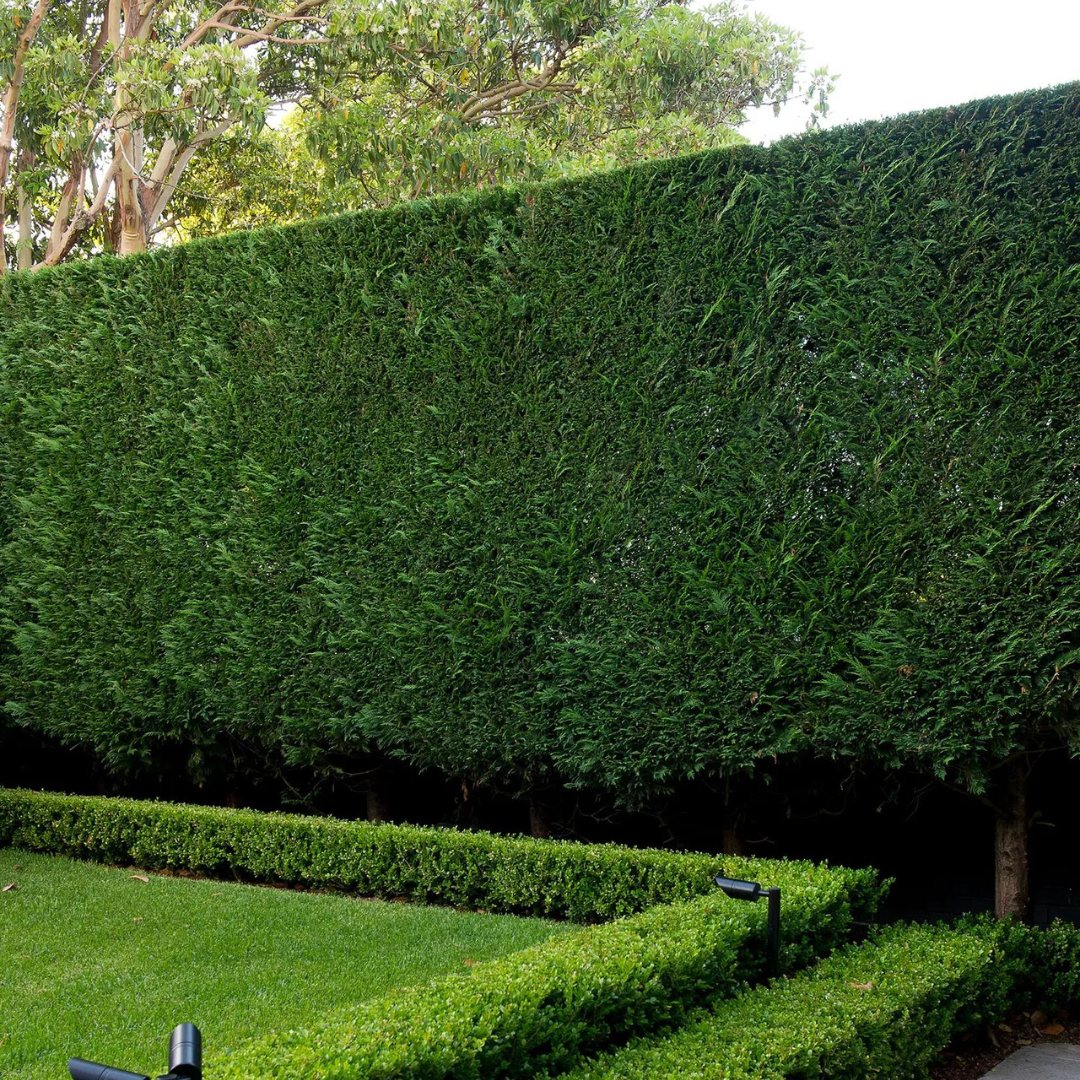
Tough, dense, and very frost hardy. Miles Choice is the bay tree variant bred for upright Australian hedging, and it sails through cold mornings that other plants find tricky.

Type
Evergreen hedging tree
Height
4-6m. Can be pruned to desired height
Width
1.5-2m
Growth rate
Moderate
Foliage
Deep glossy green aromatic leaves
Form
Upright columnar
Conditions
Full sun to part shade, well-drained soil, very frost tolerant
Maintenance
Low. Trim once or twice a year
Best for
Formal hedging, cool climate gardens, frost pockets

Why choose it

One of the most frost-tolerant evergreen hedgers available. Holds dense foliage all winter.

Perfect pair

Plant in a row in front of a deciduous feature tree like a Saucer Magnolia for an evergreen base with seasonal flowering above.

Tips for planting

Mulch around the base in late autumn to protect young roots from severe frost.

Reliable structure even in the coldest pockets of the garden.

Shop Laurus nobilis 'Miles Choice'

2. Syzygium australe 'Resilience' (Resilience Lilly Pilly)

Resilience handles light to moderate frosts without skipping a beat. Dense glossy foliage and bright red new growth make it a workhorse hedger for most of Australia.

Type
Evergreen hedging tree
Height
3-5m. Can be pruned to desired height
Width
1.5-2m
Growth rate
Fast
Foliage
Dense glossy green with bright red new flushes
Flowers
Small white fluffy flowers in spring
Form
Upright dense column
Conditions
Full sun to part shade, well-drained soil, tolerates light frost
Maintenance
Low. Light trim two to three times a year
Best for
Privacy screens, frontages, suburban hedges

Why choose it

Psyllid-resistant and frost-hardy. The modern Lilly Pilly choice for problem-free hedging.

Perfect pair

Pair with a flowering Crepe Myrtle behind for summer colour above the green wall.

Tips for planting

Space plants 1m apart for a tight hedge that closes up quickly.

Dense privacy with no fuss, even where frost bites.

Shop Syzygium australe 'Resilience'

3. Photinia x fraseri 'Robusta' (Robusta Photinia)

Brilliant red new growth set against deep green mature leaves. Robusta is one of the toughest cold-climate hedgers, completely unfazed by frost and cold winters.

Type
Evergreen hedging shrub
Height
3-4m. Can be pruned to desired height
Width
1.5-2m
Growth rate
Fast
Foliage
Glossy dark green with bright red new flushes
Form
Upright bushy
Conditions
Full sun to part shade, most soils, very frost tolerant
Maintenance
Low. Trim twice yearly to encourage red new growth
Best for
Cold-climate hedging, colourful screens, fencelines

Why choose it

Few hedgers handle frost better while still delivering year round colour.

Perfect pair

Plant in front of a Snow Pear or Magnolia to layer red flushes with white spring blossom.

Tips for planting

Trim after each flush of red growth to keep the colour show going.

Year round colour and rock-solid frost resistance.

Shop Photinia x fraseri 'Robusta'

4. Elaeagnus x ebbingei (Silverberry)

Soft silver underside leaves and a tough constitution. Elaeagnus laughs at frost and wind, making it ideal for exposed cool-climate gardens.

Type
Evergreen hedging shrub
Height
3-4m. Can be pruned to desired height
Width
2-3m
Growth rate
Fast
Foliage
Mid-green leaves with silver underside, year round
Flowers
Tiny fragrant cream flowers in autumn
Form
Bushy upright
Conditions
Full sun to part shade, tolerates poor soil, very frost tolerant
Maintenance
Low. Trim once or twice yearly
Best for
Coastal-frost combinations, windbreaks, low-maintenance screens

Why choose it

Few hedgers tolerate both salt wind and hard frost. Elaeagnus does both.

Perfect pair

Pair with a Crepe Myrtle behind for soft silver and summer flower contrast.

Tips for planting

Light feed in spring to keep silver underside leaves bright.

A bulletproof hedger for windy, frosty country.

Shop Elaeagnus x ebbingei

5. Waterhousea floribunda (Weeping Lilly Pilly)

Soft weeping foliage and pink new growth. Waterhousea is a fast, lush hedger that holds light frosts in most cool-temperate Australian gardens.

Type
Evergreen hedging tree
Height
6-10m. Can be pruned to desired height
Width
3-5m
Growth rate
Fast
Foliage
Soft weeping green leaves with pink-tinted new growth
Flowers
Small white fluffy flower clusters in spring
Form
Tall upright with weeping branches
Conditions
Full sun to part shade, moist well-drained soil, tolerates light frost
Maintenance
Low. Trim after flowering to maintain dense form
Best for
Tall privacy screens, large gardens, soft natural fencelines

Why choose it

A relaxed, soft hedger that still gives full screening height for two-storey neighbours.

Perfect pair

Pair with a Snow Pear feature tree to soften the screen line.

Tips for planting

Avoid hard frost pockets when planting young trees.

Soft, fast, and tall enough to handle two-storey overlook.

Shop Waterhousea floribunda

How to plant and care for them

Pick the position
All six prefer full sun for the densest hedge. Most tolerate part shade. Sheltered positions help young Bay and Teddy Bear through the first two winters.
Prepare the planting trench
Dig a trench along the hedge line twice the width of the rootball and the same depth. Mix the original soil with aged compost.
Plant at 1m spacing
1m spacing for most hedges. 30 to 40cm for English Box low parterre hedges.
Water in deeply at planting
Soak each rootball thoroughly. Top up the watering well twice in the first day if the soil drinks fast.
Mulch out to the row
Lay 75 to 100mm of organic mulch the full length of the hedge, 50mm clear of each trunk.
Water deeply through the first two summers
Twice a week deep watering in warm weather, once a week in mild weather, through the first two summers.
Light prune through winter
Light formative pruning through the first two winters. Two to three trims a year once established.

The wrap up

The six frost-tolerant picks cover every cool-climate hedging brief. Photinia leads the colour hedge. Elaeagnus carries silver tones. English Box is the classic formal low hedge. Resilience delivers the native dense pick. Bay 'Miles Choice' and Teddy Bear round out the formal picks.