



Skip to content

OUR END OF FINANCIAL YEAR SALE IS LIVE!

20% OFF ORDERS OVER $1,500 - DISCOUNT APPLIES AUTOMATICALLY AT CHECKOUT

Best Trees to Plant in a Pot: Our 12 Top Recommendations

Best Trees to Plant in a Pot: Our 12 Top Recommendations

A practical guide to the twelve best trees to grow in pots, plus the design moves and care rules that make a pot tree last for decades. Formal, Mediterranean, tropical, sculptural and productive picks.


AcerBayContainer GardeningMagnoliaPot TreesTerraces

A planted pot turns a paved corner into a focal point in a single afternoon. The balcony reads as a garden, the courtyard gains a centrepiece, the front door takes on character. Trees in pots do work that no other planting can. They bring height and form to spaces where in-ground planting isn't possible, and they hold their shape for decades when the basics are right.

This guide is for anyone choosing a tree to plant in a pot. From the formal Buxus topiary that suits an entry pair, to the gnarled Olive with century-old character, to the architectural Dragon Tree for a sheltered courtyard, the twelve picks below cover every style and every space.

Pot size: bigger than you think

The single most important decision in pot planting is the pot itself. Going one size larger than feels necessary is almost always the right call. Roots fill the available volume within a season or two, and a tree in a generous pot grows steadily for decades while a tree in a marginal pot stalls and declines.

The working minimums by tree type: 30 to 50 L for compact features like Buxus and Miss Muffet, 50 to 80 L for medium evergreens like Bay Standards and Calamondin, 80 to 120 L for tall features like Magnolia Teddy Bear and Acer palmatum, and 200 L or larger for statement trees like ex-ground Olive. Multiple drainage holes are non-negotiable, and the pot must sit on feet so water flows away freely.

The mix matters as much as the pot

Premium red-ticked Australian Standards potting mix is the base. Garden soil compacts in a pot, drains badly through wet seasons, and often carries pests or disease. Cheap potting mix breaks down within months and the tree is back in poor conditions before the second summer.

For pot trees, improve the premium mix at planting. Add ten to twenty percent perlite or coarse propagating sand for sharper drainage, mix through ten to fifteen percent aged compost for slow-release feeding, and lightly incorporate a season of slow-release fertiliser. The result is a working medium that supports tree roots for several years before any repotting work is needed.

Watering and feeding for pot trees

Pot trees dry faster than ground-planted trees, but more pot trees die from over-watering than under-watering. The discipline is to water deeply and then leave the tree alone until the top 25 mm of mix has dried. In summer, check the surface daily. In winter, check weekly and reduce watering sharply for Mediterranean species, dormant deciduous trees and drought-tolerant species.

For feeding, match the food to the species. Citrus needs citrus food three times a year, Australian natives need low-phosphorus native feed only, Mediterranean species prefer a moderate slow-release feed in spring. Top up with liquid seaweed every six weeks through the warm growing months. Stop all feeding by late autumn so the tree hardens off for winter.

Match the tree to the style

The right pot tree completes the style of the space it sits in. For formal entries, choose Buxus topiary balls and Bay Standards. For Mediterranean courtyards, ex-ground Olive and Lavender at the base. For tropical and resort-style entries, Phoenix roebelenii and Dracaena marginata. For Japanese-inspired courtyards, Acer palmatum and Pinus thunbergii. For productive kitchen garden pots, Calamondin and Finger Lime.

The mistake is choosing a tree because it's available, then trying to make the space work around it. The right approach is to define the style first (formal, Mediterranean, tropical, sculptural, productive), then pick from the species that suit. The twelve picks below cover every common style.

Before you start: what you'll need

A generous pot
The pot is the foundation. Bigger is always better.

The single most common pot tree mistake is going too small. A pot that feels generous is actually a working minimum. The roots fill the available volume within one to two seasons, and once root-bound the tree is in permanent slow decline no amount of feed or water can reverse.

Minimum sizes by tree type:
• Compact features (Buxus, Miss Muffet, Lavandula): 30 to 50 L
• Medium evergreens (Bay, Phoenix roebelenii, Calamondin, Camellia): 50 to 80 L
• Tall features (Magnolia Teddy Bear, Acer palmatum, Dracaena marginata, Pinus thunbergii): 80 to 120 L
• Statement trees (Ex-ground Olive, mature Phoenix canariensis): 200 L or larger

Pots need multiple drainage holes and must sit on feet or risers so water flows freely away from the base.
Premium red-ticked potting mix
Garden soil is not pot mix and never should be substituted.

Garden soil compacts in a pot, drains badly through wet seasons, dries to brick in summer, and often carries pests and disease. The result is roots that never establish properly and a tree that struggles from year one.

The correct base is a premium red-ticked Australian Standards potting mix. Then improve it for tree culture: add ten to twenty percent perlite or coarse propagating sand for extra drainage, mix through ten to fifteen percent aged compost for slow-release feeding, and lightly incorporate slow-release fertiliser at planting. Cheap potting mix breaks down within months and the tree is back in poor conditions before the second summer.
Drainage essentials at the pot base
Drainage is what separates a thriving pot tree from a drowning one.

Every pot tree needs to sit on feet or risers that elevate the pot off the surface. Water must flow freely from the drainage holes and pool nowhere. A saucer can be useful for upper-floor balconies, but only if it is emptied within hours, never days.

For ceramic and concrete pots with a single drainage hole, drill additional holes with a masonry bit before planting. For very tall pots, a layer of coarse aggregate at the very base helps maintain free drainage above the holes.
The right feed for the species you choose
One size does not fit all in pot tree feeding.

Match the feed to the tree. Citrus (Calamondin, Finger Lime, lemons) need a dedicated citrus food applied three times a year. Australian natives need a low-phosphorus native feed only, never a general fertiliser. Mediterranean species (Olive, Lavender, Bay) prefer a slow-release general fertiliser at a moderate rate.

For all species, a top-up of liquid seaweed every six weeks through the warm growing months keeps everything moving. Stop all feeding in late autumn so the tree can harden off for winter.

How to keep your tree happy

Watering rhythm: deep and infrequent
Pots dry out faster than ground, but more pot trees die from over-watering than under-watering.

The discipline is to water deeply and then leave the tree alone until the top inch of mix has dried. In summer, check the surface daily by pushing a finger 25 mm into the mix. If it comes out dry, water until water flows from the drainage holes. If it comes out damp, leave the pot alone.

In winter, reduce watering sharply for Mediterranean species (Olive, Lavender, Bay), drought-tolerant species (Agave, Pinus) and dormant deciduous species (Acer). These plants resent wet feet in cold months and root rot is the most common cause of pot tree death.
Feeding by species
The right food at the right time is the difference between thriving and surviving.

Apply slow-release tree and shrub fertiliser in early spring as growth restarts for evergreens. Top up with liquid seaweed every six weeks through summer for everything in the pot row. Use dedicated citrus food three times a year for any citrus in pots (early spring, midsummer, early autumn) and follow that schedule precisely.

For Australian natives in pots, use only low-phosphorus native plant food. For Mediterranean species, less is more: an over-fed Olive becomes leggy and weak.
Mulch the surface, refresh annually
A mulched pot tree is a healthier pot tree.

Apply 30 to 50 mm of decorative mulch over the surface of every potted tree. Mulch slows evaporation in summer, insulates roots from temperature swings, suppresses weeds and reads better visually than bare mix.

Use pebble for Mediterranean species and modern courtyard styling, fine bark for naturalistic plantings, and pine bark chips for citrus and natives. Refresh the mulch annually before summer and keep it a finger's width clear of the trunk to prevent collar rot.
Repot every two to four years
Pot trees become root-bound over time. This must be addressed or the tree declines.

Signs you need to repot: water drains straight through the pot in seconds rather than soaking into the mix, roots are visible circling at the base or pushing through the drainage holes, growth is obviously slower than the previous season, the tree dries out within hours of watering.

Repot in late winter or early spring while dormant. Slide the rootball out, trim three to five centimetres from the outer roots and the bottom with a sharp pruning saw, and repot into fresh premium mix. Same pot if the tree has reached its target size, or upsize one step. Keep sheltered for four to six weeks while roots regenerate.
Reading the leaves
Your pot tree is telling you what's wrong before it shows in the form.

Yellowing leaves all over usually mean the tree is hungry. Apply the correct species-specific feed and the colour returns within weeks. Yellowing leaves with green veins on a citrus is a trace-element deficiency, almost always from the wrong fertiliser. Switch to citrus food and apply a foliar seaweed spray.

Crispy brown leaf edges mean watering is inconsistent or the tree is wind-burned. Mulch more and consider shelter. Pale leaves and slowing growth almost always mean the tree is root-bound and ready for a repot. Sudden wilting in wet mix is root rot. Check drainage urgently.

Perfect pairs for the front garden

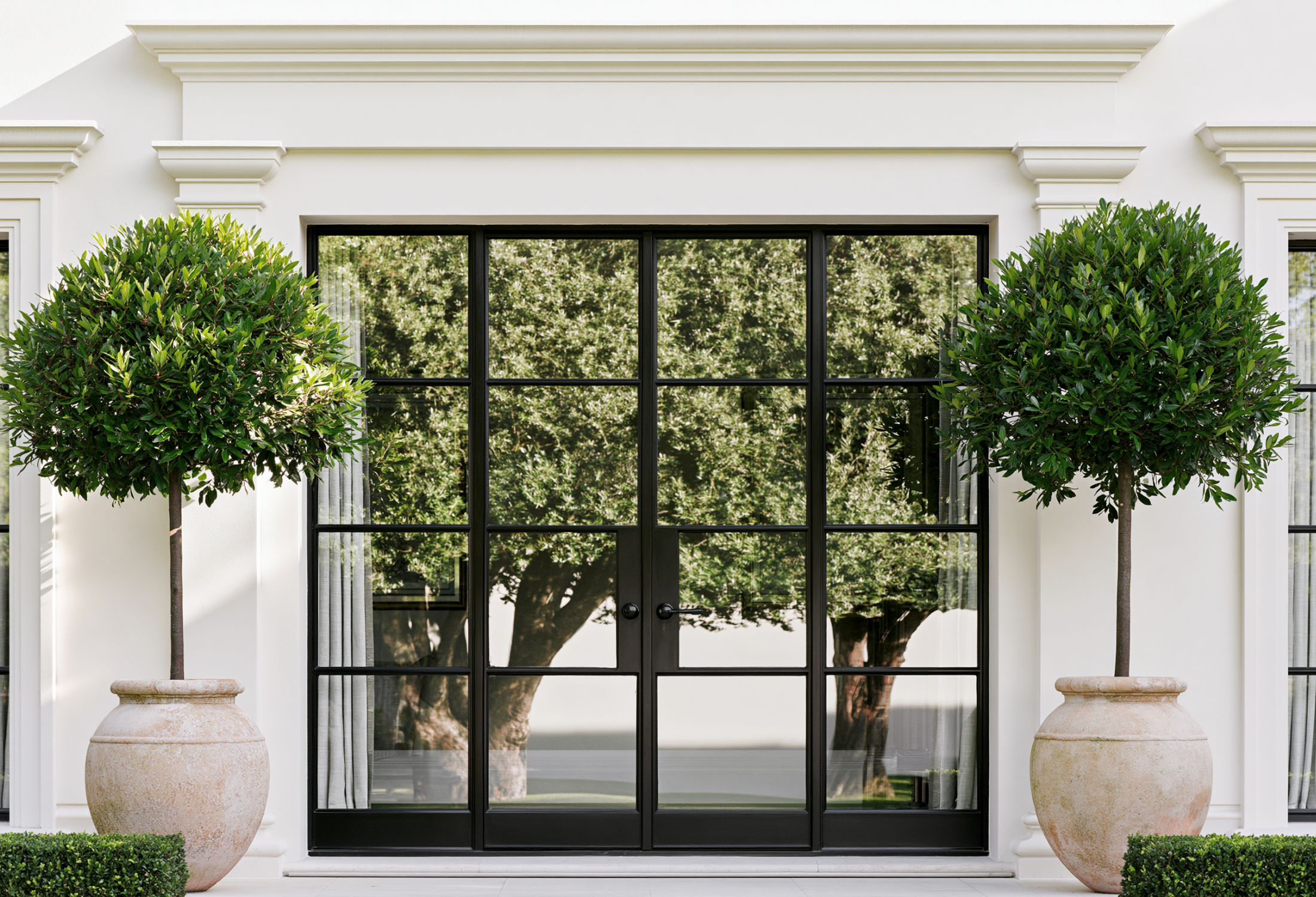
Buxus topiary + Bay Standard in matching pots
The classical formal entry pair.

Two Bay Leaf Standards in matching pots flanking the front door, with low Buxus topiary balls in matching companion pots at ground level. Together they create the tiered formal entrance that reads as European luxury.

Why it works: the Bay carries the vertical and the silhouette, the Buxus carries the symmetry and the lower band of green. Both species are slow-growing and forgive missed pruning windows, so the pair stays composed for years.
Olive ex-ground + Lavender at base
The Mediterranean composition.

A single Olea europaea ex-ground tree as the gnarled centrepiece, underplanted with a sweep of Lavandula in the same pot or a matching companion. Add a layer of pebble mulch to finish.

Why it works: the silver foliage of the Olive and the silver flowering of the Lavender share a tonal palette. Together they evoke Provence in a single planted pot. Both are drought tolerant and prefer the same lean, free-draining conditions.
Acer palmatum + Pittosporum Miss Muffet at base
The refined shaded courtyard.

An Acer palmatum as the deciduous sculptural feature with seasonal autumn colour, set in a large pot. At the base in a companion pot, a Pittosporum Miss Muffet delivers the year-round green that holds the composition through winter when the Acer is bare.

Why it works: layered foliage at two heights, with one carrying the year-round structure and the other carrying the autumn drama. Suits any partly shaded courtyard or sheltered patio.
Phoenix roebelenii + Agave attenuata
The sculptural tropical pair.

A Phoenix roebelenii (Pygmy Date Palm) in one pot, an Agave attenuata in a matching companion. The Phoenix carries the height with arching fronds, the Agave carries the bold rosette at ground level.

Why it works: two completely different leaf shapes (fine arching fronds against bold fleshy rosette) reading from the same palette of soft greens. The pair anchors any modern courtyard and tolerates the dry sunny conditions that defeat softer plantings.
Calamondin + Finger Lime
The productive citrus pair.

A Calamondin Cumquat in one pot and a Finger Lime (Citrus australasica) in the matching pot beside it. Both are productive year-round in warm climates and the pair is a kitchen garden in fifteen square feet of paving.

Why it works: the Calamondin delivers year-round fruit for cocktails, marmalade and Asian cooking. The Finger Lime adds the high-end pearl-textured native fruit. Both species need the same care: citrus food three times a year, deep watering, and bright sun.
Magnolia Teddy Bear + Buxus topiary at base
The polished urban feature.

A single Magnolia Teddy Bear as the bold-leaf central feature in a generous pot. At the base, a pair of low Buxus topiary balls in matching companion pots flanking the magnolia.

Why it works: the magnolia brings the tropical scale and seasonal white flowers. The Buxus delivers the formal symmetry that anchors the composition. The pair reads as commissioned design from day one.
Dracaena marginata + Phoenix roebelenii
The architectural courtyard duo.

A multi-trunked Dracaena marginata as the sculptural focal point in a large pot. Beside it, a Phoenix roebelenii as the textural companion in a matching pot.

Why it works: both species deliver strong architectural form, but the Dracaena's twisted trunks and strappy leaves contrast with the Phoenix's arching pinnate fronds. The result is two unmistakable plants together that double the impact of either alone. Suits sheltered courtyards or covered patios.
Pinus thunbergii + Pittosporum Miss Muffet
The Japanese-inspired pot pair.

A Pinus thunbergii (Japanese Black Pine) trained into bonsai-tradition layered form as the sculptural pot tree. At its base, Pittosporum Miss Muffet as the calm rounded green companion.

Why it works: the dramatic pine silhouette draws the eye, the Miss Muffet calms the planting at ground level. Both species are slow-growing and demand minimal maintenance once established, suiting properties where the planting is meant to age in place for decades.

Caring for your tree through the seasons

Spring: feed, plant and refresh
The major maintenance season for pot trees.

Apply slow-release tree and shrub fertiliser in early spring as growth restarts. Repot or root-prune any trees showing signs of being root-bound (drying out faster than usual, slowed growth, roots through drainage holes). Refresh the top 25 mm of decorative mulch around each pot.

Plant any new pot trees once frost has passed. Start the regular liquid seaweed schedule (every six weeks) for the warmer months. Inspect for early pest pressure: scale on citrus, scale on Magnolia, leaf miner on citrus.
Summer: water deeply and watch the heat
The most demanding season for pot trees and the season most missed waterings happen.

Check pots daily by feel. Water deeply when watering. Half-measures are worse than skipping the day. Move sensitive species to morning sun only if afternoon temperatures exceed 35 degrees.

Dark coloured pots can bake roots above 50 degrees in midday sun. Either use lighter coloured pots, position dark pots in afternoon shade, or shade the pot itself with a second outer pot. Apply liquid seaweed every six weeks. Net citrus against fruit fly in late summer.
Autumn: harvest and prepare for winter
The reward season for productive pot trees and the preparation season for everything else.

Harvest the Calamondin crop as fruit colours up. Apply a final light liquid feed in early autumn. Top-dress with fresh mulch before winter rain.

For deciduous pot trees (Acer palmatum), enjoy the autumn colour without late feeding (which delays dormancy). Begin to reduce watering for Mediterranean species (Olive, Lavender, Bay) as the cool weather returns and they enter their natural slowdown.
Winter: protect tender species and rest the rest
The most vulnerable season for pot trees, where small actions prevent major losses.

Move frost-tender species (Calamondin, Finger Lime, Phoenix roebelenii) to a sheltered position under eaves or against a north-facing wall. In extreme frost, wrap pots in hessian or bubble wrap. The roots in pots freeze and dry out faster than in the ground.

Reduce watering sharply for Mediterranean species and dormant deciduous trees. Avoid all fertilising until early spring. Plan any repotting work and order new pot trees for early-spring planting.

Pruning: when, how, and why it matters

Why pruning matters more in pots
A pot tree's shape is the design. Keep it.

The roots in a pot are constrained, which means the canopy must be too. A pot tree that's been allowed to outgrow its proportions becomes top-heavy, shades itself, dries out faster and gradually declines. Pruning in pots is not optional and not purely aesthetic.

The principle is many light passes a year rather than one heavy reshape. Always prune to the natural form for that species. A clipped Buxus stays a ball, a layered Acer stays layered, an open-vase Olive stays open.
When to prune evergreens
Most evergreens can be lightly shaped year-round.

Buxus, Bay, Magnolia Teddy Bear and Olive accept light trimming after the spring flush, again in early autumn. Pencil Pine and other conifers should only have a light shape in spring. Never cut into old wood that will not reshoot.

Citrus (Calamondin, Finger Lime) prefer a tidy after each harvest, plus the removal of any vertical water-shoots on sight. Avoid heavy reshaping of citrus, which sets fruiting back by a year or more.
When to prune deciduous pot trees
Late winter, while the tree is dormant.

Acer palmatum and other deciduous trees should be pruned in late winter when the structure is visible and the tree won't bleed sap into the pot. For Acer, work to enhance the natural layered shape. Remove crossing branches, dead twigs, and anything growing toward the centre of the canopy.

Never reduce an Acer with hedge shears or hard cuts. The species responds badly to crude pruning. Use sharp bypass secateurs and remove no more than one third of the volume in any year.
How to cut: sharp, clean, considered
Every cut is a wound the tree must heal.

Use sharp bypass secateurs for small wood, a sharp pruning saw for thicker branches. Wipe blades with methylated spirits between trees to prevent disease transfer. Cut just above an outward-facing bud, angled at about 45 degrees sloping away from the bud.

For branches over thumb-thick, use the three-cut method on saw work: an undercut, a top cut to remove the bulk of the weight, then the final clean cut close to the branch collar. Never leave long stubs, which die back and become disease entry points.
Why pruning keeps a pot tree happy
Pruning balances the canopy to the limited root volume.

A constrained root system can only support so much foliage. When the canopy outgrows the roots, the tree starts to drop leaves, weaken, and decline. Regular light pruning brings the canopy back in scale with what the pot can support.

A well-pruned pot tree can live for decades. The same species without pruning rarely makes it past five seasons in the same pot. The afternoon a year you spend on pot tree pruning is the single highest-return maintenance activity in container gardening.

Our favourite picks

1. Buxus sempervirens (Topiary Balls) (English Box Topiary Balls)

Pre-trained Buxus topiary balls — the most versatile formal pot specimen in cultivation. Matched pairs in matching terracotta pots flank entries with instant formal impact, single specimens punctuate corners. Slow growing, holds shape with light trimming.

Type
Pre-trained formal pot topiary
Height
0.4 to 0.8m
Width
0.4 to 0.8m
Growth rate
Slow
Foliage
Tight dense small dark green
Flowers
Insignificant
Form
Pre-trained sphere
Conditions
Full sun to part shade, well-drained
Maintenance
Light trim twice a year.
Best for
instant formal pot impact in matched terracotta pairs, or pre-trained spheres punctuating corner positions.

Why we love it

Buxus topiary balls are the most reliable formal pot specimens — pre-trained shape arrives ready to install, no years of training time. Matched pairs in pots create instant high-end formal impact.

Perfect pair

Plant in matched terracotta pots flanking the entry, or pair with Laurus Standards for layered formal pot feature.

Tips for planting

Pots: 30 to 50L. Light trim twice a year.

Pre-trained formal spheres. The versatile pot punctuation.

Shop Buxus sempervirens (Topiary Balls)

2. Dracaena marginata (Madagascar Dragon Tree)

Architectural pot specimen with slender twisted trunks and rosettes of narrow strappy leaves edged red. The sculptural indoor-outdoor pot tree — reads as living sculpture in modern courtyards and entry positions.

Type
Architectural pot specimen
Height
1.5 to 3m in pot
Width
0.8 to 1.5m
Growth rate
Slow
Foliage
Narrow strappy dark green edged red
Flowers
Insignificant
Form
Slender twisted trunks topped with leaf rosettes
Conditions
Bright filtered light to morning sun, frost-free
Maintenance
Very low. Remove spent leaves.
Best for
an architectural indoor-outdoor pot specimen, or a sculptural modern entry feature.

Why we love it

Dracaena marginata is the most architectural sculptural pot specimen in cultivation. The slender twisted trunks topped with leaf rosettes read as living modernist sculpture — perfect for contemporary architectural entries and minimalist courtyards.

Perfect pair

Plant in matched designer pots flanking entry, or pair with Phoenix roebelenii for layered architectural pot feature.

Tips for planting

Frost-free. Pots: 30 to 50L. Bright filtered light. Indoor-outdoor friendly.

Slender twisted trunks. Living modernist sculpture.

Shop Dracaena marginata

3. Phoenix roebelenii (Pygmy Date Palm)

Compact tropical palm perfect for pots. Slender single trunk with fine arching pinnate fronds. The iconic resort pot palm — reads as tropical holiday from a single specimen.

Type
Compact tropical pot palm
Height
2 to 3m in pot
Width
1.5 to 2m
Growth rate
Slow to moderate
Foliage
Fine arching pinnate fronds
Flowers
Insignificant cream
Form
Slender trunk with arching crown
Conditions
Full sun to part shade, well-drained, frost-free
Maintenance
Low. Remove spent fronds.
Best for
the iconic tropical resort pot palm, or matched-pair flanks at a pool entry.

Why we love it

Phoenix roebelenii is the resort pot palm. Compact size suits pots perfectly, and the slender trunk plus arching crown reads as tropical holiday from a single specimen — instant pool-resort character.

Perfect pair

Plant in matched pots flanking the pool gate, or pair with Dracaena marginata for layered architectural pot palms.

Tips for planting

Pots: 50 to 80L. Frost-free. Multi-trunk specimens are more dramatic than single.

The resort pool pot palm. Instant tropical.

Shop Phoenix roebelenii

4. Magnolia grandiflora 'Teddy Bear' (Teddy Bear Magnolia)

Compact bold evergreen Magnolia with thick glossy leaves and copper undersides. The most popular bold-leaf pot specimen — dense pyramidal form holds shape, fragrant summer flowers add seasonal feature, large pot required.

Type
Compact bold-leaf pot Magnolia
Height
4 to 5m
Width
2 to 3m
Growth rate
Slow
Foliage
Thick deep glossy green with copper-brown undersides
Flowers
Large fragrant cream-white in summer
Form
Compact dense pyramidal
Conditions
Full sun to part shade, well-drained, frost hardy
Maintenance
Very low.
Best for
the bold-leaf pot statement specimen, or compact courtyard Magnolia with year-round structure.

Why we love it

Teddy Bear is the bold-leaf pot Magnolia. Compact 4 to 5m mature scale suits large pots, and the thick glossy leaves with copper undersides give the pot tree maximum textural impact.

Perfect pair

Plant in matched large pots flanking the entry, or pair with Acer palmatum for bold-fine pot pairing.

Tips for planting

Pots: 80L+. Light pruning only. Frost hardy.

Bold glossy leaves and copper undersides. The pot statement Magnolia.

Shop Magnolia grandiflora 'Teddy Bear'

5. Calamondin (Calamondin Cumquat)

Compact productive citrus with year-round white blossom and bright orange fruit. The iconic Mediterranean pot citrus — always something to look at, always something to harvest.

Type
Productive citrus pot specimen
Height
2 to 3m
Width
1.5 to 2m
Growth rate
Slow to moderate
Foliage
Glossy mid-green evergreen
Flowers
Fragrant white year-round followed by bright orange fruit
Form
Compact rounded
Conditions
Full sun, well-drained, frost protection in cool climates
Maintenance
Citrus feed spring and summer.
Best for
the iconic Mediterranean pot citrus with year-round fragrant flower and orange fruit.

Why we love it

Calamondin is the productive Mediterranean pot citrus that delivers fragrant white blossom AND bright orange fruit year-round. The pot is never visually quiet.

Perfect pair

Plant in matched terracotta pots at entry, or pair with Finger Lime for layered productive citrus pots.

Tips for planting

Pots: 60 to 80L. Citrus feed three times a year. Frost protect cool climates.

Year-round white blossom and orange fruit. The Mediterranean pot citrus.

Shop Calamondin

6. Pittosporum tobira 'Miss Muffet' (Miss Muffet Pittosporum)

Compact dwarf Pittosporum with glossy dark green whorled leaves and fragrant cream spring flowers. The no-fuss pot specimen — holds tight rounded form naturally without clipping, almost zero maintenance.

Type
Compact no-fuss pot evergreen
Height
0.6 to 1m
Width
0.6 to 1m
Growth rate
Slow
Foliage
Glossy dark green in dense whorls
Flowers
Fragrant cream-white in spring
Form
Tight dense rounded mound
Conditions
Full sun to part shade, well-drained
Maintenance
Very low.
Best for
the most no-fuss compact pot evergreen, or refined tidy plant that needs no maintenance.

Why we love it

Miss Muffet is the no-fuss pot specimen. The tight rounded form holds naturally without clipping — plant, walk away, and the shape stays for years.

Perfect pair

Plant in matched-pair pots at courtyard corners, or pair with Buxus Balls for layered compact pot feature.

Tips for planting

Pots: 25 to 35L. Very low maintenance.

No-fuss compact pot evergreen. Naturally tight.

Shop Pittosporum tobira 'Miss Muffet'

7. Citrus australasica 'Australian Blood Red Centre' (Finger Lime)

Australian native citrus producing distinctive elongated finger-shaped fruit filled with bright caviar-like pearls. The most chef-loved native citrus in cultivation, compact thorny form perfect for pots.

Type
Native productive citrus pot specimen
Height
2 to 3m
Width
1 to 1.5m
Growth rate
Slow to moderate
Foliage
Small bright green
Flowers
Small white spring followed by finger-shaped fruit
Form
Compact thorny upright
Conditions
Full sun to part shade, well-drained, frost protection
Maintenance
Citrus feed spring and summer.
Best for
an Australian native productive pot citrus, or the chef's prized lime-pearl harvest at courtyard scale.

Why we love it

Finger Lime is the Australian native productive pot citrus. The finger-shaped fruit filled with caviar-like pearls is prized by chefs globally — having one in your courtyard pot is both productive and a talking-point.

Perfect pair

Plant in matched pots beside Calamondin Cumquat for layered productive native-Mediterranean citrus.

Tips for planting

Pots: 40 to 60L. Citrus feed three times a year. Frost protect cool climates.

Australian native finger lime pearls. The chef's pot citrus.

Shop Citrus australasica 'Australian Blood Red Centre'

8. Acer palmatum (Japanese Maple)

Refined Japanese Maple with deeply-lobed palmate foliage and brilliant red-orange autumn colour. The iconic Japanese pot tree — reads as living sculpture in pots and protected courtyards.

Type
Refined deciduous pot feature
Height
3 to 5m
Width
3 to 4m
Growth rate
Slow
Foliage
Deeply-lobed palmate, brilliant red-orange autumn
Flowers
Insignificant
Form
Layered horizontal vase
Conditions
Part shade preferred, moist well-drained, protected
Maintenance
Light pruning in winter.
Best for
the iconic Japanese pot specimen, or refined sculpture in a protected courtyard pot.

Why we love it

Acer palmatum is the refined pot sculpture. Pot culture suits the species — protected from harsh sun and wind, slow growth allows the same specimen to age in the same pot for decades.

Perfect pair

Plant in single decorative pot as courtyard centrepiece, or pair with Buxus Balls for layered Japanese-formal pots.

Tips for planting

Pots: 50 to 80L. Acidic potting mix. Protect from harsh sun and wind.

The iconic Japanese pot Maple. Living sculpture.

Shop Acer palmatum

9. Agave attenuata (Foxtail Agave)

Soft architectural Agave with pale blue-green rosette of curved leaves and no spines — safe to plant beside paths and seating. The most refined Agave for pot culture, perfect for modern courtyards.

Type
Soft architectural Agave pot specimen
Height
1 to 1.5m
Width
1.5 to 2m
Growth rate
Slow to moderate
Foliage
Pale blue-green curved rosette, no spines
Flowers
Spectacular arching foxtail flower spike once per lifetime
Form
Symmetrical curved rosette
Conditions
Full sun to part shade, well-drained, drought tolerant
Maintenance
Very low. Minimal water once established.
Best for
a soft architectural Agave for pots, or a spineless succulent safe beside seating areas.

Why we love it

Agave attenuata is the spineless Agave — architectural curved-rosette form without the dangerous spines of standard Agave species. Pots are perfect for showcasing the symmetrical structure, and the soft blue-green colour suits modern design.

Perfect pair

Plant in matched designer pots flanking entry, or pair with Dracaena marginata for layered architectural pot succulents.

Tips for planting

Pots: 40 to 60L. Spineless and path-safe. Very drought tolerant.

Spineless architectural Agave. The modern pot succulent.

10. Olea europaea 'Swan Hill' (Swan Hill Non-Fruiting Olive)

Completely non-fruiting Olive with classic silver-grey foliage. The clean pot Olive — Mediterranean character with zero fruit drop staining paving. Ex-ground specimens also work beautifully in very large pots.

Type
Non-fruiting Mediterranean pot Olive
Height
3 to 5m in pot
Width
2 to 3m
Growth rate
Moderate
Foliage
Silver-grey narrow evergreen
Flowers
Sterile — no fruit
Form
Sculptural multi-trunk in pot
Conditions
Full sun, well-drained, drought tolerant
Maintenance
Light pruning to shape.
Best for
the clean Mediterranean pot Olive without fruit drop, or sculptural ex-ground specimens for very large pots.

Why we love it

Swan Hill is the clean pot Olive. Where Manzanillo and Tolley's Upright produce some fruit, Swan Hill is completely sterile — zero fruit, zero mess on paving. Drought tolerant and lives for centuries.

Perfect pair

Plant in matched large pots flanking the entry, or pair with Laurus Standards for layered Mediterranean pot.

Tips for planting

Pots: 80L+. Sterile cultivar. Ex-ground specimens for very large pots.

Non-fruiting silver-grey Olive. The clean pot Mediterranean.

Shop Olea europaea 'Swan Hill'

11. Olea europaea (Ex-Ground) (Ex-Ground Olive Tree)

Mature ex-ground Olive trees with sculptural multi-trunk character developed over decades. The most dramatic pot specimens in cultivation — ancient gnarled trunks transferred into very large pots for instant Mediterranean character no nursery-grown tree can match.

Type
Mature sculptural Mediterranean pot Olive
Height
3 to 5m in pot
Width
2 to 4m
Growth rate
Slow (already mature)
Foliage
Silver-grey narrow evergreen
Flowers
Insignificant cream
Form
Mature sculptural multi-trunk with character
Conditions
Full sun, well-drained, drought tolerant
Maintenance
Light pruning to shape.
Best for
instant mature Mediterranean character in a pot, or sculptural ancient trunk feature at the entry.

Why we love it

Ex-ground Olive trees are the only way to have a mature gnarled Mediterranean Olive in a pot from day one. Where standard nursery-grown Olives take decades to develop the sculptural trunk character, ex-ground specimens arrive with full mature presence — every trunk tells the story of its original century-old life in the grove.

Perfect pair

Install as central courtyard feature in a very large pot, or pair with Olea 'Swan Hill' for layered Mediterranean Olive pot feature.

Tips for planting

Very large pot required (100L+). Each specimen is unique — select for the trunk character you love. Drought tolerant once established.

Instant mature Mediterranean character. Ancient gnarled trunks in a pot.

Shop Olea europaea (Ex-Ground)

12. Pinus thunbergii (Japanese Black Pine)

The bonsai-tradition pine. Distinctive dark needle clusters on twisted character branches, sculptural form that develops with age. The most-trained pot pine in Japanese garden tradition — reads as living artwork.

Type
Sculptural Japanese pot pine
Height
1.5 to 3m in pot
Width
1 to 2m
Growth rate
Slow
Foliage
Dark needle clusters in pairs
Flowers
Insignificant cones
Form
Sculptural twisted multi-branched
Conditions
Full sun, well-drained, drought tolerant
Maintenance
Light shaping annually.
Best for
the bonsai-traditional sculptural pot pine, or Japanese-inspired courtyard centrepiece.

Why we love it

Pinus thunbergii is the sculptural pot pine with Japanese bonsai tradition. The twisted character branches and dark needle clusters develop over years into living artwork — the patient pot specimen that rewards careful shaping.

Perfect pair

Plant as single sculptural specimen in decorative pot, or pair with Acer palmatum for Japanese pot pairing.

Tips for planting

Pots: 50 to 80L. Light annual shaping. Drought tolerant.

The bonsai-tradition sculptural pot pine.

Shop Pinus thunbergii

Frequently asked questions

What size pot do I need for a tree?
Minimum sizes by tree type: 30 to 50 L for compact features like Buxus topiary and Miss Muffet; 50 to 80 L for medium evergreens like Bay Standards, Phoenix roebelenii and Calamondin; 80 to 120 L for tall features like Magnolia Teddy Bear, Acer palmatum, Dracaena marginata and Pinus thunbergii; and 200 L or larger for statement trees like ex-ground Olive. When in doubt, choose one size larger than feels necessary.
Can I use garden soil in pots?
No. Garden soil compacts in a pot, drains poorly, dries to brick in summer and often carries pests or disease. Always use premium red-ticked Australian Standards potting mix with 10 to 20 percent added perlite or coarse propagating sand for extra drainage, and 10 to 15 percent aged compost mixed through for slow-release feeding.
How often do I water trees in containers?
Check daily in summer by pushing a finger 25 mm into the mix. Water deeply only if the top 25 mm is dry, until water runs from the drainage holes. Reduce watering significantly in winter, particularly for Mediterranean species like Olive and Bay and for dormant deciduous trees like Acer palmatum. Self-watering pots are excellent for thirsty species like citrus and Buxus.
Which trees are best for pots in Australia?
Reliable container performers include Acer palmatum, ex-ground Olive, Magnolia Teddy Bear, Cupressus Pencil Pine, Buxus topiary balls, Calamondin Cumquat, Bay Standards, Phoenix roebelenii Pygmy Date Palm, Pittosporum Miss Muffet, Dracaena marginata, Pinus thunbergii Japanese Black Pine, Agave attenuata and Finger Lime. All twelve picks in this guide have proven track records in Australian pot culture.
How often should I repot my container tree?
Every two to four years. Signs you need to repot: water drains straight through in seconds rather than soaking, roots visible circling at the base or through drainage holes, growth significantly slower than previous seasons, the tree dries out within hours of watering. Best done in late winter or early spring while dormant. Trim 3 to 5 cm off the outer roots and bottom of the rootball before repotting into fresh premium mix.
How do I protect container trees from frost?
Move frost-tender species (Calamondin, Finger Lime, Phoenix roebelenii) to a sheltered position under eaves or against a north-facing wall before the first frost. Wrap pots in hessian or bubble wrap in extreme frost to insulate the roots, which freeze and dry out faster in pots than in the ground. Reduce watering significantly for Mediterranean species like Olive and Bay through winter.
Which pot trees suit a small balcony?
For a balcony of limited size, the most rewarding picks are compact and slow-growing. Choose from Calamondin Cumquat for productive fruit, Buxus topiary balls for formal structure, Pittosporum Miss Muffet for an easy rounded shrub, Bay Standards for kitchen-garden character and Acer palmatum for autumn drama in a sheltered corner. All five fit in 30 to 50 L pots and stay manageable for years.

Comments

  • Andrew RobinsOctober 15, 2024

    I found this guide on small trees for container gardening incredibly insightful! It’s great to see so many tree options that thrive in confined spaces while still adding beauty and shade to a garden. One question I had relates to the eventual size and health of these trees. If a container-grown tree begins to outgrow its space or becomes unhealthy, what would be the best approach to removing it safely without causing damage to nearby plants or hardscaping? Any tips on minimizing disruption during the tree removal process would be really helpful!

Leave a comment. Comments will be reviewed before being published.