



Skip to content

OUR END OF FINANCIAL YEAR SALE IS LIVE!

20% OFF ORDERS OVER $1,500 - DISCOUNT APPLIES AUTOMATICALLY AT CHECKOUT

Fast-Growing, Low-Maintenance and Dense Hedging: Our Top 3 Options for a Property Line

Fast-Growing, Low-Maintenance and Dense Hedging: Our Top 3 Options for a Property Line

Three fast, dense, low-maintenance hedges that perform reliably in Australian gardens.

Fast GrowingHedging and ScreeningLow Maintenance

The perfect privacy hedge ticks three boxes at once: fast-growing so you get screening in two summers, dense so the line never gaps, and low-maintenance so weekend pruning is twice a year not twelve. Most species nail one or two of these and fall short on the third. The three picks below clear all three.

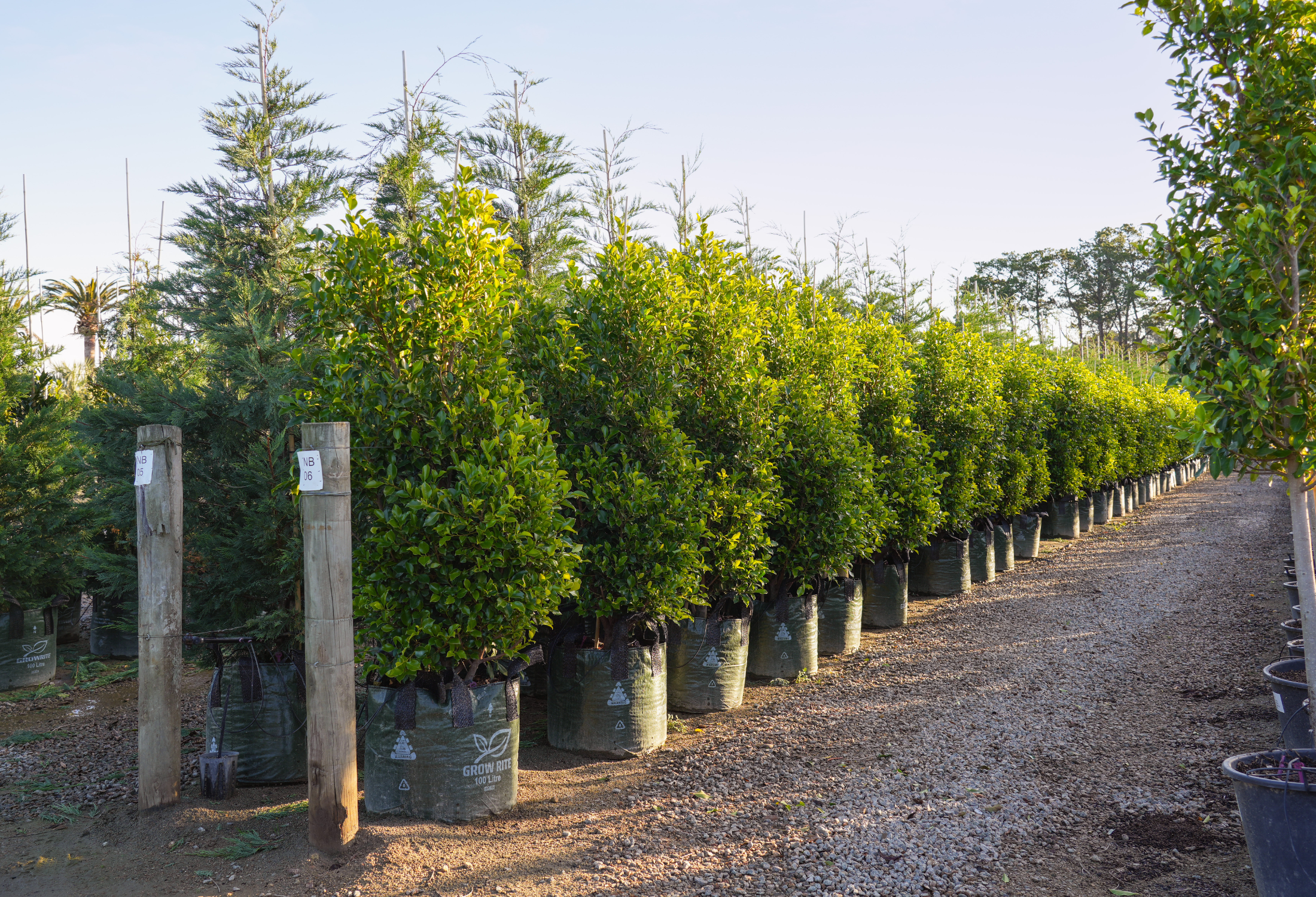
Ficus hillii is the formal benchmark. Polished dark green leaves, very dense and clip-tolerant, growth of 1 to 1.5 metres per year, and the most architectural finished hedge of any evergreen in this list. Waterhousea floribunda (Weeping Lilly Pilly) is the soft native choice for a more relaxed informal screen. Massive growth rate, drooping foliage that softens the boundary, glossy pinkish new growth, and complete psyllid resistance. Syzygium 'Resilience' is the upright native classic, bred specifically for psyllid resistance and dense bottom-to-top foliage so the hedge never goes thin at the base.

The criteria below walk through formal versus informal, exposed versus sheltered positions, height target and clipping frequency so the right pick fits the right boundary.

What makes a great hedge

Formal versus informal hedge style

Formal

For a clipped, architectural look, choose Ficus hillii or Syzygium 'Resilience'. Their upright growth and compact foliage shear cleanly into a tight box form. Ficus hillii in particular pleaches well, training into a raised screen with a clear trunk line and room to underplant beneath.

Informal

For a softer, more natural screen, choose Waterhousea. Its weeping habit and looser foliage form a full, relaxed edge that suits a garden built around movement rather than hard structure.
Target height
If you want a hedge up to 3 metres: any of the three will work.
If you want 3 to 5 metres: choose Waterhousea or Syzygium 'Resilience'.
If you want 5 metres or more: choose Ficus hillii, or leave Waterhousea untrimmed (it can reach 8 to 10 metres on its own).
Sun position and climate
Ficus hillii thrives in full sun across all temperate to subtropical climates and tolerates light frost. Waterhousea wants full sun to part shade and ample moisture. Syzygium 'Resilience' tolerates full sun to part shade and is the most cold-tolerant of the three.
Spacing and density
Our rule of thumb is the same for all three: plant at 1 metre spacing. This gives each tree the room to reach its mature height without competing, so growth is never restricted, and depending on the variety the plants knit into a dense hedge within 12 to 18 months.
Pest and disease tolerance
Resilience was bred specifically to resist psyllid damage that disfigures other lilly pillies. Waterhousea is naturally psyllid-resistant. Ficus hillii has very few pest issues but can host scale in shade.
Root behaviour
Waterhousea and Syzygium 'Resilience' typically have non-invasive, fibrous root systems that suit planting near boundaries, paths and paving.

As a general rule, a tree's roots grow in proportion to its size above ground, so the way you manage the hedge has a strong influence on the roots. Holding the hedge at the height you want helps keep the root system in proportion to match.

This is why Ficus hillii works well as a clipped hedge. Its roots can become invasive at full maturity, around 40 years away, if the tree is left to grow unchecked. Kept clipped to a set hedge height, the root system is far less likely to become invasive.

1. Ficus hillii 'Flash' (Flash Hill's Fig)

Flash is the fast, dense and tidy evergreen hedge of choice. Lime-green new growth contrasts the dark mature foliage.

Type
Evergreen hedging tree
Height
5 to 10 m
Width
2 to 3 m
Growth rate
Fast
Foliage
Glossy dark green with lime new growth
Form
Upright dense
Conditions
Full sun to part shade
Maintenance
Low to moderate, can be pruned to desired height
Best for
Fast dense privacy in warm to temperate climates.

Why choose it

Flash gives you a wall of glossy dark foliage lit by lime-green new growth, a clean backdrop that lifts everything planted in front of it. It is among the fastest dense screens available, responds well to regular shearing into a tight, formal face, and grows tall enough to screen a double-storey home or neighbouring apartment block.

Perfect pair

Pair a Flash hedge with Ligularia reniformis and clipped Buxus balls over a soft carpet of moss, then anchor the bed with a white birch or a Lagerstroemia 'Natchez' as the feature tree.

Tips for planting

Plant 60 cm to 1 m apart. Prune in late winter, just before the spring flush, so the fresh growth bushes out and thickens the hedge through the warmer months. Prune again in late summer to hold the shape and keep the screen dense.

Fast, dense and tidy.

Shop Ficus hillii 'Flash'

2. Waterhousea floribunda (Weeping Lilly Pilly)

Waterhousea is a fast Australian native with a soft weeping habit and dense foliage.

Type
Evergreen native hedging tree
Height
6 to 10 m
Width
3 to 4 m
Growth rate
Fast
Foliage
Glossy weeping mid-green with pink new growth
Form
Weeping
Conditions
Full sun to part shade
Maintenance
Low
Best for
Native fast screening in temperate and warm climates.

Why choose it

Waterhousea brings soft, lush weeping foliage that reads as a relaxed informal screen rather than a hard wall. It is a fast Australian native with typically non-invasive roots, attracts birds into the garden, and asks very little once established, making it a low-maintenance choice for a natural-looking boundary.

Perfect pair

Pair a Waterhousea hedge with a white birch feature tree, underplanted with Ligularia reniformis, clipped Buxus japonica balls and gardenias over a soft carpet of moss.

Tips for planting

Plant 80 cm to 1 m apart. Prune at the end of winter, as the spring flush begins, to encourage dense new growth through spring, then lightly again in late summer to keep the weeping form neat. Mulch in spring.

Soft, weeping and fast.

Shop Waterhousea floribunda

3. Syzygium australe 'Resilience' (Resilience Lilly Pilly)

Resilience is fast, frost-tolerant, psyllid-resistant and clean. The best all-rounder Lilly Pilly available.

Type
Evergreen hedging tree
Height
4 to 6 m
Width
2 to 3 m
Growth rate
Fast
Foliage
Glossy green with bronze new growth
Form
Dense upright
Conditions
Full sun to part shade
Maintenance
Low, can be pruned to desired height
Best for
Fast low-maintenance privacy hedges in most climates.

Why choose it

Resilience was bred to shrug off the psyllid that scars other lilly pillies, so the foliage stays clean and dense year-round. It is fast, frost-tolerant and low maintenance, takes a crisp formal clip, and performs across a wide range of soils and climates, which is why we rate it the best all-round hedging Lilly Pilly we stock.

Perfect pair

Resilience hedge with a Magnolia Little Gem feature.

Tips for planting

Plant 75 cm to 1 m apart. Prune at the end of winter, just before the spring flush, to push dense new growth through spring, then again in late summer to hold a tight formal line. Mulch annually.

The complete fast-hedge package.

Shop Syzygium australe 'Resilience'

Compare at a glance

CultivarHeightWidthFormFoliageBest if you…
Ficus hillii 'Flash'
Flash Hill's Fig
5 to 10 m2 to 3 mUpright denseGlossy dark green with lime new growthFast dense privacy in warm to temperate climates.
Waterhousea floribunda
Weeping Lilly Pilly
6 to 10 m3 to 4 mWeepingGlossy weeping mid-green with pink new growthNative fast screening in temperate and warm climates.
Syzygium australe 'Resilience'
Resilience Lilly Pilly
4 to 6 m2 to 3 mDense uprightGlossy green with bronze new growthFast low-maintenance privacy hedges in most climates.

How to plant and care for them

Prepare the trench, not just individual holes
For any hedge, dig a continuous trench at least 600mm wide along the planted line. Loosen the soil, mix in compost and gypsum on clay sites. A continuous root run is the difference between a dense hedge and a gappy one.
Plant at consistent depth and spacing
Set every plant at the same depth so the eventual canopy aligns. Measure spacings with a stick or tape, not by eye. Inconsistent spacing is the most common cause of an uneven hedge line.
Heavy mulch and consistent watering
75mm coarse mulch the full length of the hedge. Run drip irrigation along the row. Deep weekly water through the first two summers. Hedges fail fastest in the establishment years; consistent water is non-negotiable.
First tip prune at six months
Once new growth appears, tip prune lightly to encourage branching from the base. Do not let the hedge develop a single dominant leader; you want bottom-up density.
Annual feeding
Two feeds per year of a complete hedge or native fertiliser, late winter and late summer. Waterhousea and Syzygium prefer slow-release native fertiliser low in phosphorus.
Twice-yearly shaping
Light tip prune in spring and autumn. Heavy reductions only on Ficus hillii in late spring or summer. Keep top narrower than the base so light reaches all the way down.

The wrap up

Three hedging picks that nail speed, density and low maintenance simultaneously: Ficus hillii for the formal clipped benchmark, Waterhousea for the soft informal native screen, Syzygium 'Resilience' for the upright psyllid-resistant native classic. The guide explains formal versus informal, target height, spacing, pest tolerance and root behaviour so you can match the right pick to your property line.

Comments

  • Carlo BeltrameJanuary 12, 2026

    Hello, looking for around 3 or 4 tall, fast growing evergreen trees (currently 4+ m tall, growing to say 6-7 m).
    Require them to flank a boundary and provide privacy from a new 2 story neighbour’s house. Ideally trees that could also form a windbreak effect and possibly be shaped for effect. Height important with a foliage diameter around 2 m.

    Currently we have tall Manchurian Pear trees but they are deciduous and badly shaped by previous owner.
    Options might be Pittosporum or Evergreen Alder but any suggestions welcomed for trees in stock.
    Planning to plant end winter after leaves have fallen.
    We are in Heidelberg, a Melbourne NE suburb
    Carlo
    Call to discuss if ok otherwise email
    0437421591

    Regards

Leave a comment. Comments will be reviewed before being published.